Takht i Bahi: A Complete Guide
Takht i Bahi is the great hilltop monastery of ancient Gandhara. This ancient site crowns a spur of hills near Mardan. Buddhist monks built it here nearly two thousand years ago. Stupas, shrines and cells fill its ruined courts. This site ranks among the finest Buddhist remains on earth. This guide covers Takht i Bahi for the curious traveller, explaining the setting the history the architecture the finds and how to visit.
This guide offers a general overview. Details and figures vary between sources.
Quick answer: Takht i Bahi is an ancient Buddhist monastery on a hilltop near Mardan in Khyber Pakhtunkhwa. It has been a UNESCO World Heritage Site since 1980. Founded in the 1st century CE, it is the most complete Buddhist monastery in Pakistan and a jewel of the Gandhara civilisation. Its remains include a main stupa court, meditation cells and an assembly hall. A high setting long kept it safe from raids and floods. Spring and autumn are the finest seasons.
About Takht i Bahi
Takht i Bahi crowns a spur of hills near Mardan. It is located a short way north west of the city. Peshawar rises around eighty kilometres to the south west. Green plains spread out below the ancient site.
A high setting shaped the whole monastery. Monks chose the hilltop for peace and safety. Its height kept it clear of the busy plains. This lofty perch long guarded the ruins.
A curious name carries an old meaning. Takht i Bahi means the throne of water in the local tongue. Springs on the hill likely gave it the name. This title has clung to the site for ages.
A great honour marks the ancient monastery. UNESCO named it a World Heritage Site in 1980. Its ruins rank among the best preserved of their kind. Few Buddhist sites survive in such fine order.
History of Takht i Bahi
Takht i Bahi carries a very long history. Monks founded it in the first century of our era. Buddhist learning flourished on the hill for centuries. Deep history rests among the ruins.
Early kings shaped the first monastery. An inscription of an Indo Parthian king was found here. Kushan rulers held the area soon after. Great kings such as Kanishka aided the faith.
This monastery grew over many ages. Builders added courts and halls in later centuries. Monks lived and studied on the hill for generations. A great centre of Buddhism rose here.
Decline came with the passing of the faith. Raids and change weakened the monastery in time. Buddhism faded from the area by the seventh century. This site fell quiet and was slowly abandoned.
Architecture of ruins in Takht i Bahi
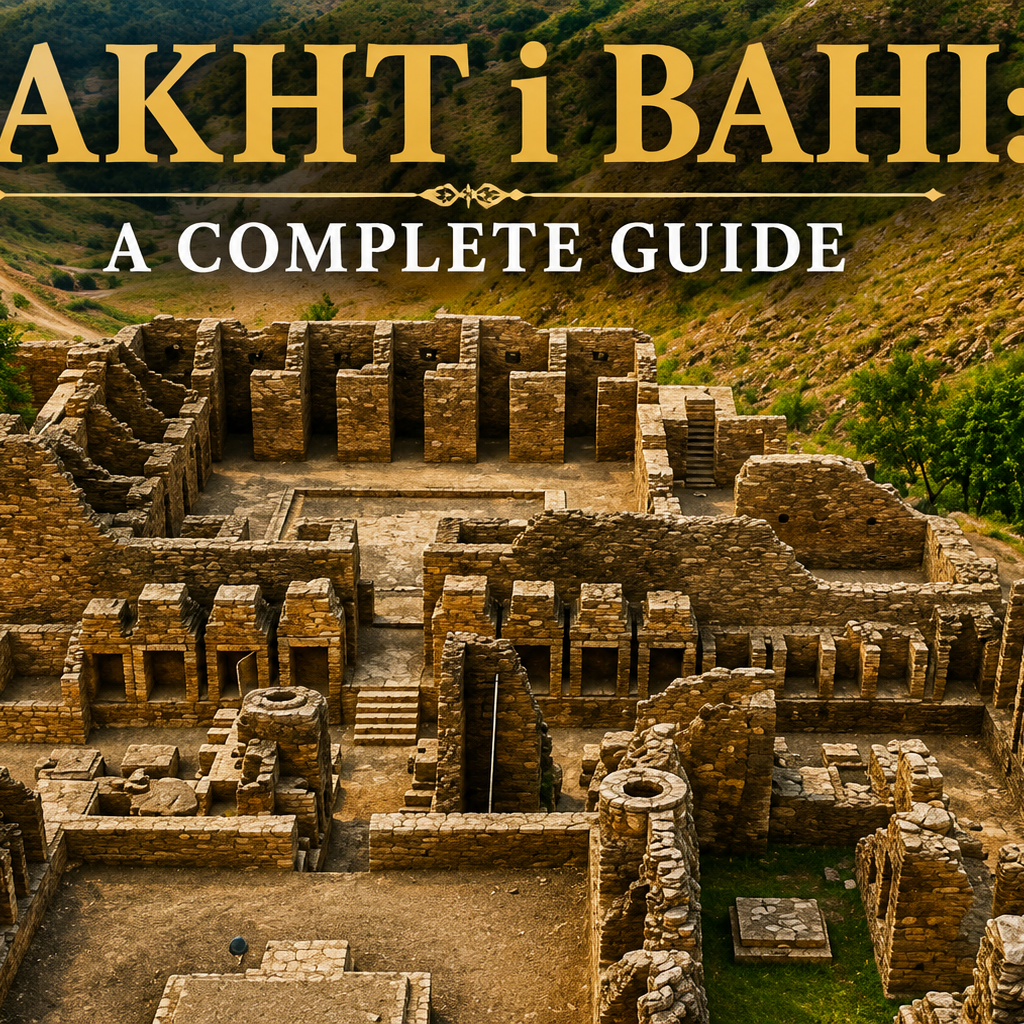
Takht i Bahi shows the finest Gandhara design. Its builders worked in local dressed stone. Lime and mud mortar bound the blocks. This style marks the monasteries of the age.
A high setting shaped the whole plan. Buildings rise across hilltops of differing heights. Steps and paths link the scattered courts. A clever design fits the rugged spur with care.
A main stupa court forms the heart of the site. Small shrines once ringed the central space. A great stupa rose in the middle of old. Pilgrims gathered here to worship and pray.
Living quarters filled the monastic square. Cells for the monks lined a central court. Kitchens and stores served the daily needs. An assembly hall gathered the community together.
Finds and Sahri Bahlol
Takht i Bahi has yielded many fine treasures. Diggers found statues among the ruins. Inscriptions and carvings came to light too. These works reveal the art of Gandhara.
Statues of the Buddha filled the shrines. Figures of Bodhisattvas stood in the courts. Fine carving marked the Gandhara school. Museums now hold most of these treasures.
A great museum guards many of the finds in Peshawar. Its galleries display the statues from the hill. Visitors see there what once adorned the courts. These two sites tell one story together.
Sahri Bahlol rests close to the monastery. This small walled city dates from the same age. It formed part of the World Heritage listing. Together the sites show a whole Buddhist world.
Visiting Takht i Bahi
Come in spring or autumn. Summers grow hot on the hill and plains. Winters turn cool and pleasant. Mild seasons suit a visit best.
Reach the site with ease. Roads link it to Mardan and Peshawar. A short drive brings the traveller here. Local transport serves the nearby town.
Climb to the ruins on foot. A path and steps lead up the hill. Sturdy shoes help on the rugged ground. A short climb rewards those who make it.
Explore the courts and cells. A great stupa court reveals the heart of the site. Meditation cells recall the life of the monks. Bring time to take in the whole complex.
Frequently asked questions
What is Takht i Bahi? Takht i Bahi is an ancient Buddhist monastery set on a hilltop near the city of Mardan in Khyber Pakhtunkhwa. Founded in the first century of the Common Era, it was once a thriving centre of Buddhist learning and worship in the ancient kingdom of Gandhara. It remained in use until around the seventh century. Today it is celebrated as the most complete Buddhist monastery in Pakistan with its stupas, shrines, meditation cells and halls still clearly seen among the ruins. Its remarkable state of preservation makes it one of the finest Gandhara monuments in the country.
Why is Takht i Bahi a UNESCO World Heritage Site? Takht i Bahi was listed as a UNESCO World Heritage Site in 1980, together with the nearby city ruins of Sahri Bahlol, for its outstanding value as a Buddhist monastic complex. It is regarded as one of the most characteristic and best preserved examples of a Gandhara monastery, showing clearly how such communities lived and worshipped between the first and seventh centuries. Its high hilltop position protected it from the raids and floods that damaged many other sites, leaving its layout and buildings remarkably intact. For these reasons it is treasured as a monument of world importance.
What does the name Takht i Bahi mean? A name like Takht i Bahi is usually taken to mean the throne of water or throne of the water spring. It draws on the local words for a throne or high place and for water. This name likely refers to the springs found on the hill where the monastery was built along with its lofty, throne like place above the plains. Some sources also render the name as the throne of origins. Whatever the exact meaning, this old name reflects both the lofty setting of the site and the water that helped sustain the monks who once lived there.
What can you see at Takht i Bahi? Takht i Bahi offers a remarkably complete view of an ancient Buddhist monastery, spread across a series of hilltops. Its main features include the main stupa court a central courtyard once ringed by small shrines and topped by a great stupa. Nearby stand a court of votive stupas and a group of three stupas. Visitors can also explore the monastic quadrangle with its cells where the monks lived and meditated an assembly hall, kitchens, storerooms and covered stepped passageways. Though the statues found here are now in museums the buildings themselves give a vivid sense of monastic life.
How do you get to Takht i Bahi? Takht i Bahi is easy to reach, lying a short distance north west of the city of Mardan and around eighty kilometres from Peshawar in Khyber Pakhtunkhwa. Good roads link the site to Mardan, Peshawar and the wider country. A traveller can reach it by car or local transport with the nearby town of Takht i Bahi serving as the gateway. From the town a road leads to the foot of the hill from where a path and steps climb to the ruins. Sturdy shoes are useful for the walk up a climb that rewards visitors with both history and fine views.
Jewel of Gandhara
Takht i Bahi is the hilltop jewel of ancient Gandhara. This ancient monastery crowns a spur of hills near Mardan. Buddhist monks built it here nearly two thousand years ago. Stupas, shrines and cells fill its ruined courts. A high setting has kept it whole through the ages. Few Buddhist sites on earth survive in such fine order.
You may come to Takht i Bahi for the history the ruins or the views. This site rewards the visit either way. You can climb the hill where monks once lived. You can stand in the great court of the stupas. You can trace the cells where the monks meditated. Come to Takht i Bahi and discover the jewel of Gandhara. This is the great monastery of the frontier.