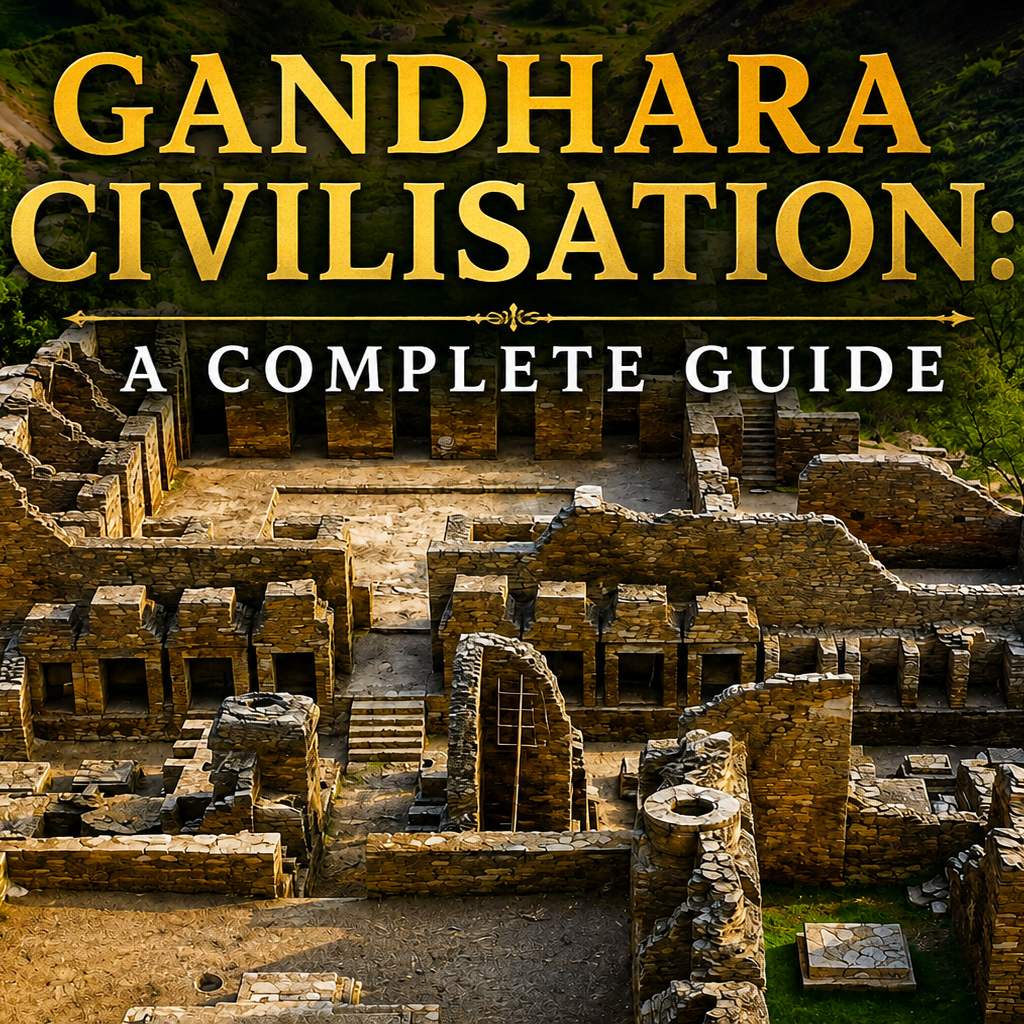
Gandhara Civilisation: A Complete Guide
Gandhara was one of the great civilisations of the ancient world. This old kingdom rose in the valley of Peshawar and beyond. Persians, Greeks, Mauryans and Kushans all shaped it. Its artists first carved the Buddha in human form. Stupas and cities of Gandhara still dot the country. This guide covers the Gandhara civilisation for the curious traveller. It explains the setting the history the golden age the art the sites and the legacy.
This guide offers a general overview. Details and figures vary between sources.
Quick answer: Gandhara was an ancient civilisation centred on the Vale of Peshawar in what is now north west Pakistan. Its lands reached into the Swat and Kabul valleys and towards Taxila. A great crossroads of trade and culture, it was ruled in turn by Persians, Greeks, Mauryans and Kushans. It reached its height under the Kushan king Kanishka, when it became a holy land of Buddhism. Gandhara is famous above all for its Greco Buddhist art. Its sites lie across Peshawar, Swat, Mardan and Taxila.
About Gandhara
Gandhara rose in the valley of Peshawar. Its heartland filled the vale and the nearby hills. Its lands reached into the Swat and Kabul valleys. Taxila marked its great eastern city.
A crossroads position shaped its whole story. Trade routes met here between distant lands. India, Persia and Central Asia all touched it. Ideas and goods flowed through the country.
Great cities anchored the ancient kingdom. Purushapura, now Peshawar, served as a capital. Pushkalavati and Taxila ranked among the chief towns. Markets and monasteries filled these places.
A great name faded after many centuries. Gandhara flourished for well over a thousand years. Muslim rule later reshaped the country. So the old name slipped from common use.
History of Gandhara
Gandhara carries a very long history. Empire after empire ruled this ancient country. Its story runs across many centuries. Few lands saw so many rulers.
Persia held Gandhara in early days. Darius counted it among his lands. Alexander the Great crossed it next. His armies swept through in the fourth century before Christ.
Mauryan kings ruled the country after. Ashoka spread the Buddhist faith across it. He raised edicts in stone for all to read. Buddhism took deep root in the country.
Greeks and others followed in turn. Bactrian Greek kings held it for a time. Menander embraced the Buddhist faith. Shakas and Parthians ruled before the Kushans came.
Golden age of Gandhara
Gandhara reached its height under the Kushans. This people came from Central Asia of old. They took Peshawar as their great capital. Their empire stretched across vast lands.
Kanishka ruled as the greatest Kushan king. His reign marked the golden age of Gandhara. He gave the Buddhist faith his royal favour. Monasteries and stupas rose across the country.
This empire spread far in his day. Its lands reached from Bengal to Central Asia. Peshawar ruled as the seat of power. Trade and faith flourished under Kushan rule.
Buddhism spread out from Gandhara. Traders and monks carried it along the Silk Road. It reached China, Tibet and the Far East. So the faith of the country touched half of Asia.
Art of Gandhara
Gandhara art ranks among the wonders of the ancient world. Its sculptors blended East and West. Greek and Roman styles met Buddhist faith. This fusion gave a new and lasting art.
Artists first carved the Buddha in human form. Earlier ages had shown him only by symbols. Gandhara sculptors gave him a human face. Flowing robes and calm features marked their work.
This art drew on many traditions. Hellenistic grace shaped the faces and folds. Indian faith gave the subjects and meaning. Central Asian touches added to the blend.
Carvings told the story of the Buddha. Panels showed his life and former births. Miracles and teachings filled the stone. This art spread far across the Buddhist world.
Great sites of Gandhara
Gandhara has left its mark across the country. Ruins of cities and monasteries survive. Stupas and carvings dot the valleys. Travellers can trace them at many sites.
Taxila ranks among the greatest of the ruins. This ancient city was a seat of learning. A famed university drew scholars from afar. A great stupa the Dharmarajika, rises nearby.
Peshawar and its valley hold many treasures. Charsadda marks the old city of Pushkalavati. Takht i Bahi crowns a hill near Mardan. Shahbaz Garhi keeps the edicts of Ashoka.
Swat guards a wealth of Buddhist ruins. Butkara raises one of the oldest stupas. Rock carvings dot the hills of the valley. Museums now hold the finest of the finds.
Decline and rediscovery
Gandhara faded after its golden age. Raids and change weakened the old country. Buddhism slowly waned across the valleys. New faiths and rulers took its place.
Decline set in from the fifth century. Invaders struck at the monasteries and towns. This blow cost the faith its ancient strength. Many sites fell quiet over the years.
Muslim rule reshaped the country in time. A conqueror, Mahmud of Ghazni, took it in the eleventh century. This old name slipped from use. Its ruins lay forgotten for centuries.
Scholars rediscovered Gandhara in later ages. British archaeologists dug its buried sites. Statues and stupas came to light once more. A lost civilisation returned to the world.
Frequently asked questions
What was the Gandhara civilisation? A great civilisation, Gandhara was centred on the Vale of Peshawar in what is now north west Pakistan with extensions into the Swat and Kabul valleys and towards Taxila. Flourishing for well over a thousand years from around the sixth century BCE, it stood at a great crossroads of trade and culture between India, Persia and Central Asia. Ruled in turn by Persians, Greeks, Mauryans and Kushans, it became a major centre of Buddhism and gave rise to the famous Gandhara school of art. Its cities, stupas and monasteries left a rich heritage that survives across the area today.
Why is Gandhara famous for its art? Gandhara is famous above all for its Greco Buddhist art a striking sculptural tradition that blended the naturalism of Greek and Roman art with the subjects and beliefs of Buddhism. Gandhara sculptors were among the first to depict the Buddha in human form, giving him flowing robes, wavy hair and calm, lifelike features drawn from classical models. Their carvings illustrated the life of the Buddha, his former births, his miracles and his teachings, in fine stone panels and statues. Gandhara art spread far along the trade routes, shaping Buddhist art across Central Asia, China and the Far East.
Who was Kanishka? Kanishka was the greatest king of the Kushan Empire. This power held Gandhara during its golden age in roughly the first and second centuries CE. Under his reign, Gandhara reached its cultural height with its capital at Purushapura the modern city of Peshawar. Its empire stretched from Bengal to Central Asia. Kanishka was a great patron of Buddhism, promoting the building of stupas and monasteries and helping the faith spread across his lands and beyond. His age saw the flowering of Gandhara art and the growth of Buddhist learning, leaving a legacy that shaped much of Asia.
Where can you see Gandhara heritage today? Gandhara heritage can be seen at many sites across north west Pakistan from ancient cities and monasteries to fine museum collections. Taxila, near Islamabad, holds the ruins of a great city and university along with the Dharmarajika stupa. Takht i Bahi near Mardan is one of the best preserved Buddhist monasteries in the country. A green valley, Swat holds the Butkara Stupa and many other ruins. Charsadda marks the old city of Pushkalavati. A grand museum in Peshawar guards one of the finest collections of Gandhara art in the world, making it an ideal starting point.
When did the Gandhara civilisation decline? A great civilisation began to decline from around the fifth century CE. Raids by invaders such as the Hephthalites weakened its monasteries and towns. Buddhism slowly lost its hold. Over the following centuries, new faiths and rulers reshaped the country. After the conquest by Mahmud of Ghazni in the eleventh century the name Gandhara faded from use. Its ruins lay largely forgotten for many centuries, until British archaeologists rediscovered and excavated them from the nineteenth century onward. Their work brought the lost civilisation with its remarkable art, back into the light.
Cradle of Buddhist art
Gandhara is the ancient cradle of Buddhist art. This old kingdom rose in the valley of Peshawar. Persians, Greeks, Mauryans and Kushans all shaped it. Its artists first gave the Buddha a human face. Stupas and cities of Gandhara still dot the country. Few civilisations left so rich a legacy to the world.
You may come to Gandhara for the history the art or the ruins. This ancient country rewards the visit either way. You can walk the ruins of the great city of Taxila. You can climb to the monastery of Takht i Bahi. You can admire the Gandhara art in the Peshawar Museum. Come to the country of Gandhara and discover the cradle of Buddhist art. This is the ancient heart of the frontier.