Rivers of Punjab: A Complete Guide
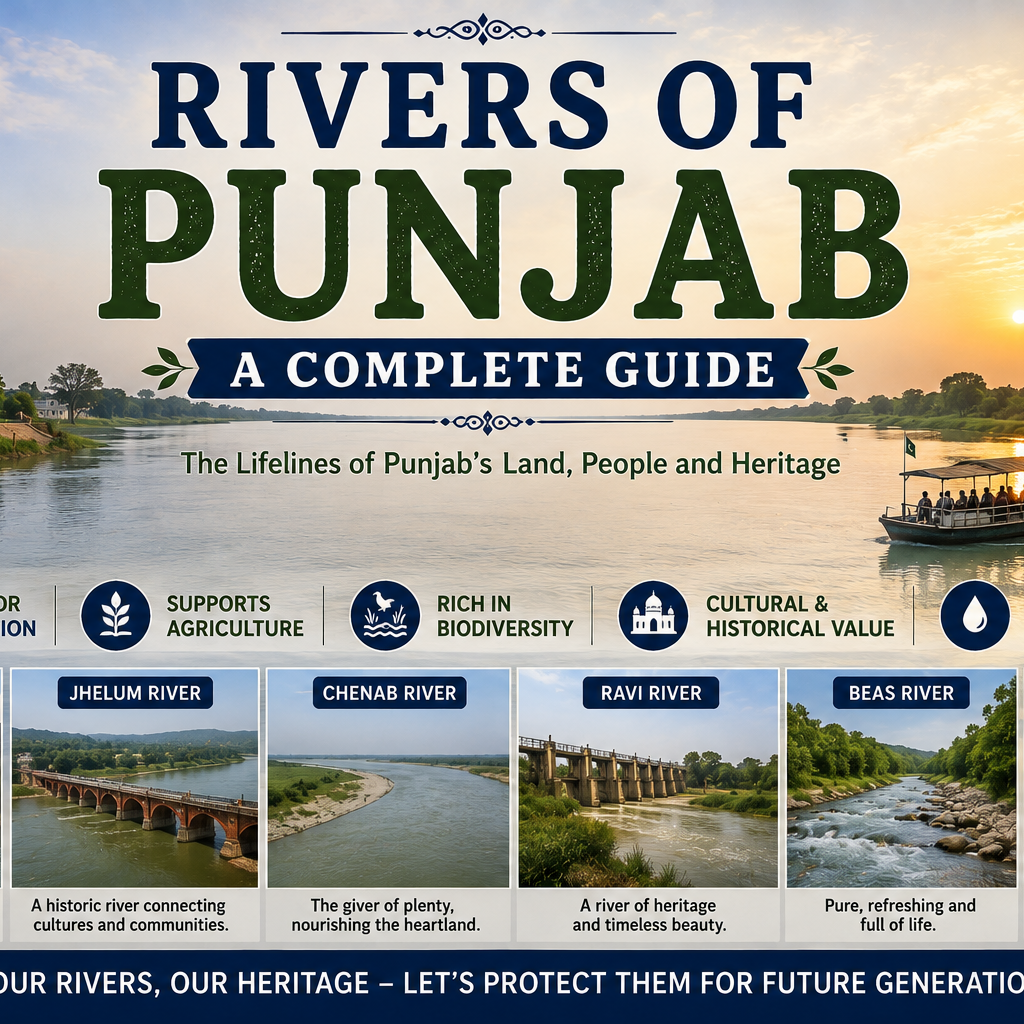
Punjab draws its very name and soul from its rivers. Five great rivers thread the plains from the mountains to the Indus. They water the fields that feed the whole country. They have nourished civilisations along their banks for thousands of years. Their confluence forms the mighty Panjnad in the south. This guide covers the rivers of Punjab for the curious traveller. It explains the name the five rivers the confluence the treaty and their story.
This guide offers a general overview. Figures and details vary between sources.
Quick answer: Punjab means the land of five waters, from the Persian panj, meaning five with ab meaning water. Its five rivers are the Jhelum, Chenab, Ravi, Beas and Sutlej all tributaries of the Indus. They merge one by one to form the Panjnad River, joining the Indus at Mithankot. Their waters were divided between India and Pakistan by the Indus Waters Treaty of 1960. These rivers have shaped the farming, history and culture of Punjab for millennia.
Land of five waters
Punjab takes its name from its rivers. Two Persian words give the name its meaning. Panj means five and ab means water. So Punjab is the land of five waters.
Five great rivers cross the province. They flow down from the northern mountains. They spread across the wide plains below. All feed the great Indus in the end.
These rivers gave Punjab its life. Their waters made the plains fertile. Farms and cities rose along their banks. This bounty shaped the whole province.
They carry an ancient story. Ancient Greeks called this land Pentapotamia. This word also means the land of five rivers. Rivers have defined Punjab for millennia.
Jhelum and the Chenab
Jhelum ranks as the westernmost of the five. This river rises in the mountains of Kashmir. An old name for it was the Vitasta. It flows through a broad and storied valley.
This river waters a great swathe of land. Cities and farms line its winding course. Barrages tame its flow for the fields. This river feeds one of the great canal networks.
Chenab is the largest by volume. Two mountain streams the Chandra and Bhaga, form it. So it once carried the name Chandrabhaga. This river gathers the greatest flow of the five.
This river holds a place in legend. Folk romances set their tales along its banks. Its very name echoes through Punjabi poetry. This river runs deep in the culture of the land.
Ravi the Beas and the Sutlej
Ravi is the river of Lahore. This stream flows past the great city. An old name for it was the Iravati. It is the smallest of the five rivers.
Beas carries an ancient fame. This river marked the limit of Alexander the Great. He turned back at its banks in 326 BC. An old name for it was the Vipasha.
Sutlej is the longest of the five. This river rises far off near Lake Rakshastal in Tibet. An old name for it was the Shatadru. It is the easternmost of the rivers.
These three rivers flow to the south west. They cross the plains towards the Indus. Their waters feed vast stretches of farmland. Great canals carry their flow to the fields.
Panjnad and the Indus
These five rivers merge one by one. Jhelum and Ravi join the Chenab first. Beas joins the Sutlej higher up. So the waters gather step by step.
Below them forms the Panjnad. Sutlej and Chenab join near Uch Sharif. Their meeting forms the great Panjnad. Its name means five rivers in the old tongues.
From there it flows on to the Indus. It runs south past Bahawalpur towards the great river. It joins the Indus at Mithankot. So the five waters reach the mighty Indus.
A mighty Indus carries all to the sea. It gathers the waters of Punjab and beyond. Flowing on across the plains of Sindh, it empties at last into the Arabian Sea.
Indus Waters Treaty
These rivers cross an international border. They rise in India and flow into Pakistan. This raised the question of sharing the water. A treaty settled the matter in 1960.
A landmark treaty divided the rivers. World Bank experts helped broker the agreement. It shared the six rivers of the Indus system. Each country received a set of rivers.
India received the eastern rivers. Ravi, Beas and Sutlej were allotted there. Pakistan received the western rivers. Indus, Jhelum and Chenab flow there.
These western rivers carry the greater flow. They hold around four fifths of the water. Pakistan depends on them for its farms. This treaty shaped the water map of the land.
Rivers and the land
These rivers made Punjab a farming heartland. Their waters feed one of the great canal systems. Wheat, rice and cotton grow across the plains. This bounty feeds much of the country.
They nourished ancient civilisations. An Indus Valley Civilisation rose on these plains. Its cities drew life from the rivers. People have farmed here for thousands of years.
These rivers run deep in the culture. Folk tales and poems set their scenes along them. Sufi poets sang of the Chenab and the Ravi. This heritage flows through Punjabi life.
These rivers face modern pressures. Dams and canals have changed their flow. Some run low for parts of the year. Careful sharing of water matters more than ever.
Frequently asked questions
What are the five rivers of Punjab? A famous five rivers cross Punjab: the Jhelum, Chenab, Ravi, Beas and Sutlej. They give the province its name, meaning the land of five waters. All five are tributaries of the great Indus River, rising in the Himalayas and the Tibetan plateau and flowing south west across the plains. Jhelum and Chenab are the western rivers the Ravi runs past Lahore, while the Beas and Sutlej flow to the east. Together they merge, one by one, to form the Panjnad River, finally joining the Indus in southern Punjab.
Why is Punjab called the land of five rivers? Punjab is called the land of five rivers because its name comes from two Persian words. Panj means five and ab means water a reference to the five great rivers that flow through it. These rivers the Jhelum, Chenab, Ravi, Beas and Sutlej, have shaped the province throughout its history, watering its fields and supporting its people. Ancient Greeks knew the same land as Pentapotamia a word that also means the land of five rivers. This deep tie between Punjab and its waters has defined its farming, history and culture for thousands of years.
What is the Panjnad River? A Panjnad River is the combined stream formed by the successive merging of the five rivers of Punjab, its name meaning five rivers in Persian and Sanskrit. Jhelum and Ravi first join the Chenab, while the Beas joins the Sutlej. Finally the Sutlej and Chenab meet near Uch Sharif to form the Panjnad. From there the river flows south past Bahawalpur before joining the mighty Indus at Mithankot. In this way the Panjnad gathers the waters of all five Punjab rivers and delivers them into the Indus, on its long journey to the Arabian Sea.
What is the Indus Waters Treaty? An Indus Waters Treaty is a water sharing agreement signed in 1960 between India and Pakistan, brokered with the help of the World Bank. It divided the six rivers of the Indus system between the two countries. India received the eastern rivers the Ravi, Beas and Sutlej, while Pakistan received the western rivers the Indus, Jhelum and Chenab. These western rivers carry the greater share of the water around four fifths of the total flow, on which Pakistan depends heavily for its agriculture. This treaty has long governed how the waters of these rivers are shared.
Why are the rivers important to Punjab? These rivers are the lifeblood of Punjab, watering one of the largest canal irrigated farming areas in the world and making the province a great producer of wheat, rice and cotton. Their fertile plains nourished the ancient Indus Valley Civilisation, one of the oldest urban cultures on earth. They have supported continuous settlement for thousands of years. Beyond farming the rivers run deep in the culture of Punjab, celebrated in folk tales, poetry and the songs of Sufi poets. In every sense the story of Punjab is bound up with the story of its rivers.
Land of five waters
These rivers are the soul of the land of five waters. They flow down from the mountains to cross the wide plains. They water the fields that feed millions of people. They gather at last into the great Panjnad and the Indus. They have shaped the history and culture of Punjab for ages. Few lands are so deeply defined by their rivers.
You may look to the rivers for their history their bounty or their beauty. Their story rewards the telling either way. You can trace the five rivers from the mountains to the plains. You can follow them to their meeting at the Panjnad. You can see how they feed the fields and cities of Punjab. Their waters have made this land what it is. These are the rivers of Punjab.