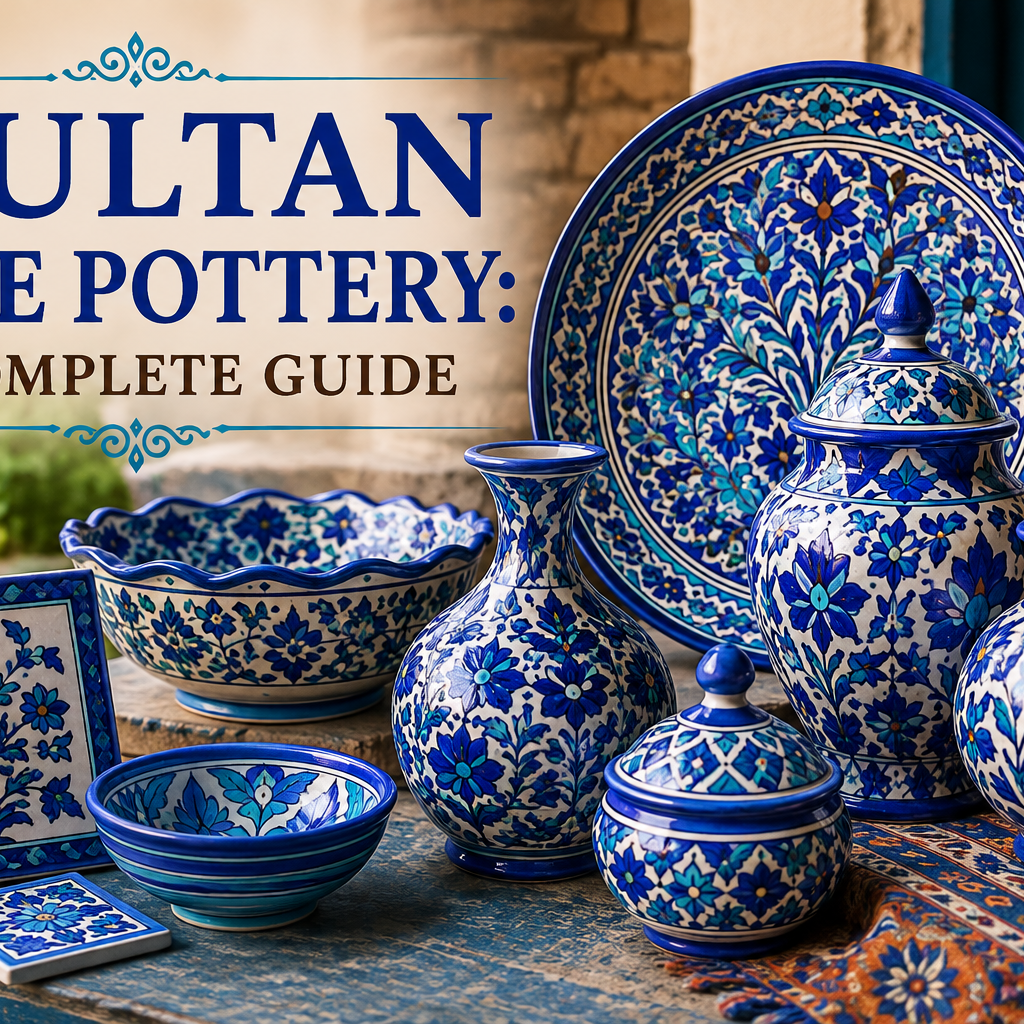
Multan Blue Pottery: A Complete Guide
Multan blue pottery is one of the great craft treasures of Pakistan. Glowing cobalt and turquoise designs mark this ancient art. Multan has shaped the craft for over a thousand years. Kashigari, its local name, recalls its journey along the Silk Road. Vases, plates and tiles carry its beauty around the world. This guide covers Multan blue pottery for the curious traveller. It explains the roots the technique the designs the products and where to find it.
This guide offers a general overview. Details and dates vary between sources.
Quick answer: Multan blue pottery art is known locally as Kashigari. It is a centuries old ceramic craft famous for its cobalt blue and turquoise designs on a white ground. Its roots reach back to Persia and Central Asia along the Silk Road. It is thought to have come to Multan through early Islamic and Sufi links. Artisans hand paint clay bodies with cobalt oxide before glazing and firing them. This craft adorns the shrines of Multan and produces vases, plates, tiles and lamps. Multan is its great home.
Roots of the craft
Multan blue pottery is an ancient art. Its story reaches back over a thousand years. This craft came from Persia and Central Asia. Trade along the Silk Road carried it east.
Its local name tells the story. People call the craft Kashigari here. This name recalls the city of Kashan in Persia. Some link it to Kashgar in China too.
This craft came early to Multan. Oral tradition ties it to the first Muslim arrivals. Artisans are said to have settled here long ago, making the craft over a thousand years old.
Great empires refined the art. Mughal patronage helped it flourish. Persian and local styles merged over time. This gave the craft its Multani character.
Techniques in blue pottery
Multan blue pottery begins with the clay. Artisans mix local clay with quartz and gum. This blend forms a strong white body. A pale ground shows off the colours well.
A potter shapes each piece by hand with wheels and moulds form vases and plates. Skilled hands craft each object with care and every piece dries before the next stage.
Painting brings the pottery to life. Artisans hand paint each design in cobalt oxide. This gives the deep blue that marks the craft. Turquoise and white complete the palette.
Fire seals the beauty in. A glaze coats the painted piece. A hot kiln fires it at high heat. This locks the colours into a glassy shine.
Colours and designs of blue pottery
Blue is the soul of the craft. Cobalt oxide gives the deep azure hue. Turquoise adds a brighter shade of blue. White forms the ground beneath them.
These designs follow old traditions of floral patterns wind across the surface and geometric shapes bring order and balance. Islamic motifs recall the sacred art of the mosque.
Each piece bears a unique hand. Artisans paint the patterns without machines. So no two pieces are quite alike. This handwork gives the craft its charm.
This style is distinctly Multani. Cobalt, turquoise and white mark the palette. These colours echo the tiles of the shrines. They tie the pottery to the city itself.
Shrines and the tilework
Kashi tilework glows across Multan. This craft first adorned mosques and shrines. Glazed tiles sheathe their domes and walls, blue and turquoise shining in the desert sun.
A shrine of Shah Rukn e Alam is a marvel. Its great dome wears a coat of blue tiles. Kashi work covers its mighty walls. This tomb ranks among the jewels of Multan.
Other shrines carry the craft too. Tiled domes rise across the old city. Their glowing colours mark the skyline. Multan earns its fame as a city of shrines.
This tilework shaped the pottery. Artisans drew the same colours into their vases. Shrine and pottery share one palette. This bond runs deep in the craft.
Blue pottery and the artisans
Multan blue pottery takes many forms. Vases, plates and bowls fill the shops. Tiles and lamps carry the craft too. Tea and soup sets grace many homes.
Camel skin lamps join the craft. Artisans paint them in the same blue style. Their glow lights many a Multani home. A dedicated guide covers these lamps.
Master craftsmen guard the art. Families pass the skills down the generations. Kashigars keep their secrets of colour and fire. Children learn the craft from an early age.
Women play a growing role. Many now shape and paint the pottery. Some lead artisan groups and train others. This work brings new life to the craft.
Finding and buying blue pottery
Come to Multan for the best pieces. Its bazaars brim with blue pottery. Workshops let you watch the artisans work. This is the true home of the craft.
Look for the marks of quality. Fine handwork shows in the painted lines. A true piece bears small human touches. Its cobalt should glow deep and rich.
Choose a piece to treasure. Vases and plates make fine display pieces. Tiles and coasters travel home with ease. Each carries a piece of Multan.
Help keep the craft alive. Buying from artisans supports their work. Old kilns face hard times today. Your custom helps the tradition survive.
Frequently asked questions
What is Multan blue pottery? Multan blue pottery, known locally as Kashigari, is a centuries old ceramic craft from the city of Multan in southern Punjab. It is famous for its glowing cobalt blue and turquoise designs on a white ground. Artisans mix local clay with quartz and gum to form a strong white body. They then hand paint it with floral, geometric and Islamic patterns in cobalt oxide, before glazing and firing it at high heat. This craft has adorned the mosques and shrines of Multan for centuries and today produces vases, plates, tiles, lamps and tableware prized across Pakistan and beyond.
Where does Multan blue pottery come from? Its roots reach back to Persia and Central Asia. It is closely tied to the Kashi tilework of the Persian city of Kashan from which the name Kashigari is thought to derive. Techniques of glazed ceramics travelled along the Silk Road, reaching Multan through early Islamic and Sufi links. Local tradition holds that artisans settled in the city over a thousand years ago. Under later Mughal patronage the craft flourished as Persian methods merged with local styles to create a distinctly Multani form of blue pottery.
How is Multan blue pottery made? Making Multan blue pottery is a slow and skilled process carried out by hand. Artisans begin by mixing local clay with quartz and gum to form a strong, pale body then shaped on a wheel or in moulds and left to dry. Once ready the piece is hand painted with detailed designs in cobalt oxide the source of the deep blue along with turquoise and white. A glaze is then applied. Firing in a kiln at high temperature follows. This locks in the colours and gives the finished piece its glassy shine.
Why is Multan famous for blue pottery? Multan is famous for blue pottery because the city has led the craft for over a thousand years. This makes it one of the oldest continuous ceramic traditions in South Asia. Cobalt and turquoise colours from the pottery also glow on the tiled domes and walls of the great shrines, such as the tomb of Shah Rukn e Alam. This ties the craft closely to the identity of Multan. Generations of master artisans are known as Kashigars have preserved and refined the skills by keeping the tradition alive and earning the city lasting fame.
Where can you buy Multan blue pottery? A best place to buy Multan blue pottery is Multan itself. Its bazaars and workshops offer a wide range of vases, plates, tiles, lamps and tableware. Visitors can often watch artisans at work. Genuine handmade pieces show fine, slightly irregular hand painting and a rich, deep cobalt glaze, marking them apart from mass produced imitations. Blue pottery also appears in craft shops and cultural centres in other cities. Buying directly from artisans helps support a craft that faces real challenges today, keeping a centuries old tradition alive.
Cobalt jewel of Multan
Multan blue pottery is the cobalt jewel of the city of saints. This ancient craft came east along the Silk Road. It glows in the blue tiles of the great shrines. Skilled hands shape and paint each piece with care. Vases, plates and lamps carry its beauty afar. Few crafts hold such deep and glowing history.
You may come to blue pottery for the colour the history or the art. This craft rewards the eye either way. You can watch the artisans paint the deep cobalt lines. You can marvel at the tiled dome of Shah Rukn e Alam. You can carry home a vase or plate of your own. Come to Multan and discover the cobalt jewel. This is the blue pottery of Multan.