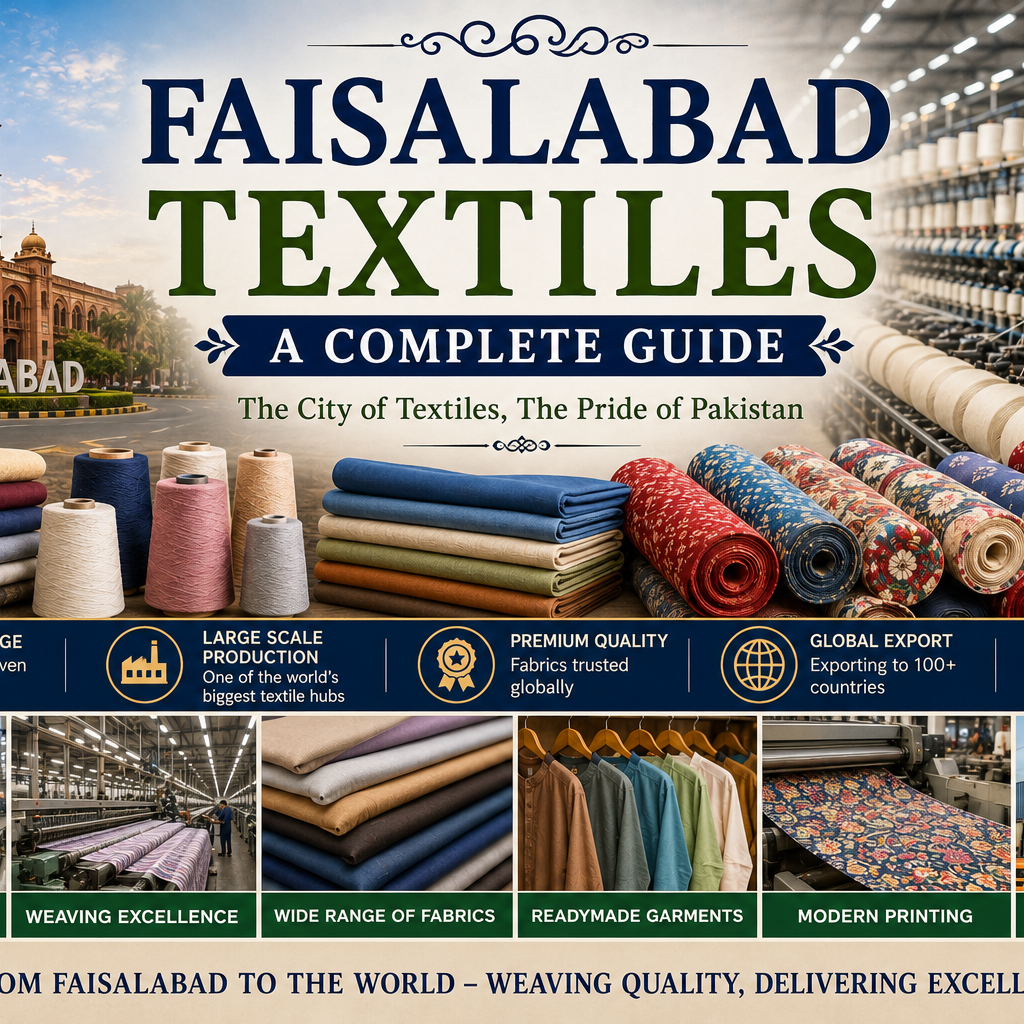
Faisalabad Textiles: A Complete Guide
Faisalabad textiles clothe much of Pakistan and the world beyond. This central Punjab city is the great textile hub of the country. Cotton mills, looms and dyeing units fill its industrial estates. Yarn, cloth and garments flow from here to distant markets. People call the city the Manchester of Pakistan for good reason. This guide covers Faisalabad textiles for the curious traveller. It explains the roots the cotton the process the industry and its place in the world.
This guide offers a general overview. Figures and dates vary between sources.
Quick answer: Faisalabad, in central Punjab, is the great textile centre of Pakistan, often called the Manchester of Pakistan. Founded by the British as Lyallpur in the 1890s, it grew on the cotton of the surrounding plains. Its mills spin, weave, dye and finish cotton into yarn, cloth and garments, exported around the world. Thousands of firms and vast numbers of workers drive the trade. Faisalabad accounts for a large share of national textile output and exports.
Roots of Faisalabad
Faisalabad began as a British canal town. Its first name was Lyallpur. Sir James Lyall gave the town its name. He served as governor of the Punjab.
A planned town rose on the plains. Eight bazaars spread out from a central point. A clock tower marks the heart of the old city. This layout still shapes Faisalabad today.
Canal water made the plains bloom. New canals turned dry land into farms. Cotton grew well in the rich fields. This crop would feed a great industry.
A new name came in 1979. This town took the name Faisalabad. This honoured King Faisal of Saudi Arabia. He had aided the country in its growth.
Cotton and the setting
Cotton rests at the root of the trade. Faisalabad rises in the cotton belt of Punjab. Fields of cotton surround the city. This crop feeds the mills close at hand.
Canal farming fills the fields. Water from the rivers reaches the land. Rich soil and warm sun suit the cotton. A great harvest comes from these plains.
Local cotton fed the early mills. Growers sold their crop to the factories. Short travel kept the cotton cheap. So the industry grew near its raw material.
A good setting suited the trade well. Roads and railways linked the city. Markets lay within easy reach. Faisalabad grew into a trading hub.
Making of textiles
Cloth making involves various stages. In each stage, cotton is made into fabric. The mills carry out the process of turning cotton into fabrics.
Ginning is the process that takes place at the very beginning. The seeds are stripped off from the fiber by machines. The cleaned cotton is taken for spinning.
Spinning is the process that makes yarn from the fiber. Machines are used to make thread from cotton fibers. The weavers take the threads for weaving.
Weaving builds the yarn into cloth. Looms cross the threads into fabric. Power looms speed the work along. Dyeing and printing add colour at the end.
Textile industry and its growth
This industry grew from small beginnings. A few mills stood at the birth of the country. Spinning and weaving led the early trade. Growth came fast in the decades after.
Thousands of firms now fill the city. Spinning units and weaving sheds crowd the estates. Dyeing and finishing plants line the roads. Garment factories turn cloth into clothes.
Vast numbers of workers drive the trade. Its mills employ great crowds of people. Many women work in the garment sheds. Textiles feed countless families in the city.
Faisalabad leads the national trade. It makes a large share of the cloth of the country. Much of the textile export flows from here. No city rivals its place in the trade.
Textiles and the world
Faisalabad textiles reach distant markets. Cloth and garments ship across the globe. Europe america and the Gulf buy its goods. This city clothes people far from Punjab.
A wide range of goods leaves the mills. Yarn and grey cloth ship in bulk. Finished fabric and garments follow them. Towels and bedwear fill many orders.
This trade faces real challenges too. High energy costs press on the mills. Rival makers abroad compete on price. New machines and methods help the city keep pace.
A greener path now beckons the trade and mills work to save water and power. Cleaner methods meet the demands of buyers. This shift shapes the future of the industry.
Frequently asked questions
Why is Faisalabad called the Manchester of Pakistan? Faisalabad is called the Manchester of Pakistan because of its huge concentration of textile mills, spinning units, weaving sheds and dyeing plants. This recalls the English city of Manchester in the age of the Industrial Revolution. Set in the cotton belt of central Punjab the city grew into the greatest textile centre of the country. Its mills produce yarn, cloth, garments and home textiles for markets at home and abroad. It accounts for a large share of national textile output and exports. It also employs vast numbers of workers, making the textile trade the very heart of the local economy.
What is the history of Faisalabad? Faisalabad was founded by the British in the 1890s as Lyallpur, named after Sir James Lyall then Lieutenant Governor of the Punjab. Built as a planned canal colony town, it was laid out with eight bazaars radiating from a central clock tower. This design still marks the old city today. Canal irrigation turned the surrounding plains into rich cotton farmland. This in time fed a growing industry. In 1979 the city was renamed Faisalabad in honour of King Faisal of Saudi Arabia, who had supported the country. It has since grown into a major industrial hub.
Why is cotton important to Faisalabad? Cotton is the foundation of the Faisalabad textile industry. This city is located in the heart of the cotton growing belt of central Punjab. Surrounding plains, watered by canal irrigation from the rivers, produce large harvests of cotton. This gives the mills a ready and relatively cheap supply of raw material close at hand. This local cotton fed the early mills and allowed the industry to grow near its source. A strong link between cotton farming and textile manufacturing remains a key reason for the success and scale of the industry in Faisalabad.
What textile products does Faisalabad make? Faisalabad produces a very wide range of textile goods, covering every stage from raw fibre to finished garment. Its mills spin cotton into yarn, weave yarn into grey and finished cloth then dye and print fabric in many colours and patterns. Garment factories turn this cloth into clothing, while other units make home textiles such as towels, bedwear and furnishing fabrics. These goods are sold within Pakistan and exported to markets in Europe, North America and the Middle East. This makes Faisalabad a key supplier of textiles to buyers around the world.
What challenges does the Faisalabad textile industry face? Several issues are encountered by a Faisalabad textile industry, the main ones being the high cost of energy and power deficiency, which increase costs of production and make the local industries less competitive compared to their counterparts in India and Bangladesh. The issue of upgrading machinery and embracing new technologies due to the increasing need for quality products to be delivered in a timely manner is another major issue. On the other hand, there is the increasing trend of producing environmentally-friendly goods. This is the case because many industries try to conserve water, use less chemicals and embrace cleaner forms of energy production to satisfy foreign consumers' demands.
Manchester of Pakistan
Faisalabad textiles have made this city the Manchester of Pakistan. Its mills grew from the cotton of the surrounding plains. Spinning, weaving and dyeing turn fibre into fine cloth. Yarn, fabric and garments ship to markets worldwide. Vast numbers of workers drive this great trade. Few cities clothe so much of the world.
You may look to Faisalabad for the cloth the history or the sheer scale. This industry rewards the interest either way. You can trace the trade from a cotton field to a finished shirt. You can picture the thousands of looms at work each day. You can see how cotton built a great industrial city. Cotton has carried Faisalabad to the world. These are the textiles of Faisalabad.