Wazir Khan Mosque: The Jewel of Lahore's Walled City
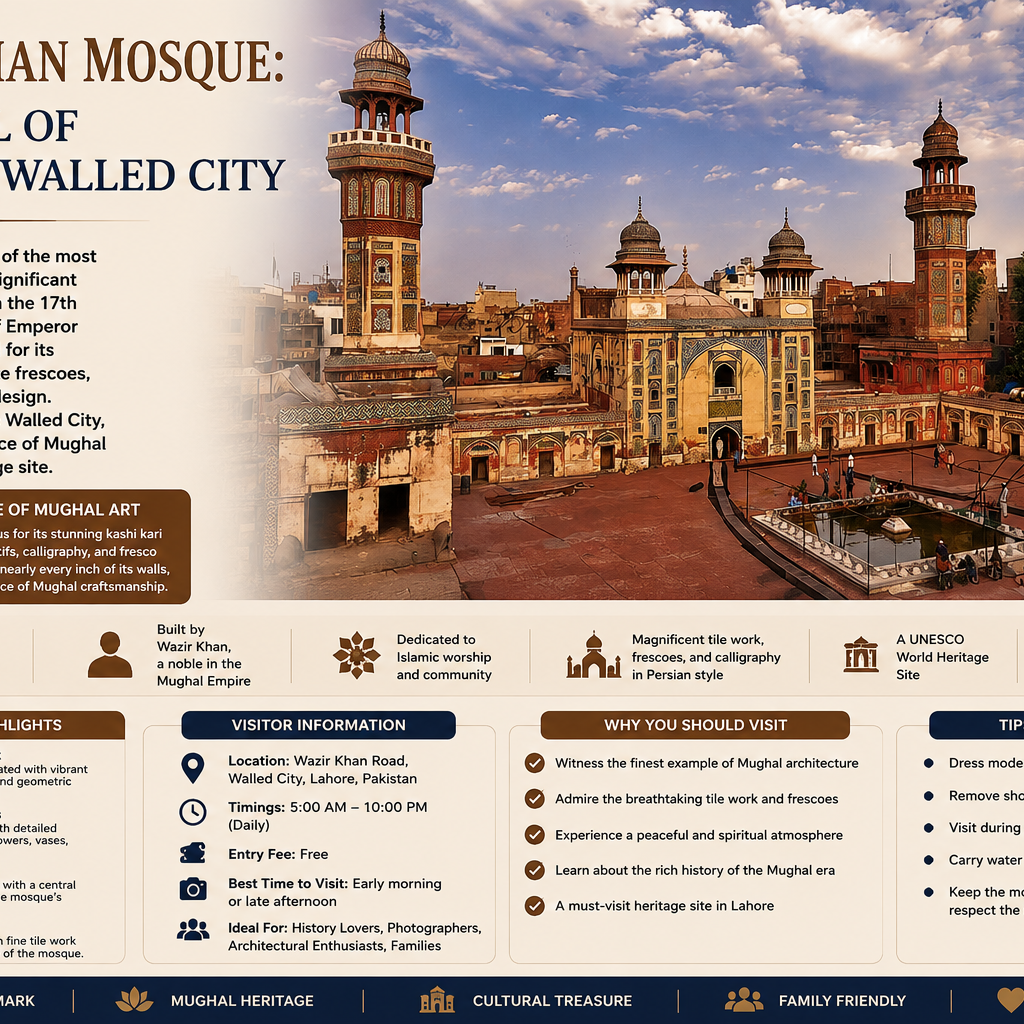
The Wazir Khan Mosque stands deep within the Walled City of Lahore near the Delhi Gate. People often call it the jewel of the old city. It was built in the seventeenth century during the reign of Shah Jahan. It counts as the most ornately decorated Mughal mosque. Its walls are almost entirely covered in intricate tile work, frescoes and calligraphy. The Badshahi Mosque impresses by its scale. The Wazir Khan Mosque enchants by its detail. It is one of the great treasures of the Walled City.
This guide explains what the Wazir Khan Mosque is, its history, its remarkable decoration and its setting in the old city. It covers both the mosque itself and its place among the landmarks of the Walled City. It treats the mosque with respect as a place of worship and heritage.
The Wazir Khan Mosque
The Wazir Khan Mosque is a seventeenth-century Mughal mosque in the Walled City of Lahore. Shah Jahan reigned when it was built. It stands along the southern side of the Shahi Guzargah, the royal road that Mughal nobles once travelled on their way to the Lahore Fort, near the historic Delhi Gate. It ranks as the most ornately decorated mosque of the Mughal era.
The mosque is renowned above all for its decoration. Its surfaces inside and out are almost entirely covered in intricate faience tile work known as kashi-kari. Detailed frescoes, calligraphy and other decorative techniques cover it too. This wealth of ornament sets the mosque apart with its rich colours and fine detail. Other monuments of the Shah Jahan period feature similar tile work. None match the scale and intensity of the Wazir Khan Mosque.
The mosque is rectangular in plan. It measures around 280 by 160 feet. It sits on a raised plinth and is entered through a grand gateway. Four minarets mark the corners of the main courtyard. The Wazir Khan Mosque is said to have set the trend for placing a minaret at each corner. Other mosques later followed this feature. The courtyard is flanked by small chambers. The tomb of a Sufi saint lies at its heart. The mosque was built around this tomb.
The Wazir Khan Mosque sits on the UNESCO World Heritage Tentative List. It has been the subject of major conservation work in recent years. It remains an active place of worship and one of the most admired landmarks of the Walled City. It draws visitors from across the world to marvel at its artistry.
Quick answer: The Wazir Khan Mosque is a seventeenth century Mughal mosque in the Walled City of Lahore near the Delhi Gate. Shah Jahan built it between 1634 and 1641. It counts as the most ornately decorated Mughal mosque. It is famous for its intricate kashi-kari tile work, frescoes and calligraphy covering almost every surface.
History of the Wazir Khan Mosque
Hakim Ilm-ud-din Ansari commissioned the mosque. People knew him widely as Wazir Khan. He served as the governor of Punjab during the reign of Shah Jahan. His life was a remarkable rise. He was born in Chiniot. He studied medicine and became a physician. He entered the service of the future emperor and rose to become the royal physician and then the governor of Punjab.
Construction of the mosque began in 1634. Workers completed it over about seven years by around 1641. The mosque was built as part of a larger ensemble. This included the nearby Shahi Hammam baths, a forecourt, a serai and bazaars. The mosque was endowed to support the community. Wazir Khan owned substantial property near the Delhi Gate. He commissioned several monuments in Lahore. The mosque is the most famous of them.
The mosque was built around an existing sacred site. This was the tomb of Syed Muhammad Ishaq Gazruni, also known as Miran Badshah. He was a Sufi saint who had migrated from Iran centuries earlier and lived in Lahore. An older shrine to the saint had stood on the site. The mosque was built to enclose the tomb. The tomb now lies in the courtyard. This gave the mosque both a religious and a spiritual significance from the outset.
The identity of the chief architect of the mosque remains unknown. Wazir Khan is documented to have employed skilled artisans and craftsmen from his hometown of Chiniot. Chiniot was renowned for its woodwork and stonework. The mosque served as an important religious and social centre during the Mughal era. It was the main congregational mosque of the city before the Badshahi Mosque was built. It was also the official place for the Friday prayers of the emperor when in Lahore. The mosque witnessed the changing fortunes of the city over the following centuries. It had fallen into disrepair by the late nineteenth century. Extensive restoration has been carried out from 2009 onwards under the direction of the Aga Khan Trust for Culture and the Government of Punjab with international support. This work has revived the original splendour of the mosque.
Decoration and architecture
The decoration of the Wazir Khan Mosque is its defining feature. It earns the mosque its reputation as the most ornately decorated of the Mughal era. The mosque brings together a range of decorative techniques applied with extraordinary skill across almost every surface.
The most famous of these is the kashi-kari. This is the intricate faience tile work that covers the exterior and the courtyard facades. It uses rich Persian-influenced colours. These include cobalt blue, cerulean, white, green, orange, yellow and purple. The tiles form star-shaped flowers, grapevines and geometric and floral patterns. The mosque is noted as the first Mughal monument to borrow the cypress tree motif from Persia. This tile work is unmatched among the monuments of the period in its scale and detail.
Detailed frescoes cover the interior alongside the tile work. Painters used the buon fresco technique. In this technique pigments are applied to fresh plaster so they become part of the wall itself. These frescoes combine imperial Mughal elements with local Punjabi decorative traditions. They adorn the prayer hall and the small side chambers. They are rare surviving examples of Mughal fresco work outside the imperial centres. Other techniques include brick-imitation work and lime plaster decoration. They add further layers of ornament.
The architecture provides the frame for this decoration. Visitors enter through a grand gateway with a Timurid-style iwan. It is richly decorated with tile work and calligraphy including the declaration of faith and Quranic verses. The gateway is one of the earliest examples in Lahore of muqarnas, the honeycomb-like architectural element found in great Islamic buildings elsewhere. The main prayer hall inside is divided into sections along a single aisle. The central section is topped by the largest dome of the mosque, resting on four arches in a Persian form. Four corner minarets each rise around 32 metres and complete the composition. A distinctive feature of the entrance area is the calligraphers' bazaar. This was a market for calligraphers and bookbinders that crossed the axis of the entrance. It reflected the role of the mosque as a centre of learning and culture.
The setting in the Walled City
The Wazir Khan Mosque sits in the heart of the Walled City of Lahore near the Delhi Gate. The Delhi Gate is one of the historic gates of the old city. This setting along the ancient royal road places the mosque within a rich concentration of heritage. It makes a visit especially rewarding.
The mosque stands on the Shahi Guzargah, the route that ran from the Delhi Gate towards the Lahore Fort. Mughal emperors and nobles travelled this road. This royal trail is lined with heritage. The mosque forms part of an ensemble that includes the nearby Shahi Hammam, the Mughal-era royal baths, also restored in recent years. The Wazir Khan Chowk is the square in front of the mosque. It and the Chitta Gate are part of the same historic setting. The Delhi Gate itself stands nearby as one of the original gates of the Walled City.
The wider Walled City spreads out around the mosque. Its narrow lanes, old havelis and bustling bazaars offer a step into the traditional life of old Lahore. The great landmarks of the Lahore Fort and the Badshahi Mosque lie a short distance away at the other end of the old city. The Wazir Khan Mosque combines with them and with a walk through the bazaars for a full experience of Mughal and old Lahore.
The mosque and the Walled City are central to the identity of Lahore as a city of history and culture. The restoration of the mosque and the royal trail has been part of a wider effort to revive the heritage of the old city. It is part of what makes Lahore a distinctive and desirable city. The mosque is one of the landmarks that captures the artistry and depth of the heritage of the old city.
Visiting the Wazir Khan Mosque
The Wazir Khan Mosque ranks among the most rewarding places to visit in Lahore. It offers an intimate encounter with the finest Mughal decorative art. It is an active place of worship as well as a landmark. Visitors should approach it with respect for its customs.
The mosque opens to visitors daily, generally from the morning until the evening. Access may be limited during prayer times. Entry is generally free with donations appreciated. Modest dress is expected. Shoes must be removed before entering the prayer areas. Visitors are asked to behave respectfully, particularly during prayers. Photography is generally permitted. The tile work, frescoes and calligraphy of the mosque make it one of the most photogenic sites in the city.
The mosque is reached through the Walled City near the Delhi Gate by car, taxi, rickshaw or ride-hailing service. The narrow lanes of the old city mean the final approach is often on foot. Walking in along the restored royal trail from the Delhi Gate past the Shahi Hammam is part of the experience. Guided tours are available and help visitors understand the history and the meaning of the decoration.
The cooler months from around October to March offer the most comfortable time to visit. They avoid the summer heat and make the walk through the old city more pleasant. Climbing one of the minarets where permitted offers views over the rooftops of the Walled City. A visit to the mosque combines with the Shahi Hammam, the Delhi Gate and the bazaars of the old city. The Lahore Fort and Badshahi Mosque lie nearby for a full day exploring the heritage of old Lahore.
Places near the Wazir Khan Mosque
The Wazir Khan Mosque sits within reach of many landmarks and useful places in the old city. This helps visitors plan a fuller trip. The Shahi Hammam stands close to the mosque as part of the same royal trail. The Delhi Gate marks the entrance to this part of the Walled City. The Lahore Fort and the Badshahi Mosque lie a short distance away.
The bazaars of the old city surround the mosque. These include the Shah Alami Market and the Akbari Mandi, one of the largest wholesale spice and grocery markets in the city. Data Darbar, the shrine of Data Ganj Bakhsh, lies within a short drive. Mayo Hospital, Sir Ganga Ram Hospital and the King Edward Medical University serve the central area. The Government College University stands in the historic heart of the city. These landmarks make the area around the mosque a centre of heritage, trade, faith and learning.
Frequently asked questions
Where is the Wazir Khan Mosque located? The Wazir Khan Mosque sits in the Walled City of Lahore near the Delhi Gate. It stands along the Shahi Guzargah or royal road that once led to the Lahore Fort. It lies in the heart of the old city a short distance from the Lahore Fort and the Badshahi Mosque.
Who built the Wazir Khan Mosque and when? Hakim Ilm-ud-din Ansari commissioned the mosque. People knew him as Wazir Khan, the governor of Punjab under Emperor Shah Jahan. Construction began in 1634 and finished over about seven years by around 1641.
Why is the Wazir Khan Mosque famous? The mosque is famous as the most ornately decorated Mughal mosque. It is renowned for its intricate kashi-kari tile work, detailed frescoes and calligraphy covering almost every surface. The Badshahi Mosque impresses by scale. The Wazir Khan Mosque is celebrated for its detail and artistry.
What is kashi-kari? Kashi-kari is the intricate faience tile work for which the mosque is famous. It uses rich Persian-influenced colours such as cobalt blue, cerulean, white, green and orange. The colours form floral, geometric and calligraphic patterns. The tile work covers the exterior and courtyard facades of the mosque.
Whose tomb is inside the mosque? The mosque was built around the tomb of Syed Muhammad Ishaq Gazruni, known as Miran Badshah. He was a Sufi saint who migrated from Iran centuries earlier and lived in Lahore. The tomb lies in the courtyard. The mosque was built to enclose the earlier shrine on the site.
Can visitors go inside the mosque? Yes. The mosque opens to visitors daily with generally free entry. Access may be limited during prayer times. Modest dress is expected and shoes must be removed before entering the prayer areas. Photography is generally allowed and guided tours are available.
The Wazir Khan Mosque is one of the great treasures of Lahore. People often call it the jewel of the Walled City. It counts as the most ornately decorated mosque of the Mughal era. Shah Jahan built it in the seventeenth century. Its walls are covered in intricate tile work, frescoes and calligraphy.
The mosque is one of the highlights of the Walled City. It stands along the ancient royal road near the Delhi Gate at the heart of the rich heritage of the old city. Its artistry, its history and its setting among the bazaars and landmarks of old Lahore make it one of the most rewarding places to visit. The restoration of the mosque and its surroundings has helped revive the heritage of the Walled City. Its spiritual significance or the experience of walking the royal trail through the old city whether you visit the Wazir Khan Mosque for its tile work, its frescoes. It remains one of the essential landmarks of Lahore and a lasting jewel of the Walled City.