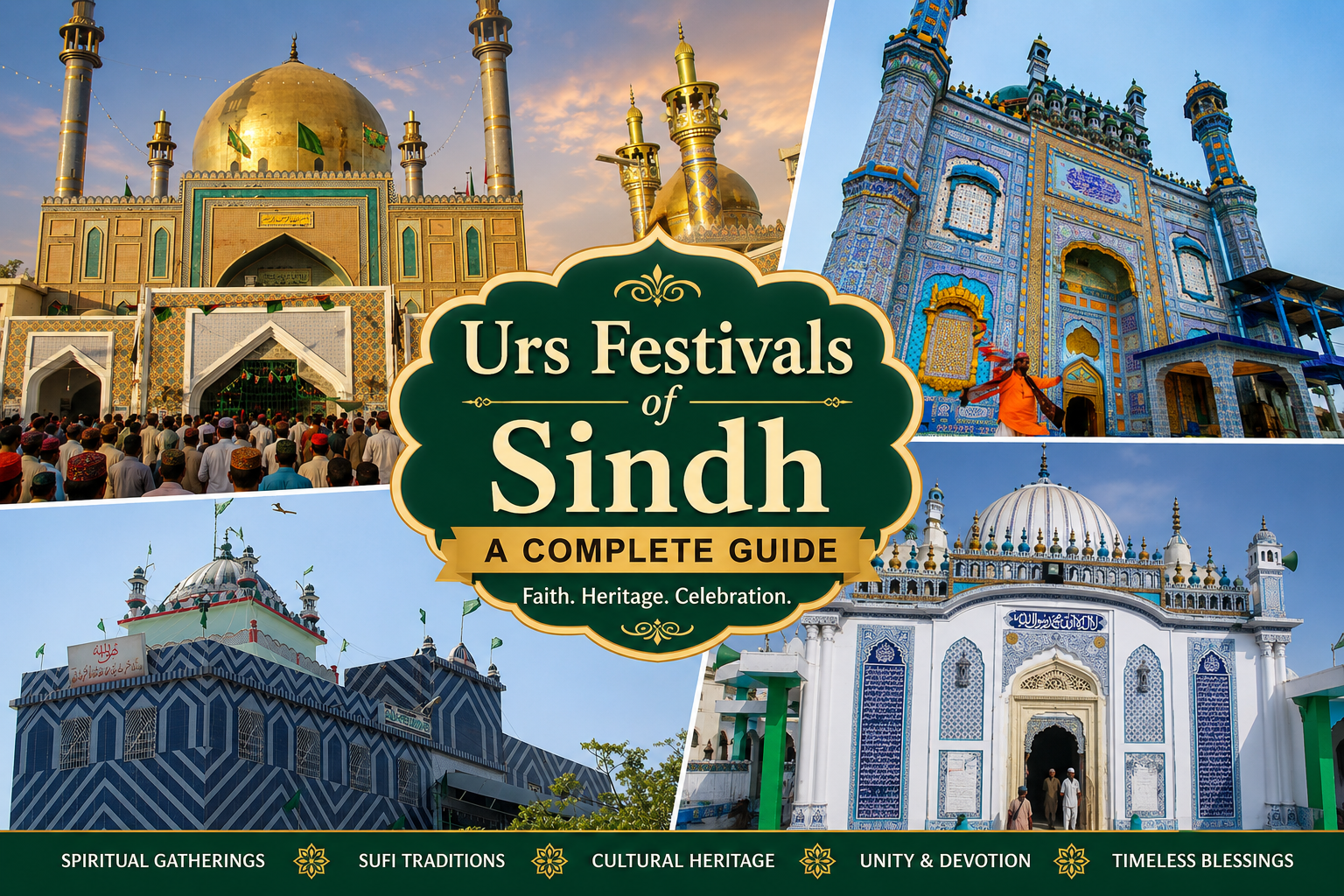
Urs Festivals of Sindh: A Complete Guide
The Urs festivals are the great spiritual gatherings of Sindh. They mark the death anniversaries of the Sufi saints. Millions of pilgrims travel to the shrines for them. The nights fill with dhamaal, qawwali and the sharing of food. People of many faiths gather side by side. This guide covers the Urs festivals of Sindh for the curious traveller. It explains the meaning the great festivals the rituals and how to attend.
This guide offers a general overview. Dates follow the Islamic calendar and move through the solar year.
Quick answer: An Urs marks the death anniversary of a Sufi saint. The word means marriage, standing for the union of the saint with the divine. The greatest Urs in Sindh is that of Lal Shahbaz Qalandar at Sehwan. It draws over two million pilgrims. The Urs of Shah Abdul Latif Bhittai at Bhit Shah is another. The festivals feature dhamaal, qawwali, langar and poetry. They welcome people of all faiths.
Meaning of the Urs
The Urs marks a death anniversary. It commemorates the passing of a Sufi saint. Devotees gather at the shrine each year. This annual festival is central to Sufi life in Sindh.
The word carries a deep meaning. Urs means marriage in the tradition. It represents the union of the saint with the divine. Death is seen as this union. The festival is a celebration, not a mourning.
The Urs blends devotion and culture. It joins prayer with music and dance. This blend of the spiritual and the festive is worship and celebration at once.
The festivals cross religious lines. They draw Muslims, Hindus, Sikhs and others. People of many faiths gather together. This inclusivity is a mark of Sindhi Sufism. It reflects the message of the saints.
Urs of Lal Shahbaz Qalandar
This is the greatest Urs in Sindh. It honours Lal Shahbaz Qalandar at Sehwan. He was the most beloved saint of the province. The dedicated guide to the saint covers his life. His festival is the largest of all.
The crowds are enormous. Over two million pilgrims travel to Sehwan. They come from across Pakistan. Some come from India and Bangladesh. It is essentially a South Asian affair.
The festival falls in Shaban. It is held on the 18th of that month. Shaban is the eighth month of the Islamic calendar. The date moves through the solar year. It runs over three days.
The dhamaal defines it. Devotees dance to the beat of great drums. Malangs perform with fierce devotion in red the colour of the saint. The whole town fills with the ritual.
The shrine suffered an attack in 2017. A bombing killed many worshippers. The caretaker rang the shrine bell the next morning. The dhamaal resumed the following evening. This defiance became a symbol of resilience.
Urs of Shah Abdul Latif Bhittai
This is another great Urs. It honours Shah Abdul Latif Bhittai at Bhit Shah. He is the greatest poet of Sindh. The dedicated guide to the poet covers his work. His festival is deeply cultural.
It celebrates his poetry. The Urs begins with poetry marathons. Literature conferences honour his verse. Faqirs sing his Shah Jo Risalo. This literary focus sets it apart.
The festival falls in Safar. It is held on the 14th of that month. Safar is the second month of the Islamic calendar. Scores of devotees travel to Bhit Shah. They come from across the country.
The music fills the nights. Singers perform the verse of the poet. They use his own musical modes. The dedicated guide to Sufi music covers this. The singing runs through the festival.
Rituals of the Urs
The dhamaal is the iconic ritual. It is an ecstatic devotional dance. Drums drive the rhythm. Devotees enter a trance. It is the most famous feature of the Urs.
Qawwali fills the shrines. Musicians perform devotional songs. They recount the life and teachings of the saint. The soul stirring music carries the crowd. It is central to the gathering.
The mehfil e sama gathers the devout. This is a traditional Sufi assembly. It features poetry and prayer. Spiritual discussion runs through it and spreads the message of peace and unity in the world.
The langar feeds everyone. Volunteers distribute free food. Rich and poor eat together. It is a cherished part of the festival.
The lights adorn the shrine. Illuminations cover the buildings. Fireworks light the night sky. These add to the grandeur. The shrine glows through the festival.
Wider festival culture
The Urs draws folk traditions too. Malakhra wrestling often features. This is a traditional Sindhi sport. Bouts draw great crowds and add to the atmosphere.
Every shrine has its Urs. Almost every village holds one. Local saints have their own festivals. These smaller Urs serve their communities. They fill the calendar across the province.
The festivals sustain the culture. They keep the poetry and music alive. They pass the tradition to new generations and draw the community together.
The government marks the great Urs. The province declares public holidays for them. This recognises their importance. It lets people attend fully. The Urs of the great saints are major public events.
Attending an Urs
Check the dates before you travel. The festivals follow the Islamic calendar. Their dates move each year. Confirm the timing before you plan. The great Urs draw enormous crowds.
Come prepared for the crowds. The festivals are vast and busy place. The shrines overflow with pilgrims. Guest houses fill quickly. The tourism body offers some facilities.
Visit respectfully. The Urs is a religious festival so dress modestly and follow the customs. Remove your shoes at the shrine. Respect the devotion around you.
Evening is the time for the dhamaal. The dance builds after sunset. The music deepens through the night. This is the most powerful time. Many find it deeply moving.
Frequently asked questions
What is an Urs? An Urs marks the death anniversary of a Sufi saint. The word means marriage, standing for the union of the saint with the divine. Death is seen as this union, so the festival is a celebration rather than a mourning. Devotees gather at the shrine each year for several days. The Urs blends devotion with cultural festivities, featuring dhamaal, qawwali, langar and poetry. The festivals welcome people of many faiths.
What is the biggest Urs in Sindh? The greatest Urs in Sindh is that of Lal Shahbaz Qalandar at Sehwan. It draws over two million pilgrims from across Pakistan and parts of India and Bangladesh. It falls on the 18th of Shaban in the Islamic calendar and runs over three days. The festival is famous for its dhamaal. Devotees dance to great drums dressed in red the colour of the saint. It is one of the largest Sufi gatherings in the world.
When are the great Urs festivals held? The Urs festivals follow the Islamic calendar, so their dates move through the solar year. The Urs of Lal Shahbaz Qalandar falls on the 18th of Shaban. The Urs of Shah Abdul Latif Bhittai falls on the 14th of Safar. Almost every shrine in Sindh holds its own Urs on the anniversary of its saint. Check the dates before you travel as they change each year.
What happens at an Urs festival? An Urs features several rituals over its days. The dhamaal is an ecstatic devotional dance performed to great drums. Qawwali singers perform devotional songs recounting the life of the saint. The mehfil e sama gathers the devout for poetry and prayer. Volunteers distribute langar the free food, to all. Lights and fireworks adorn the shrine. Folk traditions such as Malakhra wrestling often join the festivities.
Can non Muslims attend an Urs? The Urs festivals welcome people of all faiths. They draw Muslims, Hindus, Sikhs and others together. This inclusivity is a mark of the syncretic Sufi tradition of Sindh. Visitors should dress modestly, remove their shoes at the entrance of shrine and respect the devotion around them. Evening is the best time to witness the dhamaal. Many find it deeply moving. The festivals are a profound experience for any respectful visitor.
Great gatherings of the faith
The Urs festivals are the beating heart of Sindhi Sufism. They turn the death of a saint into a celebration of union with the divine. They fill the shrines with drums, song and shared food. They draw millions to Sehwan and thousands to Bhit Shah. They welcome every faith and every background. Few festivals anywhere carry such devotion.
You may come to an Urs as a pilgrim or a curious traveller. The festival will move you either way. You can watch the dhamaal build under the shrine lights. You can hear the qawwali carry through the night. You can share in the langar with the crowd. Come respectfully and check the dates first. The Urs festivals are the soul of Sindh laid bare.