Tomb of Jahangir: History and Guide
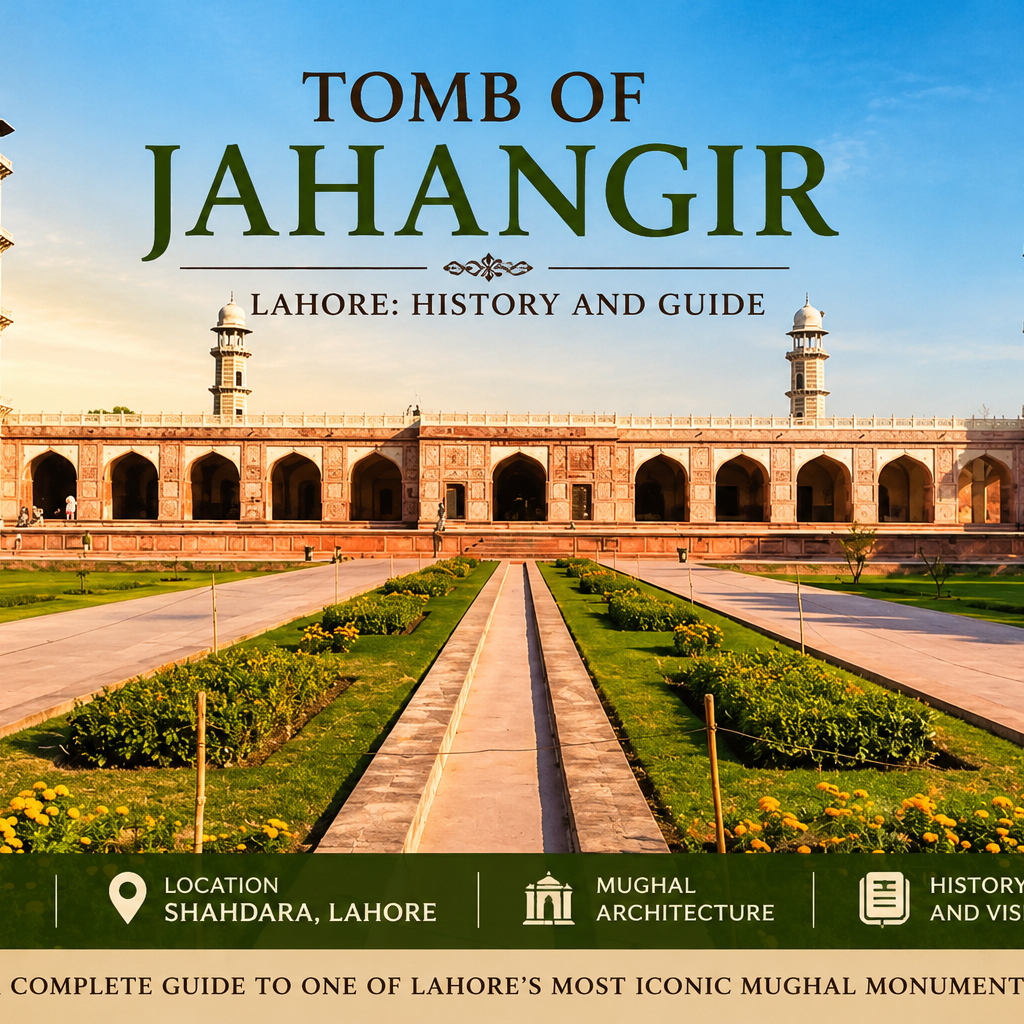
The Tomb of Jahangir is situated across the River Ravi from the old city of Lahore in the area of Shahdara Bagh. It is the resting place of the fourth Mughal Emperor. A vast Persian garden surrounds this single storey mausoleum of red sandstone and marble. It is famous for its four tall minarets, its richly decorated interior and its distinctive lack of a dome. It holds a special place among the heritage of Lahore.
The Tomb of Jahangir
The Tomb of Jahangir is the mausoleum of the Mughal Emperor Jahangir. He ruled from 1605 to 1627. The tomb stands in Shahdara Bagh on the western bank of the River Ravi to the northwest of the Walled City of Lahore. It dates from 1637. It is celebrated for its interiors, extensively decorated with frescoes and marble. Its exterior is richly inlaid with pietra dura, the art of setting semi precious stones into stone.
The tomb is situated within a vast walled garden laid out in the Persian charbagh or paradise garden style. This garden is known as the Dilkusha Garden. It had been a favourite retreat of Jahangir and his wife, the influential Empress Nur Jahan, when they lived in Lahore. Paved walkways and water channels divide the garden into quadrants and further subdivisions. Water tanks and fountains sit at the intersections. Together they create a serene setting for the mausoleum.
The tomb building itself is a single storey square structure raised on a plinth. Arcades line all four sides. Its most distinctive feature beyond its rich decoration is that it has no dome. Four octagonal minarets rise from each corner of the building. They stand around 100 feet tall. Inlaid marble in zigzag patterns decorates them. White marble cupolas crown them. This gives the tomb a distinctive profile unlike the domed Mughal tombs such as the Taj Mahal.
The tomb forms part of an ensemble along with the adjacent Akbari Sarai and the Tomb of Asif Khan. This ensemble is situated on the tentative list for UNESCO World Heritage status. The tomb is the only remaining major Mughal imperial tomb in the country. It once appeared on the national currency. It is one of the most significant and popular heritage sites in Lahore.
Quick answer: The Tomb of Jahangir is the mausoleum of the fourth Mughal Emperor. It stands in Shahdara Bagh across the River Ravi from Lahore and dates from 1637. A vast Persian garden surrounds the single storey red sandstone tomb. It is famous for its four 100 foot minarets, its pietra dura and fresco decoration and its distinctive lack of a dome.
History of the tomb
The Tomb of Jahangir was built in memory of the Emperor Jahangir. His full name was Nur ud din Muhammad Salim. He was the son of the great Emperor Akbar. Jahangir ruled the Mughal Empire for over two decades. He was known as a patron of the arts and a lover of nature and gardens. He died in 1627 at Rajauri while travelling to Kashmir to improve his health.
The body of Jahangir was brought to Lahore according to his wishes. It was buried in the Dilkusha Garden, the pleasure garden owned by his celebrated queen Nur Jahan in Shahdara. Jahangir and the empress had loved this area during their time in the city. The garden had first been laid out in the mid sixteenth century during the reign of Akbar. Nur Jahan later acquired it and gave it its name.
The construction of the grand mausoleum took around ten years. Workers completed it in 1637 at a great cost for the time. Historians discuss who was the driving force behind it. The contemporary court accounts credit the son of Jahangir, the Emperor Shah Jahan, the builder of the Taj Mahal, with the construction. Many historians believe the vision behind the tomb was that of Nur Jahan. The empress was a noted patron of architecture. She had built several structures and gardens. She was deeply devoted to her late husband. The design draws comparison with the tomb of her father in Agra. She had also commissioned that tomb.
The tomb passed through difficult times over the centuries. Much of its ornamentation and marble was stripped during the Sikh period and taken to decorate the Golden Temple in Amritsar and other buildings. The site was used as a residence and suffered damage. It was used as a depot under British rule. A railway line was built through the wider Shahdara complex. Flooding from the nearby River Ravi has threatened the site many times over the years. The British carried out restoration work in the late nineteenth century. Conservation efforts have continued since. They preserve the tomb as one of the most important Mughal monuments in the country.
Architecture of the tomb
The architecture of the Tomb of Jahangir reflects the Mughal style influenced by Persian and Timurid traditions. It is notable both for its rich decoration and for the choices that set it apart from other Mughal tombs. The mausoleum is built as a raised platform structure, a form used in Mughal funerary architecture.
The most striking architectural choice is the absence of a dome. Jahangir is said to have forbidden the construction of a dome over his tomb in keeping with a particular religious tradition. The roof is kept simple and free of the domes that later featured on tombs like the Taj Mahal built by his son. This gives the tomb its distinctive low horizontal profile. The four corner minarets and the symmetry of the garden dominate the composition.
The four octagonal minarets stand one at each corner. Each rises around 100 feet in several stages. Each stage is decorated with zigzag patterns of inlaid white, yellow and black marble. Marble railings and brackets define each stage. A cupola crowns each minaret. The bases of the minarets feature fine pietra dura detail. The exterior facade of the mausoleum is built of red sandstone inlaid with white marble motifs. Arcades line the perimeter.
The interior is where the decoration of the tomb is at its richest. The building is divided into a series of vaulted compartments richly decorated with Mughal buon fresco. Carved marble screens known as jali admit light in patterns. An octagonal chamber lined with carved marble lies at the centre. The remains of the emperor rest there beneath a cenotaph. This white marble cenotaph is inlaid with fine pietra dura in floral patterns. It features the ninety nine names of God in black marble inlay, a theme common in Islamic tradition. The floors and passageways are decorated with mosaic work and cut stone. Hardly any part is left unembellished. This combination of restrained exterior form and rich interior decoration gives the tomb its distinctive character.
Shahdara complex
The Tomb of Jahangir does not stand alone. It forms part of a larger Mughal complex in Shahdara Bagh known as the Shahdara ensemble. This grouping of monuments is aligned along an axis. It makes the site especially rich for visitors interested in Mughal heritage.
The Akbari Sarai lies immediately to the west of the tomb of Jahangir. This is a large caravanserai or inn dating from the Shah Jahan period. It is built around a great courtyard with cells lining its sides and a small mosque. It served as a station for travellers and for the caretakers of the tomb. It forms the grand entrance to the tomb complex through its western gateway. The Tomb of Asif Khan stands beyond the Akbari Sarai. Asif Khan was the brother of Nur Jahan and the father of Mumtaz Mahal, the wife of Shah Jahan for whom the Taj Mahal was built. This octagonal tomb with its bulbous dome dates from the 1640s and stands in its own walled garden.
The Tomb of Nur Jahan herself is the last of the Shahdara monuments. The powerful empress lies a short distance away. A railway line built in the British period separates her tomb from the others. Together these monuments tell the story of one of the most influential families of the Mughal age. They include the tombs of the emperor, his empress and her brother along with the sarai.
A trip to the Tomb of Jahangir can take in the whole ensemble. It offers a fuller picture of Mughal Lahore. The complex is situated in its gardens across the river from the old city. It is a peaceful retreat from the busy city and one of the most rewarding heritage destinations in Lahore.
The setting and significance
The Tomb of Jahangir is situated in Shahdara on the northwestern edge of Lahore across the River Ravi from the Walled City. This area was once a rural retreat known for its pleasure gardens where the Mughal court came to relax. Shahdara today is part of the wider Lahore metropolitan area. It is connected to the city by road and more recently by the Orange Line metro.
The tomb holds deep significance for Lahore and for the heritage of the region. It is the only remaining major Mughal imperial tomb in the country and the resting place of an emperor. It is a monument of national importance and a direct link to the Mughal age that shaped the city. Its image has appeared on the national currency, a mark of its standing.
The tomb is part of what gives Lahore its reputation as a city of Mughal heritage. It stands alongside the Lahore Fort, the Badshahi Mosque and the Shalimar Gardens. It adds to its standing as a distinctive and desirable city. The improvement of connections to Shahdara, including the Orange Line metro, has made this heritage more accessible. The growth of the area as part of the metropolitan city continues. The Tomb of Jahangir captures the Mughal legacy from which the city draws so much of its character. It is a peaceful garden retreat that rewards a visit.
Visiting the Tomb of Jahangir
The Tomb of Jahangir ranks among the most rewarding heritage sites to visit in Lahore. It offers history, architecture and the tranquillity of its gardens in one setting along with the wider Shahdara complex.
The tomb opens to the public daily, generally from the morning until the evening. The entry ticket is modest with a higher rate typically for foreign visitors. The complex and the gardens are large. Visitors should allow a couple of hours to explore the tomb, the Akbari Sarai and the nearby Tomb of Asif Khan. The gardens suit a relaxed visit. The peaceful setting is a contrast to the busy city.
The tomb is reached from central Lahore in around 30 minutes by road via the GT Road or the Ring Road across the River Ravi. It is also accessible via the Orange Line metro to Shahdara station followed by a short rickshaw ride. Taxis and ride hailing services reach the entrance directly. Parking is available near the complex.
The cooler months from around October to March offer the most comfortable time to visit. They avoid the summer heat. The gardens are pleasant much of the year. The tomb offers excellent opportunities for photography, from the minarets and the red sandstone facade to the pietra dura detail and the frescoes of the interior. Visitors are asked to respect the tomb, avoid damaging its features and help keep it clean. A visit to the tomb combines with the wider Shahdara ensemble for a full and rewarding visit to Mughal Lahore.
Places near the Tomb of Jahangir
The Tomb of Jahangir is situated within reach of several useful and well known places. This helps visitors plan a fuller trip. The Akbari Sarai and the Tomb of Asif Khan stand within the same complex. The Tomb of Nur Jahan lies a short distance away across the railway line. The River Ravi and its bridges connect Shahdara to the old city.
Shahdara has grown into a busy part of the Lahore metropolitan area. It offers local markets and services. The Orange Line metro links it to the wider city with a stop at Shahdara station. The heart of the old city with the Lahore Fort and the Badshahi Mosque lies across the river a short drive away. Data Darbar and the central hospitals of Lahore, including Mayo Hospital and Sir Ganga Ram Hospital, fall within reach in the central area. These connections make the tomb easy to combine with the other landmarks and services of the city.
Frequently asked questions
Where is the Tomb of Jahangir located? The Tomb of Jahangir is situated in Shahdara Bagh on the western bank of the River Ravi to the northwest of the Walled City of Lahore. It is reached from central Lahore in around 30 minutes by road or via the Orange Line metro to Shahdara station.
Who was Jahangir? Jahangir was the fourth Mughal Emperor. His full name was Nur ud din Muhammad Salim. He was the son of Akbar the Great. He ruled from 1605 to 1627 and was known as a patron of the arts and a lover of nature and gardens. He died in 1627 while travelling to Kashmir.
When was the tomb built and who built it? The tomb was completed in 1637 after around ten years of construction. Court accounts credit the son of Jahangir, the Emperor Shah Jahan. Many historians believe the vision behind it was that of the queen of Jahangir, Nur Jahan, a noted patron of architecture.
Why does the tomb have no dome? Jahangir is said to have forbidden the construction of a dome over his tomb in keeping with a particular religious tradition. The roof is therefore kept simple. This gives the tomb its distinctive low profile. The four corner minarets and the garden symmetry dominate.
What else is in the Shahdara complex? The tomb forms part of a larger ensemble. This includes the Akbari Sarai, a Mughal caravanserai that serves as the entrance. It also includes the Tomb of Asif Khan, the brother of Nur Jahan. The Tomb of Nur Jahan herself lies a short distance away. Together they form a remarkable cluster of Mughal monuments.
What are the opening hours and entry fee? The tomb opens daily from the morning until the evening with a modest entry ticket and a higher rate for foreign visitors. Visitors should check current timings and rates before visiting. They should allow a couple of hours to see the wider complex.
The Tomb of Jahangir is one of the great Mughal landmarks of Lahore. It is the resting place of the fourth Mughal Emperor and the only remaining major Mughal imperial tomb in the country. A vast Persian garden surrounds it across the River Ravi in Shahdara. Its red sandstone form, four tall minarets, rich pietra dura and fresco decoration and distinctive lack of a dome make it a monument unlike any other.
The tomb offers a direct link to the Mughal age that shaped the city. It stands alongside the Lahore Fort, the Badshahi Mosque and the Shalimar Gardens as part of the remarkable heritage of the city. Its setting within the wider Shahdara ensemble places it alongside the tombs of the empress Nur Jahan and her brother Asif Khan. This makes it one of the richest heritage destinations in the city. Its peaceful gardens offer a retreat from the busy life of Lahore. It remains one of the essential landmarks of Lahore and a lasting monument to the golden age of the Mughals whether you visit the Tomb of Jahangir for its architecture, its history, its garden setting or the wider Mughal complex around it.