Tomb of Allama Iqbal: History and Significance
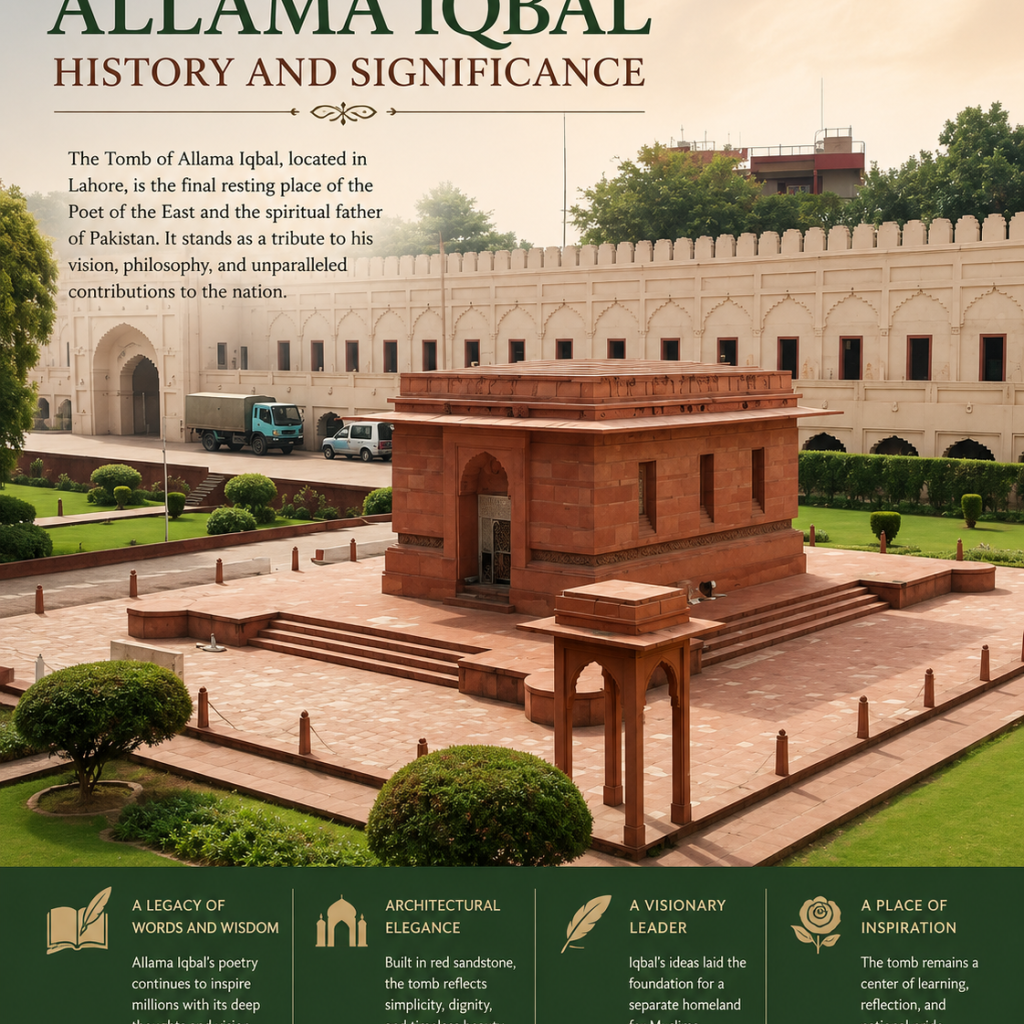
Tomb of Allama Iqbal is situated at Hazuri Bagh which is located between Badshahi Mosque and Lahore Fort. This is where Muhammad Iqbal, the national poet of Pakistan and one of the most prominent minds responsible for the making of the country was laid to rest. The tomb was built using red sandstone in an Afghan-Moorish-Mughal fusion style. A lapis lazuli tombstone, a gift from the people of Afghanistan, marks the grave. Thousands of visitors come each day to pay their respects. For anyone getting to know Lahore, the tomb is a place of history and quiet reflection.
This guide explains what the Tomb of Allama Iqbal is, the life of the poet, the history of the mausoleum and its setting in the Hazuri Bagh. It covers both the tomb itself and its place among the great landmarks of old Lahore.
The Tomb of Allama Iqbal
The Tomb of Allama Iqbal is also known as Mazar e Iqbal. It is the mausoleum of Muhammad Iqbal, the national poet of the country. It stands within the Hazuri Bagh in Lahore. This is the enclosed garden between the entrance of the Badshahi Mosque and the Lahore Fort. The tomb sits next to the walls of the great Mughal mosque in the heart of old Lahore.
Iqbal is revered as one of the major inspirations behind the Pakistan Movement. People know him by two titles. Muffakir e Pakistan means the Thinker of Pakistan. Shair e Mashriq means the Poet of the East. He gave voice to the idea of a separate homeland for the Muslims of the subcontinent. His poetry and thought continue to hold a central place in the culture of the country.
The mausoleum is a simple but impressive structure. It is rectangular in plan and built of red sandstone. It was kept deliberately low in height so as not to block the view of the great Badshahi Mosque behind it. Two gates, one on the eastern side and one on the southern side, are inlaid with marble. A small garden surrounds the tomb, divided into neat plots. Official guards from the Pakistan Rangers stand at the mausoleum.
The tomb is a place of daily pilgrimage. Thousands of visitors come to pay their respects to the poet philosopher. Entry is free. The tomb is listed among the protected heritage monuments of the Archaeology Department of Punjab. It stands as a place of national remembrance in the heart of the historic city.
Quick answer: The Tomb of Allama Iqbal is also well-known as Mazar-e-Iqbal in the nation. The mausoleum belongs to the poet of the nation called Muhammad Iqbal. It is situated in the Hazuri Bagh, in between Badshahi Mosque and Lahore Fort. Constructed from the red sandstone in the style of Afghan and Moorish architecture, the construction of the mausoleum was finished in 1951.
Who was Allama Iqbal?
Allama Muhammad Iqbal was one of the most important figures in the history of the country. He was a poet, philosopher, politician, lawyer and scholar. He was born on 9 November 1877 in Sialkot in Punjab. He rose from modest beginnings to become a towering intellectual figure. His work shaped the thinking behind the creation of the country.
Iqbal is widely regarded as one of the most important poet in Urdu and Persian literature. He wrote many volumes of poetry in both languages. His verses are still recited in classrooms and gatherings across the country. Poem such as Sare Jahan se Accha remain widely known. His poetry is blend of literary beauty with deep philosophical and spiritual themes. He drew inspiration from the Persian poet and mystic Rumi, whom he regarded as his spiritual guide.
Iqbal was also a political thinker of great influence. He urged the Muslims of the subcontinent towards self determination. His address at Allahabad in 1930 is often seen as an early articulation of the idea of a separate Muslim homeland. This vision helped to shape the movement that led to the creation of the country in 1947. Iqbal did not live to see it. He earned the titles the Thinker of Pakistan and the Poet of the East for this contribution.
Iqbal died on 21 April 1938 in Lahore at the age of 60. He had suffered from illness for months before his death. He was buried in the forecourt of the Badshahi Mosque, in the Hazuri Bagh. His death was mourned across the subcontinent. An academy named after him was later established to promote and preserve his poetry and philosophy. His legacy remains central to the identity of the country.
History of the tomb
The history of the tomb begins soon after the death of Iqbal in April 1938. He was first buried in a temporary grave in the Hazuri Bagh. A committee was formed shortly afterwards to build a permanent mausoleum. Chaudhary Muhammad Hussain, a trustee of Iqbal, presided over the committee. The committee aimed for a dignified yet modest Mazar that reflected the legacy of the poet.
The design took time to settle. The committee first invited proposals from leading architects. The initial designs did not satisfy the committee. It then recommended a new combination of styles rather than following a single school. The final design broke away from pure Mughal tradition. It combined Afghan and Moorish architecture in a single domed chamber. Nawab Zain Yar Jang Bahadur, the chief architect of Hyderabad Deccan, prepared the chosen design.
Funding the tomb proved a major challenge. The committee resolved not to accept donations from local governments or state rulers. It felt such donations would not be a fitting tribute. The funds were instead raised through contributions from the friends, admirers and disciples of Iqbal. This gave the tomb the character of a memorial built by the people who valued him.
The construction spanned thirteen years. The building materials were brought from far afield. Red sandstone came from Jaipur and marble from Makrana in Rajputana. The partition of 1947 interrupted the supply of red stone from India. This was the main cause of the long delay. The tomb was completed in 1951. The lapis lazuli for the tombstone, the same stone used for the tomb of the Mughal Emperor Babur, was received as a gift from the people of Afghanistan. The mausoleum has been maintained since by the relevant authorities against the effects of weather and pollution.
Architecture of the tomb
The architecture of the Tomb of Allama Iqbal blends several traditions. It combines Afghan and Moorish styles with Mughal and other influences. The result is a structure that is dignified and distinctive without overwhelming its grand surroundings. The tomb was built entirely of red sandstone.
The mausoleum is rectangular in plan. It was designed with a low profile on purpose. This ensured it would not block the view of the historic Badshahi Mosque behind it. It is a small building compared to the mosque and the fort around it. Slightly tapering walls and bold moulding above the plinth give the building a quiet dignity among the huge historic structures nearby.
Two gates provide access, one on the eastern side and one on the southern side. Both are inlaid with marble. Inside, the cenotaph is made of pure white marble. The tombstone that rests on it is the most treasured feature. It is crafted from lapis lazuli, a deep blue semi precious stone. Quranic verses in fine calligraphy cover it. This stone was a gift from the people of Afghanistan. The calligraphy was inscribed there too.
The interior carries further tributes to the poet. Six couplets by Iqbal are carved on the inner walls. They come from his Persian work Zabur e Ajam, known as Persian Psalms. These reflect his contribution to literature and thought. A small garden divided into plots surrounds the tomb outside. According to a well known account, the founder of modern Turkey sent earth from the tomb of Rumi, the spiritual guide of Iqbal, to be sprinkled on the grave. This detail captures the reverence in which Iqbal was held.
Setting in the Hazuri Bagh
The Tomb of Allama Iqbal stands in one of the most remarkable settings in Lahore. It sits within the Hazuri Bagh, the enclosed garden laid out between the Badshahi Mosque and the Lahore Fort. The great mosque and the great fort face each other across this garden. The tomb rests in the space between them.
This setting places the tomb at the very heart of Mughal and historic Lahore. The Badshahi Mosque rises directly behind it. The Alamgiri Gate of the Lahore Fort stands across the garden. The Roshnai Gate, one of the original gates of the old city, is nearby. The Samadhi of Ranjit Singh, the memorial to the Sikh ruler, also stands close by. Few monuments anywhere sit among such a concentration of heritage.
The location adds greatly to the significance of the tomb. It places the resting place of the national poet among the grandest symbols of the history of the city and the region. The tomb sits beside the Badshahi Mosque, one of the largest mosques in the world. It also sits beside the Lahore Fort, a UNESCO World Heritage Site. This proximity gives the tomb a fitting dignity. A visit to the tomb naturally includes these great landmarks.
The wider Walled City spreads out nearby, with its lanes, bazaars and the famous Fort Road food street. Minar e Pakistan and the Greater Iqbal Park lie a short distance away. The tomb therefore sits within a full circuit of the heritage of old Lahore. This central position makes it easy to combine with the other landmarks of the historic city. For anyone getting to know Lahore, the tomb is part of the essential heart of the old city.
Visiting the Tomb of Allama Iqbal
The Tomb of Allama Iqbal is one of the most visited and revered sites in Lahore. It offers history, reflection and a place among the great landmarks of the old city. It is a place of remembrance for the national poet and draws visitors from across the country.
Entry to the tomb is free. It is a public space for remembrance and reflection. The tomb is open to visitors through the day. As a place of reverence, modest dress is expected. Shoes must be removed before entering the mausoleum. Visitors are asked to behave respectfully, mindful of the solemnity of the place. Photography is generally allowed. An information desk provides details about the site.
The tomb is reached easily as it sits in the heart of old Lahore in the Hazuri Bagh. It is accessible by car, taxi, rickshaw or ride hailing service. There is no dedicated parking directly at the tomb. Parking areas are available near the Badshahi Mosque and the Lahore Fort. Arriving early helps for those driving. The old city area can be busy, so the final approach is often on foot.
The cooler months from around October to March offer the most comfortable time to visit. The early morning or late afternoon offers a more peaceful atmosphere and avoids the crowds. A visit to the tomb combines naturally with the Badshahi Mosque and the Lahore Fort on either side. It also combines with the food street and the Walled City nearby. Visitors are asked to respect the tomb and help keep the surroundings clean.
Places near the Tomb of Allama Iqbal
The Tomb of Allama Iqbal sits within reach of the greatest landmarks of Lahore. This helps visitors plan a fuller trip. The Badshahi Mosque rises directly behind the tomb. The Lahore Fort stands across the Hazuri Bagh. The Roshnai Gate and the Samadhi of Ranjit Singh are close by. The Fort Road food street lies a short distance away.
Minar e Pakistan and the Greater Iqbal Park lie nearby. Data Darbar, the shrine of Data Ganj Bakhsh, is within reach. Anarkali Bazaar and the Mall Road, with the Lahore Museum, lie a short drive to the south. The Wazir Khan Mosque and the Delhi Gate lie in the Walled City nearby. Major hospitals of the city, including Mayo Hospital and Sir Ganga Ram Hospital, serve the central area, along with the King Edward Medical University. These connections make the tomb an easy part of a tour of the historic heart of Lahore.
Frequently asked questions
Where is the Tomb of Allama Iqbal located? The Tomb of Allama Iqbal stands in the Hazuri Bagh in Lahore. This is the enclosed garden between the Badshahi Mosque and the Lahore Fort in the heart of the old city. It sits next to the walls of the Badshahi Mosque and is easily reached from across the city.
Who was Allama Iqbal? Allama Muhammad Iqbal was a poet, philosopher and politician born in Sialkot in 1877. He is the national poet of the country and one of the major inspirations behind the Pakistan Movement. He is revered as the Thinker of Pakistan and the Poet of the East. He died in Lahore in 1938.
When was the tomb built? Iqbal was first buried in a temporary grave in 1938. A committee then built the permanent mausoleum. It took thirteen years to complete and was finished in 1951. The delay was mainly caused by the interruption in the supply of red stone from India after the partition of 1947.
What is the tombstone made of? The tombstone is made of lapis lazuli, a deep blue semi precious stone, inscribed with Quranic verses in calligraphy. It was a gift from the people of Afghanistan. It is the same stone used for the tomb of the Mughal Emperor Babur. The cenotaph beneath it is white marble.
Is there an entry fee for the tomb? No. Entry to the Tomb of Allama Iqbal is free. It is a public space for remembrance and reflection. Modest dress is expected. Shoes must be removed before entering the mausoleum. The tomb is guarded by the Pakistan Rangers.
What is near the Tomb of Allama Iqbal? The tomb stands between the Badshahi Mosque and the Lahore Fort in the Hazuri Bagh. The Roshnai Gate, the Samadhi of Ranjit Singh, Minar e Pakistan, the Greater Iqbal Park, the Fort Road food street and the Walled City are all nearby, making the area a full circuit of heritage.
The Tomb of Allama Iqbal is one of the most revered and significant landmarks in Lahore. It is the final resting place of Muhammad Iqbal, the national poet and one of the great thinkers behind the creation of the country. Built of red sandstone in a blend of Afghan and Moorish styles and completed in 1951, its dignified form and its lapis lazuli tombstone honour a figure who holds a central place in the identity of the nation.
The tomb offers both history and quiet reflection in a remarkable setting. It rests in the Hazuri Bagh between the Badshahi Mosque and the Lahore Fort, among the grandest landmarks of the historic city. Its central position places it within a full circuit of the heritage of old Lahore, from the great Mughal monuments to Minar e Pakistan and the Walled City. Whether you visit the Tomb of Allama Iqbal to honour the poet, to admire its architecture or to reflect in the heart of the old city, it remains an essential landmark of Lahore and a place of national remembrance for the Poet of the East.