The Walled City of Lahore: A Complete Guide
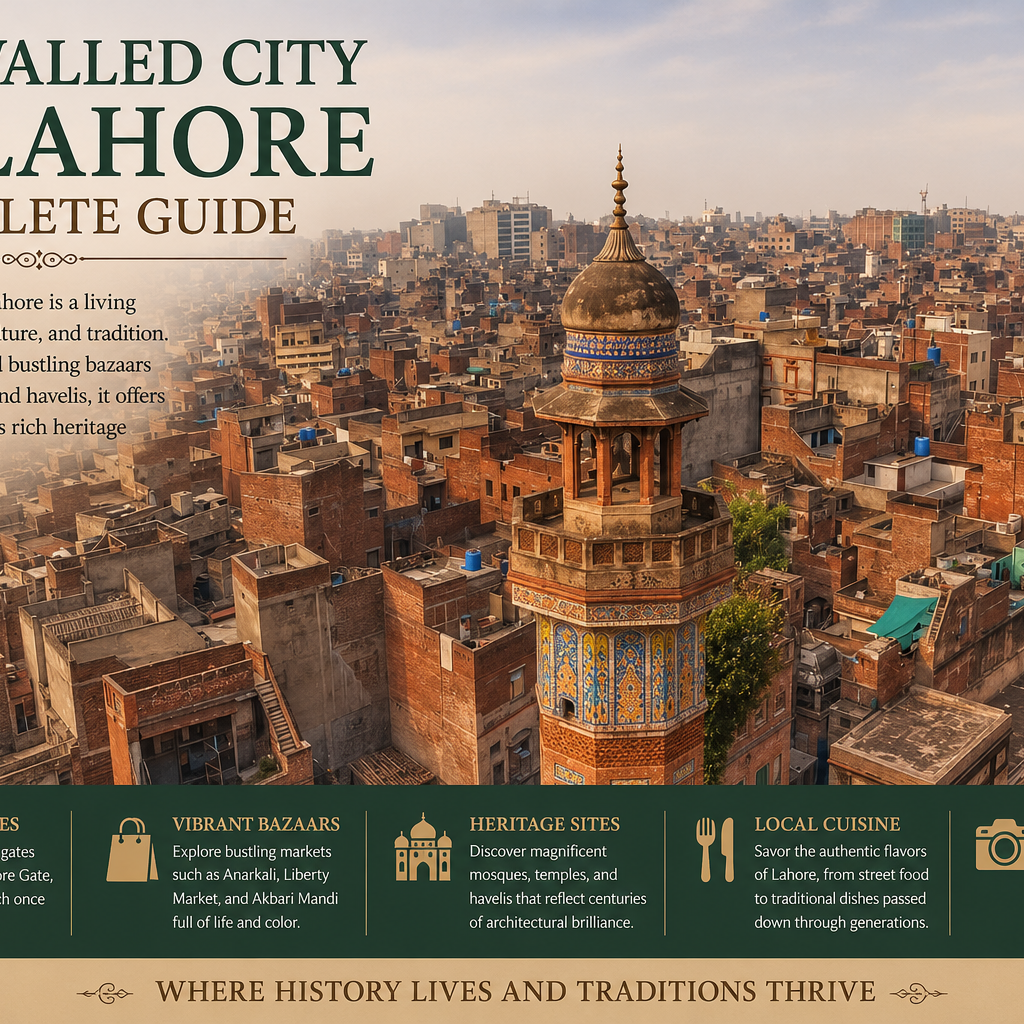
The Walled City of Lahore is the historic heart of the city. Locals call it Androon Shehr, the Inner City. This is the old city where Lahore began and grew into the great capital of the Mughal Empire. Its narrow lanes hold mosques, havelis, bazaars, shrines and some of the finest monuments in the country. The Lahore Fort, the Badshahi Mosque and the Wazir Khan Mosque all stand here. For anyone getting to know Lahore, the Walled City is the place where the story of the city truly comes alive.
This guide explains what the Walled City is, its history, its main landmarks and how to explore it. It covers both the old city as a whole and the treasures packed within its lanes.
The Walled City
The Walled City of Lahore is the historic core of the city. It is also known as the Old City, the Inner City or Androon Shehr. It refers to the area that was once fortified by a great wall during the Mughal era. The old city has been the primary cultural centre of Punjab since the late medieval period. It remains the cultural heart of Lahore today.
The old city grew over many centuries. Early settlements in the region date back thousands of years. Lahore gained the status of a proper city around 1040 and was fortified through the medieval era. It rose to real prominence when it became a Mughal capital. This led to the building of the Lahore Fort and the grand new brick wall around the city. The wall stood around nine metres high and enclosed the dense network of the old city.
The Walled City was once entered through thirteen gates. These gates pierced the wall and served as the entry points to the city. Only a few of the original gates survive today, though several have been rebuilt. The Circular Road now runs around the old city where the wall once stood. The British replaced the wall with a garden on three sides after they took control in the nineteenth century.
The old city today is a dense and living place. Its convoluted lanes remain largely intact. Old havelis of two or three storeys line the streets, with brick facades, flat roofs and carved wooden balconies. Bazaars, shrines, mosques and workshops fill the quarters. The Walled City of Lahore Authority now works to preserve and restore this heritage. The old city remains home to many of the greatest attractions of Lahore.
Quick answer: The Walled City of Lahore is known as Androon Shehr which is the historic core of the city. It was fortified with a great wall during the Mughal era and entered through thirteen gates. It holds the Lahore Fort, the Badshahi Mosque, the Wazir Khan Mosque and many bazaars, havelis and shrines. It remains the cultural heart of Lahore.
History of the Walled City
The history of the Walled City stretches back over a thousand years. The origins of Lahore are ancient, with settlements in the region dating back thousands of years. The early city took shape during the medieval period. It was first protected by mud walls. The old city laid the foundation of modern Lahore.
The Walled City rose to prominence under the Mughals. The Emperor Akbar made Lahore a Mughal capital in the late sixteenth century. He ordered a grand palace built at what is now the Lahore Fort. He also rebuilt and fortified the walls of the city and extended them to enclose more ground. The old gates of the city were built around this time. Akbar also established the Akbari Mandi as a grain market at the eastern edge of the city. It still exists today.
The old city flourished through the Mughal period. The Mughal nobles built palaces and gardens in and around Lahore. Many of the first grand havelis of the city date from this era. European visitors described the city as populous, with bazaars full of valuable goods. The later Emperor Aurangzeb built the great Badshahi Mosque and the massive Alamgiri Gate of the fort. The old city was the thriving heart of one of the most important cities of the empire.
The fortunes of the Walled City changed after the Mughals. The city declined during the unstable period that followed the collapse of Mughal rule. It later came under the Sikh Empire, when the walls were repaired. The British took control in the mid nineteenth century. They demolished the city walls and most of the gates after the events of 1857. They built a garden around the old city and focused new development in the suburbs to the south and east. The old city has remained the historic core through all these changes.
Gates of the Walled City
The gates of the Walled City are among its most famous features. The old city was once entered through thirteen gates. These gates pierced the great wall and controlled entry to the city. Each gate had its own name, character and story. Many were named after their direction, their function or a local feature.
The thirteen gates were the Akbari Gate, the Bhati Gate, the Delhi Gate, the Kashmiri Gate, the Lohari Gate, the Masti Gate, the Mori Gate, the Mochi Gate, the Roshnai Gate, the Shahalmi Gate, the Sheranwala Gate, the Taxali Gate and the Yakki Gate. The Delhi Gate faced towards Delhi and remains one of the most important. The Kashmiri Gate faced towards Kashmir. The Roshnai Gate, near the Badshahi Mosque, is the oldest surviving gate. The Lohari Gate was named after the blacksmiths of the city.
The gates suffered greatly over the centuries. The British demolished all the gates except the Roshnai Gate after they took control of the city. Several gates were later rebuilt, though some were lost forever. The Shahalmi Gate burned down during the riots of 1947. Others, such as the Akbari, Masti and Taxali gates, no longer survive as structures. Today only a handful of the original gates remain, including the Bhati, Delhi, Kashmiri, Lohari, Roshnai and Sheranwala gates.
The areas around the gates remain busy and full of character. The Delhi Gate leads to one of the largest cloth markets in the region and to the Wazir Khan Mosque. The Bhati Gate area is famous for its food. The Lohari Gate neighbourhood is known for its traditional eateries. The Kashmiri Gate leads to the Kashmiri Bazaar and the great Azam Cloth Market. The gates and their surroundings are covered in more detail in a dedicated guide.
Main landmarks in Walled city
The Walled City holds an extraordinary concentration of landmarks. Some of the greatest monuments in the country stand within or beside the old city. A visit can take in Mughal forts, mosques, shrines and bazaars within a small area. This makes the old city one of the richest heritage destinations anywhere.
The Lahore Fort stands at the northern edge of the old city. It is the great Mughal citadel and a UNESCO World Heritage Site. It holds the Sheesh Mahal, the Naulakha Pavilion, the Picture Wall and the grand Alamgiri Gate. The Badshahi Mosque stands beside the fort, across the Hazuri Bagh. It is one of the largest mosques in the world, built by Aurangzeb. The tomb of Allama Iqbal rests in the Hazuri Bagh between the two. These landmarks form the grand northern edge of the old city.
The Wazir Khan Mosque lies deep within the old city near the Delhi Gate. It is famous as the most ornately decorated Mughal mosque, covered in intricate tile work. The nearby Shahi Hammam, the Mughal royal baths, has also been restored. The Sunehri Mosque is also called the Golden Mosque. It stands in the Kashmiri Bazaar. Data Darbar, the shrine of the Sufi saint Data Ganj Bakhsh, lies just outside the old city and is one of the most important religious sites in the country.
The bazaars of the old city are landmarks in their own right. The Akbari Mandi is one of the largest wholesale markets in the city. The Kashmiri Bazaar, the Shah Alami Market and the Azam Cloth Market draw traders and shoppers from across the region. The Fort Road food street offers rooftop dining with views of the illuminated monuments. These markets and eateries give the old city its living, working character alongside its heritage.
Royal Trail and restoration
The Royal Trail is one of the best ways to experience the Walled City. This is the historic route known as the Shahi Guzargah. It runs for around 750 metres from the Delhi Gate towards the Lahore Fort. Mughal emperors and nobles once travelled this road on their way to the fort. The trail links the Delhi Gate, the Wazir Khan Mosque, the Shahi Hammam and the surrounding bazaars and quarters.
The Royal Trail has been the focus of major restoration. The Government of Punjab began conservation work on the route with international support. The Walled City of Lahore Authority now manages this effort. The Aga Khan Trust for Culture has served as a strategic partner. The work has restored the facades of buildings along the trail and revived the historic monuments. The first phase was completed in 2015 with support from the governments of Norway and the United States.
The restoration has transformed the experience of the old city. The distinction between the Mughal heritage and the later building is now clearer along the trail. The Wazir Khan Mosque and the Shahi Hammam have been carefully restored. The route offers a walk through the layers of the history of the city. It has become one of the highlights of a visit to the old city.
The wider restoration effort continues across the Walled City. The Walled City of Lahore Authority was established in 2012 to preserve the heritage of the old city. It looks after the security and preservation of the gates, the mosques and the monuments. This work aims to protect the old city from the damage and encroachment of recent decades. It has helped revive the old city as a heritage destination for visitors from the country and abroad.
Exploring the Walled City
The Walled City is best explored on foot. The lanes are narrow and often too tight for cars. Walking is the only way to reach many of the treasures tucked within the quarters. This also gives the truest feel of the life and culture of the old city. A guided walk helps visitors find the landmarks and understand their history.
The old city rewards a slow and curious approach. Visitors can wander the bazaars, admire the carved wooden balconies of the havelis, sample the street food and visit the mosques and shrines. The Royal Trail from the Delhi Gate offers a clear route through the highlights. A motorbike or a hired horse cart can help cover ground in some areas. The Walled City of Lahore Authority runs guided tours, including special evening tours of the Lahore Fort.
The old city is reached easily from across Lahore. It sits in the historic core of the city, accessible by car, taxi, rickshaw or ride hailing service to the edge of the quarters. The Orange Line metro and the Metro Bus serve parts of the wider area. Parking is best found near the main gates or the fort, with the rest of the exploration on foot.
The cooler months from around October to March offer the most comfortable time to explore the old city on foot. The evenings are especially atmospheric, when the Fort Road food street and the illuminated monuments come alive. Visitors are asked to respect the mosques, the shrines and the homes of the residents, dress modestly at religious sites and help keep the old city clean. A visit to the Walled City is one of the most rewarding experiences in Lahore.
Places in and near the Walled City
The Walled City holds and adjoins many landmarks and useful places. This helps visitors plan a fuller trip. The Lahore Fort, the Badshahi Mosque, the tomb of Allama Iqbal, the Wazir Khan Mosque and the Shahi Hammam all stand within or beside the old city. The Fort Road food street is close to the fort. Minar e Pakistan and the Greater Iqbal Park lie just outside.
Data Darbar, the shrine of Data Ganj Bakhsh, lies just outside the old city. The Akbari Mandi, the Kashmiri Bazaar and the Azam Cloth Market are the great markets of the quarter. The Mall Road, with the Lahore Museum, lies a short drive to the south. Mayo Hospital, Sir Ganga Ram Hospital and the King Edward Medical University serve the central area. The Government College University stands nearby. These connections make the Walled City the heart of a full tour of historic Lahore.
Frequently asked questions
What is the Walled City of Lahore? The Walled City of Lahore is the historic core of the city, also known as the Old City or Androon Shehr. It was once fortified by a great wall and entered through thirteen gates. It holds many of the greatest monuments and bazaars of Lahore and remains its cultural heart.
How old is the Walled City? The origins of Lahore are ancient, with settlements dating back thousands of years. The city gained the status of a proper city around 1040 and was fortified through the medieval era. It rose to real prominence as a Mughal capital in the late sixteenth century.
How many gates does the Walled City have? The Walled City once had thirteen gates. Only a few of the original gates survive today, including the Bhati, Delhi, Kashmiri, Lohari, Roshnai and Sheranwala gates. The Roshnai Gate near the Badshahi Mosque is the oldest surviving gate.
What are the main attractions in the Walled City? The main attractions include the Lahore Fort, the Badshahi Mosque, the tomb of Allama Iqbal, the Wazir Khan Mosque, the Shahi Hammam and the Sunehri Mosque. The bazaars, such as the Akbari Mandi and the Kashmiri Bazaar, are also highlights. The Fort Road food street is another.
How do you explore the Walled City? The best way to visit the Walled City is on foot, because the streets are narrow, and vehicles cannot navigate through them. For this reason, taking the Royal Route starting from Delhi Gate makes it easy to navigate through the sites.
What is the Royal Trail? The Royal Trail is also called the Shahi Guzargah. It runs around 750 metres from the Delhi Gate to the Lahore Fort. Mughal emperors once travelled it. It has been restored in recent years and links the Delhi Gate, the Wazir Khan Mosque and the Shahi Hammam.
The Walled City of Lahore is the historic heart of the city and one of the richest heritage destinations in the country. Known as Androon Shehr, it is the old city where Lahore began and grew into a great Mughal capital. Its lanes hold an extraordinary concentration of monuments, from the Lahore Fort and the Badshahi Mosque to the Wazir Khan Mosque and the Shahi Hammam, alongside bustling bazaars, carved havelis and revered shrines.
The old city offers a journey through the layers of the history of Lahore, from the Mughal age through the Sikh and British periods to the living city of today. The restoration of the Royal Trail and the wider work of the Walled City of Lahore Authority have revived much of this heritage for visitors. Whether you explore the Walled City for its monuments, its markets, its food or simply the atmosphere of its ancient lanes, it remains the essential heart of Lahore and the place where the story of the city comes to life.