Supreme Court of Pakistan Building: Architecture & History
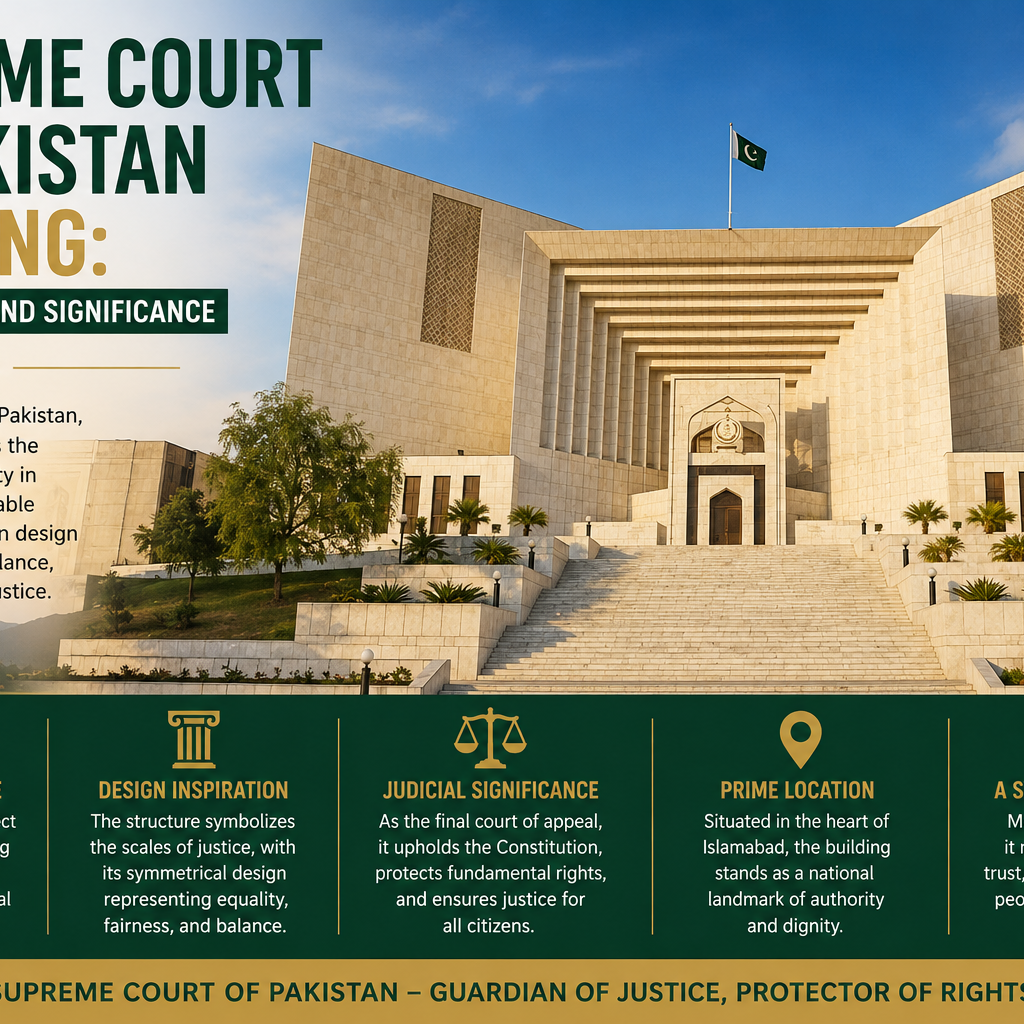
The Supreme Court of Pakistan building is situated in the Red Zone of Islamabad, among the country's main institutions of state. As the home of the country's highest court, it is one of the most important buildings in the capital and its modernist design, by a celebrated Japanese architect, makes it a notable piece of architecture in its own right.
This article explains what the Supreme Court building is, its history, its architecture and the area around it. The focus here is on the building itself, its design and its setting, written for anyone getting to know Islamabad and the landmarks that define its administrative heart.
Supreme Court of Pakistan building
The Supreme Court building is the official and principal seat of the Supreme Court of Pakistan, the apex court of the country. It is situated in the Red Zone of Islamabad, on Constitution Avenue, among the main government buildings of the capital.
The building was completed in 1993 and it is situated at the centre of the state's administrative district. It is flanked by the Prime Minister's Office to one side, with the presidency, Aiwan e Sadr and the Parliament House nearby. This places the court among the key institutions of state, arranged along the city's planned administrative axis.
The building was designed by the famous Japanese architect Kenzo Tange, one of the most celebrated architects of the twentieth century. It was built as part of an effort by the government to bring modernism into the architecture of important government buildings and Tange's design gives the court a distinctive modern form that complements the nearby Parliament House.
As the home of the country's highest court, the building is central to the justice system. It houses the courtrooms, judges' chambers, offices and a law library and it is where the most important legal cases in the country are heard. Its role and its architecture together make it one of the significant buildings of the capital.
Quick answer: The building of Supreme Court of Pakistan is the principal seat of the highest court of Pakistan and is located in Islamabad's Red Zone of Capital. Completed in 1993 and designed by the Japanese architect Kenzo Tange, it is situated among the main institutions of state.
History of the Supreme Court building
The history of the Supreme Court building is tied to both the development of Islamabad and the history of the court itself. The Supreme Court of Pakistan has its roots in the courts established before and after the country's creation and over the years the court sat in different cities before settling permanently in the capital.
In its earlier years, the court met in Karachi and later in other cities, before moving to Islamabad as the government settled into the new capital. A permanent home for the court in Islamabad was part of establishing the institutions of state in the purpose built city.
The building on Constitution Avenue was completed in 1993, after a long process of planning and construction that spanned earlier decades. The engineering and civil works involved the Capital Development Authority and other bodies, with environmental and planning consultants advising on the project. Over the years, the complex was expanded, including the addition of the court's law library.
The choice of architect was part of a wider effort to bring modern architecture to Islamabad's important government buildings. Several architects were invited to contribute to the capital's institutional structures and the government sought designs that reflected a modern approach. The Supreme Court building, completed in the early 1990s, became one of the results of this effort, standing alongside the other main state buildings of the Red Zone.
Architecture of the Supreme Court building
The architecture of the Supreme Court building is one of its most notable features, thanks to its designer, Kenzo Tange. Tange was one of the most celebrated architects of the twentieth century, known for combining modernism with a sense of tradition and recognised with the highest honours in his field, including the Pritzker Prize.
The building is designed in a modernist style, with clean lines and a strong, dignified form suited to its role as the country's highest court. The design was intended to complement the nearby Parliament House, so the two buildings work together as part of the architecture of the Red Zone. The result is a building that feels both modern and appropriate to the seriousness of its function.
Tange's approach brought his international reputation to Islamabad. He was known for major works around the world, from memorials and government buildings to stadiums and civic centres and the Supreme Court building is situated among his notable projects. His design gives the court a presence that matches its importance, using modern architecture to express the dignity of the institution.
The court complex is made up of several parts. It includes a main central block, a block for the judges' chambers and an administrative block, together covering a large area. The complex includes the courtrooms in which cases are argued, the offices required for managing the court and a law library. This system helps in providing support to the operations of the most important court in the country, blending both the functional and aesthetic aspects of the structure.
Significance of the Supreme Court building
The Supreme Court building holds significance on two levels: as the home of the country's highest court and as a notable piece of architecture in the capital.
The Supreme Court is the apex court of Pakistan and is the final authority in the legal system of country. The building is where the most important legal matters in the country are heard and decided. This makes it one of the central institutions of state, alongside the parliament and the presidency and gives the building a weight of significance beyond its physical form.
As a piece of architecture, the building is situated out as an example of modernist design by a world renowned architect. Its role in the government's effort to bring modern architecture to the capital's important buildings gives it a place in the story of Islamabad's development. The building's design, complementing the Parliament House, contributes to the character of the Red Zone as a district of modern institutional architecture.
Together, its institutional role and its architectural quality make the Supreme Court building one of the significant landmarks of Islamabad. It represents both the country's legal system and the modern architectural vision that shaped the capital's government district.
Places near the Supreme Court building
The Supreme Court building is situated in the Red Zone of Islamabad, the secure administrative district at the centre of the capital. This central setting places it among the most important landmarks of the city, surrounded by the main institutions of the state.
Its closest neighbours are the other key government buildings. The Prime Minister's Office lies to one side and the presidency, Aiwan e Sadr and the Parliament House are nearby to the other. The Pakistan Secretariat and other government institutions are part of the same district, all arranged along Constitution Avenue and the city's planned administrative axis. Together, these buildings form the cluster of state institutions at the heart of Islamabad.
The National Library of Pakistan, one of the country's leading cultural and information institutions, is located in the vicinity of the Red Zone. The Diplomatic Enclave which houses many embassies and high commissions, is situated nearby as well, in its own secure zone. This concentration of government, judicial and diplomatic buildings makes the area the centre of national administration.
Beyond the immediate district, the Supreme Court building connects to the wider capital through Constitution Avenue and Islamabad's road network. The central sectors of the city, with their markets, offices, hospitals and services, are within reach and landmarks such as the Faisal Mosque and the Pakistan Monument are part of the same central area of the capital.
For anyone understanding the geography of Islamabad, the Supreme Court building is one of the institutions that defines the administrative heart of the city. The sectors around this central district are among the capital's most established and prominent and proximity to the government and diplomatic areas shapes the character of central Islamabad.
Why the Supreme Court building matters to Islamabad
Beyond its function, the Supreme Court building holds a significant place in the identity of Islamabad. As the home of the country's highest court, it is one of the buildings most associated with the capital's role as the centre of national government and justice.
For the city, the building is part of the cluster of state institutions that gives Islamabad its purpose as the capital. Alongside the parliament, the presidency and the diplomatic missions, the Supreme Court helps make the Red Zone the administrative and judicial heart of the country. Landmarks of this kind define how the city is understood and add to its standing as the national capital.
The building also carries architectural significance, as a work by a world renowned architect and part of the modern vision that shaped Islamabad's government district. Its modernist design, dignified form and central position make it a recognisable landmark of the capital. For anyone getting to know Islamabad, the Supreme Court building is one of the important buildings that shape the character of the city's administrative centre.
Frequently asked questions
Where is the Supreme Court of Pakistan building located? The building is in the Red Zone of Islamabad, on Constitution Avenue, among the main government buildings of the capital. It is situated close to the Prime Minister's Office, the presidency and the Parliament House.
Who designed the Supreme Court building and when was it completed? It was designed by the famous Japanese architect Kenzo Tange, one of the most celebrated architects of the twentieth century. The building was completed in 1993, with engineering and civil works carried out by local and other bodies.
What is the architecture of the Supreme Court building like?The building is in a modernist style with clean, dignified lines which is designed to complement the nearby Parliament House. It reflects the government's effort to bring modern architecture to the capital's important buildings, executed by a world renowned architect.
What does the Supreme Court complex include? The complex includes a main central block, a block for the judges' chambers and an administrative block, together covering a large area. It houses the courtrooms, offices and a law library needed for the work of the country's highest court.
What is the significance of the Supreme Court building? It is significant both as the home of the country's apex court. The most important legal cases are decided and as a notable piece of modernist architecture by a celebrated architect by contributing to the character of the Red Zone.
What places are near the Supreme Court building? The Prime Minister's Office, the presidency, the Parliament House and the Pakistan Secretariat are all nearby in the Red Zone, along with the National Library and the Diplomatic Enclave. The building connects to the wider capital via Constitution Avenue.
The Supreme Court of Pakistan building is one of the significant landmarks of Islamabad. As the principal seat of the country's highest court, it is situated among the main institutions of state in the Red Zone, on Constitution Avenue, at the heart of the capital's administrative district.
Designed by the celebrated Japanese architect Kenzo Tange and completed in 1993, the building combines a dignified modernist architecture with the practical needs of the highest court in the country. Its design complements the nearby Parliament House and contributes to the modern character of the government district. For anyone getting to know Islamabad, the Supreme Court building is one of the essential landmarks, representing both the country's legal system and the architectural vision that shaped the capital's institutional heart and a key part of what makes Islamabad the centre of national government and justice.