Sunehri Mosque: The Golden Mosque of Lahore
The Sunehri Mosque is situated in the busy Kashmiri Bazaar in andron city of Lahore. It is known as the Golden Mosque for its three gilded domes. The mosque was built in 1753, during the decline of the Mughal Empire. It is raised on a high plinth above the surrounding bazaar, with shops beneath it. Its golden domes glitter in the sunlight above the crowded lanes. For anyone getting to know Lahore, the Sunehri Mosque is a beautiful and unusual landmark woven into the daily life of the old city.
This guide explains what the Sunehri Mosque is, its history, its architecture and its setting in the bazaar. It treats the mosque with respect as a place of worship and heritage.
The Sunehri Mosque
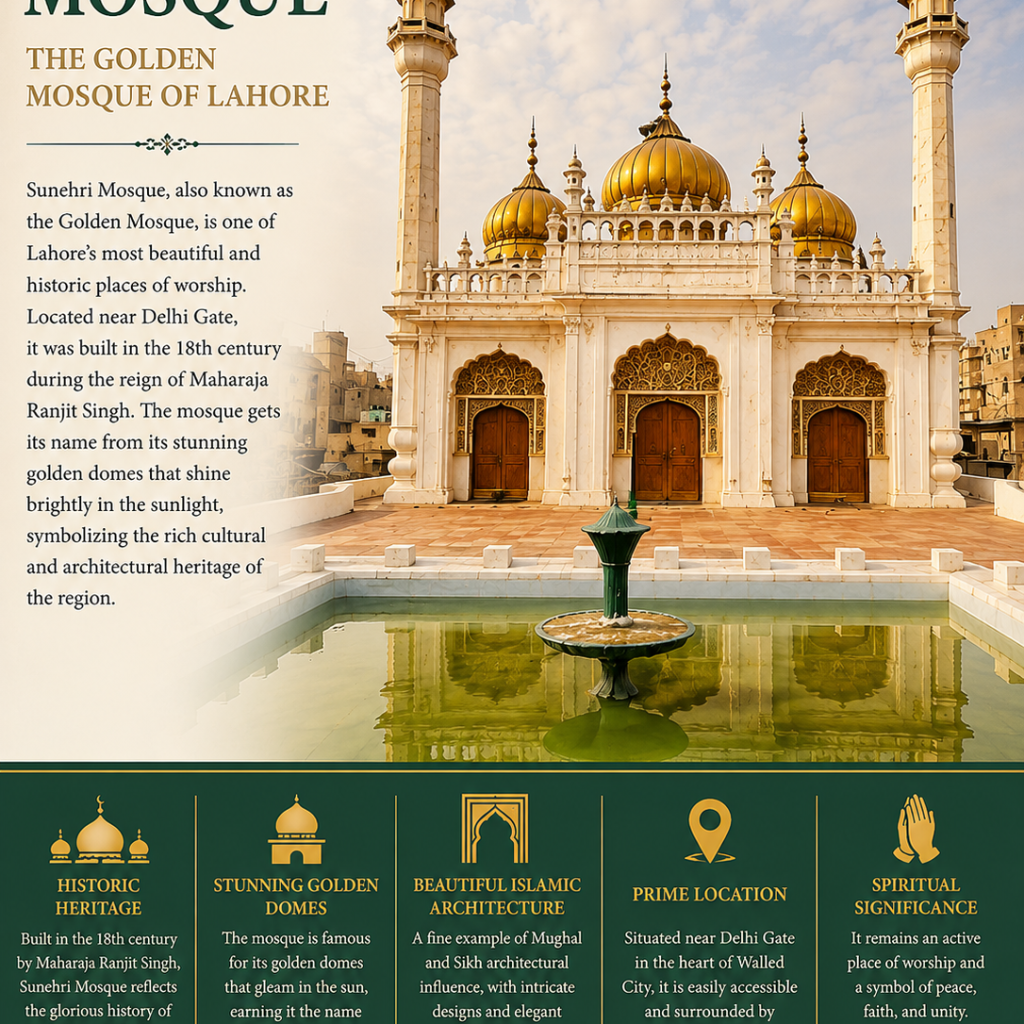
The Sunehri Mosque means the Golden Mosque in Urdu. It is also known as the Talai Mosque. It is a late Mughal era mosque in the Walled City of Lahore. The mosque stands in the Kashmiri Bazaar, at the junction of the Kasera Bazaar and the surrounding lanes. It takes its name from its three gilded domes. These give it a golden appearance.
The mosque stands out for its setting and its date. The great mosques of Lahore, such as the Badshahi Mosque and the Wazir Khan Mosque, were built at the height of the Mughal Empire in the seventeenth century. The Sunehri Mosque was built later, in 1753, when the empire was in decline. It is one of the last Mughal era mosques of the city. It is smaller in scale than the imperial mosques, a reflection of the reduced resources of the time.
The mosque is unusual in the way it situated within the marketplace. Unlike the imperial mosques built in expansive open courtyards, the Sunehri Mosque was embedded within a functioning bazaar. It rose not in isolation but among the shops of the market. The mosque is raised on a high plinth, around 11 feet above the street, with shops built into the platform beneath it. This wove the mosque into the commercial life of the old city rather than setting it apart.
The mosque remains an active place of worship. It serves the traders and residents of the Kashmiri Bazaar. On most days it holds a few rows of worshippers. During the holy month of Ramadan, the mosque fills completely, as traders shift their schedules to gather for prayers. The golden domes above the busy bazaar make the mosque one of the most distinctive landmarks of the old city.
Quick answer: The Sunehri Mosque is also called the Golden Mosque. It is a late Mughal era mosque in the Kashmiri Bazaar of the Walled City of Lahore. It was built in 1753 by Nawab Bhikari Khan, during the decline of the Mughal Empire. It is famous for its three gilded domes and its setting raised above the shops of the bazaar.
History of the mosque
The Sunehri Mosque was built in 1753, during the later Mughal period. This was a time when the Mughal Empire was in decline. Political power had weakened and resources were limited. The mosque was built by Nawab Bhikari Khan, also recorded as Bukhari Khan, the deputy governor of Lahore during the reign of the Emperor Muhammad Shah. This makes the mosque one of the last Mughal era mosques of the city.
The construction of the mosque faced an early challenge. Local shopkeepers objected to the building of a large mosque in the congested bazaar. To proceed, Bhikari Khan obtained a ruling from local religious leaders that allowed the construction to begin. This story reflects the crowded setting of the mosque and its close ties to the marketplace from the very start. The mosque was raised on a platform with shops beneath, so that it could coexist with the trade of the bazaar.
The mosque passed through a notable period during Sikh rule. The Sikh ruler Ranjit Singh captured Lahore in 1799. For a time the mosque came under Sikh control and was used for other purposes. This caused sorrow among the local Muslim community. This period is recorded as a difficult chapter in the history of the mosque. The building was briefly used as a Sikh place of worship during these years.
The mosque was later returned to Muslim worship. On the appeal of the local community, conveyed through a trusted minister of his court, Ranjit Singh agreed to restore the mosque for Islamic worship. He is also recorded as having donated gold for the domes of the mosque. This gilding gave the mosque its famous golden domes and its name. This act is often cited as an example of the policy of religious accommodation of the ruler. The mosque has served as a place of Muslim worship since then.
Architecture of the mosque
The architecture of the Sunehri Mosque is a distinctive blend of styles. It reflects the late Mughal period as well as the influences of the era in which it was restored. The mosque brings together Mughal, Hindu and Sikh design elements. This mix makes it one of the more unusual mosques of the old city.
The most famous feature is the set of three gilded domes. These bulbous, melon shaped domes are covered in gold and give the mosque its name and its glitter. The domes cover the prayer chambers of the mosque. Four minarets rise at the corners of the mosque. The gilded domes and the minarets rising above the bazaar form the most recognisable image of the mosque.
The mosque is raised on a high plinth, around 11 feet above the street. This platform accommodates shops on the ground floor beneath the mosque. A gateway leads up to the mosque from the bazaar. The courtyard holds a hauz, an ablution pond, in the traditional manner of a mosque. It is often found dry today. The prayer chamber and courtyard follow the familiar pattern of Mughal mosque design, adapted to the tight space of the bazaar.
The decoration combines several traditions. The mosque has overhanging balconies carved with geometric tracery and fresco decoration. The bulbous domes and the pillars with lotus shaped features show Hindu and Sikh design influences. The interior once carried fine fresco work. This blend of Mughal, Hindu and Sikh motifs gives the mosque a special place as a reminder of the mixed heritage of the city during a complex period of its history.
Setting in the bazaar
The Sunehri Mosque is situated in the heart of the Kashmiri Bazaar in the Walled City of Lahore. This is one of the busiest and most historic markets of the old city. The mosque stands at the junction of the Kasera Bazaar and the surrounding lanes, near the Chowk Rang Mahal. This crowded, lively setting is central to the character of the mosque.
The setting places the mosque among the great markets and monuments of the old city. The Kashmiri Bazaar around it is a busy trading area, packed with shops, cars and people. The bazaar leads towards the huge Azam Cloth Market, one of the largest cloth markets in the region. The wider Walled City, with its lanes, havelis and monuments, spreads out around the mosque. This makes the mosque part of the living, working heart of the old city.
The mosque stands within reach of the other great landmarks of the Walled City. The Wazir Khan Mosque and the Shahi Hammam lie nearby along the historic quarters. The Delhi Gate is within the old city. The Lahore Fort and the Badshahi Mosque lie at the northern edge of the Walled City. This means a visit to the Sunehri Mosque combines naturally with the markets and monuments of the old city.
The mosque faces some challenges in its crowded setting. The historic shops beneath and around the mosque have grown congested over the years. Encroachments and the clutter of the busy bazaar can obscure parts of the mosque. Restoration work has been carried out in recent years to preserve the mosque. This work has re gilded the domes, added new marble flooring and rebuilt the minarets. Efforts continue to protect the mosque within its lively and demanding setting.
Significance of the Sunehri Mosque
The Sunehri Mosque holds a special place among the landmarks of Lahore. It is one of the last Mughal era mosques of the city. It stands as a marker of a particular moment in history, the decline of the Mughal Empire.
It brings together Mughal, Hindu and Sikh elements in one building. This makes it a reminder of the mixed heritage of the city during a complex and changing time.
The history of the mosque also carries a message of coexistence of communities. The return of the mosque to Muslim worship under Ranjit Singh is often cited as an example of religious accommodation. The gift of gold for its domes is remembered in the same way. This history gives the mosque a place in the story of the different communities that have shaped Lahore. It stands as a reminder of the syncretised past of the city.
The mosque adds to the character and heritage of the old city. It is a working mosque woven into the daily life of the bazaar, as well as a heritage landmark. Its golden domes are one of the distinctive sights of the Walled City. For anyone getting to know Lahore, the Sunehri Mosque is one of the landmarks that captures the layered history and the living faith of the old city.
Visiting the Sunehri Mosque
The Sunehri Mosque is one of the more unusual mosques to visit in the old city. It offers a beautiful example of late Mughal architecture set within a busy bazaar. It is an active place of worship, so it is best approached with respect for its customs.
The mosque is generally open around prayer times. Visitors are often admitted when the mosque is open for prayers. As a place of worship, modest dress is expected. Shoes must be removed before entering the prayer areas. Visitors are asked to behave respectfully, particularly during prayers. The golden domes and the setting above the bazaar make the mosque a striking sight, best appreciated from the surrounding lanes as well as up close.
The mosque is reached through the Kashmiri Bazaar in the Walled City. It is accessible by car, taxi, rickshaw or ride hailing service to the edge of the old city. The narrow and crowded lanes of the bazaar mean the final approach is on foot. The mosque is situated amid a busy market, so it is worth navigating the crowded streets with care.
The cooler months from around October to March offer the most comfortable time to explore the old city on foot. The mosque can be combined with the nearby Wazir Khan Mosque, the Shahi Hammam and the markets of the old city. Visitors interested in the bazaar life will find the area around the mosque especially lively. Visitors are asked to respect the mosque and the traders of the bazaar and to help keep the area clean.
Places near the Sunehri Mosque
The Sunehri Mosque is situated within reach of many landmarks and useful places in the old city. This helps visitors plan a fuller trip. The Kashmiri Bazaar around the mosque leads towards the Azam Cloth Market, one of the largest cloth markets in the region. The Wazir Khan Mosque and the Shahi Hammam lie nearby along the historic quarters. The Delhi Gate is within the old city.
The Lahore Fort and the Badshahi Mosque lie at the northern edge of the Walled City. The tomb of Allama Iqbal rests nearby in the Hazuri Bagh. Data Darbar, the shrine of Data Ganj Bakhsh, lies within reach. The Akbari Mandi wholesale market is close by. Minar e Pakistan and the Greater Iqbal Park are a short distance away. Mayo Hospital and Sir Ganga Ram Hospital serve the central area. These connections make the mosque an easy part of a tour of the old city.
Frequently asked questions
Where is the Sunehri Mosque located? The Sunehri Mosque stands in the Kashmiri Bazaar in the Walled City of Lahore. It is situated at the junction of the Kasera Bazaar and the surrounding lanes, near the Chowk Rang Mahal, in the heart of the old city.
Why is it called the Golden Mosque? The mosque is called the Sunehri Mosque, meaning the Golden Mosque, because of its three gilded domes. The domes are covered in gold and give the mosque a golden appearance that glitters in the sunlight above the bazaar.
Who built the Sunehri Mosque and when? The mosque was built in 1753 by Nawab Bhikari Khan, the deputy governor of Lahore during the reign of the Emperor Muhammad Shah. It was built during the later Mughal period, when the empire was in decline.
What is special about the architecture? The mosque blends Mughal, Hindu and Sikh design elements. It is famous for its three bulbous gilded domes and its four minarets. It is raised on a high plinth with shops beneath it, woven into the marketplace rather than set apart from it.
What happened to the mosque during Sikh rule? After Ranjit Singh captured Lahore in 1799, the mosque came under Sikh control and was used for other purposes for a time. On the appeal of the local community, Ranjit Singh later returned it for Islamic worship and is recorded as donating gold for its domes.
Can visitors go inside the mosque? The mosque is an active place of worship and is generally open around prayer times. Visitors are often admitted when the mosque is open for prayers. Modest dress is expected and shoes must be removed before entering the prayer areas.
The Sunehri Mosque is one of the most distinctive and unusual landmarks of the Walled City of Lahore. Known as the Golden Mosque for its three gilded domes, it was built in 1753, during the decline of the Mughal Empire. Raised on a high plinth above the shops of the Kashmiri Bazaar, it is woven into the daily life of the old city in a way that sets it apart from the grand imperial mosques.
The mosque tells a rich and layered story. Its blend of Mughal, Hindu and Sikh design makes it a reminder of the mixed heritage of the city. Its history of passing between communities before being restored to Muslim worship adds to this during a complex period. Its golden domes glitter above one of the busiest bazaars in the old city, an active place of worship and a heritage landmark at once. Sunehri Mosque remains one of the essential smaller landmarks of Lahore and a golden crown above the old city whether you visit the Sunehri Mosque for its architecture, its history or the bustling bazaar around it.