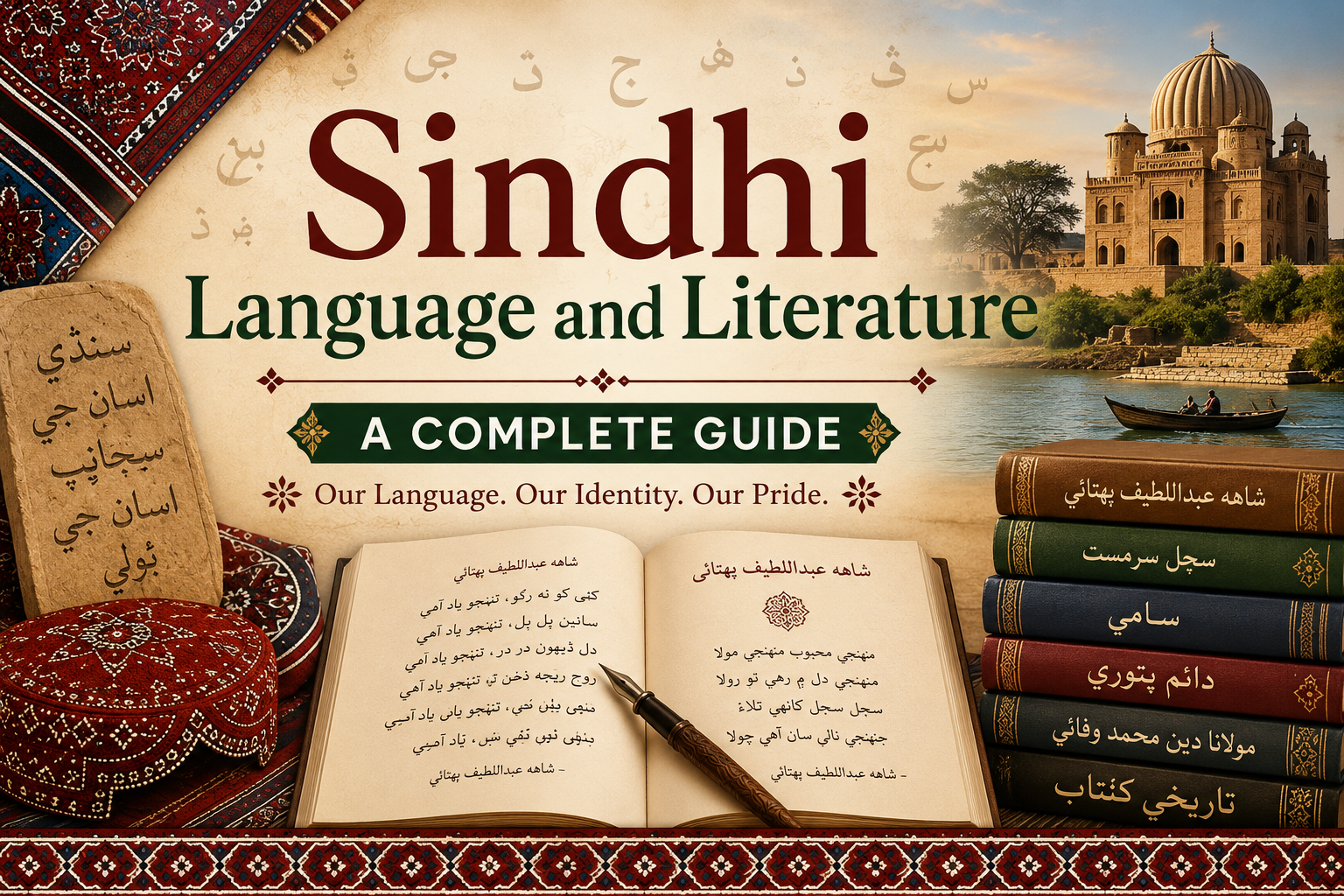
Sindhi Language and Literature: A Complete Guide
Sindhi is one of the great languages of South Asia. It is an ancient Indo Aryan language with roots by the Indus. It carries a literature of Sufi poetry admired across the world. Its script has taken many forms across the centuries. Its greatest poets blended Islamic and Vedantic thought. This guide covers the Sindhi language and its literature. It explains the origins the script the classical poets the modern age and the living language.
This guide offers a general overview. Dates for the early poets vary between sources.
Quick answer: Sindhi is an Indo Aryan language of the Sindh region. It is the official language of the province and has tens of millions of speakers. It first appeared in writing in the 8th century. Modern Sindhi in Pakistan uses a Perso Arabic script of 52 letters, standardised in the 1850s. Its literature is dominated by Sufi poetry. The classical trinity is Shah Abdul Latif, Sachal Sarmast and Sami. The Shah Jo Risalo is its greatest work.
About the Sindhi language
Sindhi is an Indo Aryan language. It belongs to the great Indo Aryan family. It is spoken by the people of the Sindh region. It has tens of millions of speakers worldwide. The diaspora has carried it far.
The roots are ancient. Sindhi probably grew from an early Indo Aryan speech of the Indus valley. Some link it to a pre Sanskrit language. Scholars place it near the Dardic languages. Lahnda and Kashmiri are its cognate sisters.
It is an official language. Sindhi is the official language of the province. It is one of the scheduled languages of India too. This status protects and promotes it. The diaspora keeps it alive abroad.
The language is rich in sound. Sindhi has a complex set of consonants. It holds distinctive implosive sounds. These set it apart from its neighbours. They demand a large alphabet.
Scripts of Sindhi Language
Sindhi has used many scripts. An early scholar recorded three of them. These were Ardhanagari, Mahajani and Khudabadi. Different communities used different scripts for centuries.
The Khudabadi script was widely used. It was once known simply as the Sindhi script. The colonial government standardised it in 1868. Hindus favoured it for education and literature.
The Perso Arabic script became standard. Sindhi Muslims had long written in Arabic letters. The British standardised a Perso Arabic script in the 1850s. This became the official form. Sindh uses it to this day.
The alphabet is large. The standard script holds 52 letters. It adds new letters to the Persian base. These capture the sounds particular to Sindhi. This makes it one of the larger alphabets of the region.
Two scripts survive today. Pakistan uses the Perso Arabic form. Sindhi Hindus in India often use a Devanagari form. Transliteration links the two. This lets speakers read across the border.
Birth of the literature
The first writing was ancient. Sindhi first appeared in writing in the 8th century. An early work was a translation of the Quran. This is held to be the first such translation. It marks the age of the written language.
Early literature is scarce. Little survives from the earliest centuries. The Soomra and Samma periods left few works. The record is thin before the classical age.
The first great poets emerged. Three Sufi mystics shaped the literature. Qadi Qadan, Shah Abdul Karim and Shah Inat Rizvi led the way. They gave Sindhi literature its character. Their poetry set the pattern.
Shah Abdul Karim left early records. His heroic ballads were set to music. They are among the earliest records of the language. He prepared the ground for what followed.
Classical trinity
The Kalhora era was a golden age. Sindhi literature flourished under the Kalhora rulers. The dedicated guide to the history of Sindh covers the period. Three great poets defined it. They are known as the trinity of Sindhi literature.
Shah Abdul Latif is the greatest. He lived from 1689 to 1752. His Shah Jo Risalo is the masterpiece of the language. He preached the oneness of God and universal brotherhood. His own dedicated guide covers his life and work.
Sachal Sarmast enriched the tradition. He lived from 1739 to around 1827. He wrote with open ecstasy in seven languages. He challenged religious orthodoxy boldly. His own dedicated guide covers his verse.
Sami completed the trinity. He lived in the 18th and 19th centuries. He was a Vedantist in his thought. His verse drew on Hindu philosophy. He ranks beside the two Sufi masters.
The literature blends two traditions. Sindhi poetry unites Islamic mysticism and Vedantic thought. This coexistence is its defining feature. It reflects the shared culture of the province. Few literatures blend so freely.
Modern age
The British era brought printing. A European scholar had a Sindhi typeset made in Germany. This printed the first edition of the Risalo in 1866. It came out in the new Arabic Sindhi script. Printing transformed the written language.
Prose came to the fore. Religious poetry slowly gave way to prose after 1843. Writers adapted works from other languages. They drew on Sanskrit, Persian and English. This broadened its range.
The novel appeared. Mirza Qalich Beg was a leading figure. He wrote the novel Zeenat in the 19th century. He translated and composed widely. His work shaped modern Sindhi prose.
The language gained institutions. A language authority now promotes Sindhi. Universities hold chairs in the poets. Scholars publish and preserve the classics. This work sustains the literature.
Living language
Sindhi thrives today. It is spoken across the province. It carries a lively press and media. It is taught in schools and universities.
The poetry still lives. Faqirs sing the Risalo at Bhit Shah nightly. Singers carry the verse across the province. The dedicated guide to Sufi music covers this. The classics remain part of daily life.
The diaspora keeps it alive. Sindhis abroad maintain the language. They teach it to their children and celebrate its literature. This keeps Sindhi a global language.
Frequently asked questions
What kind of language is Sindhi? Sindhi is an Indo Aryan language of the Sindh region. It probably grew from an early Indo Aryan speech of the Indus valley. Scholars place it near the Dardic languages, with Lahnda and Kashmiri as cognate sisters. It has a complex sound system with distinctive implosive consonants. It is the official language of the province and one of the scheduled languages of India. Tens of millions speak it worldwide.
What script is Sindhi written in? Modern Sindhi in Pakistan uses a Perso Arabic script of 52 letters. The British standardised it in the 1850s adding new letters to the Persian base for sounds particular to Sindhi. Earlier the language used several scripts, including Khudabadi. The colonial government standardised that script in 1868. Sindhi Hindus in India often use a Devanagari form. Transliteration links the two scripts across the border.
Who are the greatest Sindhi poets? The classical trinity of Sindhi literature is Shah Abdul Latif, Sachal Sarmast and Sami. Shah Abdul Latif is the greatest, known for the Shah Jo Risalo. Sachal Sarmast wrote with open ecstasy in seven languages. Sami was a Vedantist whose verse drew on Hindu philosophy. Earlier poets such as Qadi Qadan, Shah Abdul Karim and Shah Inat Rizvi gave the literature its distinctive character.
What is Sindhi literature known for? Sindhi literature is known above all for its Sufi poetry. Its defining feature is the coexistence of Islamic mysticism and Vedantic thought. The religious poetry of the 15th to 18th centuries is marked by a deep liberalism. The greatest work is the Shah Jo Risalo of Shah Abdul Latif. It preaches the oneness of God and universal brotherhood in a language rich with Sufi feeling.
When did Sindhi literature begin? Sindhi first appeared in writing in the 8th century. That work is held to be the first translation of the Quran. Literature emerged from the 11th century but took a few hundred years to flourish. The first great poets were three Sufi mystics of the 15th to 17th centuries. The classical golden age came under the Kalhora rulers, with the trinity of Shah, Sachal and Sami.
Language of the Indus
Sindhi is the language of the land along the Indus. It reaches back to an ancient speech of the valley. It carries a Sufi poetry admired far beyond its borders. It has been written in many scripts across the ages. It unites Islamic and Hindu thought in a single tradition. Few languages carry such depth of feeling.
You may come to Sindhi for its poetry, its history or its living voice. The language rewards the interest either way. You can hear the Risalo sung at the shrine of Bhittai. You can read the bold verse of Sachal Sarmast. You can find the classics in the markets and the media of the province. The dedicated guides cover the great poets in depth. Sindhi is the enduring voice of the Indus.