Shahi Hammam: The Royal Mughal Baths of Lahore
The Shahi Hammam is situated just inside the Delhi Gate in the Walled City of Lahore. It is the last surviving Mughal era bathhouse in the city. The baths were built in 1635 during the reign of Shah Jahan. They served travellers and locals who entered the old city through the Delhi Gate. The building is famous for its Persian design and its Mughal frescoes. A prize winning restoration has brought it back to its former glory. For anyone getting to know Lahore, the Shahi Hammam offers a rare glimpse into the daily life of the Mughal age.
This guide explains what the Shahi Hammam is, its history, its architecture and its award winning restoration. It covers both the baths themselves and their place among the landmarks of the old city.
Shahi Hammam
The Shahi Hammam means the Royal Baths in Urdu. It is a Persian style bathhouse in the Walled City of Lahore. It is also known as the Wazir Khan Hammam. The baths were built in 1635 during the reign of the Mughal Emperor Shah Jahan. They stand just within the old city, steps away from the Delhi Gate. They are the last remaining Mughal era hammam in the city.
The baths were built for a practical and charitable purpose. They served as a public bathhouse for the people of the old city and for travellers. They were also built as a waqf. This endowment supported the nearby Wazir Khan Mosque. The income from the baths and the shops around them helped maintain the mosque. This dual purpose combined public service with charity, a common feature of Mughal building.
The location of the baths made great sense. Travellers entered Lahore through the Delhi Gate after the long journey from Delhi. They could freshen up at the hammam before going on to pray at the Wazir Khan Mosque or to enter the city. The baths sat on the royal route through the old city. This position made them an important stop for visitors and merchants arriving in Lahore.
The Shahi Hammam is renowned today for its restoration and its frescoes. A major conservation project between 2013 and 2015 revived the building. The work uncovered and preserved the Mughal era frescoes that decorate the walls and ceilings. The project won an Award of Merit from UNESCO in 2016. The baths are now one of the best preserved Persian style royal baths in the Islamic world and a highlight of the old city.
Quick answer: The Shahi Hammam is also called the Royal Baths. It is a Persian style Mughal bathhouse in the Walled City of Lahore near the Delhi Gate. Built in 1635 under Shah Jahan, it is the last surviving Mughal era hammam in the city. It served as an endowment for the Wazir Khan Mosque and is famous for its Mughal frescoes and its award winning restoration.
History of the Shahi Hammam
The Shahi Hammam was built in 1635 during the reign of Shah Jahan. This was the golden age of Mughal art and architecture. The governor of Lahore, Hakim Ilm ud din Ansari, commissioned the baths. He was widely known as Wazir Khan. He also built the famous Wazir Khan Mosque nearby. The two share a close connection.
The story of Wazir Khan explains the name. Wazir Khan was a physician from Chiniot. He was called to treat a member of the royal household and rose to become the chief physician of the Mughal court and the governor of Lahore. The title Wazir Khan meant a high court official. The word is linked to the English word vizier. Both the baths and the mosque were named after him. The baths were built to support the mosque financially through their endowment.
The baths served the old city for around a century. The public bath offered facilities such as bathing, massage and steam, common features of hammams of the time. Men and women used the baths, with separate areas or separate days for women. The baths fell into disuse by the eighteenth century, during the decline of the Mughal Empire. The heating system was damaged during the Sikh period. Some of the decoration was removed.
The building was put to many other uses over the following centuries. Under British rule and afterwards, it served as a primary school, a girls' vocational school, a dispensary, a police lodging and offices for local government. Shops were built into the outer walls. Rooms were added on the roof. These changes and encroachments damaged the structure and caused water to seep into the foundations. Substantial parts of the building were demolished at one stage, likely to make way for the rebuilding of the Delhi Gate in the 1860s. Despite all this, the baths survived.
Architecture of the baths
The architecture of the Shahi Hammam reflects a strong Persian influence. Persian style hammams were introduced during the Mughal era, though they were never as common as in Persia. The Shahi Hammam is the finest surviving example of the form in the city. Its layout and decoration were directly inspired by Persian traditions.
The baths were arranged into distinct sections, each with its own function. The main parts were the jama khana or dressing area, the nim garm or warm baths and the garm or hot baths. The building also contained a reception chamber and a small prayer room. This arrangement guided bathers through a sequence of rooms at rising temperatures, in the manner of a traditional hammam. Separate areas served men and women.
The heating and water systems were a marvel of engineering. The baths used a hypocaust system, in which hot air and water flowed beneath the floors and through the walls to heat the rooms. An elaborate network of waterways and drainage served the baths. A water heating structure supplied the hot water. These systems were hidden beneath the floors and are among the features uncovered during the restoration. Some excavated portions are now covered by protective glass for visitors to stand on.
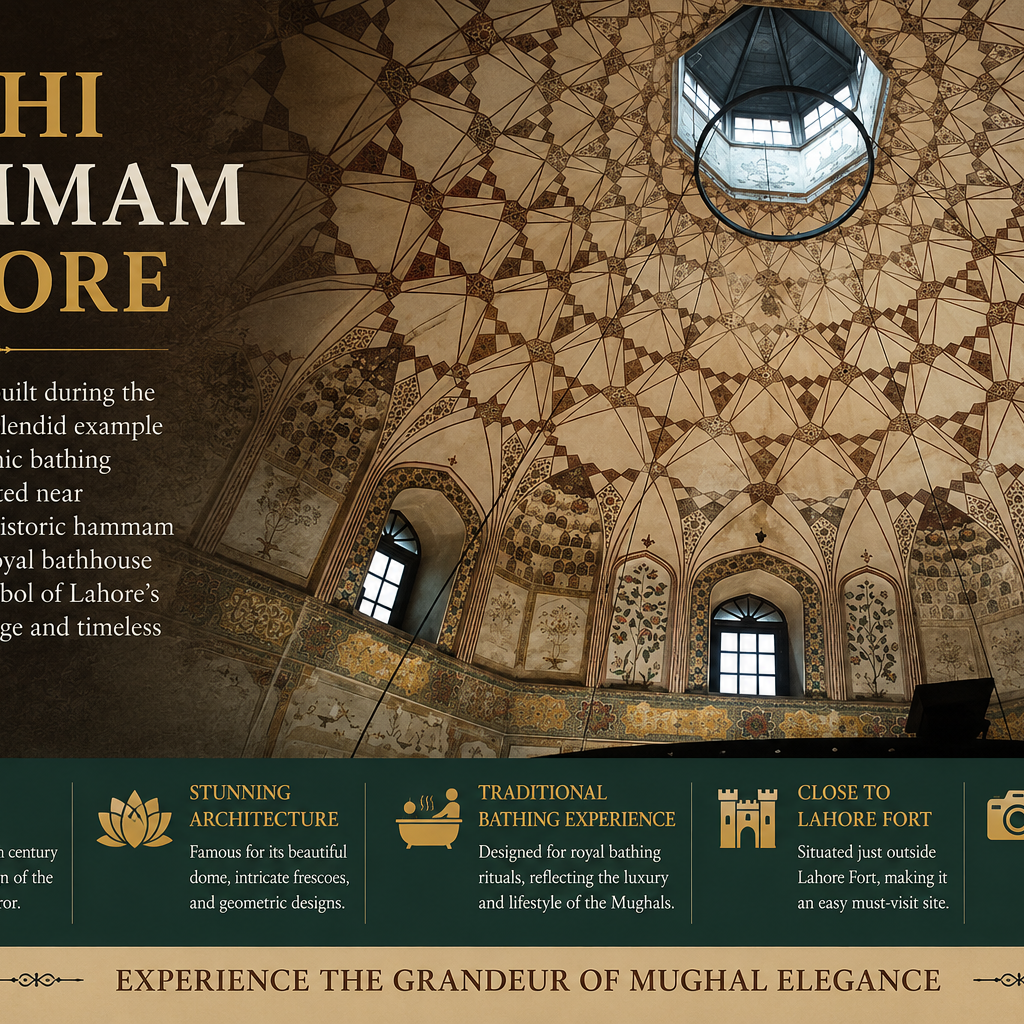
The decoration is the artistic glory of the baths. In keeping with Persian tradition, sunlight filtered through openings in the ceiling to light the rooms and aid ventilation. The main dome has an opening that lets in natural light. The walls and ceilings were decorated with Mughal frescoes. These feature floral patterns, vases of flowers, birds and other motifs, reflecting the Mughal love of flowers. The domes carry geometric designs. Much of this decoration survives and has been carefully preserved, making the baths a treasure of Mughal art.
Award winning restoration
The restoration of the Shahi Hammam is one of the great heritage success stories of the city. For many years the baths lay neglected, hidden behind encroachments and barely known as a site. The building was in a poor state, with no proper boundary and unclear access. The revival of the baths changed this completely.
The restoration was a major and careful effort. The Walled City of Lahore Authority removed dozens of encroachments from the site in 2012. The major conservation work then began in 2013. The Authority partnered with the Aga Khan Trust for Culture and the Royal Norwegian Embassy. Much of the funding came from the government of Norway. The work involved extensive excavation, digging down to the original waterways, drainage and heating systems.
The frescoes received special attention. Earlier uses of the building had covered many of the walls with whitewash. The conservation team removed this whitewash with careful chemical treatment to reveal the frescoes underneath. Fresco experts were brought in to work alongside the students of the National College of Arts. This trained local specialists in the craft of fresco restoration. The frescoes on the ceilings were renovated. Proper lighting was installed.
The results won international recognition. The work was completed in 2015. UNESCO awarded the project an Award of Merit in 2016. The award praised the high degree of technical skill and the return of the ornate baths to their former prominence. The renowned historian William Dalrymple described it as one of the best architectural restoration projects in the region. The restoration has become a model for the conservation of other heritage sites.
The setting in the old city
The Shahi Hammam is situated in a rich heritage setting within the Walled City of Lahore. It is situated just inside the Delhi Gate, one of the historic gates of the old city. This places the baths at the start of the royal route through the old city and among a remarkable concentration of Mughal landmarks.
The baths form part of an ensemble along the Royal Trail. This is the historic route, the Shahi Guzargah, that runs from the Delhi Gate towards the Lahore Fort. The Wazir Khan Mosque, built by the same patron, is situated close by along this trail. The Delhi Gate itself is steps away. The restoration of the baths was part of the wider revival of the Royal Trail and the old city. Together these monuments tell the story of Mughal Lahore.
The setting places the baths within a full circuit of the heritage of the old city. The Wazir Khan Mosque, the Sunehri Mosque, historic wells and old havelis all stand nearby within the Walled City. The great landmarks of the Lahore Fort and the Badshahi Mosque lie at the other end of the old city. This means a visit to the baths combines naturally with the mosque, the gate and a walk through the bazaars of the old city.
The baths add to the appeal and heritage of the old city. They offer a rare and intimate look at the daily life of the Mughal age, alongside the grander monuments of mosques and forts. The successful restoration has drawn visitors and added to the standing of the old city as a heritage destination. For anyone getting to know Lahore, the Shahi Hammam is one of the hidden gems that rewards a closer look at the old city.
Visiting the Shahi Hammam
The Shahi Hammam is one of the most rewarding smaller sites to visit in the old city. It offers an intimate encounter with Mughal daily life and art. It suits history lovers, students and anyone exploring the Walled City.
The baths are open to visitors, generally through the day and into the evening. The entry ticket is modest, with discounts often available for students and senior citizens. It is worth checking current timings and rates before visiting. Signposts inside, generally in both Urdu and English, help visitors understand how the baths worked. A small courtyard café offers a place to rest at the end of a visit. Visitors should take time to admire the frescoes and the uncovered bathing system.
The baths are reached through the Walled City near the Delhi Gate. They are accessible by car, taxi, rickshaw or ride hailing service to the edge of the old city. The narrow lanes mean the final approach is often on foot. Walking in along the Royal Trail from the Delhi Gate, past the shops of the old city, is part of the experience.
The cooler months from around October to March offer the most comfortable time to visit, making the walk through the old city more pleasant. The baths are an indoor site, so they can be enjoyed year round. A visit combines naturally with the Wazir Khan Mosque, the Delhi Gate and the wider old city. The Lahore Fort and Badshahi Mosque lie nearby too. Visitors are asked to respect the monument, avoid damaging its features and help keep it clean.
Places near the Shahi Hammam
The Shahi Hammam is situated within reach of many landmarks and useful places in the old city. This helps visitors plan a fuller trip. The Wazir Khan Mosque is situated close by along the Royal Trail. The Delhi Gate is steps away. The Sunehri Mosque and the bazaars of the old city are nearby. The Lahore Fort and the Badshahi Mosque lie at the other end of the Walled City.
Data Darbar, the shrine of Data Ganj Bakhsh, lies within reach. The Akbari Mandi, one of the largest wholesale markets in the city, is nearby. The Kashmiri Bazaar and the Azam Cloth Market lie close to the old city. Minar e Pakistan and the Greater Iqbal Park are a short distance away. Mayo Hospital, Sir Ganga Ram Hospital and the King Edward Medical University serve the central area. These connections make the baths an easy part of a tour of historic Lahore.
Frequently asked questions
Where is the Shahi Hammam located? The Shahi Hammam is situated just inside the Delhi Gate in the Walled City of Lahore. It is steps away from the gate, along the Royal Trail towards the Lahore Fort. The Wazir Khan Mosque is situated close by.
Who built the Shahi Hammam and when? The baths were built in 1635 during the reign of Shah Jahan. The governor of Lahore, Hakim Ilm ud din Ansari, known as Wazir Khan, commissioned them. He also built the nearby Wazir Khan Mosque. The baths were an endowment to support the mosque.
What was the Shahi Hammam used for? The Shahi Hammam was a public bathhouse for the people of the old city and for travellers. It offered facilities such as bathing, massage and steam. It also served as a waqf that supported the maintenance of the Wazir Khan Mosque.
Why is the Shahi Hammam famous? The Shahi Hammam is the last surviving Mughal era bathhouse in the city. It is famous for its Persian design, its Mughal frescoes and its award winning restoration. UNESCO gave the restoration project an Award of Merit in 2016.
When was the Shahi Hammam restored? The Shahi Hammam was restored between 2013 and 2015 by the Walled City of Lahore Authority and the Aga Khan Trust for Culture, with funding largely from the government of Norway. The work uncovered the frescoes and the original bathing system.
Can visitors go inside the Shahi Hammam? Yes. The baths are open to visitors, generally through the day, with a modest entry ticket and discounts often for students. Signposts explain how the baths worked. Some excavated areas are covered by protective glass for visitors to stand on.
The Shahi Hammam is one of the hidden treasures of the Walled City of Lahore and the last surviving Mughal era bathhouse in the city. Built in 1635 under Shah Jahan by the same patron as the Wazir Khan Mosque, it served travellers and locals who entered the old city through the Delhi Gate. Its Persian design, its ingenious heating system and its beautiful Mughal frescoes offer a rare glimpse into the daily life of the Mughal age.
The baths owe their present glory to one of the finest heritage restorations in the region. The careful work of the Walled City of Lahore Authority and the Aga Khan Trust for Culture revived the building and its frescoes, earning an Award of Merit from UNESCO. The baths sit among the great landmarks of the old city, along the Royal Trail near the Wazir Khan Mosque and the Delhi Gate. Whether you visit the Shahi Hammam for its history, its frescoes or the story of its remarkable restoration, it remains one of the essential smaller landmarks of Lahore and a window into the everyday world of the Mughals.