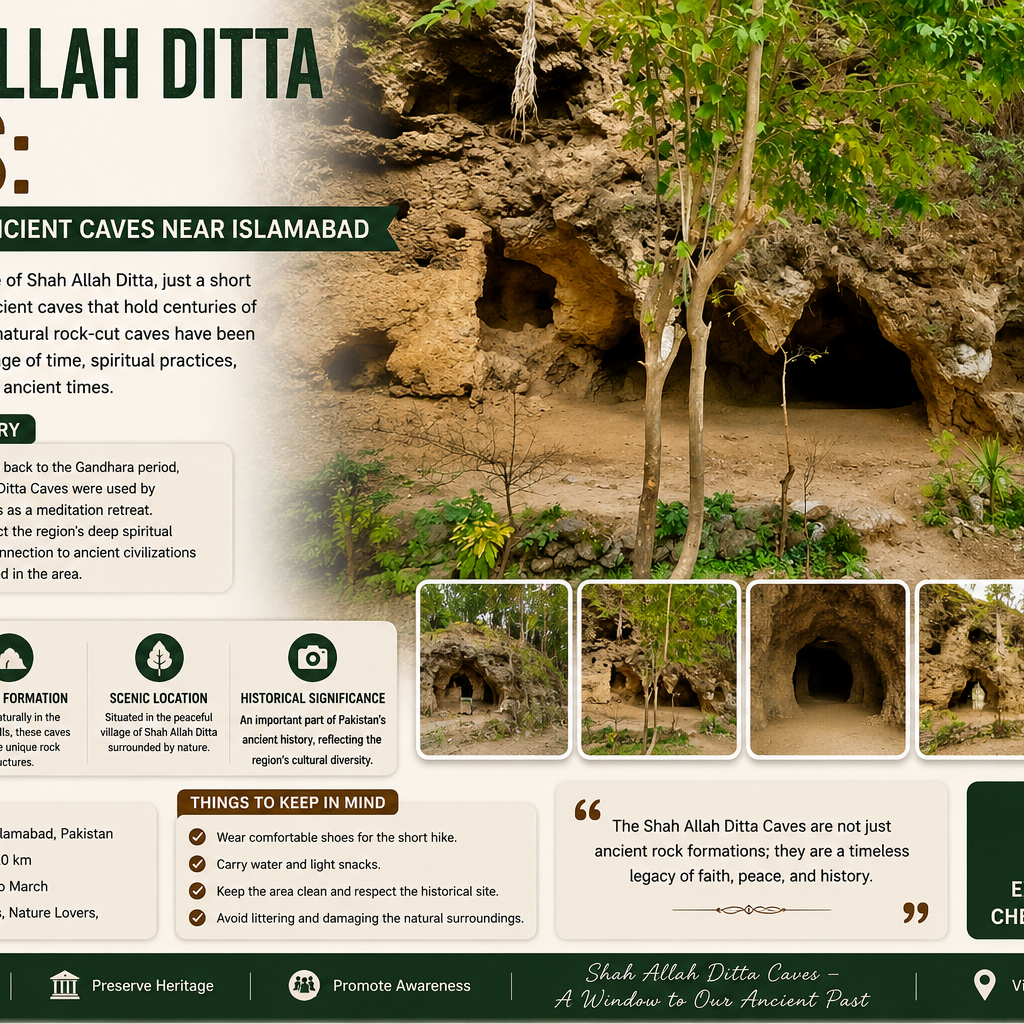
Shah Allah Ditta Caves: History of the Ancient Caves Near Islamabad
At the foot of the Margalla Hills on the western edge of Islamabad lies one of the oldest and most fascinating sites in the capital. The Shah Allah Ditta Caves is believed to be around 2400 years old situated beside a centuries old village on an ancient route once travelled by armies and traders. Carved into the rock and marked with old paintings the caves carry the layered history of Buddhist monks Hindu ascetics and Muslim mystics which make them a rare window into the deep past of the region.
This article explains what the Shah Allah Ditta Caves are their long history what there is to see and the area around them. Written for anyone getting to know Islamabad it covers both the caves themselves and their setting at the edge of the capital.
Shah Allah Ditta Caves
The Shah Allah Ditta Caves are an ancient archaeological site in the Margalla Hills on the western side of Islamabad next to the historic village of Shah Allah Ditta. The caves are believed to be around 2400 years old and they are among the most significant heritage sites in the capital.
The caves are carved into the rock at the foot of the hills and they carry traces of the different eras and faiths that used them. Old paintings and carvings on the cave walls point to their Buddhist past from the time when this region was part of the Gandhara civilisation a great centre of Buddhist learning and art. Over the centuries these caves were used by different communities which give them site a layered religious history.
The village beside the caves Shah Allah Ditta is one of the oldest settlements in the Islamabad area believed to be more than 700 years old. It is named after a Mughal era dervish a Sufi figure associated with the area. The village and the caves together form a heritage site that reaches back through many centuries of the region's history.
The site is situated on an ancient route of great historical importance. The path beside the caves was part of the route used to travel between Kabul and the Gandharan city of Taxila and it is associated with historical figures who passed through the region over the centuries. This position on a historic route adds to the significance of the caves.
Quick answer: The Shah Allah Ditta Caves are an ancient site in the Margalla Hills on the western edge of Islamabad believed to be around 2400 years old. Beside the centuries old village of Shah Allah Ditta the caves carry a Buddhist Hindu and Muslim heritage from the time of the Gandhara civilisation onwards.
History of the caves
The history of the Shah Allah Ditta Caves stretches back over two millennia making them one of the oldest sites in the Islamabad area. Archaeologists have estimated the Buddhist murals and relics in the caves to be around 2400 years old dating from the era when the region was a centre of the Gandhara civilisation.
The caves began as a place of Buddhist meditation and worship. During the Gandhara period this region flourished as a centre of Buddhist learning and art and the caves with their natural shelter and peaceful setting served as meditation cells and monastic dwellings for Buddhist monks. Carvings and murals from this era survive on the cave walls and remnants such as relics from around the eighth century point to this Buddhist past.
Over the centuries the caves passed through the hands of different communities. After the Buddhist era they came to be used by Hindu sadhus or ascetics for meditation and some of the surviving paintings and features reflect this Hindu phase. Later during the Mughal period Muslim ascetics took over the caves and the site became associated with the Sufi dervish Shah Allah Ditta after whom the village is named. This succession of Buddhist Hindu and Muslim use gives the caves their layered multi faith heritage.
The site's position on an ancient route added to its history. The path beside the caves was part of the old road between Kabul and Taxila travelled over the centuries by armies traders and rulers moving between Afghanistan and the subcontinent. Historical markers near the caves denote the significance of this route. This long history spanning faiths and empires is what makes the Shah Allah Ditta Caves such a remarkable site.
What there is to see in Shah Allah Ditta Caves
A visit to the Shah Allah Ditta Caves offers a mix of history heritage and natural beauty set at the foot of the Margalla Hills. The site rewards those interested in the deep past of the region and it is combined with a scenic and peaceful setting.
The caves themselves are the main attraction. Carved into the rock they contain the old carvings and murals that point to their Buddhist and later history. Visitors can explore the cave chambers some of which lead to smaller connected caves and see the traces of the different eras on the walls. The site conveys a sense of the meditation and worship that took place here over the centuries.
Around the caves the setting adds to the appeal. Huge ancient banyan trees stand near the caves believed to be of great age and historical significance and a water stream runs near the site. The village of Shah Allah Ditta with its own long history is situated beside the caves. Moving up the mountain from the caves there are further historical features including an old stepwell and the remains of an old mosque adding more layers to the heritage of the area.
The site also offers natural beauty and views. Set at the foothills of the Margalla Hills it is surrounded by greenery and the area offers panoramic views over the surroundings. Over the years recreational facilities have developed near the caves and restaurants on the nearby hills offer dining with views over the area. This combination of ancient heritage natural beauty and modern amenities makes the site a rewarding destination.
Conservation and preservation
Like many ancient sites the Shah Allah Ditta Caves have faced the challenges of age weather and development and their preservation has become an important concern. The centuries old murals and structures are fragile and they require careful conservation to survive.
The importance of the site has been recognised by the authorities. The Capital Development Authority approved a plan to preserve the caves and the adjacent garden known as Sadhu ka Bagh making it one of the heritage sites in Islamabad targeted for preservation alongside the historic Saidpur Village. The site was later declared a protected antiquity under the country's heritage laws and conservation efforts have continued with support and interest from various institutions.
Preserving the caves matters because they are a rare surviving example of the region's ancient Buddhist and multi faith heritage. The murals and relics are vulnerable to erosion weather and the pressures of development and tourism and ongoing care is needed to protect them. For visitors this means respecting the site not damaging the ancient features and helping to keep the area clean so that this window into the past survives for future generations.
Places near the Shah Allah Ditta Caves
The Shah Allah Ditta Caves sit on the western edge of Islamabad at the foot of the Margalla Hills in an area that combines ancient heritage with the growing city. The setting places the caves near several points of interest and connects them to the wider history of the region.
The most important nearby connection is to the ancient city of Taxila which lies on the other side of the Margalla Hills. Taxila was the great centre of the Gandhara civilisation and the Shah Allah Ditta Caves were part of the same cultural world linked by the ancient route that passed the caves. This connection places the caves within one of the most historically rich areas in the region. Other heritage sites of Islamabad such as Saidpur Village and the landmarks of the Shakarparian area are also within reach for those exploring the capital's history.
The caves are easily reached from the city a short drive of around 20 to 30 minutes from central Islamabad near Sector D 12. The main road through the village is generally good though roads further into the hills can be rougher so a suitable vehicle helps for exploring beyond the main site. There is no direct public transport so a private vehicle taxi or ride hailing service is the way to reach it.
For the wider area the caves sit close to some of Islamabad's newer and sought after residential sectors. Posh residential sectors such as D 12 and D 13 have developed at the foot of the Margalla Hills near the site valued for their position close to the hills and the greenery. This closeness to nature heritage and the edge of the city adds to the appeal of the western sectors of the capital. For anyone drawn to a home near the hills and history this part of Islamabad has a distinctive character and the ancient caves are one of the features that gives the area its identity. It is worth noting that the growth of housing near the hills has also raised the importance of protecting the heritage site.
Frequently asked questions
Where are the Shah Allah Ditta Caves located? The caves are at the foot of the Margalla Hills on the western edge of Islamabad next to the village of Shah Allah Ditta near Sector D 12. They are a short drive of around 20 to 30 minutes from central Islamabad.
How old are the Shah Allah Ditta Caves? The caves are believed to be around 2400 years old with the Buddhist murals and relics dating from the era of the Gandhara civilisation. The village beside them is thought to be more than 700 years old.
What is the history of the caves? The caves began as a Buddhist site for meditation and worship during the Gandhara period and were later used by Hindu ascetics and then by Muslim mystics during the Mughal era. This gives them a layered heritage spanning three faiths and many centuries.
What can you see at the Shah Allah Ditta Caves? Visitors can explore the rock carved caves with their old carvings and murals see the ancient banyan trees and water stream nearby and visit the historic village. Further up the hill are an old stepwell and the remains of an old mosque along with scenic views.
How do you get to the caves? The caves are reached by private vehicle taxi or ride hailing service as there is no direct public transport. The drive from central Islamabad takes around 20 to 30 minutes. The main village road is generally good though roads further into the hills can be rough.
Is there an entry fee for the caves? The Shah Allah Ditta Caves are generally free to visit though it is best to check for any current entry policies before a trip. Visitors are encouraged to respect the ancient site avoid damaging the heritage features and help keep the area clean.
The Shah Allah Ditta Caves are one of the most remarkable and least known treasures of Islamabad an ancient site that reaches back some 2400 years into the region's deep past. Carved into the rock at the foot of the Margalla Hills beside a village more than seven centuries old the caves carry the layered heritage of the Buddhist monks Hindu ascetics and Muslim mystics who used them over the ages.
For those getting to know Islamabad the caves offer a rare link to the ancient Gandhara civilisation and the historic routes that once passed through the region all within a short drive of the modern city. Their setting at the foot of the hills near the growing western sectors of the capital combines heritage with natural beauty and connects to the wider historical landscape of Taxila and the Margalla Hills. Whether you visit the Shah Allah Ditta Caves for their ancient history their multi faith heritage or their scenic surroundings they remain one of the most fascinating landmarks near Islamabad and a precious window into the long story of the land the capital now occupies.