Saint Thomas Church and Islamabad's Places of Worship
Islamabad is a planned capital and among its sectors and green spaces are situated places of worship serving communities of different faiths. The best known is the Faisal Mosque the national mosque but the capital is also home to churches such as Saint Thomas Church temples and a gurdwara at the historic Saidpur Village and revered shrines. Together these places of worship reflect the mix of communities that make up the city and the wider heritage of the region.
This article looks at Saint Thomas Church and the range of places of worship in Islamabad covering their history architecture and role as community and heritage landmarks. Written for anyone getting to know the capital it treats these sites as part of the city's fabric with respect for the communities they serve.
Saint Thomas Church
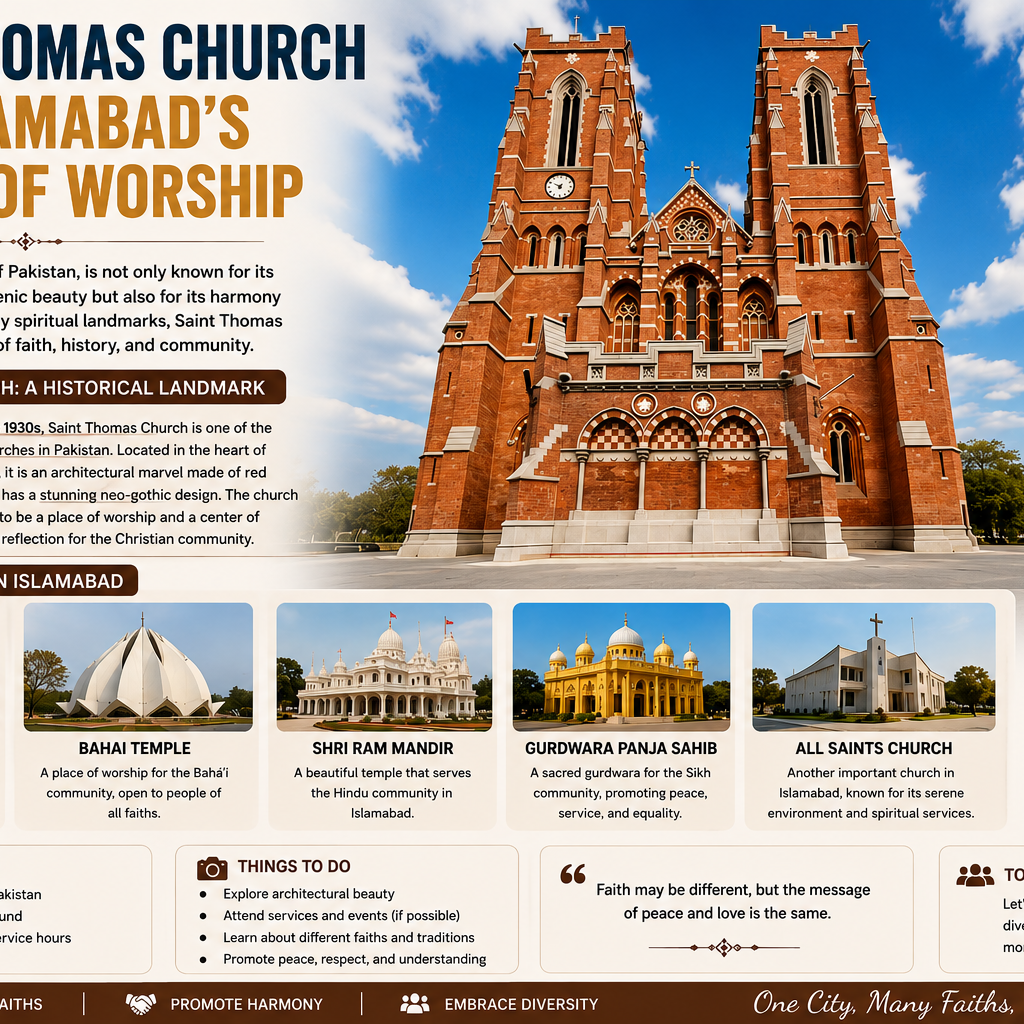
Saint Thomas Church is one of the main churches in Islamabad serving the Christian community of the capital. It is located on Hospital Road in Sector G 7 in a central part of the city and it is part of the Church of Pakistan the united Protestant church that brought together several denominations.
The church has a distinctive design. It is a warm red brick structure and rather than following the Victorian Gothic style of many older churches built during the colonial period it draws on traditional local brickwork and Mughal architectural influences. This gives it a character rooted in the region blending the function of a church with local building traditions. A large hall is situated beneath the church itself on the sloping site adding to its use as a community space.
The church was built in the early 1990s started in 1990 and completed in 1993. Its design was the result of research into how to create an appropriate architectural language for a church in the local setting moving away from imported styles towards something that reflected local practice and materials. The name honours Saint Thomas one of the disciples associated in tradition with early Christian activity in the wider region including the Taxila area.
As a working church Saint Thomas serves an active congregation holding services in both English and Urdu reflecting the mix of local and international worshippers in the capital. It functions as both a place of worship and a community centre for Islamabad's Christian population.
Quick answer: Saint Thomas Church is a main church in Islamabad on Hospital Road in Sector G 7 part of the Church of Pakistan. Built in the early 1990s it is known for its red brick design drawing on local and Mughal brickwork traditions and it serves an active congregation with services in English and Urdu.
Faisal Mosque: the national mosque
No account of Islamabad's places of worship is complete without the Faisal Mosque the national mosque of Pakistan and the most recognised landmark in the capital. Standing at the foot of the Margalla Hills its white tent shaped form is visible from much of the city.
The Faisal Mosque is one of the largest mosques in the world and the biggest in South Asia. Named after the late King Faisal of Saudi Arabia who supported the project it was designed by the Turkish architect Vedat Dalokay and completed in 1986. Its modern design shaped like a Bedouin tent with four tall minarets broke away from traditional mosque architecture and became an influential example of contemporary Islamic design.
The mosque is both a place of worship and a major attraction. Its main prayer hall holds around ten thousand worshippers with the courtyard and grounds able to accommodate many more during major occasions. Alongside the prayer hall the complex includes a library a lecture hall and other facilities. As the national mosque set against the green backdrop of the hills it is the spiritual and architectural centrepiece of the capital drawing both worshippers and visitors from across the country and beyond.
Temples and gurdwara of Saidpur Village
Islamabad's religious heritage reaches back centuries and nowhere is this clearer than at the historic Saidpur Village in the Margalla Hills. This centuries old village carries a layered heritage of different faiths still visible in its religious sites.
Before the partition of 1947 Saidpur was a place where Muslim Hindu and Sikh communities lived alongside one another and this is reflected in its buildings. The village is home to the Rama Mandir a small Hindu temple dating from the sixteenth century dedicated to the god Rama which was for centuries a place of Hindu pilgrimage. Beside it is situated a Sikh gurdwara built in the early twentieth century which served as a place of worship and a school for the teachings of Guru Nanak. A mosque and a Sufi shrine were also part of the village giving it a genuinely interfaith character.
After 1947 the Hindu and Sikh communities largely migrated and the temple and gurdwara ceased to be used for worship. Today these structures are preserved as part of the village's restored heritage following the conservation of Saidpur as a cultural site. They stand as reminders of the diverse religious history of the area and they are among the features that make the village such a distinctive heritage destination. For visitors they offer a window into the layered past of the region where communities of different faiths once worshipped side by side.
Shrines and Sufi heritage
Alongside its mosques churches and temples Islamabad is home to revered shrines that form an important part of its spiritual life. The most significant is the shrine of Bari Imam in the village of Nurpur Shahan at the foot of the Margalla Hills.
The Bari Imam Shrine is the resting place of Syed Abdul Latif Shah Kazmi a Sufi saint of the seventeenth century revered as the patron saint of the capital. Originally built during the Mughal era the shrine is one of the most visited spiritual sites in the region drawing large numbers of devotees especially during its annual urs festival. It reflects the tradition of Sufism that has shaped the spiritual life of the area for centuries and its free community kitchen embodies the values of hospitality associated with the shrine.
Other shrines and Sufi sites are found across the wider area part of a long tradition of Sufi devotion in the region. Together with the mosques these shrines form an important part of the religious heritage of the capital offering places of devotion and reflection alongside the more formal architecture of the national mosque.
A city of different communities
Taken together the places of worship of Islamabad reflect the mix of communities that make up the capital. As the seat of national government and home to a diplomatic community the city brings together people from across the country and the world and its religious sites serve this diverse population.
The mosques of the capital from the grand Faisal Mosque to the many neighbourhood mosques across the sectors serve the Muslim majority and are central to the daily life of the city. The churches such as Saint Thomas Church and others across the capital serve the Christian community holding services and acting as community centres. The preserved temples and gurdwara at Saidpur and the shrines across the area add further layers to this religious landscape reflecting both the present communities and the deep history of the region.
This mix is part of the character of Islamabad as a modern planned capital. The presence of places of worship for different faiths alongside one another in the same city reflects the diversity of the country and its capital. For residents and visitors alike these sites are not only places of devotion but also landmarks of heritage and community each telling part of the story of the city and the region.
Places of worship as landmarks
Beyond their religious role the places of worship of Islamabad are landmarks that shape the character of the capital and the areas around them. They are woven into the city's fabric from the iconic to the everyday.
The Faisal Mosque is the foremost example anchoring one of the most attractive parts of the capital at the foot of the Margalla Hills and defining the image of the city to the wider world. Its presence shapes the appeal of the prestigious northern sectors nearby. Saint Thomas Church and the other churches sit in central sectors serving their communities and adding to the mix of the city. The heritage sites at Saidpur and the shrine at Nurpur Shahan draw visitors and add to the cultural richness of the areas around the Margalla Hills.
For the character of the capital this range of places of worship adds depth and diversity. They reflect the communities that live in the city the history of the region and the planned nature of a capital built to serve the whole country. For anyone getting to know Islamabad these sites offer insight into both the present life and the deep past of the city and they are part of what gives the capital its distinctive character. The sectors near major landmarks such as the Faisal Mosque and the heritage sites of the Margalla Hills carry an appeal shaped in part by these places which form part of the identity of their surroundings.
Visiting the places of worship
For those wishing to visit Islamabad's places of worship a respectful approach is important as these are active places of devotion as well as landmarks. Each site has its own customs and expectations and visitors are encouraged to be mindful of them.
The Faisal Mosque is the most visited welcoming both worshippers and tourists. Visitors are generally welcome to view the courtyard and exterior outside prayer times with modest dress expected and shoes removed before entering the prayer areas. Saint Thomas Church and other churches hold regular services and as active congregations are best approached with respect for worship times; the churches have security arrangements as is common. The heritage temples and gurdwara at Saidpur are preserved as part of the village's heritage site and can be viewed as part of a visit to the village. The Bari Imam Shrine welcomes visitors and devotees with the same respectful approach expected.
The cooler months from around October to March are the most comfortable time to explore the capital and its landmarks. Many of these sites can be combined with other attractions since the Faisal Mosque Saidpur and the shrine at Nurpur Shahan all lie near the Margalla Hills. Approaching each with respect for its community and customs allows visitors to appreciate both the spiritual and the heritage significance of these places.
Quick answer: Islamabad's places of worship from the Faisal Mosque to Saint Thomas Church the heritage temples and gurdwara at Saidpur and the Bari Imam Shrine welcome respectful visitors. Modest dress and awareness of worship times are expected and many sites can be combined with other attractions near the Margalla Hills. The cooler months are ideal for visiting.
Frequently asked questions
Where is Saint Thomas Church located? Saint Thomas Church is on Hospital Road in Sector G 7 in a central part of Islamabad. It is part of the Church of Pakistan the united Protestant church and serves the Christian community of the capital.
When was Saint Thomas Church built? The church was built in the early 1990s started in 1990 and completed in 1993. Its red brick design draws on traditional local and Mughal brickwork rather than the Victorian Gothic style of many older colonial era churches.
What is the main mosque in Islamabad? The Faisal Mosque is the national mosque of Pakistan and the main mosque in Islamabad. Located at the foot of the Margalla Hills and completed in 1986 it is one of the largest mosques in the world and the most recognised landmark in the capital.
Are there temples and gurdwaras in Islamabad? The historic Saidpur Village in the Margalla Hills is home to a sixteenth century Hindu temple the Rama Mandir and a Sikh gurdwara from the early twentieth century. These are preserved as part of the village's heritage reflecting the area's diverse religious history though they are no longer used for worship.
Can visitors see the places of worship in Islamabad? Yes. The Faisal Mosque welcomes worshippers and respectful visitors the heritage temples and gurdwara at Saidpur can be viewed as part of the village and the Bari Imam Shrine welcomes visitors and devotees. Churches such as Saint Thomas are active congregations best approached with respect for worship times.
What places of worship reflect Islamabad's religious diversity? The capital is home to mosques including the Faisal Mosque churches such as Saint Thomas Church the preserved Hindu temple and Sikh gurdwara at Saidpur and Sufi shrines such as Bari Imam. Together these reflect the mix of communities and the deep religious heritage of the region.
The places of worship of Islamabad reflect both the communities that make up the modern capital and the deep religious heritage of the region. Saint Thomas Church with its distinctive local brickwork design serves the Christian community in the heart of the city while the Faisal Mosque is situated as the national mosque and the defining landmark of the capital.
For those getting to know Islamabad these sites offer insight into the character of the city from the grand architecture of the national mosque to the preserved temples and gurdwara at Saidpur that recall the interfaith past of the area and the revered shrines that continue the region's Sufi tradition. Together they form part of the fabric of the capital serving as places of devotion community and heritage. Whether you encounter them as a worshipper a visitor or someone getting to know the city the places of worship of Islamabad tell part of the story of a capital built to serve a diverse country and of a region with a religious history reaching back centuries.