Saidpur Village Islamabad: A Historic Village in the Margalla Hills
Saidpur Village is situated in a ravine in the foot of the Margalla Hills on the northern edge of Islamabad the capital. It is one of the oldest settlements in the area, with a history stretching back around five centuries. Today it draws visitors with its old buildings, cobbled streets, cultural sites and restaurants, set against the green backdrop of the hills.
This article explains what Saidpur Village is, its long history, what there is to see and the area around it. Written for anyone getting to know Islamabad, it covers both the village itself and its setting within the scenic Margalla Hills close to the capital.
Saidpur Village
Saidpur Village is a historic settlement in the Margalla Hills, within the Islamabad Capital Territory. It lies in a ravine near the Daman e Koh viewpoint, on the northern side of the city, tucked into the slopes of the hills that form Islamabad's green backdrop.
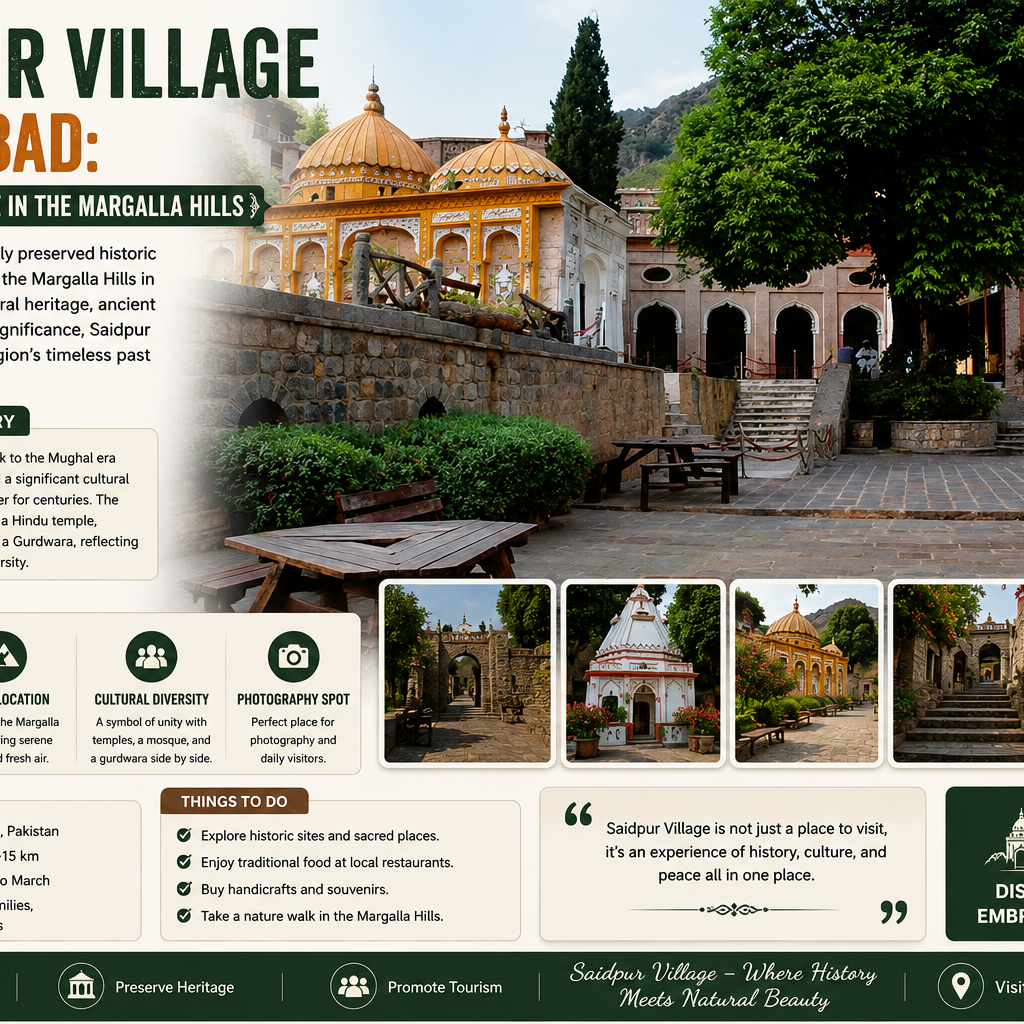
The village is known for its rich and layered heritage. Over its long history, it has carried the influence of Muslim, Hindu and Sikh communities and this mix is still visible in its buildings and religious sites. In Saidpur, there is a temple, a remnant of a gurdwara of Sikhs, and a mosque from the Mughal period which are found inside this village indicating the various ages and religions involved in the development of the village.
Saidpur is one of the oldest villages in this area and it is estimated that the village has been in existence for about 500 years. The village was formed during the time of the Mughal Empire and it served as a significant site for culture and religion. More recently, this village has been turned into a tourism spot by preserving its old form.
Currently, Saidpur has become a popular place visited not only by locals but also tourists from other countries because of its old architecture, art galleries, restaurants, and scenic view over the city and mountains.
Quick answer: Saidpur Village is a roughly 500 year old settlement in the Margalla Hills of Islamabad, near the Daman e Koh viewpoint. Known for its Mughal, Hindu and Sikh heritage, it has been restored as a cultural and tourist destination with old buildings, galleries and restaurants.
History of Saidpur Village
The history of Saidpur is long and layered, reaching back to the Mughal era. The village takes its name from Said Khan, a figure connected to the Gakhar chiefs of the Potohar region during Mughal times. The settlement was transferred to his family as a reward for their service and over time it came to be known as Saidpur.
The village has a notable connection to Mughal royalty. According to the historical record, Said Khan's daughter married the Mughal prince who later became Emperor Jahangir and the village was given to her as a wedding gift. Jahangir's own memoir mentions a stay at a place beyond Rawalpindi, believed to be Saidpur, on his way to Kabul. At that time, the village was a garden resort, with a natural spring providing water for drinking and irrigation.
Saidpur also has a deep religious history. In the late sixteenth century, it was developed as a place of Hindu worship, with ponds and temples built at the site. The village became a Hindu pilgrimage centre, home to a small temple dedicated to the god Rama, known as the Rama Mandir or Ram Kund Temple. For centuries, Hindus travelled to worship there and a fair was held each year at a nearby pond. The village was a place where Hindus, Sikhs and Muslims lived alongside one another, reflected in its temples, gurdwara and mosque.
The partition of 1947 brought major change. The Hindu and Sikh residents largely migrated and the village became a predominantly Muslim community, though the older religious structures remained. The temple ceased to be used for worship and for a time its building served other uses. In more recent decades, the character of the village shifted again as Islamabad was planned and built nearby, bringing the modern city to the edge of this ancient settlement.
Restoration of Saidpur
By the early 2000s, Saidpur was recognised as an important piece of Islamabad's heritage and steps were taken to restore and revitalise it. The Capital Development Authority led a major project to transform the village into a cultural and tourist destination while preserving its old core.
The village was declared an arts and crafts village and significant funds were spent on preservation and restoration. The work aimed to protect the centuries old buildings and character while adding modern amenities such as restaurants and exhibition spaces. Technical assistance was provided from abroad as part of the effort and the restored village opened to visitors, becoming one of the capital's cultural attractions.
The restoration turned Saidpur into a place where the past and present sit side by side. Old temples, the mosque and traditional houses were preserved, while galleries, cafés and restaurants brought new life to the streets. This blend of heritage and contemporary use is central to the village's appeal today, though maintaining the balance between preservation and commercial development remains an ongoing challenge.
What there is to see and do
Saidpur offers a mix of history, culture, food and scenery which is why it draws visitors from across the capital and beyond. A visit combines a walk through centuries of heritage with the pleasures of a scenic hillside village.
The historic sites are the heart of the village. The Rama Mandir, the old Hindu temple, is one of the main landmarks, along with the remains of the Sikh gurdwara and the Mughal era mosque with its red sandstone and decorative details. Walking the cobbled streets, visitors pass old buildings that reflect the Mughal, Hindu, Sikh and colonial layers of the village's past. A small museum in the village displays photographs and material on the history of the area and of Islamabad itself.
Beyond the historic sites, Saidpur has become known for its restaurants and cafés. Traditional Pakistani food is a major draw, with village style eateries offering an atmospheric dining experience against the backdrop of the hills. Art galleries and craft shops add a contemporary cultural layer and pottery and handicrafts, a traditional craft of the village, are available to buy.
The setting is part of the attraction. Saidpur is situated at the foot of the Margalla Hills and the views over Islamabad from the village are one of its pleasures. Walking trails lead up into the hills from the village and a Sufi shrine can be reached by a cobbled trail up a nearby slope. This combination of history, food, art and scenery makes Saidpur a well rounded destination for a half day or full day visit.
Rama Mandir and religious sites
Among the historic sites of Saidpur, the Rama Mandir is situated out as one of the most significant. This small temple, dedicated to the Hindu god Rama, dates back to the sixteenth century and is situated at the heart of the village's religious heritage. It is also known as the Ram Kund Temple, a name linked to the sacred pond associated with the site.
For centuries, the temple was an active place of Hindu worship and pilgrimage. According to old records, a fair was held each year at the nearby pond and Hindus travelled from across the region to worship at the temple, with an adjoining rest house providing lodging for pilgrims. The temple was part of a wider landscape of ponds and shrines built at the village which was regarded as a sacred site.
After the partition of 1947, the temple ceased to be used for worship and its idols were removed. For a period, the building served other purposes before being taken over as a heritage site. Today it is situated preserved as part of the village's restored heritage, one of the structures that tells the story of Saidpur's diverse religious past.
Alongside the temple, the village holds the remains of a Sikh gurdwara and a Mughal era mosque built of red sandstone with decorative detailing. Together, these three sites, from three different faiths, capture the interfaith character that defined Saidpur for much of its history. Walking between them, visitors can see how closely the different communities once lived and how their heritage has been preserved side by side.
Places near Saidpur Village
Saidpur is situated in the Margalla Hills on the northern edge of Islamabad, close to several of the capital's important places. This setting, at the meeting point of the historic hills and the modern city, adds to the village's appeal and makes it easy to combine with other viis situated.
The village lies near the Daman e Koh viewpoint, one of the most popular scenic spots in Islamabad which looks out over the city from the hills. The wider Margalla Hills National Park surrounds the area, offering trails and green space. The Faisal Mosque, at the foot of the hills, is also within easy reach, making it natural to combine a visit to the mosque and the village.
Saidpur is well connected to the rest of the capital despite its tucked away feel. It is a short drive from central Islamabad, reachable from the main sectors through the roads that lead up towards Daman e Koh. The Blue Area business district is only a short drive away and taxis and ride hailing services make access straightforward. Parking is available for visitors.
The village is situated close to some of Islamabad's most prestigious northern sectors, such as the F and E series which are among the most established and sought after areas of the capital. Their closeness to the Margalla Hills, Saidpur, Daman e Koh and the green spaces adds to their appeal and proximity to these historic and scenic places is part of what gives the northern part of the capital its character. For anyone drawn to a location close to nature and heritage, this side of Islamabad has a particular charm and Saidpur is one of the features that defines it.
Frequently asked questions
Where is Saidpur Village located? Saidpur Village is situated in a ravine in the Margalla Hills, on the northern edge of Islamabad, near the Daman e Koh viewpoint. It is a short drive from central Islamabad and the Blue Area, tucked into the slopes of the hills.
How old is Saidpur Village? This village has a historical timeline of approximately 500 years starting from the time of the Mughals. This village was initially set up in the time of the Mughals and then went on to develop as an important place of culture and religion.
What is Saidpur Village known for? Saidpur Village is known for its layered heritage with Mughal, Hindu and Sikh influences visible in its buildings. Landmarks include the Rama Mandir Hindu temple, a Sikh gurdwara and a Mughal era mosque. Today it is also known for its restaurants, art galleries and hillside setting.
What can you do in Saidpur Village? Visitors can explore the historic temples, mosque and old buildings, walk the cobbled streets, visit the small museum and art galleries, dine at traditional restaurants, buy pottery and handicrafts and enjoy views over Islamabad, with walking trails leading up into the Margalla Hills.
How do you get to Saidpur Village? The village is a short drive from central Islamabad, reachable through the roads leading up towards Daman e Koh. Taxis and ride hailing services are the easiest way to reach it and parking is available for those driving.
What places are near Saidpur Village? The Daman e Koh viewpoint, the Margalla Hills National Park and the Faisal Mosque are all nearby. The prestigious northern sectors of Islamabad and the Blue Area business district are within a short drive of the village.
Saidpur Village is one of the most atmospheric places in Islamabad, a settlement whose history reaches back around five centuries into the Mughal era. Tucked into a ravine in the Margalla Hills, it carries the layered heritage of the Muslim, Hindu and Sikh communities that shaped it, still visible in its temple, gurdwara and mosque.
For those getting to know Islamabad, the village offers a rare chance to step into the region's past while enjoying the scenery of the hills, the food of its restaurants and the work of its artists and craftspeople. Its restoration has given it new life as a cultural destination and its setting close to Daman e Koh, the Margalla Hills and the northern sectors of the capital makes it easy to reach and easy to enjoy. Whether you visit Saidpur for its history, its food, its art or its views, it remains one of the most distinctive landmarks of Islamabad and a living link to the long story of the area the capital now occupies.