Real Estate vs Gold vs Stocks: Best Investment in Pakistan Compared
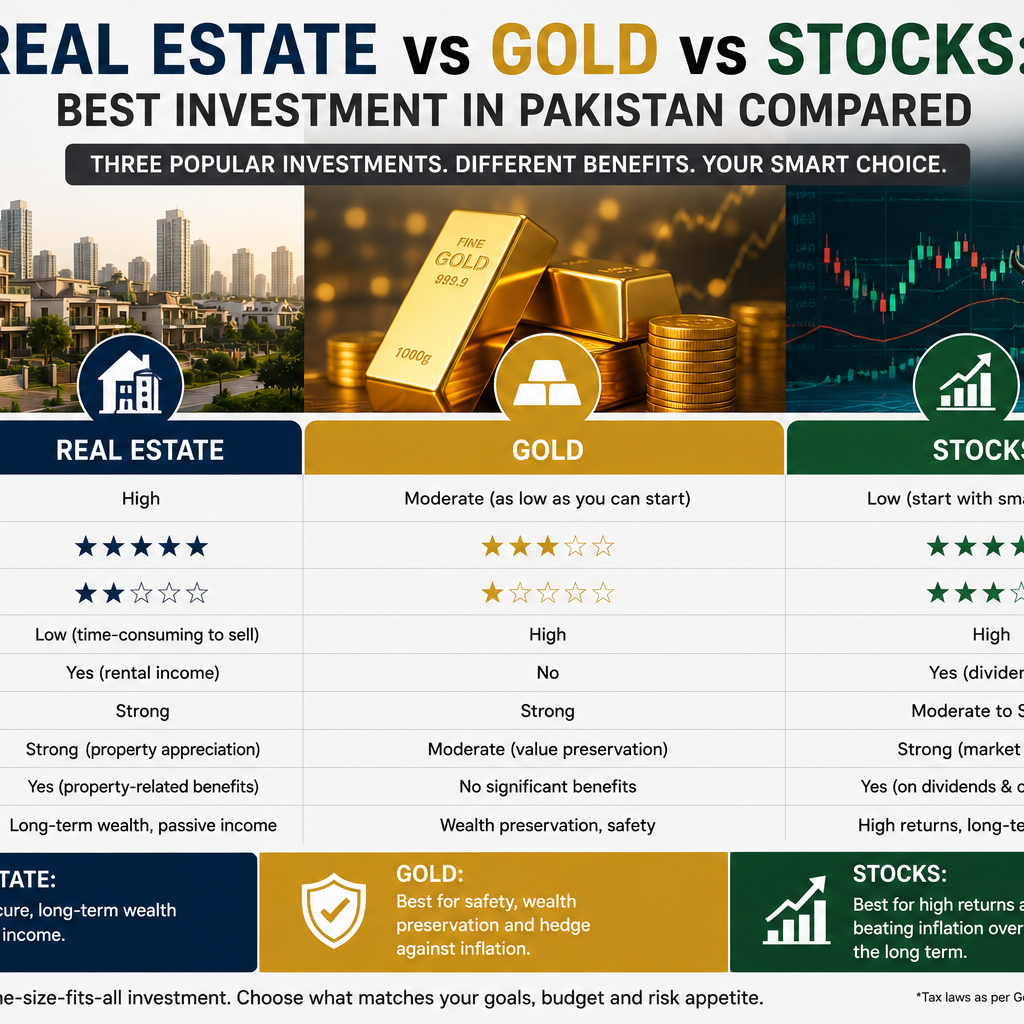
When people in Pakistan have money to invest, three options usually come to mind: property, gold and the stock market. Each has its supporters, its history and its own balance of risk and reward. Choosing between them is one of the most common financial questions families face.
There is no single right answer. The best choice depends on your goals, your timeline, how much money you have and how much risk you can carry. This guide compares the three honestly, so you can see how they differ and decide what suits your situation.
Why these three options dominate
Property, gold and stocks have long been the main places Pakistanis put their savings. Each became popular for a reason.
Property is a real, physical asset that has historically held value and protected against inflation. Gold has been trusted by most of the people for generations as a store of wealth and hold. Stocks offer a share in businesses and the chance of growth with the convenience of buying and selling quickly. Bank savings exist too, but they often struggle to keep pace with inflation, which is why many people prefer these three. Understanding what each offers is the first step to choosing well.
Real estate: the familiar favourite
Property is the most popular investment for many Pakistani families. Its strengths are real and so are its limits.
Property is tangible, which brings a sense of security. Over the long term, well chosen property in good locations has tended to hold and grow in value and it can produce rental income while you hold it. It also protects against inflation, since property prices have generally risen as the value of money has fallen.
The drawbacks are equally important. Property is not liquid, so you cannot always sell quickly when you need cash. It ties up large sums in a single asset, which concentrates risk. It demands research to avoid fraud and poor locations and it carries costs of buying, holding and selling.
Gold: the traditional store of value
Gold has been trusted in Pakistan for generations. Gold is easy to buy, even in small amounts which makes it accessible to anyone. It is liquid, since you can sell it quickly when you need money. It is portable and easy to store and it has held its value over long periods, often rising when the currency weakens. For protecting savings against inflation and currency loss, gold has a long record.
The weaknesses are clear too. Gold produces no income while you hold it, unlike a rented property or a share that pays a dividend. Its price can swing, rising and falling with global markets. Storing it safely brings a small worry, since physical gold can be lost or stolen. Gold preserves wealth well, but it does not work for you the way an income producing asset does.
Stocks: growth with higher risk
The stock market offers a share in businesses and the chance of growth. It is the least used of the three by ordinary families, partly because it is less understood.
Stocks are highly liquid, since you can buy and sell quickly during market hours. They require far less money to start than property, so a small investor can begin easily. Over the long term, a well chosen portfolio can grow well and many stocks pay dividends, giving income along the way. Stocks also spread risk if you hold several, rather than concentrating everything in one asset.
The risks are significant. Stock prices can be volatile because of rising and falling sharply which unsettles many investors. Success in stocks requires knowledge since picking good stocks and managing risk is a skill. A careless or unlucky investor can lose money. Stocks offer strong potential, but they demand learning and a steady temperament.
Comparing them on liquidity
Liquidity means how quickly you can turn an investment back into cash. This is where the three differ most sharply.
Stocks are the most liquid, sold within minutes during market hours. Gold is also liquid, since you can sell it quickly to a dealer. Property is the least liquid by far, often taking weeks or months to sell and a rushed sale usually means a lower price. If you may need your money quickly, property is risky, while gold and stocks give you far more flexibility. Match the liquidity to how soon you might need the funds.
Comparing them on income
Income means what the investment pays you while you hold it, separate from any rise in value. Here the three diverge again.
Property can produce rental income, giving a return while you hold it, though rental yields in Pakistan have often been modest against property values. Stocks can give dividends, providing income from the businesses you own a share in. Gold produces no income at all, since it simply sits and stores value. If you want your investment to pay you along the way, property and stocks offer that, while gold relies entirely on its price rising. Decide whether income matters to you, as it points towards one option or another.
Comparing them on the money needed to start
The amount of money required to begin differs greatly, which affects who can invest in what.
Property demands the largest sums, putting good property out of reach for many small investors, at least to begin with. Gold can be bought in small amounts, making it accessible to almost anyone. Stocks also need very little to start, so a modest budget can begin building a portfolio. For a small investor, gold and stocks open the door more easily than property. As wealth grows, property becomes more reachable. Your budget is a real factor in the choice.
Comparing them on risk
Each carries risk, but of a different kind. Understanding these differences helps you match an investment to your temperament.
Property risk centres on poor locations, fraud, illiquidity and a slow or stalled market. Gold risk lies mainly in price swings and the worry of storing it safely, though it rarely loses value over the long term. Stock risk is volatility and the danger of picking poorly without knowledge. Property and gold feel safer to many people because they are tangible, while stocks feel riskier because prices move visibly day to day. Yet a concentrated property investment in a bad location can be riskier than a spread of good stocks. Judge risk by the specifics, not just the type.
Comparing them on knowledge required
How much you need to know varies and this matters when choosing where to put your money.
Gold requires the least knowledge, since buying and holding it is straightforward. Property requires real research to choose locations, verify documents and avoid fraud, but it draws on familiar, common sense judgement about places and homes. Stocks require the most specialised knowledge, since picking businesses and managing a portfolio is a learned skill. Be honest about how much time you are willing to spend learning. An investment you do not understand is a risk in itself, whatever its type.
Spreading your money across all three
Many sensible investors do not choose just one. They spread their money across property, gold and stocks, balancing the strengths of each.
This approach reduces the risk of relying on any single asset. Property offers long term growth and rental income on the other hand gold offers liquidity and protection against inflation and currency loss. Stocks offer growth and income with easy access. Together they cover different needs and cushion. Spreading your money is not always possible for small investors, but as wealth grows, a balanced mix is often steadier than betting everything on one.
How they perform over different time periods
The three options behave differently over short and long periods and your timeframe should shape your choice.
Over short periods, stocks and gold can swing sharply, rising or falling within months, which makes them risky for money you need soon. Property moves more slowly, but it too can stay flat or dip for a while. Over long periods, all three have rewarded patient investors, though in different ways. Property and stocks have offered growth, while gold has chiefly preserved value against inflation. If you are investing for many years, you can ride out the swings of stocks and gold and the slow patches of property. If your horizon is short, the steadier, more liquid options deserve more weight. Be honest about how long you can leave the money invested.
Think about your own temperament
Beyond the numbers, your own temperament matters. An investment that keeps you awake at night is the wrong one, whatever its returns.
Some people cannot bear watching prices swing and the daily movement of stocks would unsettle them. Others find comfort in a tangible asset like property or gold that they can see and hold. Some are happy to learn and take more risk for higher reward. Know yourself before you choose. An investor who panics and sells at the wrong moment loses more than one who picks a steadier option and holds calmly. The best investment for you is one you can hold through good times and bad without losing your nerve.
Matching the choice to your goals
The best investment is the one that fits your situation, not the one that performs best in the abstract. Ask yourself a few questions.
How soon might you need the money? If soon, lean towards gold or stocks for their liquidity. Do you want income while you hold? Property and stocks offer it. How much do you have to start? Gold and stocks suit small budgets, property suits larger ones. How much risk and effort can you handle? Each option demands a different amount. Your answers point clearly towards the right balance for you. There is no universal best, only the best for your goals.
Final thoughts
Property, gold and stocks each have a real place in a Pakistani investor's choices and none is simply better than the others. Property offers tangible, long term growth and rental income, but ties up large sums and sells slowly. Gold offers liquidity and protection against inflation, but pays no income. Stocks offer growth, income and easy access, but demand knowledge and a steady nerve.
The wisest approach for many is not to choose one and ignore the rest, but to understand what each offers and build a balance that fits your goals, timeline and means. Match the investment to your situation, spread your risk where you can and invest only money suited to each option's nature. Do that and you put your savings to work sensibly, whichever mix you choose.