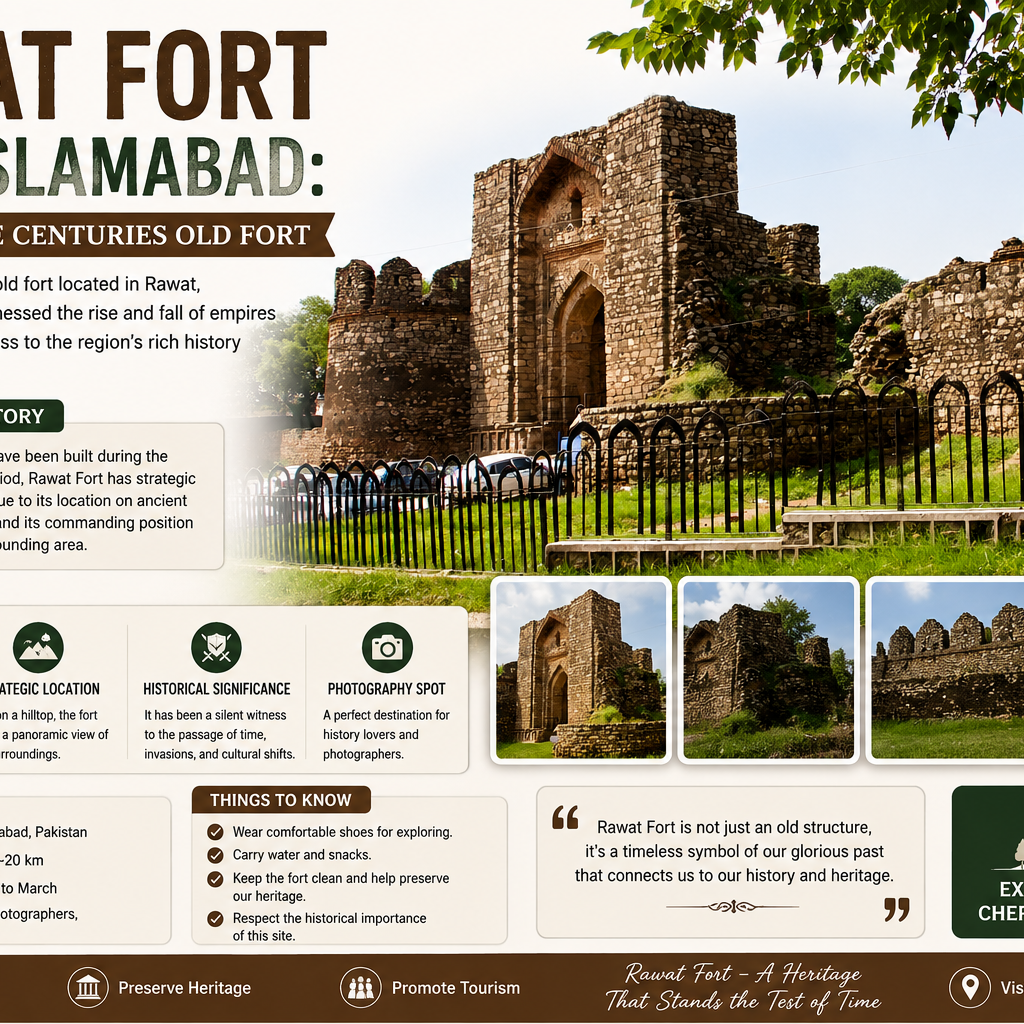
Rawat Fort Near Islamabad: History of the Centuries Old Fort
Rawat Fort is situated on the Grand Trunk Road, on the Pothohar Plateau just east of Rawalpindi and close to Islamabad. It is one of the oldest historical sites in the area, a centuries old fortified caravanserai with a story of trade, war and the powerful local tribe that once ruled the region. For anyone interested in the history around the capital, it is a landmark worth knowing.
This article explains what Rawat Fort is, its long history, its architecture and the area around it. Written for anyone getting to know Islamabad and its surroundings, it covers both the fort itself and its setting on the historic Pothohar Plateau.
Rawat Fort
Rawat Fort is an early fortified caravanserai on the Pothohar Plateau, near the city of Rawalpindi and close to Islamabad. It is situated on the Grand Trunk Road, the ancient route that has carried travellers and armies across the region for centuries, about 17 to 18 kilometres east of Rawalpindi.
The fort's name comes from the Arabic word for a caravanserai, an inn built to shelter travelling caravans and merchants. This reflects its original purpose. It was a resting place on the trade route providing lodging for the caravans that passed along the Grand Trunk Road before it became a fort. Over time, it was fortified and took on a military role.
The fort is nearly square in shape, with high stone walls enclosing a large central courtyard. Inside, it holds a mosque, small chambers that once housed merchants and a number of graves, including a notable tomb. The structure is built of stone and lime mortar, in a plain but powerful style suited to its role as both an inn and a defensive stronghold.
Today, Rawat Fort is situated as a quiet reminder of the past of region. It is a one of the many historical relics scattered across the Pothohar Plateau. Though often overshadowed by larger and grander forts, it holds an important place in the history of the area around the capital.
Quick answer: Rawat Fort is a centuries old fortified caravanserai on the Grand Trunk Road, on the Pothohar Plateau near Rawalpindi and close to Islamabad. Originally an inn for travelling caravans, it was fortified by the local Gakhar tribe and is known for its mosque, courtyard and the tomb of a Gakhar chief.
History of Rawat Fort
The history of Rawat Fort reaches back several centuries and it is a story tied to trade, tribal power and the wars of the sixteenth century. The fort is believed to have been founded as a caravanserai in the fifteenth century, an inn on the Grand Trunk Road for the caravans and merchants who travelled the route. Some accounts suggest it may have been built atop an even older structure from the Ghaznavid era.
The fort's most significant chapter came in the sixteenth century, when the local Gakhar tribe fortified the caravanserai. The Gakhars were a powerful warrior clan who ruled the Pothohar Plateau are known for building forts across the region. They were loyal supporters of the Mughals and they strengthened the structure to defend the plateau against the forces of Sher Shah Suri, the Afghan ruler who challenged Mughal power.
This loyalty led to a dramatic and tragic event. The Gakhar chief Sultan Sarang Khan, who ruled the Pothohar region in the first half of the sixteenth century, resisted the Suri forces. According to the accounts, a battle took place around the fort in the mid 1540s, in which Sultan Sarang Khan and a number of his sons were killed defending their ground against Sher Shah Suri's army. The graves in the fort's courtyard are traditionally linked to the chief and his sons who died in that fight.
The wider struggle left another famous mark nearby. Sher Shah Suri built the mighty Rohtas Fort, some distance away, specifically to subdue the Gakhar tribe and bring the region under his control. The two forts, Rawat and Rohtas, stand as reminders of that conflict. After the Mughal period, Rawat Fort passed through other hands, being used by the Sikhs and later coming under the British. Over the centuries, it changed from a busy inn on the trade route to a quiet historical relic.
Architecture of Rawat Fort
The architecture of Rawat Fort reflects its dual role as both a caravanserai and a defensive stronghold. It is a plain but solid structure, built for function rather than decoration which gives it a distinctive character among the historical sites of the region.
The fort is almost square in plan, with high stone walls enclosing a large central courtyard. It has gateways on its sides and along the inside of the walls run small chambers or cells. These rooms once served the fort's original purpose as an inn, providing lodging for the travelling merchants and caravans that stopped here on their journeys along the Grand Trunk Road.
The western wall is dominated by a three bay mosque, each bay topped by a dome. The archways along the front of the mosque are a notable feature and the structure is one of the more decorative parts of the fort. This mosque is considered an important example of its kind in the region.
The most prominent feature inside the fort is the octagonal tomb, traditionally believed to be linked to Sultan Sarang Khan, the Gakhar chief. The tomb is built in stages, with an octagonal base supporting a drum that carries a low dome and it has entrances on its sides with deep recessed archways. Around it, the courtyard holds a number of graves associated with the chief and his sons. Together, the mosque, the tomb, the chambers and the courtyard make up a complex that tells the story of both the fort's everyday role and its dramatic history.
Restoration of Rawat Fort
Like many historical sites, Rawat Fort has faced the challenges of time, neglect and encroachment from the growing settlements around it. There have been attempts in recent times to conserve and reconstruct the fort since it has been identified as an essential element of the heritage of the region.
The administration of the fort has been transferred from one authority to another in time past, and there have been some instances where the monument was subjected to invasion and neglect. However, in recent times, the Department of Archaeology and Museums has embarked on the conservation of the fort by reconstructing some parts of it including the merchant cells and the mosque. This is done to ensure that the fort is protected.
It is important to mention here that Rawat Fort is one of the forgotten gems in the history of the twin cities which has remained unexplored despite being very close to the capital. It was endangered by the houses and stores that had been erected nearby.
Places near Rawat Fort
Rawat Fort is situated on the Pothohar Plateau, on the edge of the Islamabad Capital Territory and close to Rawalpindi, in an area rich with history and well connected to the twin cities. Its location on the Grand Trunk Road places it near several important places and makes it easy to reach.
The most notable nearby historical site is the Mankiala Stupa, an ancient Buddhist monument that can be seen from the roof of the fort's mosque. This adds another layer of history to the area, showing the depth of the region's past. Further afield, the great Rohtas Fort, connected to the same sixteenth century conflict, lies some distance away and is a major heritage site in its own right.
The fort is very accessible. It is situated close to the Grand Trunk Road, just off the highway and is only a short drive from the Islamabad Expressway. This places it within easy reach of both Islamabad and Rawalpindi. The Rawat area itself has grown into a busy town and the fort is situated close to the southeastern edge of the capital territory.
For the wider area, Rawat Fort is situated near the growing developments on this side of the twin cities. The DHA area of Islamabad is nearby and the Rawat area connects to the main routes linking the capital to Lahore and other cities. As Islamabad and Rawalpindi continue to grow and as more people settle on this side of the twin cities, the fort's location near major roads and expanding neighbourhoods gives it renewed relevance. For anyone drawn to a location with history close at hand, the area around Rawat has a character shaped by its long past and the fort is one of the landmarks that defines it.
Frequently asked questions
Where is Rawat Fort located? Rawat Fort is situated on the Grand Trunk Road, on the Pothohar Plateau, about 17 to 18 kilometres east of Rawalpindi and close to Islamabad, near the southeastern edge of the Islamabad Capital Territory. It is a short drive from the Islamabad Expressway.
How old is Rawat Fort and who built it? The fort is believed to have been founded as a caravanserai in the fifteenth century, possibly atop an older structure. It was fortified in the sixteenth century by the local Gakhar tribe to defend the Pothohar Plateau against the forces of Sher Shah Suri.
Why is Rawat Fort historically important? It is tied to the sixteenth century conflict between the Gakhar tribe, loyal to the Mughals and Sher Shah Suri. The Gakhar chief Sultan Sarang Khan and a number of his sons are said to have died defending the area and their graves lie in the fort's courtyard.
What can you see at Rawat Fort? The fort has high stone walls around a large courtyard, gateways, small chambers that once housed merchants, a three bay domed mosque and an octagonal tomb traditionally linked to Sultan Sarang Khan, along with a number of graves. The ancient Mankiala Stupa can be seen from the fort.
Can you visit Rawat Fort? Yes. The fort is accessible just off the Grand Trunk Road and a short drive from the Islamabad Expressway. Govt has done conservation work in recent years and is open to visitors who are interested in history and heritage.
What places are near Rawat Fort? The ancient Mankiala Stupa is close by and visible from the fort. The great Rohtas Fort lies further away, connected to the same history. The fort is near the growing Rawat area, the DHA area of Islamabad and the main routes linking the twin cities.
Rawat Fort is one of the hidden historical treasures near Islamabad, a centuries old caravanserai turned fortress that has stood on the Grand Trunk Road through the rise and fall of empires. Its plain stone walls hold a dramatic story, from its origins as an inn for travelling caravans to its role in the sixteenth century struggle between the loyal Gakhar tribe and the forces of Sher Shah Suri.
For those getting to know Islamabad and its surroundings, the fort offers a direct link to the deep history of the Pothohar Plateau, with its mosque, its courtyard and the tomb of the Gakhar chief who died defending it. Recent conservation efforts have helped protect the site and its location near the growing Rawat area and the main routes of the twin cities gives it a place in both the past and the present. Whether you visit Rawat Fort for its history, its architecture or simply to see one of the oldest landmarks near the capital, it remains a quiet but powerful reminder of the long story of the land around Islamabad.