Ranikot Fort: The Great Wall of Sindh
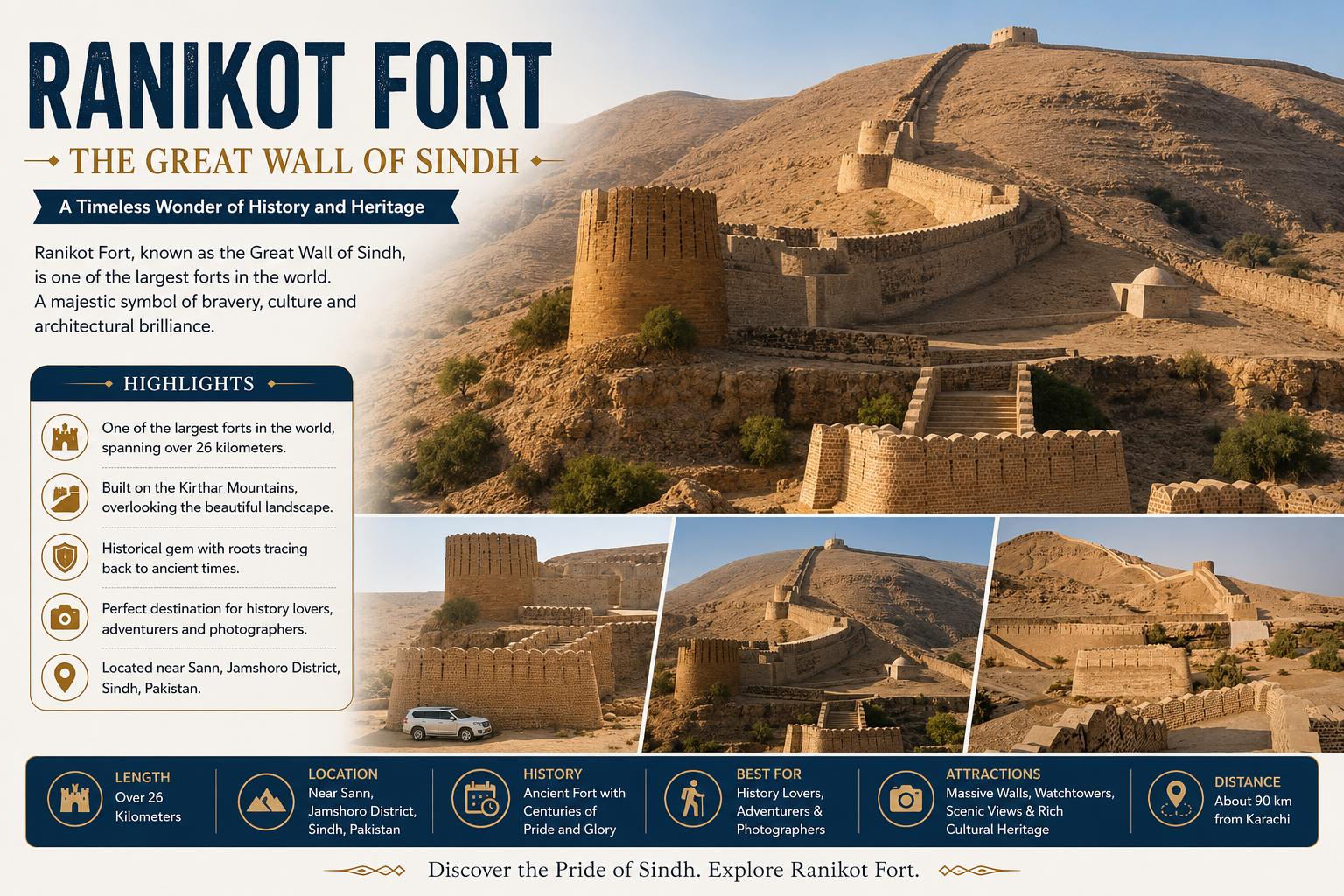
Ranikot Fort is one of the most extraordinary monuments in the country. It is a vast rampart winding for tens of kilometres. Its walls cross the bare hills of the Kirthar range. Many call it the Great Wall of Sindh. It is widely held to be among the largest forts in the world. Nobody knows who first built it or why. This guide covers Ranikot for the curious traveller. It explains the history, the mystery, the gates, the inner forts and how to visit.
This guide offers a general overview to help you plan a visit.
Quick answer: Ranikot Fort is a huge historic fort near Sann in the Jamshoro district of Sindh. It lies about ninety kilometres north of Hyderabad. Its walls run for roughly thirty kilometres around the hills. This has earned it the name of the Great Wall of Sindh. It has a reputation as one of the largest forts in the world. It holds four main gates and three inner forts, including Miri and Shergarh. The origins are disputed. It has been on the tentative World Heritage list since 1993.
About Ranikot Fort
Ranikot ranks among the largest forts in the world. Its walls run for roughly thirty kilometres around the hills. This scale has earned it a great reputation. Estimates of the exact circumference vary between sources. The scale is astonishing whichever figure is right.
The fort is called the Great Wall of Sindh. Its winding ramparts follow the ridges and contours of the Kirthar hills. Observers have often compared them with the Great Wall of China. This comparison has given the fort its popular name.
The fort has heritage recognition. Ranikot has been on the tentative World Heritage list since 1993. National law protects it as a historical site. It remains far less visited than its scale deserves.
Great mystery of Ranikot
Nobody knows who built Ranikot. The original builders and the purpose remain unknown. This uncertainty is the great puzzle of the site. This mystery has fascinated historians for generations.
Scholars have proposed many origins. Various theories attribute the fort to the Bactrian Greeks or the Sassanian Persians. The Scythians and Arab governors of the early Islamic period also feature. These theories all remain unproven.
The Talpur period shaped what we see. Much of the visible structure dates from rebuilding in the 19th century. It happened under the Talpur dynasty. Nawab Wali Muhammad Leghari led the work. This restoration covered the Sann Gate complex, the southern walls and the small inner fort.
The purpose is equally puzzling. The fort encloses bare hills that seem never to have held a large population. It guards no obvious city or route. Writers have long remarked on a fortress that appears to defend nothing.
Walls, the gates and the inner forts
The walls follow the natural contours. Builders raised the fortification wall of gypsum and lime cut sandstone. It follows the natural contours of the hills. Solid semi circular bastions punctuate it at intervals. The natural rock formation serves as the defence on the northern side. Walls enclose the other three sides.
The fort has four main gates. Ranikot holds the Sann Gate, the Mohan Gate, the Amri Gate and the Shah Pere Gate. Most visitors enter through the Sann Gate on the eastern side. The walls there are among the best preserved.
Miri is the fort within the fort. It is a small fortress around three kilometres from the Sann Gate. It is believed to have held the royal quarters of the Mirs. Parts of it survive well. This inner fort is the easiest to explore and a popular spot for camping.
Shergarh crowns the heights. It is the third stronghold of the complex. It occupies a high point in the Kirthar hills. It is visible from Miri. Reaching it requires a full day and a hard climb. Few visitors make the journey.
Canyons and the Pond of Fairies
The Mohan Gate leads into the canyons. The track becomes a walking route beyond the gate. It passes through rolling canyons and seasonal rain streams. This walk is one of the highlights of a visit. The rocks can be slippery.
Villagers live within the walls. The local Gabol villagers make their homes inside the fort. They have long relied on its streams for water. Their presence makes Ranikot a living place. Be respectful of their homes and privacy.
The Pond of Fairies lies deep inside. A walk of a few kilometres beyond the Mohan Gate leads to a green pool. Locals know it as Pariyan jo Tar. Folklore holds that fairies visit the pool under a full moon. The water is deep and the pebbles slippery.
Visiting Ranikot
The fort lies near Sann in Jamshoro. Ranikot is around ninety kilometres north of Hyderabad. You reach it from the Indus Highway near Sann. A rough link road follows. The guide to Jamshoro covers this in more detail. Sann also has a railway station.
A sturdy vehicle is essential. The link road and the tracks inside the fort are rough. A four wheel drive is strongly recommended for exploring the full site. Some visitors camp overnight near Miri with guides.
Come in the cooler months. The area is hot, dry and exposed. The cooler months from November to February are by far the best time to visit. Carry plenty of water, sun protection and sturdy shoes. A local guide is a great help on the tracks.
Frequently asked questions
Where is Ranikot Fort located? Ranikot Fort is located near the town of Sann in the Jamshoro district of Sindh. It lies around ninety kilometres north of Hyderabad. You reach it from the Indus Highway near Sann. A rough link road of about twenty kilometres runs into the Kirthar hills. Sann also has a railway station on the line north from Kotri. A four wheel drive vehicle is strongly recommended for the approach.
Why is Ranikot called the Great Wall of Sindh? Its ramparts wind for roughly thirty kilometres across the ridges of the Kirthar hills. Observers have often compared this sight with the Great Wall of China. The scale is extraordinary. The fort is widely held to be among the largest in the world. Estimates of the exact circumference vary between sources. Every figure places it among the giants.
Who built Ranikot Fort? Nobody knows for certain who first built Ranikot Fort or why. This is the great mystery of the site. Various theories attribute it to the Bactrian Greeks or the Sassanian Persians. The Scythians and Arab governors of the early Islamic period also feature. None of these is proven. Much of the visible structure dates from rebuilding in the 19th century under the Talpur dynasty. Nawab Wali Muhammad Leghari led that work.
What is there to see at Ranikot Fort? The main sights are the great walls with their semi circular bastions. The four gates and the inner forts reward exploration. Miri lies around three kilometres from the Sann Gate. It is thought to have held the royal quarters and is the easiest to explore. Shergarh occupies the high hills and needs a full day. A walk beyond the Mohan Gate leads through the canyons to the Pond of Fairies.
When is the best time to visit Ranikot Fort? The best time falls in the cooler months from November to February. The weather is comfortable then for walking and climbing. The area is hot, dry and exposed. Summer visits can be dangerous in the midday heat. Carry plenty of water whenever you go. Wear sturdy shoes and sun protection. Travel in a four wheel drive with a local guide who knows the tracks.
Fortress that guards nothing
Ranikot Fort is one of the great enigmas of the country. It is a rampart of gypsum and sandstone winding for tens of kilometres across empty hills. It guards no city. It serves no purpose that anyone has yet explained. The site offers the well preserved Sann Gate and the royal quarters of Miri. The distant heights of Shergarh and the green pool hidden in the canyons add to the appeal. Its scale, its silence and its unsolved history make it unforgettable.
You may come to Ranikot for its extraordinary walls, its mystery or the adventure of reaching it. This is one of the most remarkable places in Sindh either way. You can walk the ramparts for a view across the Kirthar hills. You can explore the quarters of Miri. You can follow the canyon path to the Pond of Fairies. You can camp beneath the stars too. You reach it from the Indus Highway near Sann. Visit in winter and see a fortress on a scale few can explain.