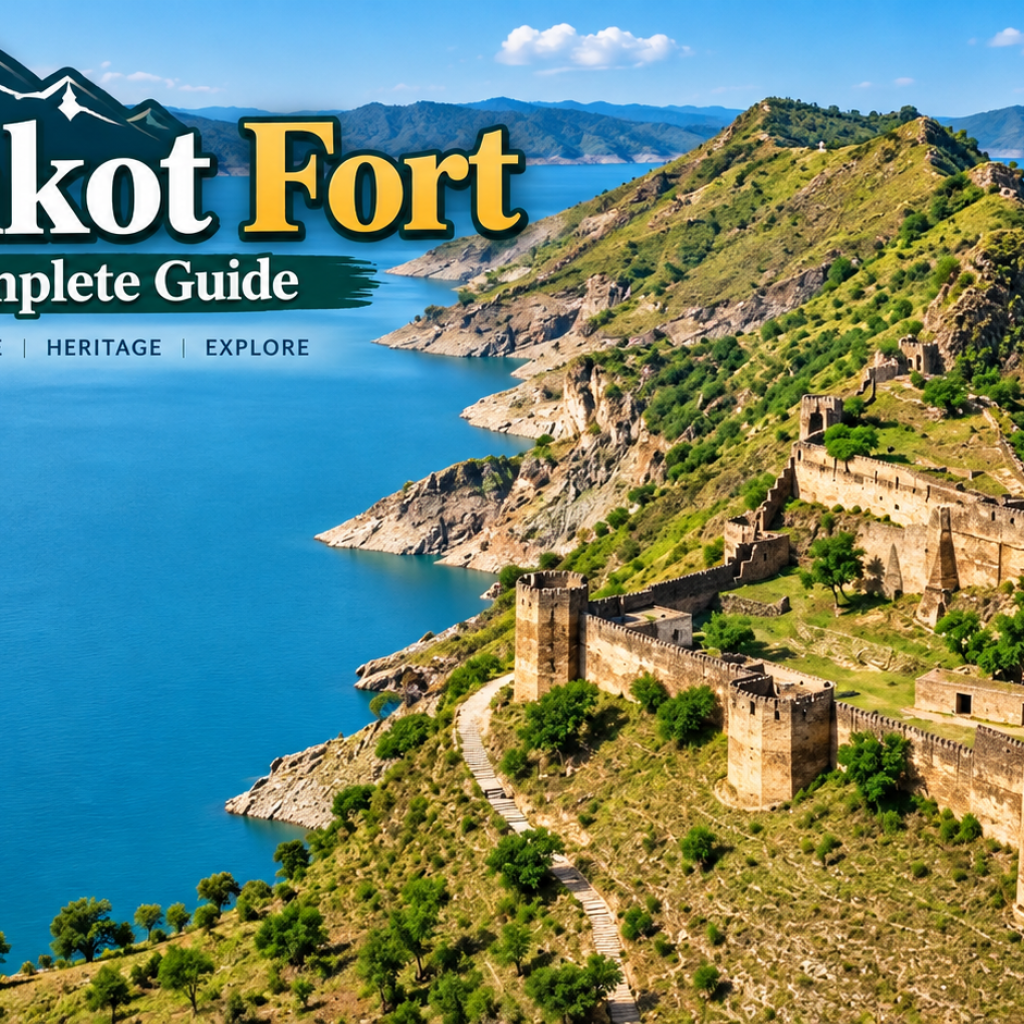
Ramkot Fort: A Complete Guide
Ramkot Fort is one of the most dramatic historic sites in all Azad Kashmir. A medieval fortress rises on a hilltop above the blue Mangla Lake. Water rings the fort on three sides in a stunning setting. A boat ride and a steep climb of stairs reach its gate. Centuries of history and sweeping views reward every visitor. This guide covers Ramkot Fort for the curious traveller. It explains the fort, its builders the rivers the design the boat trip and the ruins.
This guide offers a general overview. Details and figures vary between sources.
Quick answer: Ramkot Fort is a medieval hilltop fort near Mirpur in Azad Kashmir, set on a peninsula above Mangla Lake, opposite New Mirpur City. Built by the Muslim rulers of Kashmir in the 16th and 17th centuries, it guarded the meeting point of the Jhelum and Poonch rivers, rising over an even older site. Its ramparts hold thick walls a single well defended gate and sweeping views. Reached by a boat ride across the lake and a steep climb of stairs, it is now largely in ruins. A rewarding heritage trip, it is best visited in spring and autumn.
Ramkot Fort: A fort above the water
A fort above the water, Ramkot crowns a lonely hill. Blue lake rings the base. Old walls rise on top. So the setting stuns the eye.
A hilltop perch marks the fort. It is located above Mangla Lake. Steep slopes fall to the water. So the site commands the view.
A lonely spot marks Ramkot. Few visitors make the trip. Quiet rules the old walls. So the fort keeps its calm.
A grand sight marks the fort. Rivers wrap the green hill. Blue water shines below. So the scene rewards the climb.
Built by the rulers of Kashmir
Built by the rulers of Kashmir the fort guarded old borders. They raised it long ago. Strong walls held the frontier. So the fort served its age.
A Muslim rule marks the build. Old rulers of Kashmir raised it. They worked in the 16th century. So the fort dates from then.
A border aim marks the fort. It guarded the old boundaries. Watchmen scanned the rivers. So the walls held the line.
A shared style marks the design. Mangla and Muzaffarabad match it. All three rose in one age. So the forts form a family.
Ramkot Fort: A fort ringed by rivers
A fort ringed by rivers holds a natural moat. Water guards three sides. Cliffs fall to the rivers. So the site defied attack.
A river guard marks the fort. Jhelum water wraps the hill. Its Poonch branch joins near. So two rivers ring the base.
A confluence spot marks the place. Two rivers meet below. A peninsula holds the fort. So water shields the walls.
A steep cliff marks the sides. Rock falls sharp to the water. Few could scale the slopes. So the height aided defence.
Design and defences of Ramkot Fort
Design and defences reveal a fortress of war. Thick walls ring the top. One gate guards the way. So the fort stood ready.
A single gate marks the fort. One entrance guards the walls. Sloped rock protects the door. So the design foiled attack.
A war feature marks the walls. Loopholes served the musket. Openings held the cannon. So the fort met its foes.
A water tank marks the yard. A store held the supply. A raised plinth bore a hall. So the fort could hold out.
Reaching the Ramkot fort by boat
Reaching the fort by boat forms a memorable trip. A boat crosses the lake. Stairs climb the steep hill. So the journey rewards effort.
A boat ride marks the start. It leaves from the Mangla club. A short trip crosses the water. So the lake opens the way.
A steep climb marks the hill. Hundreds of stairs rise up. Good fitness eases the way. So the top tests the legs.
A grand reward marks the summit. Wide views open all around. Blue water encircles the fort. So the climb repays itself.
Ruins and restoration
Ruins and restoration frame the fort today. Time has worn the walls. Vegetation cloaks the stone. So the site needs great care.
A worn ruin marks the fort. Walls and towers still stand. Decay creeps through the stone. So the years have taken a toll.
A wild growth marks the walls. Plants climb the old stone. Neglect has left its mark. So nature reclaims the fort.
A hope of repair marks the site. Restoration would save it. Care could bring back its glory. So the fort awaits help.
Frequently asked questions
What is Ramkot Fort known for? Ramkot Fort is known as one of the most striking historic forts in Azad Kashmir, famous for its dramatic setting on a hilltop above Mangla Lake, near Mirpur. It is celebrated for its position on a peninsula, ringed by the waters of the Jhelum River on three sides. Sweeping views open over the lake and surrounding hills. Built by the Muslim rulers of Kashmir several centuries ago, it is admired for its old walls, single defended gate and military design. An added thrill the journey by boat and steep climb of stairs boost its appeal as a memorable heritage destination.
Who built Ramkot Fort and when? Ramkot Fort, in its present form is generally believed to date from the Muslim rulers of Kashmir in the 16th and 17th centuries. They raised a number of forts to secure their boundaries. In style and design it closely resembles the Mangla and Muzaffarabad forts, built in the same era. A far older place the site itself has yielded relics from nearby excavations dating back many centuries, showing that the hilltop was occupied in ancient times. Later rulers made further additions to the defences. This long history gives the fort a deep sense of the past.
How do you get to Ramkot Fort? Reaching Ramkot Fort is an adventure in itself as the fort rests on a hill surrounded by water on three sides. A popular route takes a boat ride from the water sports club at Mangla. It crosses the lake for around ten to fifteen minutes to reach the foot of the hill. From there a steep climb of several hundred stairs leads up to the main gate of the fort. A lakeside site the fort is located opposite New Mirpur City. While some land routes exist the boat journey across the lake is by far the most scenic and popular approach.
Is Ramkot Fort worth visiting? Of course, it is well worth seeing Ramkot Fort for everyone who enjoys exploring history and nature. The fort may be in ruins at present, but the spectacular location on the hill with picturesque blue lake surrounding the fort from all sides makes Ramkot Fort unforgettable. It is amazing how beautiful one can see everything from there. It is a real adventure because one can feel an adventurer going on a journey by boat and then climbing to the fort. The site is rather remote, so it is a good place for rest and peace away from noisy places.
When is the best time to visit Ramkot Fort? A fine window runs through the milder seasons of spring and autumn, roughly March to April and October to November. At that time the weather is pleasant for the boat ride and the climb. During these months the days are comfortable the scenery is green and the lake looks its best. Summers around Mirpur can be very hot, making the steep climb tiring, while winters are cooler though still workable. For the most enjoyable experience the spring and autumn months are ideal, offering good weather and clear views over the lake and surrounding hills.
Ramkot: Crumbling giant of Mirpur
Ramkot Fort is the crumbling giant on the hills above Mangla Lake. A medieval fortress rises on a hilltop over the blue water. Rivers ring the fort on three sides in a stunning setting. A boat ride and a steep climb of stairs reach its gate. Centuries of history and sweeping views reward every visitor. Few sites hold so dramatic a setting as this one.
You may come for the history the boat trip or the views. This crumbling giant rewards the curious traveller. You can cross the blue lake by boat to the foot of the hill. You can climb the long stairs to the old fortress gate. You can gaze over the water and hills from the ramparts. Come to know Ramkot Fort and its dramatic heritage. This is the crumbling giant of Mirpur.