Plot vs House: Which Is the Smarter Investment?
Every property investor in Pakistan faces this question sooner or later. Should you buy a plot of land or a built house? Both can grow your money, but they behave very differently and the right choice depends on what you want from the investment.
There is no single answer that fits everyone. A plot suits one investor's goals, while a house suits another's. This guide compares the two honestly, weighing the advantages and drawbacks of each, so you can decide which fits your situation.
The basic difference
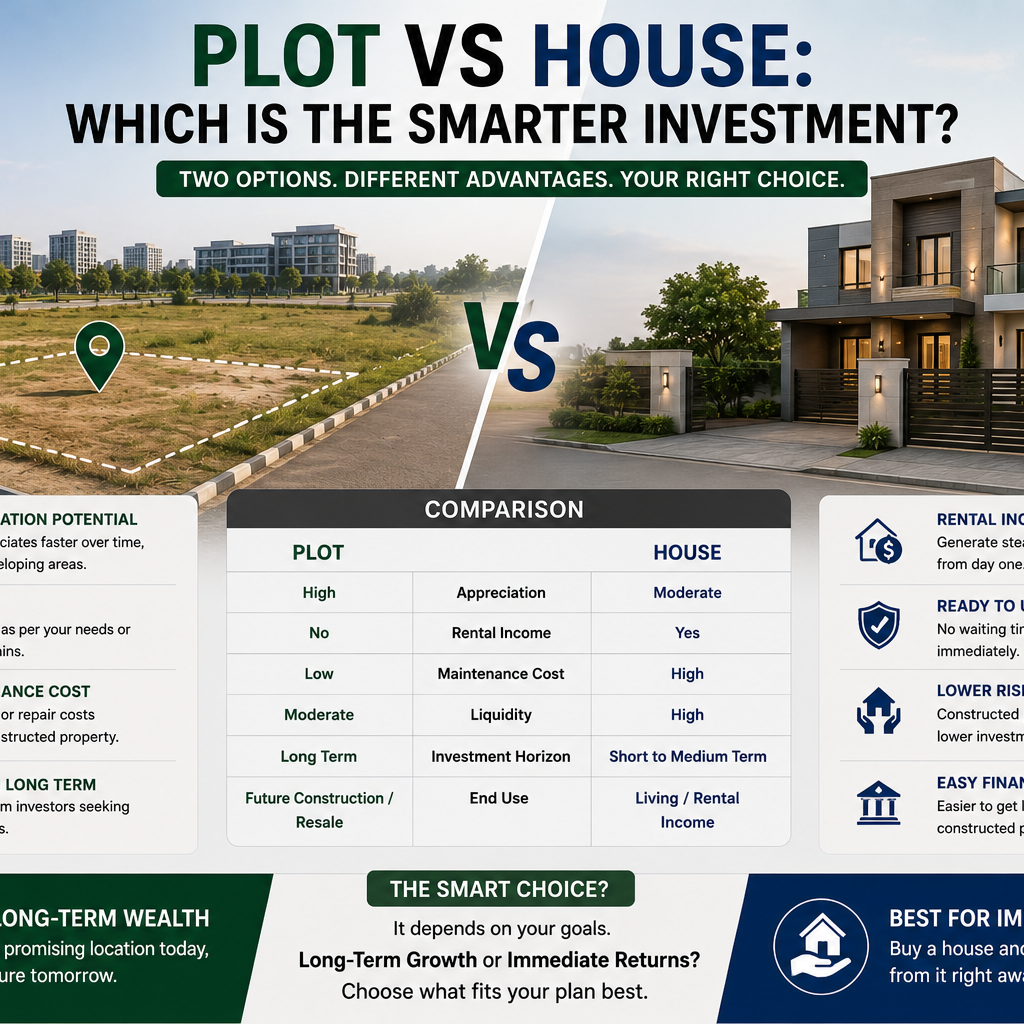
A plot is a piece of land with no building on it. Its value depends entirely on the land itself: its location, size and the demand for it. It earns nothing while you hold it and your return comes only when you sell at a higher price.
A house is land with a building on top. It can earn rental income while you hold it and its value reflects both the land and the construction. It also needs upkeep and brings the responsibilities of ownership. These differences shape everything else, so keep them in mind as we compare the two.
The case for buying a plot
Plots have long been a favourite investment in Pakistan and for good reasons. They suit investors focused on long term growth.
A plot is simpler to own. There is no building to maintain, no tenant to manage and no wear and tear to repair. You buy it, hold it and sell it. Plots in good, developing areas have historically risen well in value as the area matures and demand grows. They also require less ongoing money than a house, since there are no repairs or tenant costs. For an investor with patience and no need for income along the way, a plot can be an efficient way to grow capital.
Plots are also often easier to buy into at a range of budgets, since you can find land at many price levels, including in newer, more affordable developments.
The drawbacks of a plot
Plots are not without their problems and these deserve equal attention. The biggest is that a plot earns nothing while you hold it.
Your money sits idle, producing no income, until you sell. If the market is slow, you may wait years for the value to rise, with nothing coming in during the wait. Plots in new, undeveloped areas carry the risk that the promised development never fully arrives, leaving the plot worth little. Bare land can also attract encroachment or disputes if not watched. And a plot sold as a file, before any development, carries the risk that the actual plot never materialises. These risks make careful selection essential.
The case for buying a house
A house offers something a plot cannot: income while you hold it. This changes the whole nature of the investment.
A rented house produces regular rental income, giving you a return even when the market is flat. This cushions you against slow periods and can cover some of the costs of ownership. A house also serves a practical purpose, since you or your family could live in it, which a plot cannot do. In a strong location, a well built house combines rental income with the prospect of rising value, offering two ways to benefit rather than one.
For investors who want their money to work while they hold it, a house has clear appeal that a plot lacks.
The drawbacks of a house
A house brings more responsibility and more cost than a plot and these must be weighed honestly.
A house needs maintenance. Repairs, upkeep and the wear of time all cost money over the years. If you rent it out, you take on the work of finding and managing tenants, dealing with their needs and handling any disputes. A house also ties up more money than a plot in the same area, since you pay for the construction as well as the land. And an older house may add little value above the land, since a buyer might plan to rebuild. These factors make a house a more demanding investment.
How the two compare on returns
Investors often ask which grows faster. The honest answer is that it varies and neither always wins.
A plot's return depends entirely on price growth, which can be strong in a rising area but absent in a slow one. A house offers price growth plus rental income, but the rental return in Pakistan has often been modest against the property's value and the costs of upkeep eat into it. In a fast rising area, a well chosen plot can outperform. In a flat market, a house at least pays rent while you wait. The better performer depends on the specific property, the location and the market over your holding period.
How the two compare on effort
The two investments demand very different amounts of work and this matters more than many investors expect.
A plot is low effort. Once bought, it largely looks after itself, needing only occasional attention to guard against encroachment or disputes. A house is high effort, especially when rented. Tenants, repairs and upkeep all take time and attention, year after year. If you want a hands off investment, a plot fits better. If you are willing to manage a property in exchange for income, a house suits. Be honest about how much involvement you want before you choose.
How the two compare on liquidity
Liquidity means how easily you can turn the investment back into cash when you need it. Both plots and houses can be slow to sell, but they differ.
A house has a narrower pool of buyers, since it must suit someone's specific needs, which can make it slower to sell. On the other hand, a house in a strong residential area with steady demand can also find buyers readily. Neither is as liquid as cash or gold, so plan to hold either for the long term rather than counting on a quick sale.
The option to build on a plot later
One advantage of a plot is flexibility. You can hold it as it is or build on it later when your means and plans allow. This middle path suits some investors well.
Buying a plot and then constructing house on it in the future lets you spread the cost over time. You secure the land at today's price, then add the building when you are ready. By the time you build, the land may have risen in value and you end up with a house worth more than your total spending. This route requires patience and careful planning and construction brings its own costs and risks. But for an investor who cannot afford a finished house today, a plot with the option to build later is a sensible way to reach the same goal in stages.
Keep the costs of each in mind
The full cost of owning a plot and a house differs and this affects which is the smarter investment for you. Look beyond the purchase price.
A plot carries lower ongoing costs, since there is no construction to maintain, though it may have development charges or society dues. A house carries the cost of upkeep, repairs and, if rented, the expenses of managing tenants. Both involve taxes and charges on buying and selling. An older house may also need money spent to keep it desirable. Weigh these ongoing costs, not just the price, when comparing the two. A plot's lower running cost can suit an investor who wants to tie up money with minimal further outlay, while a house's costs are offset by the rent it earns.
Matching the choice to your goals
The smarter investment is the one that fits your goals, not the one that sounds best in general. Ask yourself what you want from the money.
If you want long term growth, have patience, prefer low effort and do not need income along the way, a plot may suit you. If you want income while you hold, are willing to manage a property and value the option of living in it, a house may be the better fit. Your budget, your timeline and your appetite for involvement all point towards one or the other. There is no universally smarter choice, only the choice that matches your situation.
The importance of location for both
Whichever you choose, location decides the outcome. This rule holds equally for plots and houses.
A plot in a well located, approved, developing area stands a strong chance of rising in value. A plot in a poor or risky location can sit idle for years. A house in a strong residential area with good demand rents well and holds its value. A house in a neglected area struggles on both counts. The choice between plot and house matters, but it matters less than choosing a good location. A poor location undermines either investment.
Balanced approach
Some investors do not choose only one. As their means allow, they hold both a plot for long term growth and a house for income, spreading their risk across the two.
Balanced approach is not possible for everyone, especially smaller investors who can only afford one property. But it is worth keeping in mind. A mix gives you the growth potential of land and the income of a rented house, while reducing reliance on either alone. As your wealth grows, holding both can make for a steadier overall position than putting everything into a single type.
Final thoughts
The choice between a plot and a house is not about which is better in the abstract, but about which is better for you. A plot offers simplicity, low effort and long term growth, but earns nothing while you hold it. A house offers rental income and a practical use, but demands more money, effort and upkeep.
Match the choice to your goals, your budget and how much involvement you want. Above all, choose a good location, since that matters more than the plot or house decision itself. Whether you pick land or a built home, careful selection and patience are what turn a property into a smart investment. Decide what you want from your money first and the right choice between the two becomes much clearer.