Pharwala Fort Near Islamabad: A Forgotten Historical Landmark
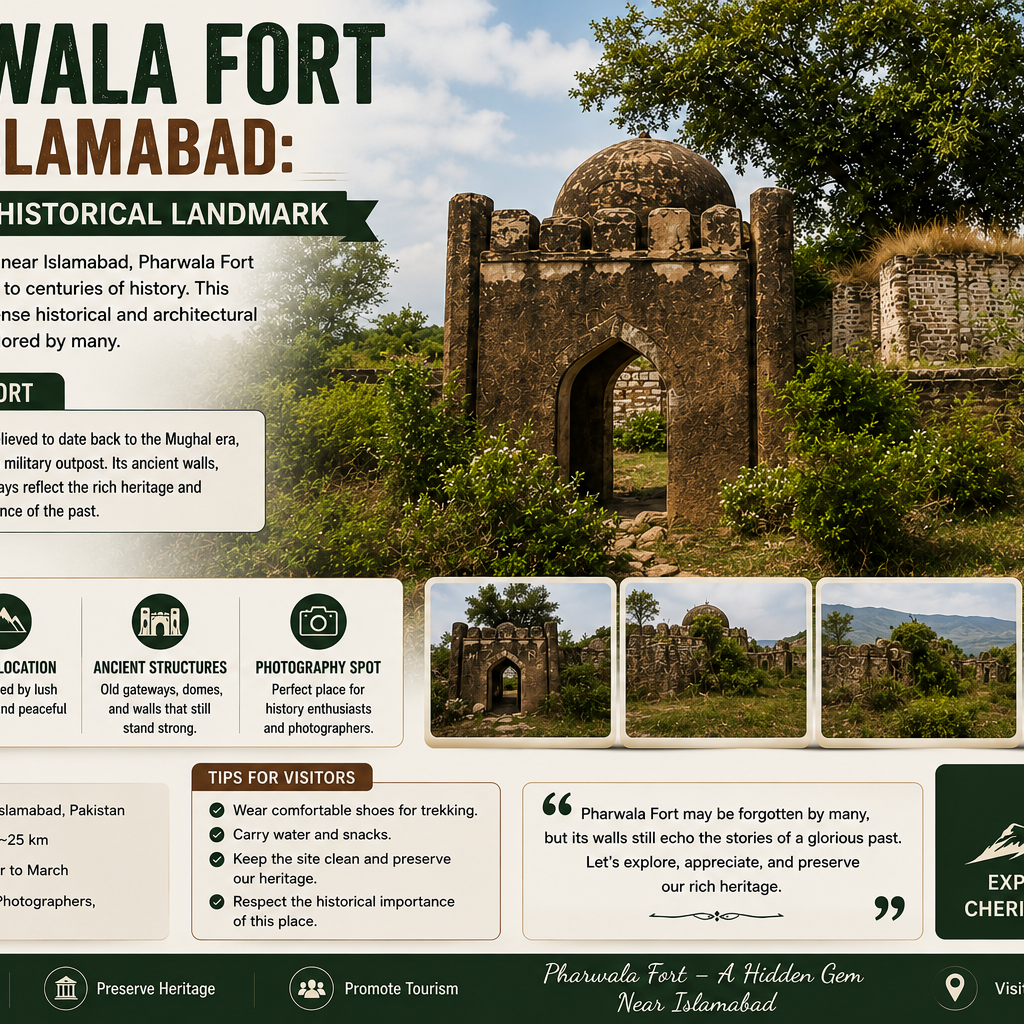
Pharwala Fort is situated in the hills of the Kahuta area, on the edge of the Islamabad Capital Territory, guarded by a range of hills on one side and the Soan River on the other. It is one of the oldest and most legendary forts in the region, once the stronghold of the powerful Gakhar tribe. For centuries it was thought almost impossible to capture and its ruins still carry the story of the clan that ruled the Pothohar Plateau.
This article explains what Pharwala Fort is, its long history, its architecture and the area around it. Written for anyone getting to know Islamabad and its surroundings, it covers both the fort itself and its setting in the historic hills near the capital.
Pharwala Fort
Pharwala Fort is an ancient hill fort in the Kahuta area, within the Islamabad Capital Territory, some distance southeast of Rawalpindi. It is situated in a naturally defended position, protected on one side by a small range of the Himalayan foothills and on the other by the Soan River. This setting made it one of the most secure forts in the region for much of its history.
The fort is closely tied to the Gakhar tribe, a powerful warrior clan who ruled the Pothohar Plateau for centuries. Pharwala fort used to provid a safe and strategic base from where they could exercise control over the surrounding areas. The strong location of the fort and its significance as the headquarters of the Gakhars made it extremely important throughout the history of the area.
The fort used to be an elaborate structure, comprising a fort wall and a number of gateways. The structure used to be quite big as it was designed to accommodate a group of soldiers and even horses and elephants. Unfortunately, most parts of the structure have now been lost over the years, but some traces of the fort’s walls and gates remain.
Pharwala Fort is one of the historically valuable monuments around the city, although for many years it was forgotten and out of bounds. Now the fort receives deserved attention and is located to serve as a strong reminder of the Gakhar dynasty on the Pothohar Plateau.
Quick answer: Pharwala Fort is an ancient hill fort in the Kahuta area near Islamabad, once the main stronghold of the Gakhar tribe. Naturally defended by hills and the Soan River, it dates back around a thousand years and is known for its Gakhar history and its ruined gates and walls.
History of Pharwala Fort
The history of Pharwala Fort stretches back around a thousand years, making it one of the oldest forts in the region. It is believed to have been built in the eleventh century by Sultan Kai Gohar, a founder of the Gakhar dynasty and an associate of Mahmud of Ghazni. The fort was constructed on a strategic site, possibly over the ruins of an even older structure, chosen for its natural defences and its commanding view of the Pothohar Plateau.
For centuries, Pharwala served as the capital and stronghold of the Gakhar chieftaincy. The Gakhars ruled the Pothohar region for a very long period and the fort was at the heart of their power. It witnessed many sieges and changes of command over its long history because different rulers and armies sought to control the region.
One of the most famous episodes came in 1519, when the Mughal Emperor Babur attacked and captured Pharwala Fort during the reign of the Gakhar chief Hathi Khan. Babur is said to have strengthened the fort's walls after taking it. The two sides later reconciled and Babur returned the fort to the Gakhars. From that point, the Gakhars remained loyal to the Mughals, even supporting the Emperor Humayun during his time in exile. Many Gakhar soldiers died in the battle against Babur's army and their graves and tombs are found in villages around Islamabad.
The Gakhar loyalty to the Mughals brought them into conflict with Sher Shah Suri, the Afghan ruler who challenged Mughal power. The Gakhars resisted him fiercely and Sher Shah Suri could never take Pharwala from them. To subdue the tribe, he built the mighty Rohtas Fort some distance away. The Gakhars held Pharwala for centuries, through the Mughal period and beyond, until control eventually passed to the Sikhs and later the British. The fort even served at times as a residence for notable figures, before finally falling into decline.
Architecture of Pharwala Fort
The architecture of Pharwala Fort reflects its role as a great defensive stronghold. It was built for strength and security, using the natural landscape as part of its defences and its scale gives a sense of the power of the Gakhars who held it.
The fort was originally protected by a fortification wall and a series of gateways. Accounts describe six gates in total, each with its own name, including the imposing Hathi Gate or Elephant Gate. Over the centuries, much of the wall and most of the gates have disappeared, but some survive and they hint at the former grandeur of the complex. The remaining gates and sections of wall on some sides still show the strength of the original design.
The fort's natural defences were central to its security. With a range of hills on one side and the Soan River on the other, along with steep ridges and ravines, Pharwala was considered almost impossible to attack. This natural protection combined with the built defences that is why it earned a reputation as one of the most secure forts in South Asia.
The fort was large enough to serve as a full military headquarters with space for a garrison of soldiers along with horses and elephants. Inside and around the fort are graves and tombs linked to the Gakhar chiefs and soldiers, adding to its historical significance. The structures are built mainly of stone with lime or mud mortar, in a style similar to the nearby Rawat Fort, reflecting the shared building traditions of the Gakhars. A famous old banyan tree is situated within the fort and a small community believed to be descended from the Gakhars still lives inside the walls.
Restoration of Pharwala Fort
For many decades, Pharwala Fort suffered from neglect. Parts of its fortification walls crumbled, sections fell into disrepair and the site became difficult to access. Its remote location in the Kahuta hills and the lack of a proper road left it overlooked and it risked being lost to time and the growth of settlements around it.
A new chapter began recently, when the Department of Archaeology and Museums started conservation and preservation work at the fort. The effort included clearing dense vegetation, excavating debris and restoring parts of the structure. Following this, the fort was once again opened up for public visits in January 2024.
This renovation is important as Pharwala Fort is one of the most historically important forts close to the capital but also one of the lesser-known ones. This will help ensure its preservation and allow history enthusiasts and visitors from twin cities to visit it. As with many heritage sites, the ongoing challenge is to protect the fort from the pressures of nearby development and to maintain it for the future.
Places near Pharwala Fort
Pharwala Fort is situated in the Kahuta area, on the edge of the Islamabad Capital Territory, in a region rich with Gakhar history. Its setting in the hills, near the Soan River, places it among several historical sites and connects it to the wider story of the Pothohar Plateau.
The area around the fort holds other Gakhar monuments. The Mai Qamro Mosque, believed to be one of the oldest mosques in the Islamabad area, is situated nearby on the bank of the Soan River, near the village of Bagh Jogian. This mosque, linked to a notable woman of the Gakhar dynasty, is an important piece of the region's heritage. The tomb of a Gakhar chief is also located in the same area and graves connected to the Gakhar battles are scattered across villages nearby.
Further afield, the fort is connected in history to the Rawat Fort, another Gakhar linked site closer to Rawalpindi and to the great Rohtas Fort, built to subdue the Gakhars. Together, these sites form a trail of Gakhar and Mughal era history across the region.
The fort lies some distance southeast of Rawalpindi, reached through the Kahuta and Lehtrar road areas. Because of its location, a visit usually involves a day trip from Islamabad or Rawalpindi and a short hike may be needed to reach the fort itself. As the twin cities grow and as housing and development spread towards this side of the capital, the historic Kahuta area is gradually becoming more connected. For anyone drawn to a location with deep history and natural surroundings on the edge of the city, this part of the region has a distinctive character shaped by its Gakhar past and Pharwala Fort is the landmark that defines it.
Frequently asked questions
Where is Pharwala Fort located? Pharwala Fort is situated in the Kahuta area, on the edge of the Islamabad Capital Territory, some distance southeast of Rawalpindi. It is naturally defended by a range of hills on one side and the Soan River on the other, reached through the Kahuta and Lehtrar road areas.
How old is Pharwala Fort and who built it? The fort is believed to have been built in the eleventh century by Sultan Kai Gohar, a founder of the Gakhar dynasty, making it around a thousand years old. It was constructed on a strategic site, possibly over the ruins of an older structure.
Why is Pharwala Fort historically important? It was the main stronghold and capital of the Gakhar tribe, who ruled the Pothohar Plateau for centuries. It was captured by the Mughal Emperor Babur in 1519 and later returned to the Gakhars, who remained loyal to the Mughals and resisted Sher Shah Suri.
What can you see at Pharwala Fort? Visitors can see the surviving gates, including the Hathi Gate, remnants of the fortification walls and graves and tombs linked to the Gakhars. A famous old banyan tree is situated inside and the fort offers sweeping views of the surrounding hills and the Soan River.
Can you visit Pharwala Fort? Yes. After conservation work, the fort was reopened to the public in January 2024. A visit usually involves a day trip from Islamabad or Rawalpindi and a short hike may be needed to reach the fort, so comfortable shoes and water are recommended.
What places are near Pharwala Fort? The Mai Qamro Mosque, one of the oldest mosques in the area and the tomb of a Gakhar chief are nearby on the Soan River. The fort is connected in history to the Rawat Fort and the great Rohtas Fort, forming a trail of Gakhar era heritage.
Pharwala Fort is one of the most legendary yet overlooked historical landmarks near Islamabad. Built around a thousand years ago and held for centuries as the stronghold of the Gakhar tribe, it is situated as a powerful reminder of the clan that ruled the Pothohar Plateau and of the battles that shaped the region's history.
For those getting to know Islamabad and its surroundings, the fort offers a direct link to a deep and dramatic past, from its capture by Babur to the long Gakhar resistance against Sher Shah Suri. Its ruined gates, its natural defences and its setting between the hills and the Soan River give it a character unlike anywhere else near the capital. Recent conservation work and its reopening have given the fort new life, making it accessible once more to those who appreciate history. Whether you visit Pharwala Fort for its Gakhar heritage, its architecture or its sweeping views over the Pothohar Plateau, it remains one of the most remarkable historical sites near Islamabad and a proud reminder of the region's long story.