Parliament House Islamabad: Pakistan's Seat of Power Explained
Parliament House is situated in the Red Zone of Islamabad which is the home of the country's federal legislature. It is where the two houses of Pakistan's parliament meet and one of the most important government buildings in the capital. Its clean, modern lines have made it a familiar sight in the heart of Islamabad's administrative district.
This article explains what Parliament House is, its history, its architecture and the area around it. The focus here is on the building itself, its design and its role, along with the part of Islamabad it anchors, written for anyone getting to know the capital and its landmarks.
Parliament House
Parliament House is the seat of the Parliament of Pakistan, the country's supreme legislative body. Located in the Red Zone of Islamabad, it houses both chambers of the national legislature: the National Assembly, the lower house and the Senate, the upper house.
The building was designed by the American architect Edward Durell Stone, a well known figure whose other works include major buildings around the world. It was inaugurated in 1986, after a construction period of around a decade and became the home of the federal legislature. Since then, it has stood as one of the central institutions of the capital.
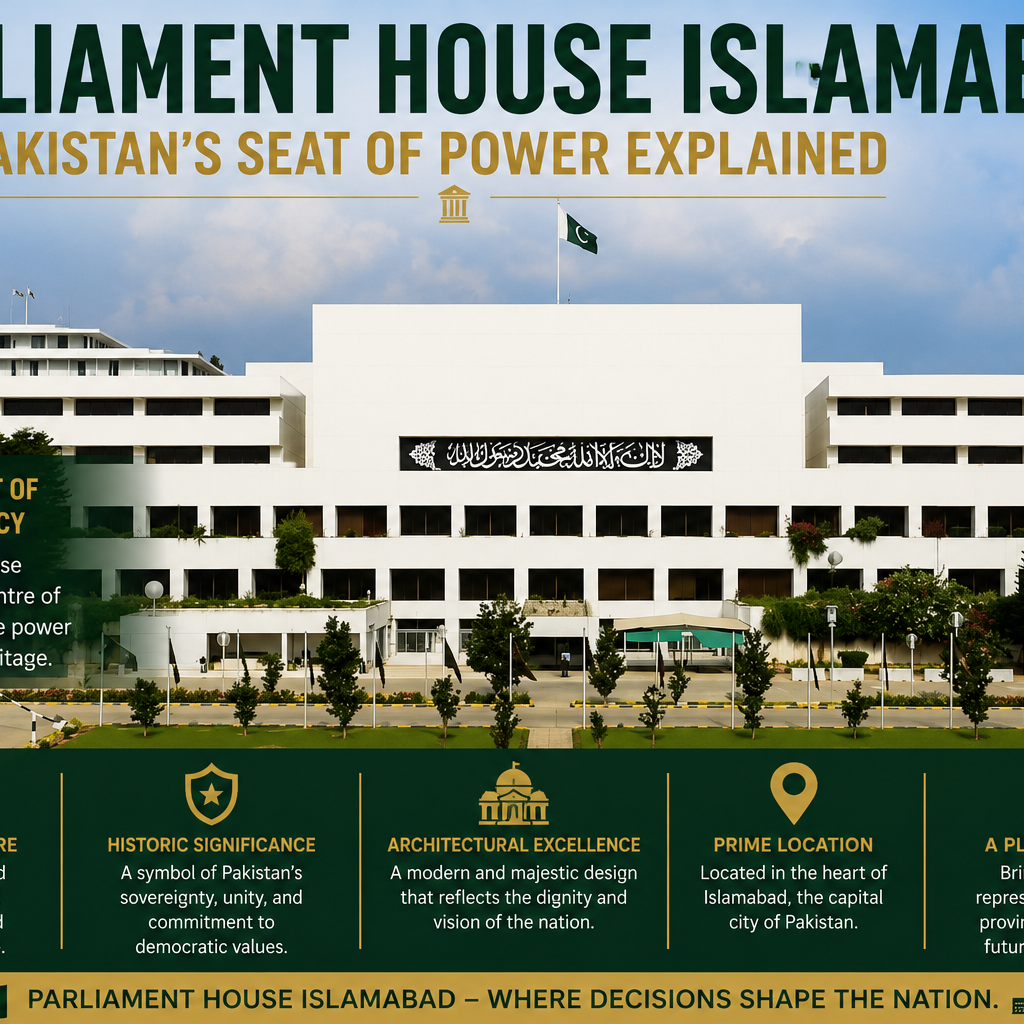
Parliament House is a five storey building with a large total floor area. Its design is notable for the way the upper floors are smaller than the two below, giving the structure a stepped, layered form. The building is situated within the secure Red Zone, alongside the other main institutions of the state, in a part of Islamabad planned as the administrative heart of the capital.
Parliament House holds a central role in national life as the place where the laws of country are debated and passed. Its location, design and function makes it one of the defining buildings of Islamabad and country.
Quick answer: Parliament House in Islamabad's Red Zone is the seat of the Parliament of Pakistan, housing the National Assembly and the Senate. Designed by American architect Edward Durell Stone and inaugurated in 1986, it is one of the capital's most important government buildings.
History of Parliament House
The story of Parliament House is tied to the creation of Islamabad itself. When the capital moved to the newly built city, the country needed a permanent home for its legislature which had previously sat elsewhere. Building a parliament in Islamabad was part of establishing the new capital as the centre of government.
Construction of Parliament House took place over roughly a decade, beginning in the mid 1970s. The project was a major undertaking and the building was completed and inaugurated in 1986. Its opening marked an important step in settling the institutions of state into the new capital.
The building was designed by Edward Durell Stone, an American architect commissioned to design several of Islamabad's key institutional buildings. His work brought a particular modern style to the capital's government structures and Parliament House is among his notable projects.
In more recent years, the building has continued to develop. A Senate Museum was established at Parliament House in 2018, adding a public and educational dimension that lets people learn about the history and workings of the upper house. Over its decades of use, Parliament House has remained the steady home of the federal legislature.
Architecture of Parliament House
The architecture of Parliament House reflects the style of its designer, Edward Durell Stone and the era in which it was built. It combines contemporary architecture with architectural features that fit its context and use which creates a dignified and unique building.
This building features a robust, square-shaped structure with a feeling of order and simplicity. A characteristic feature is the design in which the top three floors of the structure are smaller than the bottom two floors. It is this feature that makes the structure recognizable.The design pays attention to light and setting. Four light wells, one at each corner of the building, help bring natural light into the interior. A terrace with plants runs around part of the perimeter at one level, softening the structure. These touches combine practical function with the building's formal character.
Inside, the two main chambers are central to the design. The Senate Chamber and the National Assembly Hall are positioned back to back, separated by a common area. The National Assembly Hall is large, with tiered seating that rises gradually and galleries on several sides for visitors, guests and the press. Both chambers are equipped with modern systems for sound, interpretation, voting and display, reflecting their working role.
The building also includes committee rooms, offices and a range of services and facilities to support the work of parliament. Its landscaping includes front lawns and a collection of trees planted over the years by visiting foreign dignitaries adds a distinctive touch to the grounds. Overall, the architecture combines modern form, practical function and a dignity suited to the seat of the legislature.
Role of Parliament House
Parliament House serves as the working home of Pakistan's federal legislature. It is where the National Assembly and the Senate meet, hold their sessions and carry out the business of making the country's laws.
The National Assembly, as the lower house and the Senate, as the upper house, each have their own chamber within the building, along with the committee rooms and offices needed for their work. The building is equipped to support debates, voting and the many functions of a modern legislature. Its facilities reflect its role as the centre of the country's law making process.
Because of its function, Parliament House is a secure building within the Red Zone and access is controlled. It is primarily a working institution rather than a general tourist site, though its history and significance make it one of the landmarks people associate with the capital. The building is situated as a symbol of the country's system of governance and its democratic institutions.
Two houses within Parliament House
Parliament House is home to the two chambers of Pakistan's bicameral legislature and understanding them helps explain the building's design and purpose. The two houses situated within the same building but serve different roles in the law making of country.
The National Assembly is the lower house which made up of members who represent constituencies across the country. Its chamber within Parliament House is the larger of the two, with tiered seating that rises in gradual steps and galleries on several sides for visitors, guests and the press. The scale of the hall reflects the number of members it seats and its central role in the legislative process.
The Senate is the upper house and its chamber is situated back to back with the National Assembly Hall, separated by a common area. The Senate represents the federating units of the country, giving the provinces and territories a voice in the legislature. Its chamber, though smaller, is equipped with the same kind of modern systems for sound, interpretation and voting.
Both chambers are supported by committee rooms, offices and facilities within the building. The committees do much of the detailed work of reviewing legislation and several of the committee rooms are equipped with interpretation systems. This arrangement of two chambers, committee rooms and supporting offices under one roof is what allows the building to function as the working home of the entire federal legislature.
Places near Parliament House
Parliament House is situated in the Red Zone of Islamabad, the secure administrative district that holds many of the country's most important institutions. This central setting places it among the key landmarks of the capital and the area around it is the heart of national government.
The building's closest neighbours are the other main institutions of the state. The Aiwan e Sadr, the presidency, is situated close by, with a terraced lawn spread between them. The Supreme Court of Pakistan building lies a short distance to the southeast and the Prime Minister's Office is also nearby. Together, these buildings form the cluster of state institutions at the centre of Islamabad, arranged along the city's planned administrative axis.
The National Library of Pakistan, one of the country's leading cultural and information institutions, is located in the vicinity of the Red Zone. The Diplomatic Enclave which houses many embassies and high commissions, is situated nearby as well, in a secure zone of its own.
Beyond the immediate government district, Parliament House connects to the wider capital through Constitution Avenue and Islamabad's well planned road network. The central sectors of the city, with their markets, offices, hospitals and services, are within reach and landmarks such as the Faisal Mosque and the Pakistan Monument are part of the same central area of the capital.
For anyone understanding the geography of Islamabad, Parliament House marks the centre of the administrative district. The sectors surrounding this part of the capital are among its most established and prominent and proximity to the government and diplomatic areas shapes the character of central Islamabad.
Why Parliament House matters to Islamabad
Beyond its function, Parliament House holds a central place in the identity of Islamabad. As the home of the federal legislature, it is one of the buildings most associated with the capital's role as the seat of national government.
For the city, Parliament House anchors the Red Zone, the administrative district that gives Islamabad much of its purpose and character. The presence of parliament, the presidency, the courts and the diplomatic missions in this central area is what makes Islamabad the capital in practice as well as in name. Landmarks of this kind define how the city is seen and understood.
The building also carries symbolic weight, standing for the country's system of governance and its institutions. For anyone getting to know Islamabad, Parliament House is one of the essential buildings to understand.
Frequently asked questions
Where is Parliament House located? Parliament House is in the Red Zone of Islamabad, the secure administrative district at the centre of the capital. It is situated close to the Aiwan e Sadr, the Supreme Court and the Prime Minister's Office, along the city's planned government axis.
Who designed Parliament House and when was it built? It was designed by the American architect Edward Durell Stone, who designed several of Islamabad's key institutional buildings. Construction took place over roughly a decade and the building was inaugurated in 1986.
What is inside Parliament House? The building houses the two chambers of the legislature, the National Assembly Hall and the Senate Chamber, positioned back to back. It also contains committee rooms, offices and supporting facilities, along with the Senate Museum, established in 2018.
What is the architecture of Parliament House like? It is a five storey building in a modern style, notable for the way its three upper floors are smaller than the two below, giving a stepped profile. It features light wells at its corners and a formal, dignified form suited to its role.
Can the public visit Parliament House? Parliament House is a secure working institution in the Red Zone and access is controlled. It is primarily a place of government rather than a general tourist site, though guided viis situated and events are sometimes arranged and the Senate Museum offers a public dimension.
What places are near Parliament House? The Aiwan e Sadr, the Supreme Court, the Prime Minister's Office and the National Library are all nearby in the Red Zone, along with the Diplomatic Enclave. The building connects to the wider capital via Constitution Avenue and the city's road network.
Parliament House is one of the defining buildings of Islamabad. As the seat of the Parliament of Pakistan, home to the National Assembly and the Senate, it is situated at the centre of the country's system of governance and at the heart of the capital's administrative district.
Designed by Edward Durell Stone and inaugurated in 1986, the building combines a modern, dignified architecture with the practical function of a working legislature. Its position in the Red Zone, alongside the presidency, the courts and the diplomatic missions, anchors the part of Islamabad that gives the city its purpose as the national capital. For anyone getting to know Islamabad, Parliament House is one of the essential landmarks, a building that represents both the capital and the institutions of the country it serves.