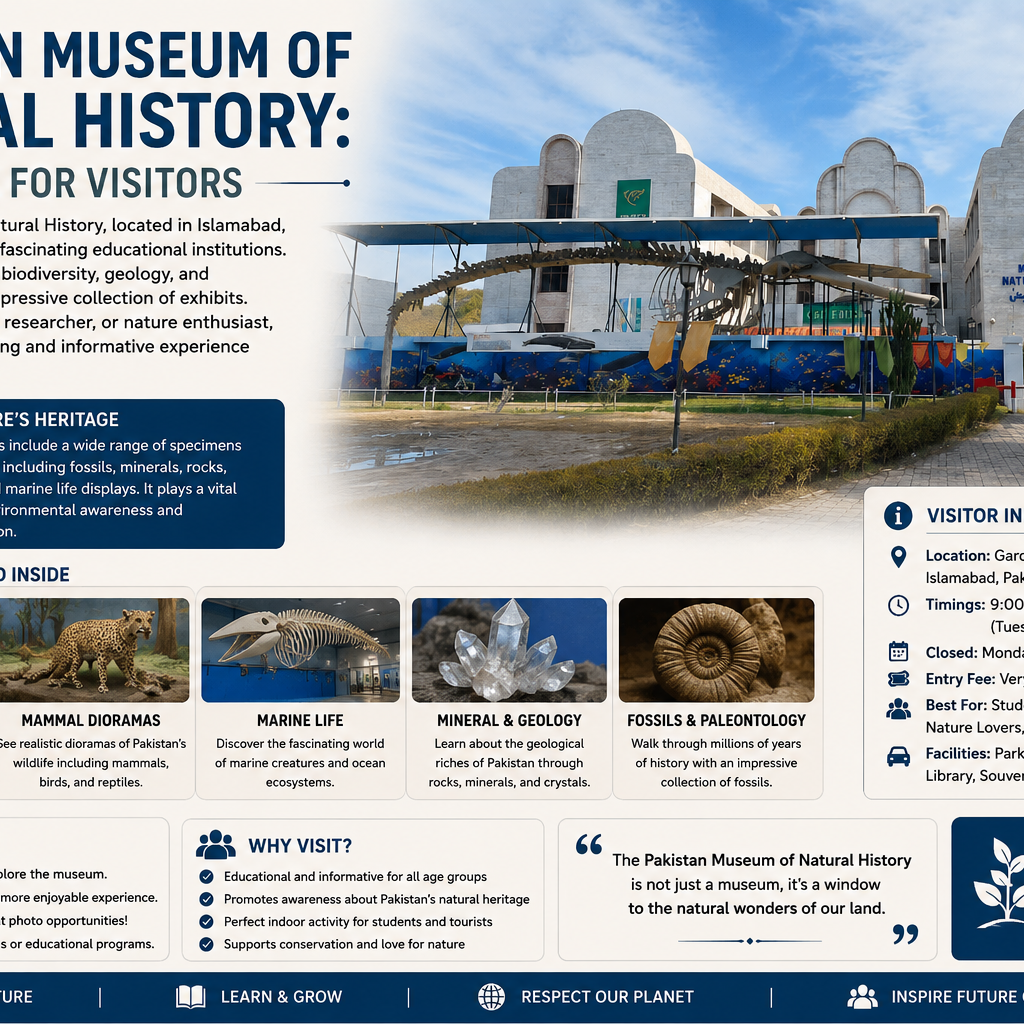
Pakistan Museum of Natural History: A Guide for Visitors
On the Shakarparian Hills in Islamabad close to the Pakistan Monument and the Lok Virsa Museum is situated one of the capital's most engaging museums. The Pakistan Museum of Natural History takes visitors on a journey through the natural world of the country from million year old fossils and towering dinosaur models to gemstones wildlife and the great blue whale skeleton that greets visitors at the entrance. For families students and the curious it offers a mix of learning and fun that has made it a favourite in the capital.
This article explains what the Pakistan Museum of Natural History is its history what there is to see and how it fits into the appeal of the Shakarparian area. Written for anyone getting to know Islamabad it covers both the museum itself and its setting among the capital's cultural landmarks.
Pakistan Museum of Natural History
The Pakistan Museum of Natural History is a public natural history museum on Garden Avenue in the Shakarparian area of Islamabad within the Shakarparian National Park. It is dedicated to the natural history of the country with exhibits and galleries covering its ecology geology and palaeontology and it is one of the leading scientific and educational institutions in the capital.
The museum holds a very large collection put at over 600,000 objects ranging from fossils and skeletons to rocks minerals gemstones and preserved specimens. It is housed in a large building with several floors and many galleries and it combines display with research working closely with the neighbouring Lok Virsa Museum and other institutions.
The museum is managed by the Pakistan Science Foundation under the Ministry of Science and Technology and it serves both as a public museum and a research centre. It has several scientific divisions covering plants animals and earth sciences engaged in the collection identification and study of the country's natural resources alongside a public services division responsible for education and the popularisation of natural history.
For visitors the museum offers an accessible and engaging way to learn about the natural world of the country. Its combination of large impressive exhibits such as the blue whale skeleton and the dinosaur models with informative displays on wildlife geology and the environment makes it a rewarding destination for all ages and one of the most family friendly museums in the capital.
Quick answer: The Pakistan Museum of Natural History is a public museum on Garden Avenue in the Shakarparian area of Islamabad dedicated to the country's ecology geology and palaeontology. Established in 1976 and holding over 600,000 objects it is known for its blue whale skeleton dinosaur models and wildlife and gemstone displays.
History of the museum
The Pakistan Museum of Natural History was established in 1976 under the patronage of the Pakistan Science Foundation and the Ministry of Science and Technology. It was created to collect preserve research and display the natural history of the country and to educate the public about its natural wealth.
From its founding the museum was given a broad mission. It was set up with several scientific divisions covering botanical zoological and earth sciences tasked with collecting and studying the plants animals and mineral resources of the country alongside a public services division responsible for education and public exhibits. This combination of research and public education has defined the museum throughout its history.
Over the decades the museum has grown its collection and its exhibits adding specimens and displays on a regular basis. Landmark additions such as the large blue whale skeleton at the entrance and the model of an ancient extinct mammal have become signature features. More recently the museum has introduced modern and interactive elements including virtual and digital exhibits aimed at drawing in younger visitors and keeping the displays engaging.
Today the museum is situated as one of the country's foremost institutions for natural history combining a large public museum with an active research role. Its position on the Shakarparian Hills among the capital's cultural landmarks has made it a well established destination for families students and visitors interested in the natural world.
What there is to see in National Museum of History
The Pakistan Museum of Natural History offers a wide range of exhibits across its galleries which is why it appeals to such a broad mix of visitors. The displays combine large impressive specimens with informative and interactive sections making it both educational and entertaining.
The most famous exhibit greets visitors at the entrance: the skeleton of a large blue whale discovered along the coast near Pasni in the late 1960s. As the skeleton of the largest animal ever to have lived it is a striking sight and one of the museum's signature attractions. Nearby a model of an ancient extinct mammal one of the largest land mammals to have existed adds to the sense of the deep past.
Dinosaurs are a major draw especially for children. The museum features dinosaur models and skeletons including large models in the courtyard some of which move and produce sounds to the delight of young visitors. Alongside these the palaeontology displays include fossils found in the country illustrating the ancient life of the region.
The museum's galleries cover the breadth of natural history. A biological gallery displays wild flora and fauna in their habitats while an ecological gallery uses visuals and audio to explain ecological cycles habitats and environmental problems such as deforestation and threats to wildlife. The earth sciences displays cover rocks minerals and geology including a rock garden and models explaining phenomena such as volcanoes and earthquakes with an interactive earthquake exhibit. A collection of gemstones and precious stones is a particular favourite with many visitors.
Wildlife is well represented too with preserved specimens skeletons and dioramas showing animals in their natural environments. A trophy section displays specimens of hoofed animals many now endangered aimed at raising awareness of the impact of human activity on biodiversity. The grounds also include a fish pond home to many species popular with children and a lotus pond that adds to the setting. This variety from the giant whale skeleton to the smallest gemstones is what makes the museum so engaging.
Why the museum matters to Islamabad
Beyond its role as an attraction the Pakistan Museum of Natural History holds an important place in the educational and cultural life of Islamabad. As one of the country's leading natural history institutions it combines public education with scientific research on the natural wealth of the country.
For the capital the museum is a valuable educational resource especially for families and students. It offers an accessible way to learn about the country's wildlife geology and environment and it is a popular destination for school trips and family outings. Its focus on conservation and the environment highlighting threats to wildlife and habitats adds an important message to its displays. The research role of the museum studying and documenting the natural resources of the country adds to its significance beyond the public galleries.
The museum is also part of the cluster of cultural institutions that gives the Shakarparian area its character. Alongside the Pakistan Monument the Pakistan Monument Museum and the Lok Virsa Museum it makes the area a centre for learning about the country's history culture and natural world. This concentration of institutions adds to the appeal of the central scenic Shakarparian area and to the character of this part of the capital. For anyone getting to know Islamabad the museum is one of the destinations that makes the Shakarparian area a rewarding place to explore and its presence contributes to the cultural richness of the central sectors nearby.
Visiting the museum
The Pakistan Museum of Natural History is one of the more rewarding and family friendly places to visit in Islamabad offering an accessible mix of learning and fun. It is well suited to families with children students and anyone interested in the natural world.
The museum is located on Garden Avenue in the Shakarparian area within the Shakarparian National Park. It is easily reached via the Shakarparian Interchange on the Islamabad Expressway and Garden Avenue also connects to the Pakistan Monument and the Lok Virsa Museum nearby. This makes it easy to combine a visit to the museum with the other landmarks of the area. It is reachable by car taxi or ride hailing service with parking available.
Entry to the museum is affordable with a modest ticket price making it an accessible outing for families. The opening hours run through the day though it is worth checking the current timings before a visit as these can vary and the museum observes breaks for lunch and prayers. Given the range of galleries across the floors visitors should allow a couple of hours to see the exhibits properly.
The cooler months are the most comfortable time to visit the Shakarparian area and to combine the museum with the outdoor landmarks nearby though the museum itself is enjoyable year round. For families the dinosaur models the whale skeleton the fish pond and the interactive exhibits are particular highlights while adults will appreciate the informative displays on wildlife geology and the environment. Combining the museum with the Pakistan Monument and the Lok Virsa Museum makes for a full and rewarding day out in the capital.
Quick answer: The Pakistan Museum of Natural History is on Garden Avenue in the Shakarparian area reachable via the Shakarparian Interchange by car taxi or ride hailing service with parking. Entry is affordable and it is open through the day though timings can vary. Allow a couple of hours and combine it with the nearby Pakistan Monument and Lok Virsa Museum.
Frequently asked questions
Where is the Pakistan Museum of Natural History located? The museum is on Garden Avenue in the Shakarparian area of Islamabad within the Shakarparian National Park. It is easily reached via the Shakarparian Interchange on the Islamabad Expressway close to the Pakistan Monument and the Lok Virsa Museum.
When was the museum established? The Pakistan Museum of Natural History was established in 1976 under the patronage of the Pakistan Science Foundation and the Ministry of Science and Technology. It was created to collect research and display the natural history of the country.
What can you see at the museum? Highlights include the large blue whale skeleton at the entrance dinosaur models and fossils wildlife specimens and dioramas a gemstone collection rock and geology displays and interactive exhibits such as an earthquake simulation. There are also fish and lotus ponds in the grounds.
Is the museum good for children? Yes. It is one of the most family friendly museums in the capital. Children particularly enjoy the dinosaur models which move and make sounds the whale skeleton the fish pond and the interactive exhibits making it an engaging and educational day out.
What is the entry fee and timing? Entry to the museum is affordable with a modest ticket price. It is open through the day though timings can vary and the museum observes breaks for lunch and prayers so it is worth checking the current hours before a visit.
What is near the museum? The museum is part of the Shakarparian cluster of landmarks. The Pakistan Monument the Pakistan Monument Museum and the Lok Virsa Museum are all nearby along with the green spaces and viewpoints of Shakarparian making it easy to combine several attractions in one visit.
The Pakistan Museum of Natural History is one of the most engaging and educational destinations in Islamabad a place where the natural world of the country comes to life through fossils skeletons wildlife and gemstones. From the great blue whale skeleton at the entrance to the dinosaur models the geology displays and the interactive exhibits it offers a mix of learning and fun that appeals to visitors of all ages.
For those getting to know Islamabad the museum captures the capital's role as a centre of learning and culture combining public education with research on the natural wealth of the country. Its setting on the Shakarparian Hills among the Pakistan Monument and the Lok Virsa Museum makes it easy to combine with the other landmarks of the area and adds to the appeal of this central cultural part of the capital. Whether you visit the Pakistan Museum of Natural History for the dinosaurs the whale the gemstones or the chance to learn about the country's wildlife and environment it remains one of the essential family destinations in Islamabad and a rewarding window into the natural history of the country.