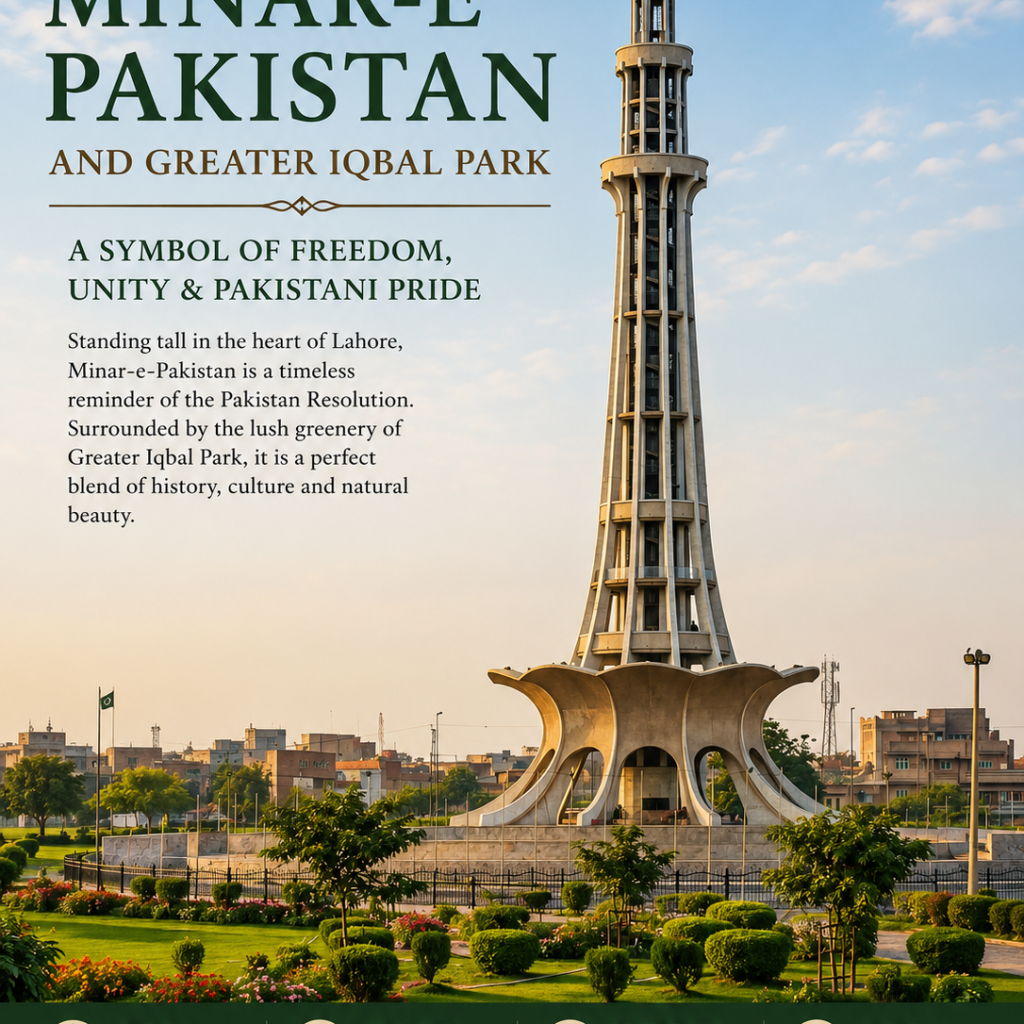
Minar e Pakistan and Greater Iqbal Park
Minar e Pakistan is located in center of greater Iqbal Park in the heart of Lahore. It is a national monument and one of the most recognisable landmarks in the country. The tower marks the site where the Lahore Resolution was passed in 1940. This resolution called for a separate homeland and led towards the creation of Pakistan in 1947. The monument was built in the 1960s and rises around 70 metres over the surrounding park. Greater Iqbal Park, a large green space with a lake and fountains, spreads out around it. For anyone getting to know Lahore, it is a place where history and city life meet.
This guide explains what Minar e Pakistan is, its history, its architecture and the park around it. It covers both the tower itself and the recreational space that draws families from across the city.
Minar-e-Pakistan
Minar e Pakistan means "Tower of Pakistan" in Urdu. It is a national monument in Lahore in Punjab. The tower stands in Greater Iqbal Park in the heart of the city, near the Walled City. It was built in the 1960s on the site of a historic political gathering. It is considered a national emblem and a symbol of the founding of the country.
The tower marks a place of great historical importance. The All India Muslim League passed the Lahore Resolution here on 23 March 1940. This resolution demanded separate states for the Muslims of the subcontinent. It laid the groundwork for the creation of Pakistan seven years later. The monument was built to commemorate this moment. The nation marks the date each year as Pakistan Day.
The tower rises around 70 metres above the ground. It has a flared base shaped like an unfolding flower. The tower narrows as it rises. A dome like top crowns it. The design blends Mughal, Islamic and modern architecture. The monument stands on a raised platform that faces the nearby Badshahi Mosque. Its pale marble and stone give it a striking presence on the skyline of the city.
Greater Iqbal Park surrounds the monument. This large park was formerly known as Minto Park and later renamed after the poet Allama Iqbal. It has since been redeveloped into a major urban park with a lake, fountains, walking paths and gardens. The park and the tower together form one of the most visited sites in Lahore. Entry to the grounds is free.
Quick answer: Minar e Pakistan is a national monument in Lahore. It stands in Greater Iqbal Park. It marks the site where the Lahore Resolution was passed on 23 March 1940. The tower was built between 1960 and 1968 and rises around 70 metres. It has a flower shaped base and blends Mughal, Islamic and modern design.
History of the Lahore Museum
The history of Minar e Pakistan begins with the Lahore Resolution. The All India Muslim League held a session at Minto Park in Lahore on 23 March 1940. The league passed a resolution demanding separate states in the Muslim majority areas of the subcontinent. This was the first official call for a separate homeland. The resolution laid the conceptual groundwork for the creation of Pakistan in 1947. The site therefore held great meaning for the new country.
The government decided to commemorate the historic site with a monument after independence. The idea gained official support by the late 1950s. A design competition was held for a Pakistan Day memorial. The competition did not produce a chosen design. The architect Nasreddin Murat Khan then took up the project. He was a Russian born engineer and architect who had settled in the country. He designed the monument and supervised its construction free of charge, donating his fee.
The construction spanned most of the 1960s. The foundation stone was laid on 23 March 1960 during the government of President Ayub Khan. The construction took around eight years. The monument was completed on 21 October 1968. The structural design was provided by the engineer Abdur Rehman Khan Niazi. Mian Abdul Khaliq and Company built the approved design. Several notable figures took part in the project, including the writer Mukhtar Masood, then the deputy commissioner of Lahore.
Minar e Pakistan has held political and civic significance in Lahore. The large grounds around the tower have hosted major political rallies over decades. Different political parties have gathered here to show their support. The monument has become a measure of the strength of a movement or party. This role gives Minar e Pakistan a place in the political as well as the historical life of the country. The tower stands as a link between the founders of the country and later generations.
Architecture of the Minar e Pakistan
The architecture of Minar e Pakistan blends Mughal, Islamic and modern styles. The design carries symbolic meaning at every level. The monument was designed to reflect both the heritage and the forward looking hopes of a young nation.
The base of the tower is shaped like an unfolding flower. The petals of this flower like base rise several metres. The base comprises four platforms, each built of a different material. The first platform uses uncut stones from Taxila. The second uses hammer dressed stones. The third uses chiselled stones. The fourth and final platform uses polished white marble. This progression symbolises the journey of the independence struggle, from humble beginnings to success.
The tower rises from this base to a total height of around 70 metres above the ground. It is slender and clad in marble. It narrows as it climbs. A dome and pinnacle crown the top in a form that recalls Mughal architecture. Crescents and stars decorate the tower as symbols of the culture of the country. An internal stairway and a lift allow visitors to climb to viewing galleries, where access is available.
The base of the monument carries extensive inscriptions. Ten converging white marble commemorative plaques stand at the base. These carry the text of the Lahore Resolution in Urdu, Bengali and English. They also carry Quranic verses and the ninety nine names of God in Arabic calligraphy. The national anthem appears in Urdu and Bengali. Excerpts from the speeches of Muhammad Ali Jinnah and couplets by Allama Iqbal are also inscribed. These inscriptions make the monument a record of the ideas behind the founding of the country.
Greater Iqbal Park
Greater Iqbal Park surrounds the monument and forms a major attraction in its own right. The park was formerly known as Minto Park in the colonial period. It was renamed Iqbal Park after the poet and thinker Allama Iqbal. In recent years it was redeveloped into a much larger urban park.
The redevelopment added many features. The park now has an artificial lake, fountains, walking and jogging tracks, gardens and open lawns. Green planted spaces spread around the monument. The park draws families, walkers and visitors from across the metropolitan area. It has become one of the main recreational spaces in the city. The fountains and lights add to the appeal in the evenings.
The park holds further points of interest beyond the monument. The tomb of Hafeez Jalandhari lies in the grounds. He wrote the national anthem of the country. The tomb of the poet Allama Iqbal stands nearby between the park and the Badshahi Mosque. These resting places add to the historical weight of the area. The park also includes eateries and facilities for visitors.
The setting of the park adds greatly to its value. It sits next to the Walled City and the great Mughal landmarks of Lahore. The Badshahi Mosque, the Lahore Fort and the Hazuri Bagh stand close by. This places Minar e Pakistan and Greater Iqbal Park within a rich cluster of heritage. A visit combines easily with the fort, the mosque and the old city. The park offers a green and open space in the heart of the historic city.
Setting and significance
Minar e Pakistan stands in the heart of Lahore near the banks of the River Ravi and the Walled City. This central location places it among the most important landmarks of the city. The monument is located in an area with heavy traffic, in which many roads converge. The expansion of the city in this region has led to its bustling nature.
The monument carries much importance for the nation. It marks the birthplace of the idea of Pakistan. It is regarded as a national emblem and a symbol of independence and national identity. Its emotional weight for the people of the country is often compared to that of great national monuments elsewhere. The monument draws visitors from across the country who come to pay tribute to the founders and the freedom struggle.
The area around the monument benefits from its heritage and its park. Greater Iqbal Park adds a large green and recreational space to this part of the city. The cluster of the monument, the park and the Mughal landmarks makes the area one of the most visited in Lahore. This heritage adds to the character and appeal of the city. It draws tourism and supports the identity of Lahore as a city of history.
Minar e Pakistan connects the Mughal past of the Walled City with the modern story of the founding of the country. For anyone getting to know Lahore, it is one of the landmarks that captures both the history and the spirit of the city.
Visiting Minar e Pakistan
Minar e Pakistan is one of the most accessible and rewarding landmarks in Lahore. It offers history, architecture and a large park in one location. It suits families, history lovers and anyone exploring the city.
Entry to the grounds of Greater Iqbal Park is free. The park is open through the day and into the evening. Visitors can walk the paths, enjoy the lake and fountains and view the monument from the grounds. Climbing the tower to the viewing galleries has been possible at times, though access can vary with maintenance and security. It is worth checking current conditions on arrival. The evenings are popular, when the fountains and lights add to the atmosphere.
The monument is reached easily from across the city by car, taxi or ride hailing service. It sits near the Walled City at a central junction. The Allama Iqbal International Airport lies around 30 to 45 minutes away by road, subject to traffic. Parking is available near the park, though the central location can be busy. The Metro Bus and other transport also serve the wider area.
The cooler months from around October to March offer the most comfortable time to visit. They avoid the summer heat and suit walking around the park. The monument is a popular subject for photography with its flower shaped base and its slender tower. A visit combines well with the nearby Badshahi Mosque, the Lahore Fort and the food street of the old city. Visitors are asked to respect the monument and the park and help keep the grounds clean.
Places near Minar e Pakistan
Minar e Pakistan sits within reach of many landmarks and useful places in Lahore. This helps visitors plan a fuller trip. The Badshahi Mosque, the Lahore Fort and the Hazuri Bagh stand close by in the Walled City. The tomb of Allama Iqbal lies between the park and the mosque. The Fort Road food street is a short distance away.
Data Darbar, the shrine of Data Ganj Bakhsh, lies nearby. Anarkali Bazaar and the Mall Road, with the Lahore Museum, are within reach for shopping and heritage. The River Ravi and its bridges lie close to the park. Major hospitals of the city, including Mayo Hospital and Sir Ganga Ram Hospital, serve the central area, along with the King Edward Medical University. The Government College University stands in the historic heart of the city. These connections make the monument an easy addition to a wider tour of Lahore.
Frequently asked questions
Where is Minar e Pakistan located? Minar e Pakistan stands in Greater Iqbal Park in the heart of Lahore, near the Walled City and the River Ravi. It sits close to the Badshahi Mosque and the Lahore Fort and is easily reached from across the city.
Why was Minar e Pakistan built? Minar e Pakistan was built to commemorate the Lahore Resolution. The All India Muslim League passed this resolution at the site on 23 March 1940. It called for separate states for the Muslims of the subcontinent and led towards the creation of Pakistan in 1947.
When was the monument built? The foundation stone was laid on 23 March 1960. The construction took around eight years. The monument was completed on 21 October 1968. The architect Nasreddin Murat Khan designed it and supervised its construction free of charge.
How tall is Minar e Pakistan? The tower rises around 70 metres above the ground. That is roughly 230 feet. It has a flared base shaped like an unfolding flower and a slender tower that narrows as it climbs, crowned by a dome and pinnacle.
Can you climb Minar e Pakistan? Visitors have been able to climb the tower to viewing galleries via an internal stairway and a lift. Access can vary with maintenance and security considerations. It is worth checking current conditions on arrival. Entry to the surrounding park is free.
What is Greater Iqbal Park? Greater Iqbal Park is the large park that surrounds the monument. It was formerly Minto Park and later renamed after Allama Iqbal. It has been redeveloped with a lake, fountains, walking tracks and gardens. It also holds the tombs of Hafeez Jalandhari and Allama Iqbal nearby.
Minar e Pakistan is one of the most significant national landmarks in the country and a defining monument of Lahore. It marks the site where the Lahore Resolution was passed in 1940, the moment that laid the groundwork for the creation of Pakistan. Built through the 1960s and rising around 70 metres, its flower shaped base and slender tower blend Mughal, Islamic and modern design into a powerful symbol of national identity.
The monument offers both history and city life in one place. Greater Iqbal Park around it provides a large green space with a lake, fountains and gardens that draw families from across the city. Its setting next to the Walled City places it among the great Mughal landmarks of Lahore, from the Badshahi Mosque to the Lahore Fort. Whether you visit Minar e Pakistan for its history, its architecture, the park around it or the view from its galleries, it remains an essential landmark of Lahore and a place where the story of the country and the life of the city come together.