Lal Shahbaz Qalandar and the Sehwan Shrine: A Complete Guide
Lal Shahbaz Qalandar is the most beloved Sufi saint of Sindh. He was a wandering dervish a scholar and a poet. He settled at Sehwan in the 13th century. He preached love, tolerance and devotion. His shrine draws pilgrims from across the country. Its drums and its dhamaal have become a symbol of Sindh. This guide covers the saint and his shrine. It explains his life the building the Urs and how to visit.
This guide offers a general overview. Accounts of the early life of the saint differ between sources.
Quick answer: Lal Shahbaz Qalandar was born Sayyid Usman Marwandi in 1177. He came from Marwand and travelled widely across the Muslim world. He settled at Sehwan in Sindh around the middle of the 13th century. He died there in 1274. His shrine grew from a simple grave into a great complex. Rulers expanded it in 1356 and again in the 18th century. His Urs falls on 18 Sha'ban and draws vast crowds.
Life of the saint
He was born Sayyid Usman Marwandi. His birth is usually dated to 1177. He came from a place called Marwand. Sources differ on exactly where that lay. His family traced its origins to Baghdad.
His father was a scholar. Sayyid Ibrahim Kabiruddin raised him in the religious sciences. The young man studied deeply. He then chose the path of the wandering ascetic.
He travelled across the Muslim world. His journeys took him through Persia, Iraq and the wider region. He performed the pilgrimage to Mecca. He reached the Indian subcontinent by the mid 13th century. He then made his way to Sindh.
He settled at Sehwan. He arrived around the middle of the century. He established a khanqah there. He taught at a religious school. He also wrote treatises in Persian. He spent his last decades in the town.
He died in 1274. The date corresponds to 18 Sha'ban in the Islamic calendar. He was then in his nineties. His followers buried him where the shrine now rises.
Name and the message
His name carries three parts. Each holds a meaning. Together they describe the man and his path.
Lal means red. Tradition links the name to the red robes he wore. Those robes symbolised spiritual passion. Devotees still wear red at the shrine.
Shahbaz means royal falcon. The name suggests a noble and soaring spirit. Legends describe his swiftness in divine service. The falcon became his emblem.
Qalandar names his order. Qalandars were wandering dervishes. They renounced worldly attachments. They lived outside the settled religious institutions. This tradition emphasised ecstatic devotion.
He preached tolerance and love. He taught that man should become one with God and he welcomed people of all religions. Hindus and Muslims both revered him. This inclusiveness remains central to his memory.
Sufi orders and the companions
His initiation is debated. Some accounts place him in the Suhrawardiyya order. They say Bahauddin Zakariya initiated him at Multan. Other accounts link him to the Qalandariyya. The sources contradict one another.
He belonged to a famous circle. Tradition groups him with three other saints. Bahauddin Zakariya, Fariduddin Ganjshakar and Jalaluddin Bukhari complete the four. Devotees call them the Four Friends. They were near contemporaries.
His teaching spread Sufi Islam in Sindh. His verse and his message reached ordinary people. He wove local custom into his practice. This approach helped his tradition take root.
Shrine of Lal Shahbaz Qalandar
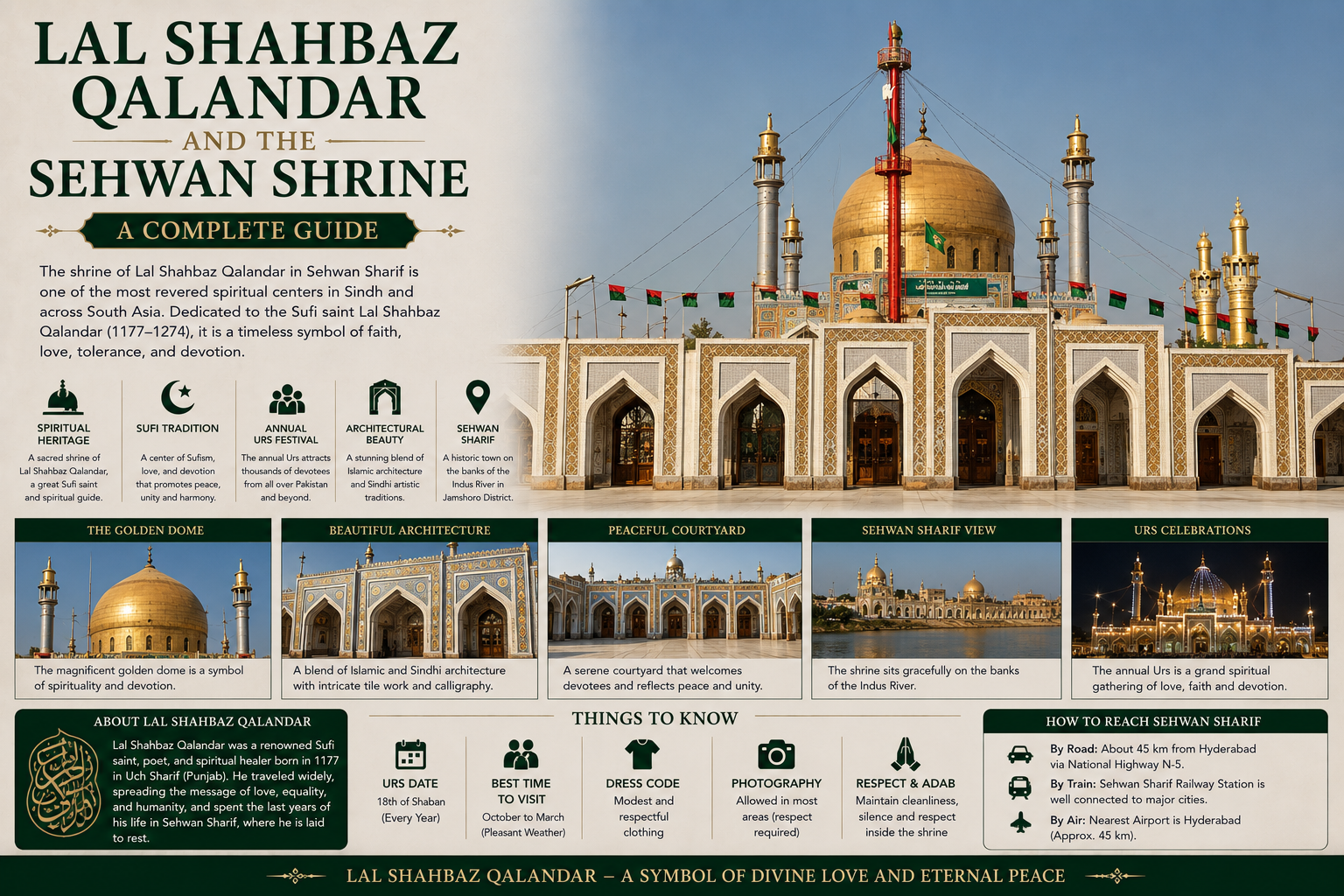
The shrine began as a simple grave. Devotees marked the burial place after 1274. The building grew over the centuries.
Rulers expanded it repeatedly. Firuz Shah Tughlaq ordered work in 1356. That project raised a proper mausoleum. The Kalhora rulers extended it in the 18th century. Later patrons added further sections.
The decoration is magnificent. Blue and white glazed tiles cover the surfaces. Craftsmen call this work kashi kari. Mirrorwork glitters inside the chamber. A dome crowns the tomb.
The doors are richly worked. Devotees have gifted precious metalwork over the years. Silver and gold decorate the entrance. These gifts reflect centuries of devotion.
The shrine suffered an attack in 2017. A bombing killed and injured many worshippers. The shrine reopened within days. The drums sounded again the next evening. That response became a symbol of resilience.
Dhamaal and the music
The dhamaal is the great ritual. Devotees dance to the beat of the drums. The rhythm builds through the evening. Dancers enter a trance like state. This ecstatic dance is the heart of the shrine.
The drums are enormous. Large kettle drums beat before the shrine. Devotees gather at their call each evening.
The dance is open to all. Men and women both take part. Transgender devotees have a recognised place too. This openness is unusual and much noted.
A famous song honours the saint. The Sufi song Dama Dam Mast Qalandar celebrates him. Singers across South Asia have recorded it. It carries his name far beyond Sindh.
Urs of Lal Shahbaz Qalandar
The Urs is the great festival. It marks the anniversary of the death of the saint. It falls on 18 Sha'ban in the Islamic calendar. The date moves through the solar year.
The crowds are vast. Hundreds of thousands of pilgrims reach Sehwan. The festival runs over three days. Tents fill the ground around the town. The narrow lanes overflow with devotees.
The programme is rich. Folk singers perform through the nights. Bands come from across the province. Devotees offer tributes at the tomb. Many make vows and prayers.
The Urs is among the largest Sufi gatherings in the country. Few festivals match its scale. It draws people of many faiths and backgrounds.
Visiting the shrine of Lal Shahbaz Qalandar
The shrine is located in Sehwan Sharif. The town is in the Jamshoro district. Hyderabad lies around 130 kilometres to the south east. The Indus Highway serves the town.
Visit respectfully. The shrine is an active place of worship. Dress modestly and remove your shoes. Follow the guidance of the attendants. Photography may be restricted in places.
Evening is the best time to come. The dhamaal begins after sunset. The atmosphere builds through the night. Many visitors find this the most moving experience of the trip.
Frequently asked questions
Who was Lal Shahbaz Qalandar? Lal Shahbaz Qalandar was born Sayyid Usman Marwandi in 1177. He came from Marwand, though sources differ on where that lay. He was a Sufi saint, scholar and poet. He travelled widely across the Muslim world before settling at Sehwan in Sindh. He preached love, tolerance and devotion across religious lines. He died at Sehwan in 1274. His shrine remains one of the most revered in the country.
What does the name Lal Shahbaz Qalandar mean? The name carries three parts. Lal means red and refers to the red robes he wore. Those robes symbolised spiritual passion. Shahbaz means royal falcon and suggests a noble and soaring spirit. Qalandar names the tradition of wandering dervishes who renounced worldly attachments. Together the three parts describe both the man and his spiritual path.
When is the Urs of Lal Shahbaz Qalandar? The Urs falls on 18 Sha'ban in the Islamic calendar. That date moves through the solar year. The festival runs over three days. Hundreds of thousands of pilgrims travel to Sehwan for it. Folk singers perform through the nights. Tents fill the ground around the town. It ranks among the largest Sufi gatherings in the country.
What is the dhamaal at the shrine? The dhamaal is an ecstatic devotional dance performed at the shrine. Large kettle drums set the rhythm. Devotees dance as the beat builds through the evening. Many enter a trance like state. Men and women both take part. Transgender devotees have a recognised place too. The dhamaal is the heart of the spiritual experience at Sehwan.
How old is the shrine of Lal Shahbaz Qalandar? The shrine grew from a simple grave marked after 1274. Firuz Shah Tughlaq ordered a proper mausoleum in 1356. The Kalhora rulers extended the complex in the 18th century. Later patrons added further sections. Blue and white kashi tile work covers the surfaces. Devotees have gifted silver and gold work for the doors over the centuries.
Red falcon of Sindh
Lal Shahbaz Qalandar remains the most beloved saint of Sindh. He came from far away and made the province his home. He taught love, tolerance and devotion for over twenty years at Sehwan. His shrine grew from a simple grave into a tiled masterpiece. Its drums have sounded for centuries. Its dhamaal draws devotees of every background.
You may come to the shrine as a pilgrim or a traveller. Sehwan will move you either way. You can stand before the tiled tomb and the worked silver doors. You can hear the great drums begin at dusk. You can watch the dhamaal fill the courtyard. Come in the evening and dress respectfully. Few places in the country carry such devotion.