Lahore Zoo: A Guide to the Historic City Zoo
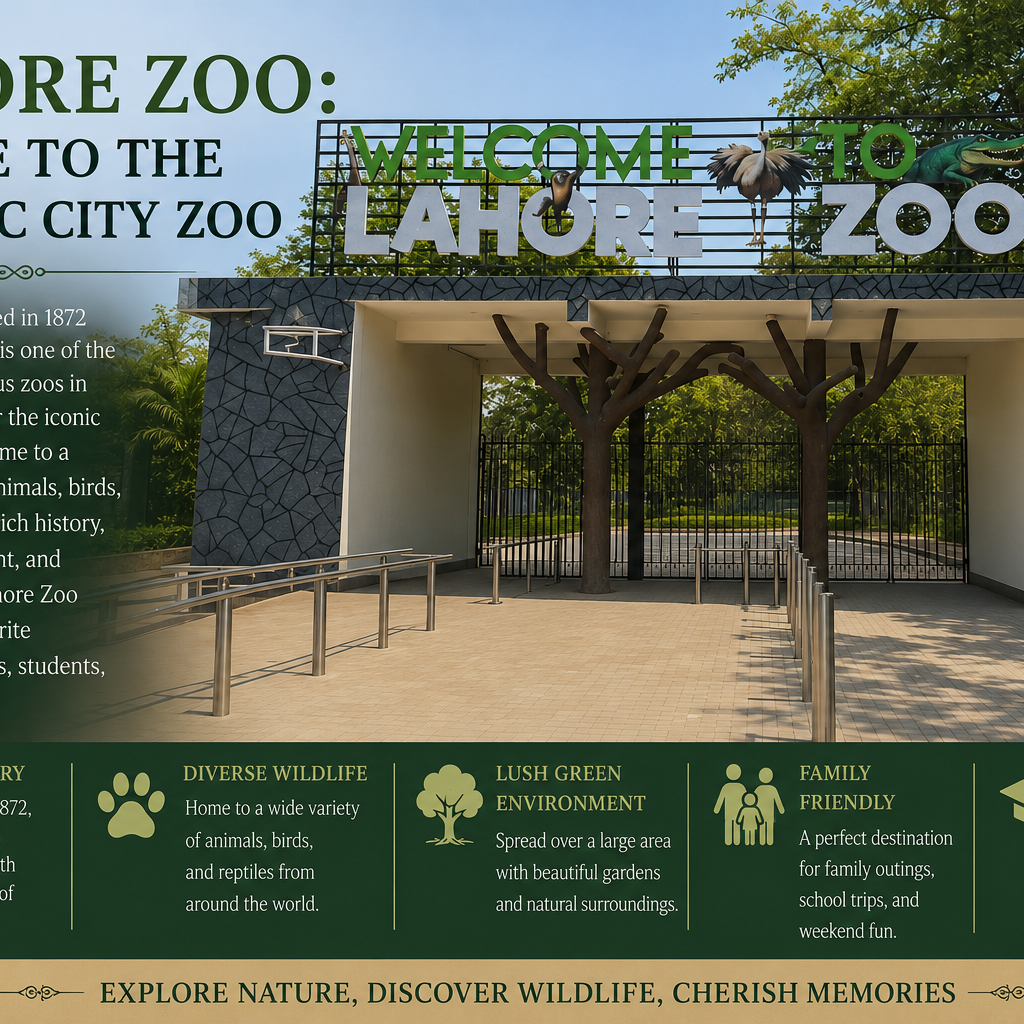
Lahore Zoo is located on The Mall opposite to the famous WAPDA house in Lahore. Lahore zoo is one of the most ancient zoos in the world as well as the biggest zoo in Pakistan. The Lahore Zoo was established in 1872 and has evolved into an important landmark. It is home to over 1,300 animals of around 135 species, from Bengal tigers and lions to black bears and exotic birds. A major revamp in recent years has modernised the zoo with new enclosures and facilities. For anyone getting to know Lahore, the zoo is a much loved family destination and a piece of the living history of the city.
This guide explains what Lahore Zoo is, its history, its animals and attractions and its setting on The Mall.
Lahore Zoo
Lahore Zoo is a public zoo situated on The Mall in central Lahore. It was established in 1872. This makes it one of the oldest zoos in the world, often cited as the third or fourth oldest. It is the largest zoo in the country. It is managed by the Wildlife and Parks authorities of the province through a dedicated zoo management committee.
Lahore Zoo has grown greatly since its modest beginnings. It now covers an area of around 25 acres in the middle of the city. It houses a collection of over 1,300 animals of around 135 species. Lahore Zoo draws around three million visitors each year. This makes it one of the most popular tourist attractions in the country. It is a place of recreation, education and conservation.
The zoo holds a wide range of animals and birds. The species here include Bengal tigers, lions, black bears, deer and many others. Lahore Zoo has bred many of its big cats successfully over the years. A large aviary near the entrance houses around 200 gamebirds and parrots. Lahore Zoo also holds reptiles, primates and a variety of other creatures. New and exotic animals have been added in recent years.
Lahore Zoo has been the subject of a major modernisation. It closed for a large revamp in November 2023 and reopened with many upgrades. The work followed the model of the great wildlife parks abroad. New glass fronted enclosures, a modern food court, a hologram zoo and other features were added. The zoo now combines its long history with modern facilities. It remains one of the most visited attractions in the city.
Quick answer: Lahore Zoo is a historic zoo located on Mall road near Punjab assembly house and opposit to Wapda house. It was established in 1872 and is one of the oldest zoos in the world and the largest in the country. It houses over 1,300 animals of around 135 species and draws around three million visitors a year. A major revamp has modernised it in recent years.
History of the zoo
The history of Lahore Zoo reaches back over 150 years. Its origins lie in the 1860s. Lahore Zoo was properly established in 1872, when a local philanthropist named Lala Mela Ram donated an aviary to the Lahore Municipal Corporation. This aviary formed the seed from which the zoo grew. The collection of animals expanded over time. Lahore Zoo grew in size.
Lahore Zoo passed through many hands over the following century. It remained under the management of the Lahore Municipal Committee from 1872 to the 1920s. Control then passed to the district administration and a zoo advisory committee until 1962. The management moved to agriculture and livestock departments after that. There was very little development at the zoo through much of this long period.
The zoo entered a new era in 1982. Its management was entrusted to the Wildlife and Parks Department in that year. This marked the start of major changes at the zoo. The department upgraded the exhibits, the layout of the buildings and the grounds. Lahore Zoo became a self financing organisation. It began to focus on conservation, research and education alongside recreation. A major master planning and improvement project was approved in 2005 to upgrade the facilities.
Lahore Zoo is now governed under modern rules. It is run by a zoo management committee constituted under the Punjab Zoos and Safari Parks Rules of 2012. This framework guides the care of the animals and the running of the zoo. Lahore Zoo hosted a major regional zoo conference in 2004, reflecting its standing. Its long and continuous history makes it a rare surviving institution from the nineteenth century in the city.
Animals and attractions
The animals are the main draw of Lahore Zoo. The zoo is home to over 1,300 animals of around 135 species. These range from big cats and bears to birds, reptiles and primates. The variety of species makes the zoo a place of interest for visitors of all ages.
The big cats are among the great highlights. The Lion House complex houses the Bengal tigers, lions and pumas. Lahore Zoo has bred many of these big cats successfully, with numerous cubs born at the zoo over the years. Lahore Zoo is home to more than twenty lions and around fifteen tigers, most of them born there. A family of black bears also lives in this complex. These large animals are among the most popular attractions.
The birds and other animals add further variety. A large aviary near the entrance houses around 200 gamebirds and parrots, including peafowl, pheasants, macaws and grey parrots. This is the oldest part of the zoo, on the site of the original 1872 aviary. A reptile house holds cobras, kraits, vipers and pythons. Lahore Zoo also has deer, primates, a range of waterfowl and other creatures. New and exotic animals have been added as part of the recent upgrades.
The zoo offers many facilities and attractions for visitors. Signboards, maps and information boards are placed around the zoo for education and guidance. Camel rides and electronic rides entertain children. Picnic areas, a waterfall and animal statues are spread across the grounds. A mosque, cafeterias, washrooms and drinking water points serve visitors. Guided tours are available for school groups, along with a touch table that lets children feel animal parts such as horns, skins and feathers. These features make the zoo an educational as well as a recreational destination.
Recent revamp
Lahore Zoo has undergone a major modernisation in recent years. This revamp has transformed the facilities and the visitor experience. Lahore Zoo closed to the public in November 2023 for the work. It reopened in 2024 with a wide range of upgrades. Further improvements have continued since.
The revamp followed an international model. The project drew on the approach of the great wildlife parks abroad, aiming to bring the zoo up to modern standards. The animal enclosures were redesigned to be more natural and more comfortable for the animals. Glass fronted enclosures were built for the lions, tigers and leopards, with a depth that lets visitors feel close to the animals in safety. The enclosures for the sloth bears, deer and other animals were enlarged to give more natural outdoor space.
The revamp added many modern features. A hologram zoo was introduced, an IT based facility using augmented and virtual reality to teach visitors about rare and endangered species. A modern food court, an amphitheatre and a new veterinary hospital were built. The parking area was extended, with an app based parking system. The bird aviary was improved and a great deal of planting was done across the grounds. An e ticketing system was introduced for the convenience of visitors.
Lahore Zoo has also added new animals. New and exotic species have been procured to enrich the collection and complete breeding pairs. These additions, alongside the modern enclosures and facilities, have renewed the zoo for a new generation. It is worth noting that the zoo periodically closes for short maintenance, so it is wise to check the current status before a visit. The revamp has helped secure the future of this historic institution.
Location on The Mall
Lahore Zoo is located on The Mall, one of the oldest and busiest roads in Lahore. This central location places it in the heart of the city, among its major landmarks and institutions. The Mall holds many of the grand colonial buildings and government offices of the city. The zoo is one of its best known attractions.
The setting places the zoo within a rich cluster of attractions. Lahore Zoo shares a green belt with the Bagh e Jinnah, the historic Lawrence Gardens, so the two can be visited together. The Alhamra Arts Council stands opposite the zoo on The Mall. The Jilani Park, the historic Racecourse Park, is a short distance away. The colonial landmarks of The Mall, including the Lahore Museum and the General Post Office, are nearby. This makes the zoo easy to combine with the other attractions of central Lahore.
The location gives the zoo great accessibility. It is only around three kilometres from the Lahore Railway Station and four kilometres from the General Bus Stand. It is served by the roads and public transport of the central city. This central position allows people to visit the zoo regularly and easily. It is one of the reasons the zoo draws such large numbers of visitors.
Lahore Zoo is part of what gives Lahore its character as a city of parks and green spaces. For anyone getting to know Lahore, the zoo is one of the places that captures both the history and the family life of the city.
Visiting Lahore Zoo
Lahore Zoo is one of the most rewarding places for a family day out in Lahore. It offers animals, greenery and history in a central location. It suits families, children, students and animal lovers.
Lahore Zoo is generally open daily from the morning until the evening but timings may vary by season. The entry ticket is very reasonable with a modest fee for both adults and children. An e ticketing system is now in place for convenience. It is worth checking the current timings and any closures before a visit, as the zoo periodically closes for maintenance. A visit of two to three hours allows time to see the main animals and attractions.
The zoo is reached easily as it is located on The Mall in central Lahore. It is accessible by car, taxi, rickshaw or ride hailing service. Its central position makes it easy to reach from most parts of the city. The parking area has been extended with a modern system. Public transport also serves the central area well.
The cooler months from around October to March offer the most comfortable time to visit, avoiding the summer heat. Early in the day is a good time to see the animals when they are most active and to avoid the largest crowds. Visitors are asked to follow the zoo rules. These include not feeding or teasing the animals and keeping the grounds clean. A visit to the zoo combines well with the neighbouring Bagh e Jinnah and the other attractions of The Mall.
Places near Lahore Zoo
Lahore Zoo is situated within reach of many landmarks and useful places in central Lahore. This helps visitors plan a fuller trip. The Bagh e Jinnah, the historic Lawrence Gardens, shares a green belt with the zoo. The Alhamra Arts Council stands opposite on The Mall. The Jilani Park, the historic Racecourse Park, is a short distance away. The Governor's House is nearby.
The colonial buildings of The Mall, including the Lahore Museum, the General Post Office and the Lahore High Court, lie close by. Anarkali Bazaar is within reach for shopping and food. Data Darbar, the shrine of Data Ganj Bakhsh, is in the central area. The Walled City with the Lahore Fort and the Badshahi Mosque lies a short drive away. The Services Hospital and Mayo Hospital serve the central area. These connections make the zoo an easy part of a tour of central Lahore.
Frequently asked questions
Where is Lahore Zoo located? Lahore Zoo is located on The Mall in central Lahore. It shares a green belt with the Bagh e Jinnah and stands opposite the Alhamra Arts Council. It is around three kilometres from the Lahore Railway Station and is easily reached from across the city.
When was Lahore Zoo established? Lahore Zoo was established in 1872, when a local philanthropist named Lala Mela Ram donated an aviary to the Lahore Municipal Corporation. Its construction had begun in the 1860s. This makes it one of the oldest zoos in the world.
What animals are at Lahore Zoo? Lahore Zoo houses over 1,300 animals of around 135 species. These include Bengal tigers, lions, black bears, deer, primates and reptiles such as cobras and pythons. A large aviary holds around 200 gamebirds and parrots. New and exotic animals have been added in recent years.
Is Lahore Zoo open after the renovation? Yes. Lahore Zoo underwent an extensive renovation process in November 2023 and reopened for public in 2024. In this renovation state of the art enclosures, a hologram zoo and a food court was developed among others.
How much is the entry fee for Lahore Zoo? The entry ticket is very affordable, with a modest fee for both adults and children. An e ticketing system is now in place for convenience. It is best to check the current rates and timings in different seasons.
When is the best time to visit Lahore Zoo? The cooler months from October to March offer the most comfortable time to visit with pleasent weather to avoid the summer heat. Early in the day is a good time to see the animals when they are most active and to avoid the largest crowds.
Lahore Zoo is one of the most cherished attractions of Lahore and one of the oldest zoos in the world. Established in 1872 from a small donated aviary, it has grown into the largest zoo in the country, home to over 1,300 animals of around 135 species. Its Bengal tigers, lions, black bears and exotic birds draw around three million visitors each year to its grounds on The Mall.
Lahore Zoo blends a long and rich history with a modern future. A major revamp in recent years has renewed its enclosures and facilities, adding glass fronted habitats, a hologram zoo and new animals, while keeping the character that generations of families have loved. Its central location, shared green belt with the Bagh e Jinnah and closeness to the landmarks of The Mall make it easy to reach and to combine with a wider day out. Whether you visit Lahore Zoo for its big cats, its birds, its history or a family day in the heart of the city, it remains one of the essential attractions of Lahore and a living link to the history of the city.