Lahore High Court: A Landmark of Colonial Architecture
Lahore High Court building is located on The Mall road Lahore. It is one of the grandest colonial buildings in the city. The British built it in the late nineteenth century as the chief court of Punjab. Its red brick facade, tall towers and white marble detailing make it a striking landmark. The building still serves as the highest court of the province. It sits among the great colonial buildings of The Mall. For anyone getting to know Lahore, the High Court is one of the finest examples of the architecture of the British period.
This guide explains what the Lahore High Court building is, its history, its architecture and its setting on The Mall. It covers both the building itself and its place among the landmarks of colonial Lahore, focusing on the structure rather than the legal work of the court.
Lahore High Court building
The Lahore High Court is the highest court of the province of Punjab. Its main building situated on The Mall, also known as Shahrah e Quaid e Azam, in central Lahore. The British built the structure in the late nineteenth century. It was constructed as the chief court of Punjab. The building is celebrated as one of the finest examples of colonial architecture in the city.
The building sits in a prominent location on The Mall. It stands near the Faisal Chowk, once known as Charing Cross between the General Post Office and state bank Lahore office. The building is set well back from the road in generous grounds. This gives it a commanding presence over this stretch of The Mall. It was built to convey the importance that the rulers of the time placed on law and justice.
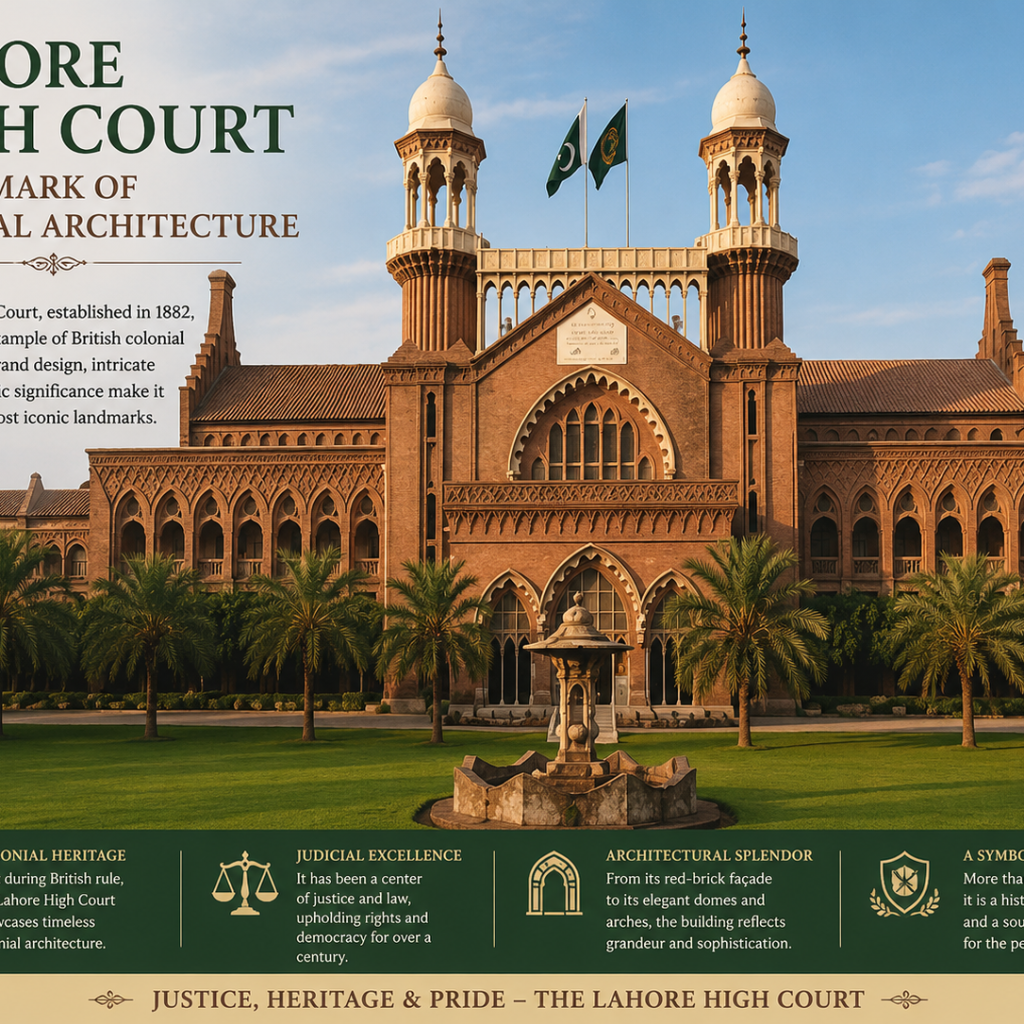
The building is a large and imposing structure of red brick. It is marked by two tall towers, a high central porch and fine white marble detailing. Its design blends European and local styles. The building has become one of the most recognisable heritage structures in the city. It draws admirers of colonial architecture alongside the many lawyers and visitors who use the court each day.
The Lahore High Court remains a working court. It serves as the highest court of Punjab, with additional benches in Rawalpindi, Multan and Bahawalpur. The court has a large bench of judges. The historic building continues to house this important institution.
Quick answer: The Lahore High Court is the highest court of Punjab. Its main building is situated on The Mall in central Lahore. The British built it in the late nineteenth century as the chief court of Punjab. The red brick building has two tall towers and white marble detailing in the Indo Saracenic style. It still serves as a working court.
History of the Lahore High court and building
The history of the Lahore High Court reaches back to the British takeover of Punjab. The East India Company defeated the Sikh Empire in 1849 and took control of the region. The British reorganised the administration and the courts. A modest chief court for Punjab was established in 1866 to handle legal matters.
The need for a proper court building grew clear by the late 1870s. The location and design of a new building were then finalised. The foundations were laid in 1882 and 1883. A shortage of funds stalled the construction work for a time. The court began to function in the new building in late 1887. The building was finally completed in 1889 at a cost of over four hundred thousand rupees. This gave Lahore a grand new home for its highest court.
The status of the court itself changed over the years. The chief court of Punjab rose to the status of a high court in 1882. The court was later reconstituted under the Letters Patent of 1919. This formally created the High Court of Judicature at Lahore. Before the partition of 1947, the jurisdiction of the Lahore High Court extended over Punjab and Delhi. The court has a long and important history in the legal life of the region.
The court has continued to serve the province since the creation of the country in 1947. It became the highest court of the province of Punjab. Benches were later established in other cities of the province, including Rawalpindi, Multan and Bahawalpur. The historic building on The Mall has remained the principal seat of the court throughout. It has served as the home of the highest court of the province for well over a century.
Architecture of the building
The architecture of the Lahore High Court is described as Indo Saracenic. This style blends European design with local and Mughal elements. It was widely used for grand public buildings during the British period. Contemporary accounts predicted that the building would become a significant architectural ornament of the province. This prediction proved correct.
The building is well proportioned and imposing. Its profile is marked by pitched roofs and gable ends. The central part of the front is accented with a high porch. Behind this porch rise two tall towers, each around 95 feet high. These towers are one of the most distinctive features of the building. Their central fluted portions were modelled after the Qutub Minar in Delhi. Corner kiosks topped with white marble cupolas crown the towers in the pattern of Mughal domed kiosks.
The building is built of neatly laid brick masonry. Specially moulded bricks form the cornices and projections. White Nowshera marble adds a dramatic accent to the pink brick. This marble appears in the cupolas, the arcading, the edgings of the arched openings and the finely carved lattice screens. These screens filter the strong sunlight of Punjab. The combination of white marble and moulded brickwork was also used at the nearby Lahore Museum.
The building carries symbolic detail fitting for a court. The central gable like front spans the space between the two towers. It carries the emblem of justice, the scales, carved in white marble and set within the exposed brickwork. The roof edge is topped with an arcaded curtain wall of white Nowshera marble. An arrangement was once made for carriages to enter the inner courtyard through the south wing. These details show the care that went into the design of the building as both a functional court and a monument.
Location on The Mall
The Lahore High Court is located on The Mall, the grand avenue of British era Lahore. This avenue holds the greatest concentration of colonial buildings in the city. The High Court is one of the finest of these. Its setting places it among the major civic and cultural landmarks of the colonial city.
The building dominates its stretch of The Mall near the Faisal Chowk. The General Post Office is located nearby along the LHC. The Lahore Museum, the National College of Arts and the Punjab University old campus are close by. The Punjab Assembly and the Governor's House lie along the same road. Together these buildings form a heritage corridor of colonial Lahore. The Alhamra Arts Council, though a modern building, was built in red brick to harmonise with these historic structures.
The setting adds to the significance of the High Court. The building stands among the institutions that shaped the administrative and civic life of the city under British rule. Its position on The Mall, set back in its grounds, gives it a dignity fitting for the highest court of the province. A visit to the High Court naturally includes the other colonial landmarks of the avenue.
The High Court and The Mall are part of what gives Lahore its character as a city of layered history. The colonial avenue sits alongside the Mughal Walled City nearby. Together they tell the story of the different ages of the city.
Significance of the building
The Lahore High Court holds significance beyond its role as a working court. Its grand design was meant to convey the authority and permanence of the law in the province. It remains a powerful symbol of justice in the province.
The building is a fine example of the Indo Saracenic architecture of the British period. It shows how the colonial builders blended European forms with local and Mughal traditions. The red brick, the white marble, the towers modelled on the Qutub Minar and the Mughal style cupolas all reflect this blend. The building stands alongside the Lahore Museum and the General Post Office as a masterwork of the era. It is a protected part of the architectural heritage of the city.
The building also carries deep historical importance. It has been the home of the highest court of the region for well over a century. It has witnessed the legal history of Punjab through the British period and since the creation of the country. Its long service gives it a place in the civic history of the city as well as its architectural heritage.
The High Court adds to the character and appeal of central Lahore. It is one of the landmarks that gives The Mall its historic grandeur. The presence of such heritage buildings adds to the identity of the city and the appeal of its central districts. For anyone getting to know Lahore, the High Court is one of the buildings that captures the colonial chapter of the history of the city.
Visiting and viewing the building
The Lahore High Court is primarily a working court rather than a tourist attraction. Most people experience the building by admiring its architecture from The Mall. The grand facade, the towers and the grounds can be viewed from the avenue. The building is one of the most photographed colonial structures in the city.
The building is a functioning court, so access to the interior is limited and subject to security and court rules. Lawyers, litigants and those with court business enter through the proper channels. Visitors interested in the architecture can admire the exterior from the public areas along The Mall. It is worth respecting that the building is a serious institution of justice, so photography and access near the entrances may be restricted.
The High Court is reached easily from across the city. It sits on The Mall in central Lahore, accessible by car, taxi, ride hailing service or the Metro Bus. The Metro Bus runs along a nearby route. The central location can be busy, so public transport is often convenient. The building stands near the other colonial landmarks of the avenue which makes it easy to include on a heritage walk.
The cooler months from around October to March offer the most comfortable time to explore The Mall on foot. The early morning or late afternoon light suits photography of the red brick facade. A view of the High Court combines well with the nearby General Post Office, the Lahore Museum and Anarkali Bazaar. Visitors are asked to respect the working nature of the court and follow any rules in the area.
Places near the Lahore High Court
The Lahore High Court sits within reach of many landmarks and useful places in central Lahore. This helps visitors plan a fuller trip. The General Post Office is located on The Mall. The Lahore Museum, the National College of Arts and the Punjab University old campus are close by. The Punjab Assembly and the Governor's House lie along the same avenue.
Anarkali Bazaar, one of the oldest markets in the city, lies close by for shopping and food. The Walled City with the Lahore Fort and the Badshahi Mosque lies a short drive to the north. Data Darbar, the shrine of Data Ganj Bakhsh, is within reach. Mayo Hospital, Sir Ganga Ram Hospital and the King Edward Medical University serve the central area. The Government College University and Aitchison College stand nearby. These connections make the High Court an easy addition to a tour of central Lahore.
Frequently asked questions
Where is the Lahore High Court located? The Lahore High Court building stands on The Mall, also known as Shahrah e Quaid e Azam, in central Lahore. It sits near the Faisal Chowk, close to the General Post Office and the other colonial landmarks of The Mall.
When was the building constructed? The foundations were laid in 1882 and 1883. A shortage of funds stalled the work for a time. The court began to function in the building in late 1887. The building was finally completed in 1889.
What style is the building? The building is designed in the Indo Saracenic style. This blends European design with local and Mughal elements. It features red brick masonry, two tall towers modelled after the Qutub Minar, white Nowshera marble detailing and Mughal style cupolas.
Is the Lahore High Court still working? Yes. The Lahore High Court is the highest court of the province of Punjab. Its principal seat remains the historic building on The Mall, with additional benches in Rawalpindi, Multan and Bahawalpur. The court has a large bench of judges.
Can visitors go inside the building? The building is a working court, so access to the interior is limited and subject to security and court rules. Visitors interested in the architecture can admire the grand exterior, the towers and the grounds from the public areas along The Mall.
What is near the Lahore High Court? The General Post Office, the Lahore Museum, the National College of Arts, the Punjab University old campus, the Punjab Assembly and the Governor's House stand along or near The Mall. Anarkali Bazaar and Aitchison College are also close by.
The Lahore High Court is one of the grandest colonial landmarks of Lahore and a masterwork of Indo Saracenic architecture. The British built it in the late nineteenth century as the chief court of Punjab. Its red brick facade, its two tall towers modelled on the Qutub Minar and its white marble detailing make it one of the finest buildings on The Mall. It has served as the highest court of the region for well over a century.
The building stands at the heart of the colonial Mall Road, among the great civic and cultural landmarks of the British period. It sits alongside the General Post Office, the Lahore Museum and the other heritage buildings of the avenue. This colonial heritage complements the Mughal Walled City nearby and tells the story of a distinct chapter in the history of the city. It remains an essential heritage building of Lahore and a lasting symbol of law and justice in the province whether you admire the Lahore High Court for its architecture, its history or its place among the landmarks of The Mall.