Lahore Fort (Shahi Qila): History and Guide
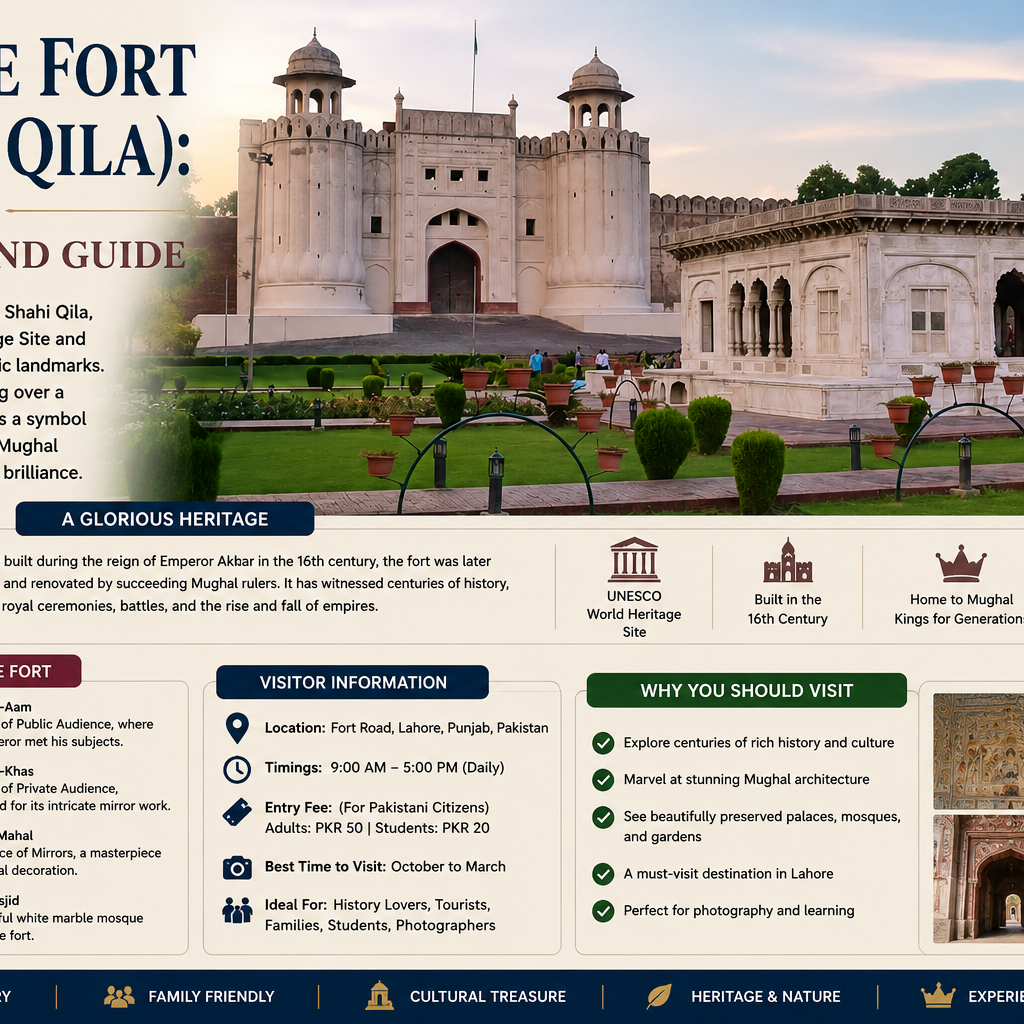
Lahore Fort stands at the northern edge of the Walled City of Lahore. Locals call it the Shahi Qila. The fort is a citadel of marble palaces, mirrored halls, painted walls and grand gateways. It counts as one of the finest surviving examples of Mughal architecture and holds UNESCO World Heritage status. A succession of emperors built and rebuilt it over centuries. The fort tells the story of the golden age of Lahore when the city was a seat of imperial power.
This guide explains what the Lahore Fort is, its long history, its main attractions and its setting in the Walled City. It covers both the fort itself and the surrounding old city that grew around it.
The Lahore Fort
The Lahore Fort or Shahi Qila is a citadel at the northern end of the Walled City of Lahore in Punjab. It spreads over an area of around 20 hectares. That makes it one of the largest and most important Mughal forts in South Asia. The complex holds fortifications, palaces, mosques, halls and gardens built during the height of the Mughal Empire.
The fort is a layered site. Successive rulers shaped it over centuries. Its present form dates mainly from the reign of the Mughal Emperor Akbar in the sixteenth century. Later emperors added to it. These included Jahangir, Shah Jahan and Aurangzeb, followed by the Sikhs and the British. Each ruler left a mark. The fort now reads almost like a record of the different eras. Red sandstone survives from Akbar's time. Marble came from Shah Jahan's reign. Aurangzeb added the grand gateway.
The fort divides into two main sections. The administrative section sits in the south. It connects well to the main entrances and includes the halls of audience and the gardens. The private residential section lies in the north. It is arranged around courtyards and holds the palaces. These include the famous Sheesh Mahal along with bedrooms and small gardens. This division reflects the dual role of the fort as both a seat of government and a royal residence.
UNESCO recognised the Lahore Fort as a World Heritage Site in 1981 alongside the nearby Shalimar Gardens. The listing celebrates it as an outstanding example of Mughal architecture from the era when the empire was at its artistic peak. The fort stands today as one of the great landmarks of Lahore and one of the most visited historic sites in the country.
Quick answer: Lahore Fort or Shahi Qila is a Mughal citadel at the northern side of the Walled City of Lahore. It spreads over around 20 hectares. Emperor Akbar built its present form in the sixteenth century and later rulers expanded it. It is a UNESCO World Heritage Site known for its palaces, the Sheesh Mahal and the Alamgiri Gate.
History of the Lahore Fort
The origins of the Lahore Fort reach back nearly a thousand years. Fortifications stood on the site long before the Mughals. Earlier structures occupied the ground through the medieval period. The fort was destroyed and rebuilt several times before the Mughal era gave it its lasting form.
The fort took its present shape under the Mughal Emperor Akbar. He occupied the site and rebuilt it in solid form in the second half of the sixteenth century, around 1566 to 1575. Akbar made Lahore a capital of his empire. The fort became his royal residence and administrative centre. It guarded the northwestern frontier. His constructions used mainly red brick and sandstone. They form the foundation of the fort and included notable gates and halls.
Akbar's successors expanded and embellished the fort. Each added a signature. Jahangir added pavilions and commissioned the vast Picture Wall, the great decorated facade. Shah Jahan built the Taj Mahal and also added the luxurious marble structures for which the fort is famous. These include the Sheesh Mahal, the Naulakha Pavilion and the marble Moti Masjid. Fine inlay and delicate craftsmanship mark them all. Aurangzeb was the last of the great Mughals. He built the grand Alamgiri Gate. It became the fort's ceremonial main entrance.
The fort passed through other hands after the decline of the Mughal Empire. It was briefly lost to the Afghan Durranis and the Marathas. It later became the residence of Maharaja Ranjit Singh, the founder of the Sikh Empire. He made his own additions. Control passed to the British East India Company in the mid-nineteenth century following the Sikh defeat. The British too modified parts of the fort. This long succession of rulers gives the fort its layered character. Each era left its trace on the site.
Main attractions inside the fort
The Lahore Fort is a large complex with many structures. Exploring it properly takes a couple of hours or more. Several attractions stand out as the highlights of any visit. Each showcases a different aspect of Mughal artistry.
The Alamgiri Gate is the grand main entrance on the western side facing the Badshahi Mosque. Aurangzeb built it in the 1670s. Its semi-circular bastions and domed cupolas make it one of the most recognisable symbols of Lahore. The gate once appeared on the currency of the country. It was wide enough for several elephants carrying members of the royal household to enter at once.
The Sheesh Mahal or Palace of Mirrors is the jewel of the fort. Shah Jahan built it in the northern part of the complex. This white marble pavilion carries frescoes, pietra dura inlay and intricate mirror-work. Thousands of tiny mirror fragments catch and scatter the light. A single candle flame is said to multiply into a thousand points of light. The effect has enchanted visitors for centuries.
The Picture Wall is another remarkable feature. This vast decorated facade runs along the northwestern side of the fort. Jahangir commissioned it and Shah Jahan completed it. It covers thousands of square metres in tile mosaics. The scenes depict elephant fights, polo matches and other subjects. It ranks among the largest such murals in the Mughal world. The Aga Khan Trust for Culture and the Walled City of Lahore Authority have carried out conservation work on the wall in recent years.
Other highlights fill the complex. The Naulakha Pavilion is a marble pavilion known for its curved roof and its costly jade and agate inlay. The Diwan-i-Aam is the hall of public audience with its rows of pillars. The Diwan-i-Khas is the hall of private audience in white marble. The Moti Masjid or Pearl Mosque is a small and elegant white marble mosque. The fort also houses museums displaying Mughal and Sikh-era artefacts. These structures together make the fort a showcase of the full range of Mughal architecture.
Setting in the Walled City
The Lahore Fort sits at the northern end of the Walled City of Lahore, the historic old city. It forms part of a remarkable cluster of landmarks. This setting makes a visit especially rewarding. Several of the greatest sites in Lahore stand close together.
The Badshahi Mosque stands directly to the west of the fort across the Hazuri Bagh garden. It is one of the largest and most beautiful mosques in the world, built by Aurangzeb. The two great monuments face each other. They form the heart of Mughal Lahore together with the Hazuri Bagh and the nearby Roshnai Gate. The Samadhi of Ranjit Singh, the memorial to the Sikh ruler, also stands in this cluster.
The fort lies close to Minar-e-Pakistan and the Greater Iqbal Park. This is the site of the historic resolution that led to the creation of the country and lies a short distance away. The Walled City itself spreads out to the south. It holds narrow lanes, old havelis, bazaars and the famous food street on Fort Road. It offers a step into the traditional life of old Lahore. This concentration of landmarks means the fort combines easily with the mosque, the food street and a walk through the old city.
The fort and its surroundings anchor the historic core of Lahore. The Walled City is a dense and traditional area rather than a modern residential district. Heritage of Shahi Qila draws visitors and shapes the identity of the city. The appeal of Lahore as a city of history and culture rests in large part on landmarks like the Lahore Fort. That reputation adds to its standing and desirability across its many neighbourhoods. The fort and the Walled City are the historic heart from which Lahore has grown.
Visiting the Lahore Fort
The Lahore Fort ranks among the most rewarding places to visit in Lahore. It offers history, architecture and atmosphere in one large complex. The site is well set up for visitors and easy to combine with the other landmarks of the Walled City.
The fort opens to the public daily, generally from the morning until the evening. The entrance sits on the western side through the Alamgiri Gate. The entry ticket is very modest for local visitors. A higher rate applies to foreign tourists. Guided tours cost an additional fee. They help visitors understand the different structures and their history. Visitors should allow at least two to three hours to see the main attractions properly.
The fort is reached easily from across the city by car, taxi or ride-hailing service. The Walled City area can be congested. Parking may require a short walk. A particular highlight for some visitors is the History by Night tour. The Walled City of Lahore Authority runs it on certain evenings. It allows exploration of the fort under lighting with guided storytelling and cultural performances such as qawwali.
The cooler months from around October to March offer the most comfortable time to visit. They avoid the harsh summer heat. The late afternoon is especially pleasant. The light gives the red sandstone and marble a warm glow, ideal for photography. Visitors are asked to respect the fort, avoid damaging its features and help keep it clean. The fort combines well with the Badshahi Mosque and the food street for a full and memorable day in old Lahore.
Places near the Lahore Fort
The Lahore Fort sits within reach of several well-known landmarks and useful places. This helps visitors plan a fuller trip. The Badshahi Mosque and the Hazuri Bagh stand right beside the fort. Minar-e-Pakistan and the Greater Iqbal Park lie a short distance away. The Fort Road food street sits close to the fort. It offers rooftop dining with views of the illuminated monuments.
Data Darbar is the shrine of the Sufi saint Data Ganj Bakhsh. It is one of the most important religious sites in the city and lies within a short drive. The historic Anarkali Bazaar sits nearby for shopping. The Azadi Chowk area connects the fort to the wider city. Mayo Hospital and Sir Ganga Ram Hospital are two of the major public hospitals in the city. They serve the central area along with the King Edward Medical University. The Government College University and the old campus of the University of the Punjab also lie in this historic part of the city. These landmarks make the area around the fort a centre of heritage, faith, learning and everyday city life.
Frequently asked questions
Where is the Lahore Fort located? The Lahore Fort or Shahi Qila sits at the northern end of the Walled City of Lahore in Punjab. It stands next to the Badshahi Mosque and the Hazuri Bagh in the historic heart of the old city. It is easily reached from across Lahore.
Who built the Lahore Fort? The fort took its present form under the Mughal Emperor Akbar in the sixteenth century, around 1566 to 1575. Later emperors expanded and embellished it. These included Jahangir, Shah Jahan and Aurangzeb. The Sikhs and the British later modified it.
Why is the Lahore Fort famous? The fort is famous for its Mughal architecture. This includes the Sheesh Mahal, the Naulakha Pavilion, the Picture Wall and the grand Alamgiri Gate. It holds UNESCO World Heritage status, recognised in 1981. It ranks among the largest Mughal forts in South Asia.
What is the Sheesh Mahal? The Sheesh Mahal or Palace of Mirrors is a white marble pavilion built under Shah Jahan. Its walls carry frescoes, inlay and intricate mirror-work. Thousands of tiny mirror fragments catch the light. By candlelight a single flame appears to multiply into a thousand points of light.
What are the opening hours and entry fee? The fort opens daily from the morning until the evening. Visitors enter through the Alamgiri Gate. The entry ticket is very modest for local visitors. A higher rate applies to foreign tourists. Guided tours cost an additional fee. Visitors should check current timings and rates before visiting.
What is near the Lahore Fort? The fort stands next to the Badshahi Mosque, the Hazuri Bagh and the Samadhi of Ranjit Singh. Minar-e-Pakistan and the Greater Iqbal Park lie close by. The Walled City spreads out nearby with its bazaars, havelis and the Fort Road food street. Data Darbar and Mayo Hospital lie within a short drive.
The Lahore Fort ranks among the great landmarks of Lahore and of the whole region. It is a Mughal citadel that captures the golden age of the city when Lahore was a seat of imperial power. The grand Alamgiri Gate, the mirrored Sheesh Mahal, the vast Picture Wall and the marble pavilions together make the fort a showcase of Mughal artistry. A succession of emperors shaped it over centuries.
The fort is the historic heart of the old city. It stands alongside the Badshahi Mosque and the landmarks of the Walled City in a remarkable concentration of heritage. Its long history, its architecture and its atmosphere make it one of the most rewarding places to visit in the country. Its status as a UNESCO World Heritage Site underlines its importance. Whether you visit the Lahore Fort for its Mughal palaces, its history, its photography or the evening tours that bring it to life, it remains an essential landmark of Lahore and a lasting reminder of the imperial past of the city.