Krishna Mandir and the Hindu Temples of Lahore
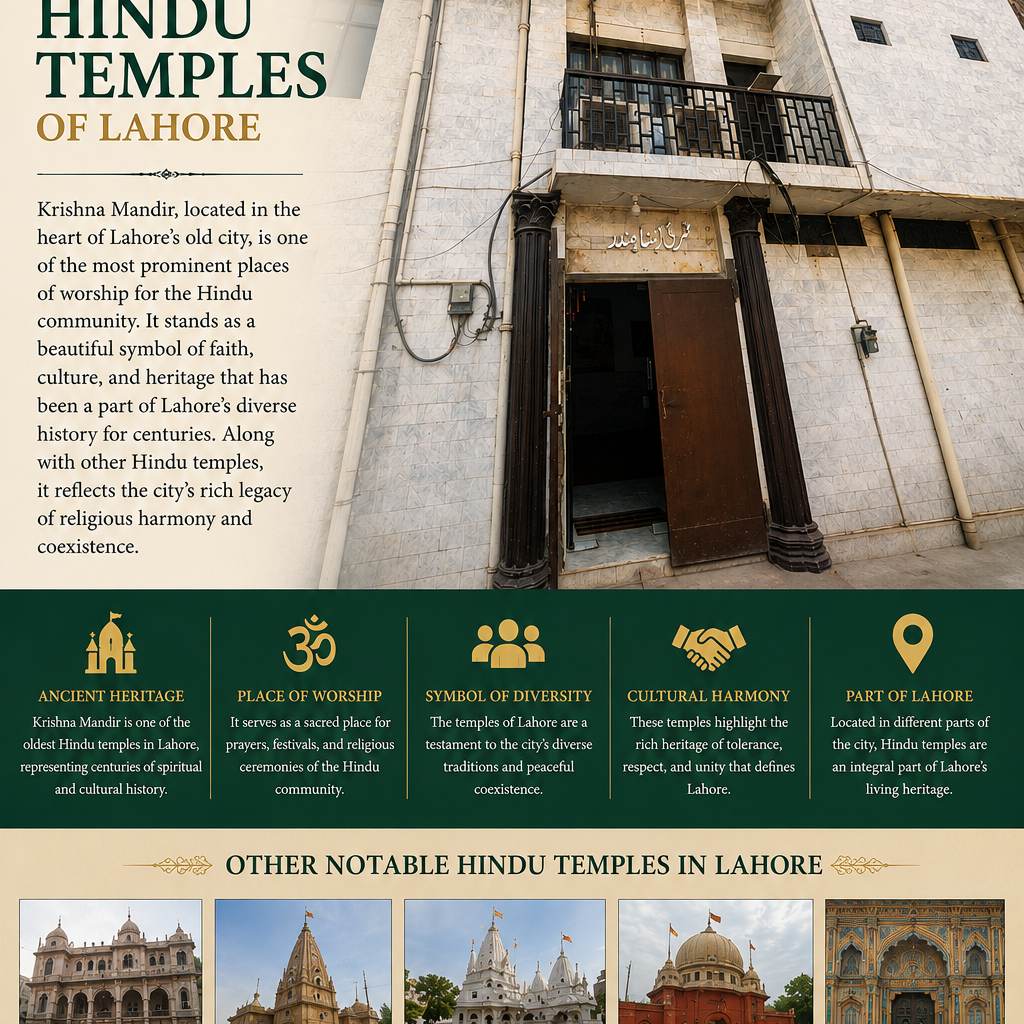
The Krishna Mandir is located on Ravi Road in Lahore. It is one of only two functioning Hindu temples in the city. The temple is dedicated to the deity Krishna and serves the small Hindu community of Lahore. The other functioning temple is the Valmiki Mandir in the Anarkali area. Lahore was once home to many Hindu temples, most of which now stand abandoned or lost. For anyone getting to know Lahore, these temples are a reminder of the diverse religious heritage of the city.
This guide explains what the Krishna Mandir is, the story of the Hindu temples of Lahore, their history and their place in the city. It treats these temples with respect as places of worship and heritage.
The Krishna Mandir
The Krishna Mandir is a Hindu temple in Lahore. It is dedicated to the deity Krishna. The temple is located on Ravi Road, opposite the Timber Market, in the northern part of the city. Ravi Road is one of the main entrances to Lahore from Shahdara, Sheikhupura and the Ring Road. The temple is one of only two functioning Hindu temples in the city today.
The temple serves the Hindu community of Lahore. It is a place where the small Hindu population of the city gathers for worship and festivals. The temple traditionally served those following the Vaishnava tradition. This tradition centres on the worship of Vishnu and his forms, including Krishna. It has been an important centre for the celebration of festivals such as Janmashtami. This festival marks the birth of Krishna.
The temple is managed by the Evacuee Trust Property Board. This is the government body responsible for the properties left behind by those who migrated at the time of the partition of 1947. The board manages and maintains the temple. It has funded renovation and extension work at the temple over the years. The temple continues to function as a place of worship under this arrangement.
The Krishna Mandir holds a special place as one of the last functioning Hindu temples in a city that once had many. The temple celebrates Diwali and other festivals with great enthusiasm. The temple stands as a living link to the Hindu heritage of Lahore. For the Hindu community of the city, it remains an important religious and community centre.
Quick answer: The Krishna Mandir is a Hindu temple on Ravi Road in Lahore, dedicated to the deity Krishna. It is one of only two functioning Hindu temples in the city, the other being the Valmiki Mandir in Anarkali. It is managed by the Evacuee Trust Property Board and serves the small Hindu community of Lahore.
Hindu heritage of Lahore
The Hindu heritage of Lahore reaches back many centuries. Lahore was once a great cosmopolitan city with a rich mix of communities. It was home to a large Hindu, Sikh and Jain population alongside its Muslim majority. Before the partition of 1947, around a third of the population of the city was Hindu or Sikh. The city contained numerous temples, gurdwaras and other places of worship.
The city was once alive with the festivals of these communities. Hindus visited temples across the city for worship. Festivals such as Dussehra, Holi and Diwali filled the streets and neighbourhoods with colour and celebration. The area around the Lakshmi Chowk and the lanes of Anarkali were centres of these celebrations. This rich religious life was part of the character of old Lahore, alongside the Muslim festivals and the great Sufi shrines.
The partition of 1947 changed this completely. The partition of British India led to one of the largest migrations in history. The vast majority of the Hindu, Sikh and Jain population of Lahore migrated to India. Many Muslims moved in the other direction from East Punjab. This great movement of people transformed the religious make up of the city almost entirely. Lahore became an overwhelmingly Muslim city.
The places of worship left behind faced an uncertain future. Many temples and other sites were abandoned after the migration. Some were repurposed as homes, schools or other buildings over the years. Others fell into ruin or were demolished. Only a small number of Hindu temples continued to function. This history explains why only two functioning Hindu temples remain in a city that once had so many.
History of the Krishna Mandir
The Krishna Mandir has served the Hindu community of Lahore through the changing fortunes of the city. It is one of the temples that continued to function after the partition of 1947, when most of the temples of the city were abandoned. It became one of the main centres of Hindu worship in the city.
The temple faced difficult moments in its more recent history. It was badly damaged in disturbances that followed the demolition of the Babri Mosque in Ayodhya in India in December 1992. These events led to tensions in the region. The temple suffered damage during this period. This was part of a wider pattern in which places of worship were caught up in the tensions of the time.
The temple was later renovated and repaired. The Evacuee Trust Property Board allocated funds for the renovation and extension of the temple in the years that followed. This work helped restore the temple as a functioning place of worship. The board continues to manage and maintain the temple. The temple has remained open for the Hindu community through these efforts.
The temple became the subject of a widely reported controversy in 2006. Media reports claimed that the temple had been demolished to make way for a commercial building. The reports drew strong reactions and legal action. The claims were later found to be incorrect. The Foreign Office confirmed that the temple was safe and intact. A petition filed over the matter was withdrawn once it was clear the temple stood. This episode drew wide attention to the temple and its importance.
Valmiki Mandir
The Valmiki Mandir is the other functioning Hindu temple in Lahore. It is located in the Neela Gumbad area of the Anarkali Bazaar. It is also known as the Nila Gumbad Valmiki temple. The temple is dedicated to the sage Valmiki, who is traditionally regarded as the author of the epic Ramayana. It is regarded as one of the oldest surviving Hindu places of worship in the city.
The temple serves a particular community. It serves the Valmiki community of the city, who have maintained their cultural and religious practices over generations. The community gathers at the temple for prayer each week. The temple has been cared for by the same family of custodians for several generations. It is both a religious site and a home for the small community it serves.
The temple has faced great hardship over the years. It was attacked and severely damaged in 1992, in the disturbances that followed the events at Ayodhya. A mob damaged the temple and its idols during this period. The temple remained in a poor state for many years afterwards. The community has continued to maintain it, largely through their own efforts.
The temple has seen recent developments in its management. The temple complex had come under the control of a local family after the partition. In 2022, the Evacuee Trust Property Board began a legal process to reclaim the temple as a property dedicated to religious use. After court proceedings, the temple was taken back into public custodianship. The board carried out basic repairs and reopened the temple to the Hindu community in August 2022.
Wider religious heritage
The Hindu temples of Lahore are part of a wider and diverse religious heritage. The city has been home to the sacred sites of many faiths over the centuries. This includes Muslim mosques and shrines, Sikh gurdwaras, Hindu temples and Jain temples. This mix reflects the long and cosmopolitan history of the city as a great centre of the wider Punjab region.
The Sikh heritage of the city is especially notable. Lahore was the capital of the Sikh Empire of Maharaja Ranjit Singh. Many Sikh sites remain in the city. Several gurdwaras continue to function or remain in good condition. These include the Gurdwara Dera Sahib near the Lahore Fort and the Samadhi of Ranjit Singh, the memorial to the Sikh ruler that stands beside the fort. These sites draw Sikh pilgrims from around the world.
The Jain community also once had temples in the city. Most of the Jain temples of Lahore are now abandoned or lost. The Neela Gumbad area was once associated with a Jain temple. These sites are a reminder of the presence of the Jain community in the city before the partition. Their loss reflects the wider changes that reshaped the religious make up of the city.
The surviving temples and sites are increasingly valued as heritage. There is growing recognition of the historical value of these places of worship. Some sites have seen restoration and greater care in recent years. These temples and shrines stand as reminders of the multicultural past of the city, when diverse faiths lived side by side. Their preservation honours the rich and layered history of Lahore.
Setting and significance
The Krishna Mandir is situated on Ravi Road in the northern part of Lahore, near one of the main entrances to the city. The Valmiki Mandir is located in the Anarkali area in the heart of the older city. These locations place the temples within the busy fabric of the city. The temples are woven into the daily life of their neighbourhoods.
The temples hold deep significance for the Hindu community of Lahore. They are the only two functioning public Hindu temples in a large city. For the small community that remains, they are vital centres of worship, festivals and gathering. They provide a place where Hindus from different areas come together to share their faith and their lives. For some, the temple serves almost as a home in the city.
The temples also hold significance for the wider heritage of Lahore. They are living reminders of the diverse religious history of the city. They stand alongside the mosques, shrines, churches and gurdwaras as part of the multi faith story of Lahore. They reflect a time when the city was home to many communities and many festivals. This heritage is part of what makes the history of the city so rich.
The temples represent the resilience of a small community. The Hindu community of Lahore has maintained its faith and its temples through great change and difficulty. The continued functioning of these temples reflects this resilience. The recent efforts to restore and protect them do the same. For anyone getting to know Lahore, the temples are part of the fuller story of the city and its many communities.
Visiting the temples
The Hindu temples of Lahore are places of worship for a small community rather than major tourist attractions. They can be visited with respect and sensitivity by those interested in the religious heritage of the city. It is important to approach them as active places of worship for the community they serve.
Visitors interested in the temples should approach them respectfully. As places of worship, modest dress is appropriate, covering the shoulders and knees. Shoes are removed before entering the temple premises. It is respectful to be mindful of worship and of the community that uses the temple. It is worth checking in advance, as access may vary and the temples are primarily for the use of the community. Guided cultural tours of the religious heritage of the city can help visitors understand these sites in their context.
The Krishna Mandir is reached via Ravi Road in the northern part of the city, near the entrance to Lahore from Shahdara. The Valmiki Mandir is in the Neela Gumbad area of Anarkali, in the older city. Both are accessible by car, taxi, rickshaw or ride hailing service. The areas around the temples can be busy, so it is worth planning the approach.
The cooler months from around October to March offer the most comfortable time to explore the religious heritage of the city. The temples can be understood alongside the wider heritage of Lahore, from the mosques and shrines to the gurdwaras and churches. Visitors are asked above all to be respectful of the communities that worship at these temples and of the sacred nature of the sites.
Places near the temples
The Hindu temples of Lahore sit within reach of many landmarks and useful places. This helps visitors plan a fuller trip. The Krishna Mandir on Ravi Road lies near the entrance to the city from Shahdara, close to the River Ravi and the route to the Tomb of Jahangir. The Valmiki Mandir in Anarkali lies close to Anarkali Bazaar and The Mall.
The Walled City with the Lahore Fort and the Badshahi Mosque lies within reach. The Samadhi of Ranjit Singh and the Gurdwara Dera Sahib stand beside the fort. Data Darbar, the shrine of Data Ganj Bakhsh, is in the central area. The Cathedral Church of the Resurrection and the Lahore Museum lie on The Mall. Mayo Hospital and Sir Ganga Ram Hospital serve the central area. These connections place the temples within the diverse religious heritage of the city.
Frequently asked questions
Where is the Krishna Mandir located? The Krishna Mandir is located on Ravi Road in Lahore, opposite the Timber Market, in the northern part of the city. Ravi Road is one of the main entrances to Lahore from Shahdara, Sheikhupura and the Ring Road.
How many functioning Hindu temples are there in Lahore? There are only two functioning Hindu temples in Lahore today. These are the Krishna Mandir on Ravi Road and the Valmiki Mandir in the Anarkali area. Lahore once had many Hindu temples, most of which were abandoned or lost after the partition of 1947.
Why are there so few Hindu temples in Lahore now? Before the partition of 1947, Lahore had a large Hindu population and many temples. The partition led most of the Hindu, Sikh and Jain population to migrate to India. Many temples were then abandoned, repurposed or lost, leaving only two functioning Hindu temples in the city.
Who manages the Krishna Mandir? The Krishna Mandir is managed and maintained by the Evacuee Trust Property Board. This is the government body responsible for the properties left behind by those who migrated at the time of the partition. It has funded renovation work at the temple over the years.
What is the Valmiki Mandir? The Valmiki Mandir is the other functioning Hindu temple in Lahore, in the Neela Gumbad area of Anarkali. It is dedicated to the sage Valmiki, regarded as the author of the Ramayana. It serves the Valmiki community and is one of the oldest surviving Hindu places of worship in the city.
Can visitors go to the temples? The temples are active places of worship for a small community rather than tourist sites. Interested visitors can approach them respectfully, with modest dress and shoes removed before entering. It is worth checking in advance, as access may vary and the temples are primarily for the use of the community.
The Krishna Mandir and the Valmiki Mandir are the last two functioning Hindu temples in Lahore, a city that once had many. The Krishna Mandir on Ravi Road is dedicated to the deity Krishna. The Valmiki Mandir in Anarkali is dedicated to the sage Valmiki. Together they serve the small Hindu community that remains in the city. They celebrate the great festivals of the faith and stand as living centres of worship and gathering.
These temples are a reminder of the diverse religious heritage of Lahore, a city that was once home to Hindu, Sikh, Jain, Muslim and Christian communities living side by side. The partition of 1947 transformed the city. Most of its temples were lost. These two survive through the resilience of the community and recent efforts to protect them. They stand alongside the mosques, shrines, churches and gurdwaras as part of the rich, multi faith story of the city. Whether understood for their faith, their history or their place in the heritage of Lahore, these temples remain an important part of the fuller story of the city and its many communities.