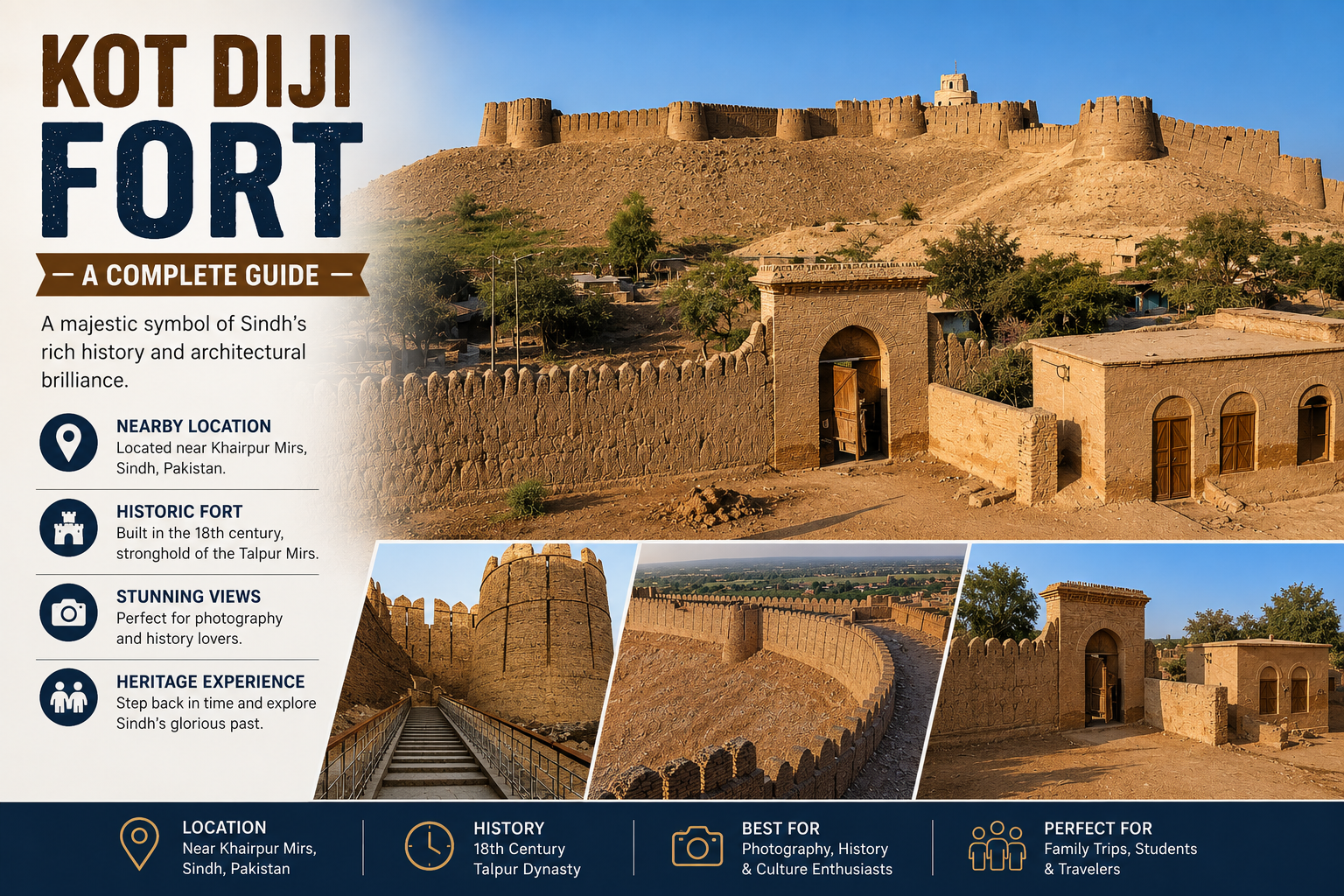
Kot Diji Fort: A Complete Guide
Kot Diji Fort is one of the finest and best preserved forts in the country. It is a great Talpur citadel of baked brick. The fort rises on a limestone ridge at the edge of the Thar Desert. Builders raised it in the late 18th century to guard the frontier of Upper Sindh. It is remarkable for its walls and towers. It is remarkable too for what lies beneath it. An ancient settlement older than Mohenjo daro rests under the hill. This guide covers Kot Diji for the curious traveller. It explains the history the defences the ancient site and how to visit.
This guide offers a general overview for planning a visit.
Quick answer: Kot Diji Fort was formerly known as Fort Ahmadabad. It is a Talpur era fort in the town of Kot Diji in the Khairpur district of Sindh. It lies around twenty two kilometres from Khairpur. Mir Sohrab Khan Talpur built it between 1785 and 1795. He founded the kingdom of Upper Sindh. The fort rises on a limestone hill about a hundred and ten feet high. Walls of baked brick and three tall towers crown it. A pre Harappan site dating to around 2500 BCE lies below.
About Kot Diji Fort
Kot Diji ranks among the best preserved forts in the country. It is a large Talpur citadel of the late 18th century. It survives remarkably well. Visitors admire it for its scale. Its walls dominate the skyline for miles around.
The fort was once called Fort Ahmadabad. That was its original name. It has long been known by the name of the town below. The name Kot Diji is often translated as the fort of the daughter.
The setting is dramatic. The fort occupies a limestone hill at the southern end of the Rohri Hills. The Indus lies about forty kilometres west. The Thar Desert begins nearby. Irrigated fields lie on one side and desert on the other. This contrast makes the position striking.
History of Kot Diji Fort
Mir Sohrab Khan Talpur built the fort. He founded the kingdom of Upper Sindh in 1783. He ordered the building of the fort to guard the frontiers of his new state. The guide to Khairpur covers this in more detail.
Construction took a decade. Work began in 1785. It took around ten years. The fort reached completion in 1795. This long effort produced one of the strongest fortifications in the region.
The fort passed down through the Talpurs. Mir Sohrab Khan made the fort his home in his later years. He then handed power to his sons. The holdings were later divided among the Talpur branches. The Khairpur branch retained its own portion.
Defences
Fort was built for the age of cannon. Kot Diji took shape when cannon had become common. Its position on a narrow ridge meant enemy guns had to fire from a great distance. Their accuracy suffered badly. Stations for cannon are built into the structure, showing real military thinking.
The walls and towers are formidable. The hill rises about a hundred and ten feet. Brick walls climb another thirty feet above it. They run for a perimeter of nearly two kilometres. Three towers of around fifty feet are placed at key points, making the fort near impregnable.
Baked brick was chosen over stone. Builders used kiln baked bricks rather than the local limestone. They thought the limestone too brittle. It was likely to shatter under cannon fire. This deliberate choice reveals how carefully the fort was planned.
The royal gate is a work of genius. The only main entrance is the Shahi Darwaza on the eastern side. Its name means the royal gate. Builders raised it on a curved plan with a small courtyard. Two heavy bastions guard the space. The heavy wooden gate is studded with iron spikes to stop elephants. Attackers would have been trapped and fired upon from above.
Ancient site below
An ancient settlement lies beneath the fort. A prehistoric mound rests under the fort. Excavators found remains of a pre Harappan settlement there. They date to roughly 2500 to 2800 BCE. This ancient site is far older than the fort itself. It predates even Mohenjo daro.
The site gave its name to a whole culture. The finds at Kot Diji were important enough to name an early phase of the Indus region. This naming marks the site as a landmark of South Asian archaeology.
The two layers make the hill remarkable. Few places bring together a Bronze Age settlement and an 18th century fortress on one hill. Four thousand years separate them. This layering of history is the great fascination of Kot Diji.
Visiting Kot Diji
The fort lies south of Khairpur. Kot Diji is around twenty two kilometres south of the city. Sukkur lies a short drive away. The main National Highway runs close by. Many visitors combine it with Khairpur and Sukkur.
Come early and in the cooler months. The fort is generally open during daylight hours. The weather in the district is hot, dry and dusty for much of the year. The cooler months from November to February are the best time. An early start leaves time to explore.
Be ready for a climb. Reaching the fort involves a walk up the hill and the ramp to the royal gate. Stairs and uneven ground follow inside. Sturdy shoes, water and sun protection are essential. A local guide helps make sense of the layout.
Frequently asked questions
Where is Kot Diji Fort located? Kot Diji Fort is located in the town of Kot Diji in the Khairpur district of Sindh. It lies around twenty two kilometres south of Khairpur. Sukkur is a short drive away. The main National Highway runs close by. The Indus lies about forty kilometres west and the Thar Desert begins nearby. The fort rises on a limestone hill at the southern end of the Rohri Hills. It is visible from a considerable distance.
Who built Kot Diji Fort and when? Mir Sohrab Khan Talpur built Kot Diji Fort. He founded the kingdom of Upper Sindh in 1783. He raised several forts to guard its frontiers. Work began in 1785 and took around ten years. The fort reached completion in 1795. It was originally named Fort Ahmadabad. Mir Sohrab Khan made it his home in his later years before handing power to his sons.
What is special about Kot Diji Fort? Kot Diji Fort ranks among the best preserved forts in the country. Its brick walls rise thirty feet above a hill of a hundred and ten feet. Three tall towers and an ingenious royal gate complete the defences. Builders designed it for the age of cannon. Gun stations and its position made it hard to bombard. A pre Harappan settlement dating to around 2500 BCE lies beneath it. That site is older than Mohenjo daro.
What is the pre Harappan site at Kot Diji? A prehistoric mound lies beneath and around the fort. Archaeologists found remains of a settlement there. They date to roughly 2500 to 2800 BCE. That places them before the mature phase of the Indus Valley Civilisation. The finds were significant enough to name an early phase of the region after the site. This makes the hill a rare place where Bronze Age remains and an 18th century fortress share the same ground.
When is the best time to visit Kot Diji Fort? The best time falls in the cooler months from November to February. The weather in the Khairpur district is hot, dry and dusty for much of the year. The fort is generally open during daylight hours. An early start gives you time to climb and explore properly. Wear sturdy shoes and carry water and sun protection. Reaching the fort involves a climb and uneven ground.
Citadel above the ancient mound
Kot Diji Fort is one of the great sights of Upper Sindh. It is a Talpur citadel of baked brick. It rises above the desert on a limestone ridge. Its walls and towers still command the country for miles around. The fort offers the curved royal gate with its spiked wooden doors. The cannon stations along the walls add to the interest. It reveals the military skill of an age when Sindh guarded its own frontiers. A settlement four and a half thousand years old lies beneath it all.
You may come to Kot Diji for its defences, its Talpur history or the ancient mound. This remarkable fort rewards the journey either way. You can climb the ramp to the royal gate. You can walk the walls for a view across irrigated fields and desert. You can consider that people lived on this hill long before the fort was imagined. You can reach it easily from Khairpur and Sukkur. Visit in winter and see four thousand years of history resting on a single hill.