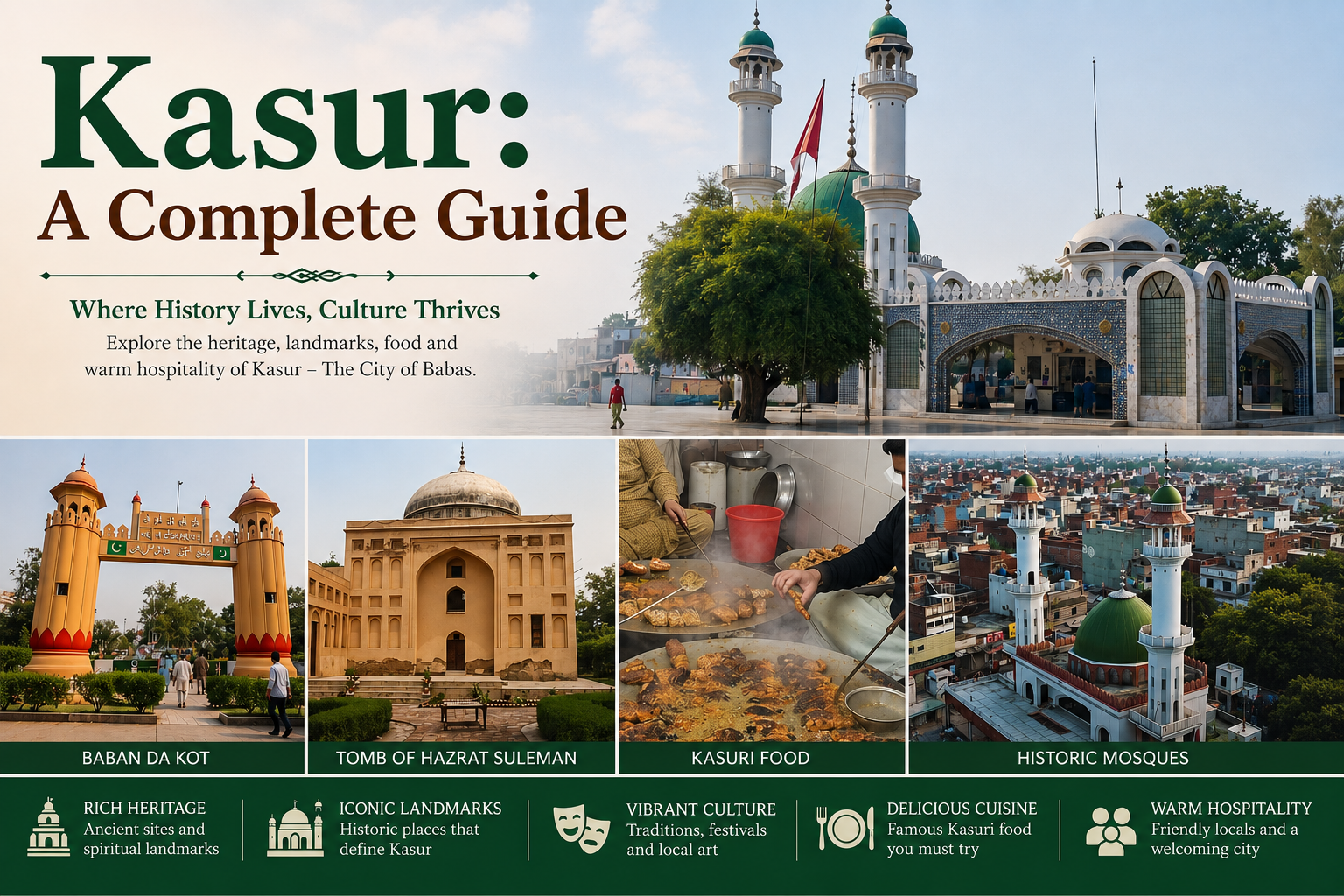
Kasur: A Complete Guide
Kasur is the city of the great Sufi poet Bulleh Shah, whose shrine draws thousands of devotees each year. It is the leather capital of the country, home to hundreds of tanneries. It lies on the border with India, near a famous flag lowering ceremony. It gave its name to Kasuri methi the fragrant fenugreek used in kitchens across the region. This guide covers Kasur for the curious traveller. It explains the history the Sufi heritage the leather trade the food the property scene and how to visit.
This guide offers a general overview. Figures for the population vary between sources.
Quick answer: Kasur is a historic city in eastern Punjab around 50 kilometres south of Lahore. It lies close to the border with India, on the plain near the Sutlej River. It is famous as the resting place of the Sufi poet Bulleh Shah. It is the leading leather and tanning centre of the country. It gave its name to Kasuri methi the dried fenugreek. The Ganda Singh Wala border once hosted a daily flag ceremony. Winter is the best time to visit.
About Kasur
Kasur is a historic city in eastern Punjab around 50 kilometres south of Lahore. It lies close to the border with India and blends deep Sufi heritage with a busy leather industry.
The setting is the flat river plain. The city lies on fertile alluvial land, with the Ravi to the north west and the Sutlej to the south east. This rich soil has long fed the district.
The name reaches into legend. Kasur is said to have been founded by Kusha a son of the Hindu figure Rama. Some trace the name instead to a Sanskrit word for a pool or lake.
The old city grew from fortified hamlets. Kasur began as a cluster of walled quarters known as kots. Some accounts count twelve, others as many as twenty six.
History of Kasur
The legendary founding ties the city to the age of Rama. The city carries a long and layered past.
The Mughals shaped the early city. A Pashtun colony settled here in the Mughal period. The Hasanzai chiefs founded a principality reaching across both banks of the Sutlej.
Ranjit Singh took the city in 1807 and brought it into his Sikh empire. This passed the town from the Pashtun chiefs to Sikh rule.
The British annexed Punjab and took Kasur, incorporating it as a municipality in 1867. It remained part of Lahore District until 1976, when Kasur was carved out as a district in its own right.
The border shaped its later story. Kasur saw fierce armoured clashes in the 1965 war, when Pakistani forces repelled advances aimed at Lahore.
Sufi heritage of Kasur
Kasur is famous as the city of Bulleh Shah. The great Sufi poet lived and worked here in the 17th and 18th centuries. His poetry preaches peace, love and spirituality. He is one of the most beloved poets of Punjab.
His shrine is the spiritual heart. The tomb of Bulleh Shah draws thousands of devotees each year. It is a major site of pilgrimage. Its own dedicated guide covers the shrine in detail.
The annual Urs is a great festival. It marks the death anniversary of the poet. Thousands gather for the music and the devotion.
Kasur became one of the great centres of Sufism in Punjab. Other saints and tombs dot the district. This spiritual heritage defines its identity.
Leather trade and industry of Kasur
Kasur is the leather capital of the country. It grew into the primary tanning hub by the 1970s. A handful of small workshops at independence swelled into hundreds of tanneries. Much of the leather is made for export. The trade is the backbone of the local economy.
Agriculture underpins the district. The canal watered plains grow wheat, cotton, rice and sugarcane. Farming employs much of the rural population.
Other industry fills the district, from cotton ginning and oil pressing to weaving, sugar mills and industrial estates.
Food and culture in Kasur
Kasur gave its name to Kasuri methi. This is the dried fenugreek used across the region. Kitchens in Pakistan and India prize its aroma. The name ties the herb directly to the city.
Kasuri fried fish is famous across Punjab. It is known for its bold, spicy flavour. Food lovers travel here to taste it.
The sweets and falooda delight. Kasur is famous for its falooda a chilled dessert of milk and vermicelli along with sweets such as andrassa. The city is also the birthplace of Noor Jehan the legendary singer and actress who remains a great cultural icon.
Border and the sights in Kasur
Ganda Singh Wala lies on the border. This crossing once hosted a daily flag lowering ceremony and served as the main border point until 1986. It still draws visitors for the spectacle, set among the scenic fields of the Sutlej plain.
Changa Manga lies in the district. It is one of the largest planted forests in the country. It offers a green escape with a lake and a wildlife park. Its own dedicated guide covers the forest.
The old city rewards a wander. The shrine the bazaars and the old kots fill it, with Mughal and colonial buildings layering its streets.
Property market of Kasur
The property market is steady. The link to Lahore drives much of the demand as the city lies within easy reach of the metropolis by road and rail. It offers value beside the metropolis. Commuters and traders look here for homes.
New housing schemes are spreading around the old city and the main roads. Demand rises with the growth of the district. The old city offers heritage and trade. New schemes offer modern living, while the rural fringe offers agricultural land.
Visiting Kasur
Come in winter. The plains are very hot in summer, so the winter months from November to February are the finest season for a visit.
Visit the shrine of Bulleh Shah the spiritual heart of the city, where the evening devotions are especially moving. Timing a trip with the annual Urs offers a powerful experience, though the city fills quickly then.
Taste the local food. The fried fish and the falooda are the great draws, so seek out the famous old spots that food lovers cherish.
Frequently asked questions
Who was Bulleh Shah and why is he linked to Kasur? Bulleh Shah was one of the greatest Sufi poets of Punjab, who lived and worked in Kasur in the 17th and 18th centuries. His poetry preaches peace, love and spirituality. It remains deeply loved across the region. His shrine in Kasur is a major site of pilgrimage, drawing thousands of devotees each year. The annual Urs marking his death anniversary fills the city with music and devotion. His dedicated guide covers the shrine in detail.
What is Kasur famous for? Kasur is famous as the resting place of the Sufi poet Bulleh Shah, with his shrine at the heart of the city. It is the leading leather and tanning centre of the country, home to hundreds of tanneries. It gave its name to Kasuri methi the dried fenugreek used in kitchens across the region. Its spicy fried fish and its falooda are much loved specialities. It is also the birthplace of the legendary singer Noor Jehan.
Why is Kasur the leather capital of Pakistan? Kasur grew into the primary tanning hub of the country by the 1970s. The industry began with a handful of small workshops at independence and swelled into hundreds of tanneries over the decades. These process hides for export and form the backbone of the local economy. The trade runs alongside agriculture and other industry such as cotton ginning and oil pressing. The concentration of tanneries makes Kasur the leather capital of the country.
What is Kasuri methi? Kasuri methi is dried fenugreek leaves a fragrant seasoning that takes its name directly from Kasur. It is prized in kitchens across Pakistan and India for the aroma it lends to curries and breads. The link between the herb and the city is a point of local pride. Kasur is also famous for other culinary specialities, including its bold, spicy fried fish and its falooda a chilled dessert made with milk and vermicelli.
When is the best time to visit Kasur? The best time to visit Kasur is winter, from November to February, when the weather is pleasant. The plains are very hot in summer, with the monsoon bringing flooding near the Sutlej. Winter suits a visit to the shrine of Bulleh Shah the old city and the nearby Changa Manga forest. Timing a trip with the annual Urs of Bulleh Shah offers a powerful experience, though the city fills quickly then.
City of the poet and the tanners
Kasur is a city of poetry and craft. It cradles the shrine of Bulleh Shah, whose verses still move the whole of Punjab. It tans the leather that clothes and shods the country. It flavours kitchens far away with the fenugreek that bears its name. It guards the border where the flag once came down each dusk. Few cities blend such devotion with such industry.
You may come to Kasur for the shrine the leather or the food. The city rewards the visit either way. You can bow at the tomb of the great Sufi poet. You can taste the spicy fish and the cool falooda. You can watch the fields stretch to the border at Ganda Singh Wala. Come in winter and let the poetry and the industry meet. Kasur is the city of the poet and the tanner.