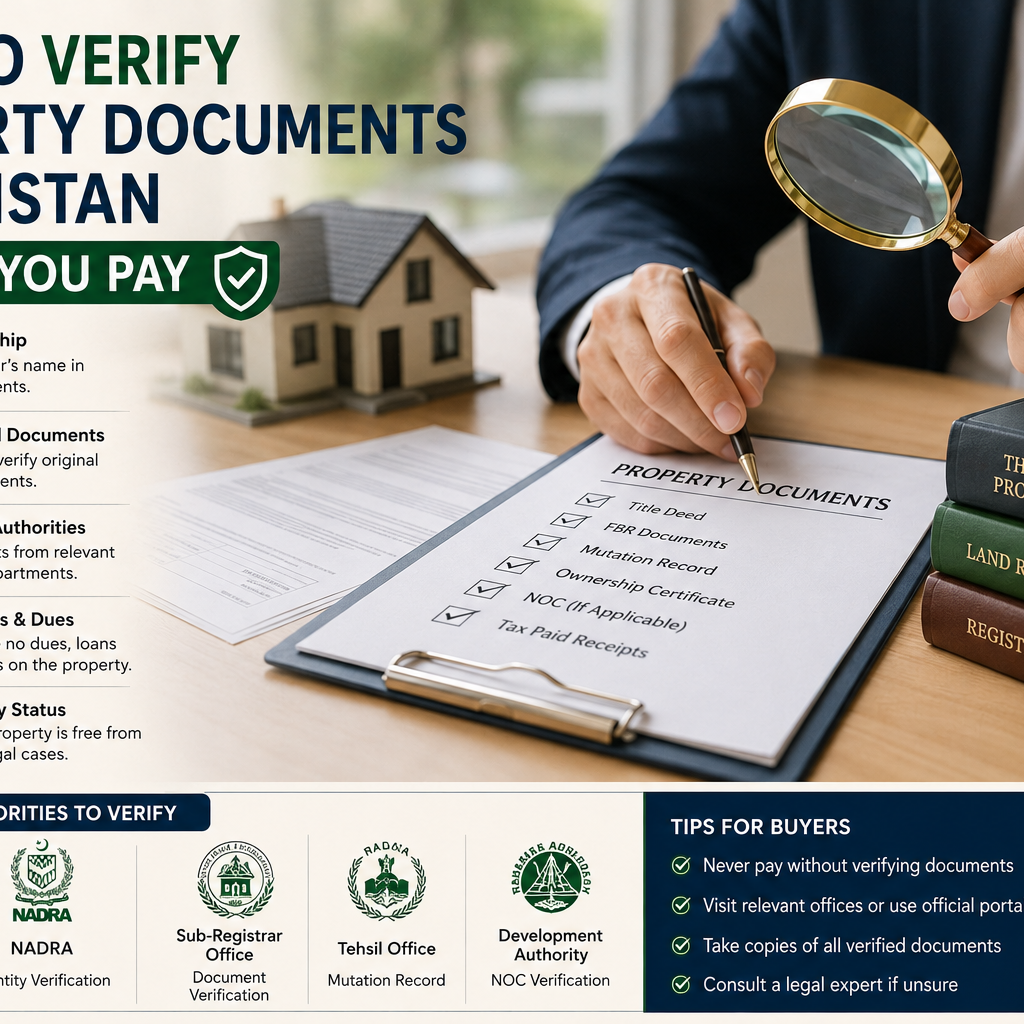
How to Verify Property Documents in Pakistan Before You Pay
Property fraud in Pakistan almost always comes back to one thing: the buyer did not check the papers properly. The house looked fine. The seller seemed honest. The price was fair. None of that protects you if the documents are fake, incomplete or hiding a dispute.
Verifying documents is the most important part of any property deal. It is also the part most people rush. This guide explains which papers matter, how to read them and where to confirm that each one is genuine. Do this work before you hand over a single rupee.
Why document checks come first
A property deal moves fast once both sides agree on a price. Token money changes hands, dates get set and suddenly you feel committed. That pressure is exactly why the checks must come early, before you are emotionally and financially tied in.
A genuine seller will not mind you verifying everything. Someone who resists, rushes you or makes excuses about missing papers is showing you a warning sign. Trust the documents, not the personality.
The Fard or record of rights
The Fard is the foundation. It is the record of rights held in the official land register and it shows who legally owns the property.
When you receive a Fard, check the owner's name against the seller's CNIC. They must match. If the seller's name does not appear, ask why. Perhaps the property was inherited or bought but never properly transferred. Either way, the chain of ownership must be clear and complete.
Look at the date and the details. A fresh Fard, issued close to the time of your purchase, is more reliable than an old one, because ownership can change. Where possible, obtain the Fard yourself from the official source rather than accepting a copy the seller hands you. A document supplied by the seller alone can be altered.
The Intiqal or mutation
The Intiqal records the transfer of a property from one owner to the next. Each time land changes hands in the revenue record, a mutation is entered.
Reviewing the mutation history shows you the chain of ownership over time. A clean chain, where each transfer flows logically to the next, gives confidence.
Pay attention to inherited property especially. When an owner dies, the property passes to the legal heirs and a mutation should reflect that. If one heir tries to sell the whole property without the others agreeing, you are walking into a dispute. Confirm that every rightful heir consents to the sale.
Registry or sale deed
Registry is also called the sale deed which is the legal document that records a sale. It is signed and registered at the time of transfer for property in the general record.
If the seller bought the property through a registered sale deed, ask to see it. It confirms how they came to own the property and on what terms. A registered document carries more weight than an unregistered agreement, because it sits in the official record.
Check that the details on the registry match everything else: the same plot, the same measurements, the same owner. Inconsistencies between documents are a classic sign that something is wrong.
Society documents for plots and houses in schemes
If you are buying inside a housing society, the paperwork looks a little different and the society office holds the master record.
The allotment letter shows who the society allotted the plot or house to. The transfer letter records later changes of ownership. Together they form the chain within the society. Take these to the society office and ask them to confirm, from their own files, that the seller is the current owner and that the property is clear.
This step matters because society records and the documents in a seller's hand do not always agree. Only the society's own record is final. Verify there, not just on paper.
Confirm the society itself is legal
A perfect set of papers means nothing if the society has no right to sell.
Before you trust any society document, confirm that the society is approved by the relevant development authority and that your specific block or phase is part of the sanctioned layout. An unapproved scheme can be sealed or left without services for years and the documents it issues carry no real protection.
Check this directly with the development authority that governs the area. Do not rely on the society's marketing or its confident staff. The authority's record is the one that counts.
Use the online verification systems
Several provinces now let you check land records online, which has made verification far easier than it used to be.
In Punjab, the Punjab Land Records Authority maintains computerised records and its Arazi Record Centres let you obtain and verify a Fard. Sindh and other provinces have their own systems at various stages of development. These tools let you confirm ownership without depending entirely on the seller.
Use them where they exist. An online or office issued record, pulled by you, is far safer than a printout the seller provides. When the digital record and the seller's papers disagree, believe the official record.
Check for loans, mortgages and charges
A property can look clean while carrying a debt against it. You need to rule this out.
Ask whether the property is mortgaged to a bank or pledged against any loan. A mortgaged property cannot transfer cleanly until the loan is cleared. If a bank has a charge over it, that must be settled and removed before you buy, with proof.
Confirm this in the record where possible, not just by asking. A seller in financial trouble has every reason to stay quiet about a loan. Your job is to find out before your money is involved.
Look for disputes and court cases
A property tied up in litigation is a trap, however good it looks.
Ask directly whether any court case touches the property. Inheritance fights, boundary quarrels and ownership challenges are all common. A property under dispute may be subject to a stay order that blocks any transfer and you could be buying a lawsuit rather than a home.
If you have any doubt, a property lawyer can help check whether litigation is attached to the property. The cost of that check is tiny next to the cost of being dragged through the courts.
Verify utility bills and dues
Smaller dues can still become your problem after purchase, so clear them up front.
Ask for recent electricity, gas and water bills and confirm they are paid. Unpaid utility dues can transfer with the property and land on the new owner. In a society, ask about pending development charges and maintenance dues as well, because these often follow the property rather than the person.
Get a clear statement of what is owed and what is paid. Make settling any outstanding amount a condition of the deal.
Read a power of attorney with extra care
Sometimes the person selling is not the owner but acts under a power of attorney. This is legal, but it is also a common route to fraud.
If a power of attorney is involved, confirm that it is genuine, valid and specific to this property and this transaction. Check that it has not expired or been revoked. An attorney granted years ago or written in vague terms, should make you pause.
Where the stakes are high, verify the attorney through proper channels and involve a lawyer. Forged and misused powers of attorney have cost many buyers dearly. Treat every one with suspicion until proven sound.
Match the documents to the ground
Paper and reality must agree. A surprising number of frauds fall apart the moment someone visits the site.
Take the documents to the property. Confirm the plot number, the block, the measurements and the boundaries against what the papers claim. For a built house, check that the construction matches any approved plan. A plot that is smaller than stated or sits in a different spot than the file shows, is a problem you want to find now.
If you cannot reconcile the documents with the actual property, do not proceed until you can.
Bring in a property lawyer
For most buyers, the safest single step is to have a property lawyer review the full set of documents before paying.
A lawyer can confirm the ownership record, trace the chain of transfers, check for loans and litigation and read the agreement for weak points. They know the local pitfalls and the tricks that catch ordinary buyers. The fee is small set against the value of the property and the peace of mind is worth far more.
This is not a sign of distrust. It is simply how careful buyers protect themselves.
Keep your own file of everything
From the first payment onward, keep a record of every document and receipt.
Hold copies of the Fard, the mutation, the registry or society papers, the agreement and every receipt for money paid. Note the dates and the people involved. If a question ever arises, this file is your evidence. Organised records have settled many disputes before they reached a courtroom.
Red flags that should stop you
A few signs deserve special attention, because they appear again and again in fraud cases.
Be wary if the seller refuses to let you verify documents, pushes you to pay quickly or keeps making excuses about missing papers. Be wary if the price is far below the going rate for no clear reason. Be wary if the names on different documents do not match or if the seller cannot explain how they came to own the property.
Any one of these on its own is reason to slow down. Two or more together is reason to walk away.
Take special care with inherited property
Inherited property deserves its own warning, because it causes a large share of ownership disputes.
When an owner dies, the property passes to the legal heirs under inheritance law. Each heir holds a share. Problems begin when one heir tries to sell the whole property or a larger share than they own, without the others agreeing. A buyer who pays in this situation can end up part owner with several strangers, all entitled to a piece of the property.
Before buying inherited property, ask to see how the inheritance was recorded. Confirm that every legal heir consents to the sale and signs the agreement. If any heir is missing, a minor or living abroad, the matter grows more complicated and needs legal guidance. Never accept assurances that the absent heirs will agree later. Get their consent first, in writing or do not proceed.
Confirm measurements and approved plans
For built property, the documents should match the actual structure and that is not always the case.
Many houses have extra construction added over the years without approval. An unapproved extension can create problems later, including penalties or orders to remove it. Compare the approved building plan, where one exists, with the house as it stands. For a plot, confirm the measurements on the ground match the documents exactly. A mismatch between paper and reality is always worth questioning before you pay.
Final thoughts
Verifying property documents is not glamorous and it takes patience. It is also the single best thing you can do to protect your money. Confirm ownership through the Fard and the official record. Trace the chain of transfers. Rule out loans and disputes. Match every paper to the ground and bring in a lawyer when the stakes are high.
A genuine seller and a clean property will pass these checks without trouble. A fraud will not survive them. That is exactly why the checks exist and why no buyer should ever skip them. Spend the time now and you buy with confidence instead of crossing your fingers.