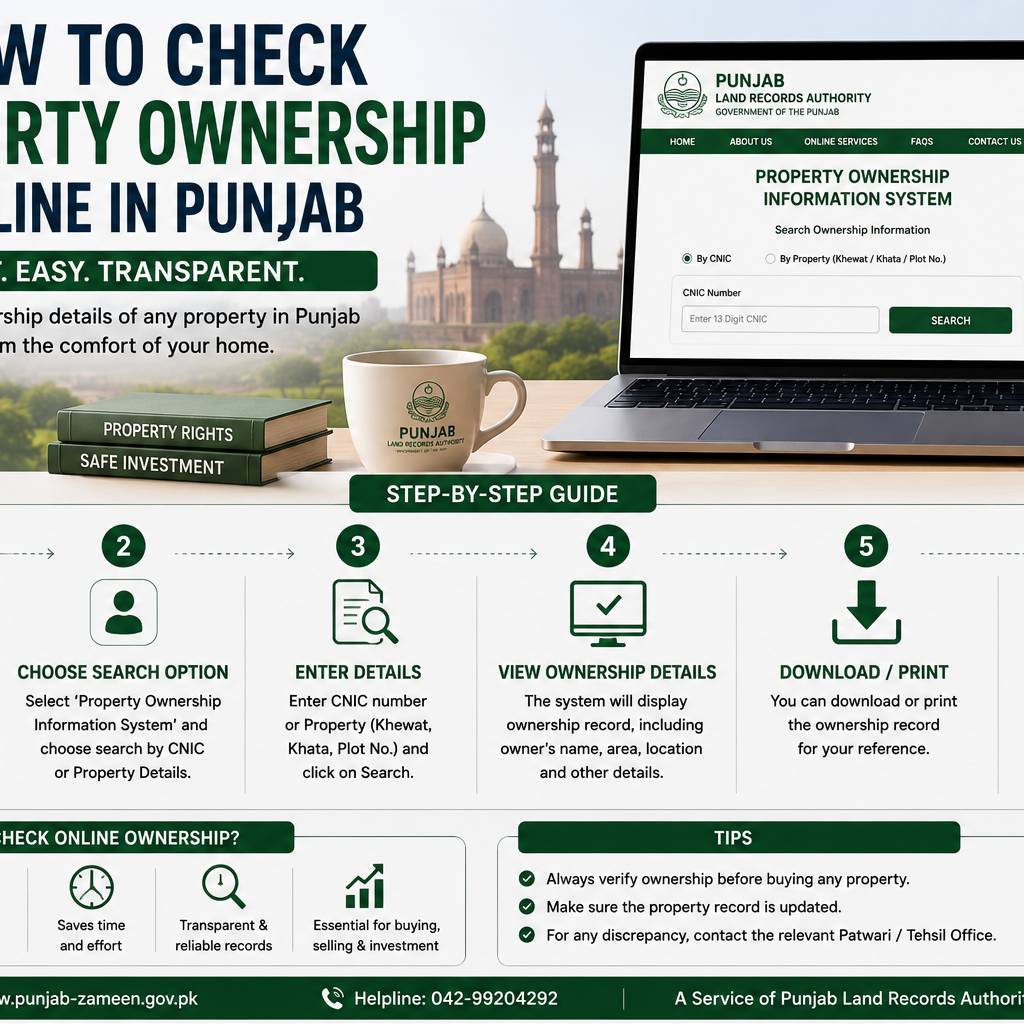
How to Check Property Ownership Online in Punjab
For years, checking who owned a piece of land in Punjab meant visiting offices, dealing with record keepers and hoping the paper you received was genuine. The process was slow and open to manipulation. That has changed. Punjab now keeps computerised land records and buyers can verify ownership far more easily than before.
This shift matters because so much property fraud begins with a false claim of ownership. Being able to check the record yourself, rather than trusting the seller's word, is one of the strongest protections a buyer has. This guide explains how property ownership can be checked in Punjab and how to use that information wisely.
Why checking ownership online matters
The single most important question in any property deal is whether the seller actually owns what they are selling. Get this wrong and everything else falls apart.
Being able to check ownership through official computerised records removes much of the guesswork. It lets you confirm the recorded owner without relying solely on documents the seller hands you, which could be altered. This independence is powerful. A fraud depends on you trusting false papers and an official record check breaks that dependence. For any buyer in Punjab, learning to verify ownership through the official system is a basic and valuable step in protecting their money.
The Punjab Land Records Authority
Punjab's land records are managed through a computerised system overseen by the Punjab Land Records Authority. This system has digitised much of the province's land record.
The authority maintains computerised records of land ownership, replacing much of the old manual, paper based system that was prone to errors and manipulation. Through this system, the record of rights for a property, the Fard, can be obtained and verified. The move to computerised records has made checking ownership faster, more reliable and harder to tamper with. Understanding that this system exists is the first step. It is the official source for confirming who owns land in Punjab and it is the record that carries weight.
The Arazi Record Centres
Alongside the online system, Punjab operates Arazi Record Centres, which are service centres for land records. These play a central role in verification.
The Arazi Record Centres allow people to obtain and verify land records, including the Fard, from the computerised system. They serve as a reliable point for getting an official record rather than depending on a copy supplied by the seller. Visiting a centre or using the official online facilities, lets you obtain a current record for the property you are interested in. For buyers, these centres are a trustworthy way to confirm ownership. They form part of the same modernised system that has made land records in Punjab far more dependable than in the past.
What information the record shows
When you obtain an official record for a property, it tells you the things a buyer most needs to know. Understanding what it shows helps you read it.
The record of rights shows the recorded owner of the property, which is the key fact you are checking. It reflects the ownership held in the official, computerised land record. By obtaining a current record, you can confirm whether the person selling matches the recorded owner. This is the heart of verification. The record gives you an independent picture of ownership, drawn from the official system rather than from the seller. Reading it carefully and matching the owner's name to the seller's identity, is how you confirm that the seller has the right to sell.
How the online checking works in practice
The practical process of checking ownership in Punjab centres on obtaining the official record. Here is the general approach.
You identify the property by its details, such as the location and the relevant record identifiers. Through the computerised system, whether online or at an Arazi Record Centre, you obtain the record of rights for that property. The record shows the current ownership held in the official system. You then compare the recorded owner against the person selling to you. Because the system is computerised, the record is drawn from the official database rather than from a potentially altered paper copy. The exact steps and facilities can change over time, so it is wise to use the current official channels and confirm the process as it stands when you need it.
Always match the owner to the seller
The point of checking ownership is to confirm the seller has the right to sell. This matching step is essential, so do it carefully.
Compare the name of the recorded owner with the CNIC of the person selling to you. They must match. If they do not, ask why and do not proceed until you have a clear, verified explanation. Perhaps the property was inherited or bought but not properly transferred, in which case the record and the chain of ownership need careful examination. A mismatch between the recorded owner and the seller is a serious warning sign. Never ignore it. This simple comparison, made against the official record, catches many attempted frauds before any money changes hands.
Obtain a current record, not an old one
The timing of your check matters, because ownership can change. A fresh record is far more reliable than an old one.
Always obtain a current record of rights, drawn close to the time of your purchase. An old record may not reflect a recent change of ownership, a new mortgage or another development. By checking the record shortly before you commit, you see the most up to date official position. This is especially important just before completing a transfer, when you want to confirm nothing has changed. A current, freshly obtained record is one of your best protections. Do not rely on a record obtained weeks or months earlier, since the situation may have moved on.
Use the official record over the seller's copy
A central benefit of the computerised system is that it lets you rely on the official record rather than the seller's documents. Always prefer the official source.
A seller can supply a copy of a document that has been altered or is out of date. The official, computerised record, obtained by you through the proper channels, is far harder to manipulate. Whenever there is any difference between the seller's papers and the official record, believe the official record. This is one of the most important habits a buyer can develop. The whole value of the modernised system lies in giving you an independent, trustworthy source. Use it and do not let a seller's confident assurances override what the official record shows.
What online checking does not replace
As useful as online checking is, it does not cover everything. Understanding its limits keeps you from relying on it alone.
Confirming the recorded owner is essential, but a full verification involves more. You should still trace the chain of ownership, check for loans, mortgages and disputes, confirm the property against its physical reality and measurements and check for any litigation. For property in a private society, the society's own records apply rather than the revenue record. Online checking of ownership is a powerful tool, but it is one part of proper verification, not the whole of it. Combine it with the other checks and with professional help where the stakes are high, for complete protection.
Combining online checks with professional help
For many buyers, especially first timers or those dealing with valuable or complex property, combining online checks with professional help is the safest approach.
A property lawyer can confirm the record, trace the chain of ownership, check for loans and disputes and read the documents for problems. They know how to use the official records and what else to examine. The online system gives you independent confirmation of ownership and a lawyer ensures the full picture is sound. The modest fee for professional help is small against the value of the property and the cost of a mistake. Using both the official records and professional guidance gives you the strongest possible protection in a property purchase.
How other provinces compare
Punjab has led in computerising land records, but it is worth knowing how the wider picture looks. The systems differ across provinces.
Other provinces have their own land record systems, at various stages of modernisation. Some have made progress in computerising records while others rely more on traditional methods. The principle remains the same everywhere: confirm ownership through the official record rather than the seller's word. While Punjab's system is among the more developed, buyers in every province should seek the most reliable official source for confirming ownership in their area and combine it with the other checks that full verification requires.
Wider benefits of computerised records
The move to computerised land records has brought benefits beyond just checking ownership. Understanding these helps you appreciate the system's value.
Computerised records reduce the errors and manipulation that plagued the old manual system. They make obtaining a record faster and more convenient. They also create a more reliable, central source of ownership information which supports cleaner transactions and reduces disputes. It means a more trustworthy way to verify what they are buying for individual buyers. The system is part of a broader improvement in how property ownership is recorded and protected in Punjab.
Staying alert to fraud despite the system
The computerised system has made fraud harder but it has not ended it. Staying cautious remains essential, even with better records available.
Fraudsters adapt and some still attempt to deceive buyers despite the modernised records. This is why you should always obtain the record yourself through official channels, match the owner to the seller carefully, get a current record and remain cautious of any pressure to skip these steps. The system is a strong tool, but only if you use it properly and combine it with general caution. A buyer who relies on the official record, verifies thoroughly and refuses to be rushed is well protected. The technology helps, but your own care remains your best defence.
Final thoughts
The move to computerised land records in Punjab has given buyers a powerful tool for verifying ownership. Through the Punjab Land Records Authority's system and the Arazi Record Centres, you can obtain an official record of rights and confirm who owns a property, rather than relying solely on the seller's documents.
To use this well, obtain a current record yourself through official channels, match the recorded owner to the seller carefully and trust the official record over any copy the seller provides. Remember that checking ownership is one part of full verification, alongside tracing the chain of title, checking for loans and disputes and confirming the property's physical reality. Combine the official records with professional help for valuable or complex purchases. Used properly, online ownership checking is one of the strongest protections a buyer in Punjab has against fraud and learning to use it is well worth the effort.