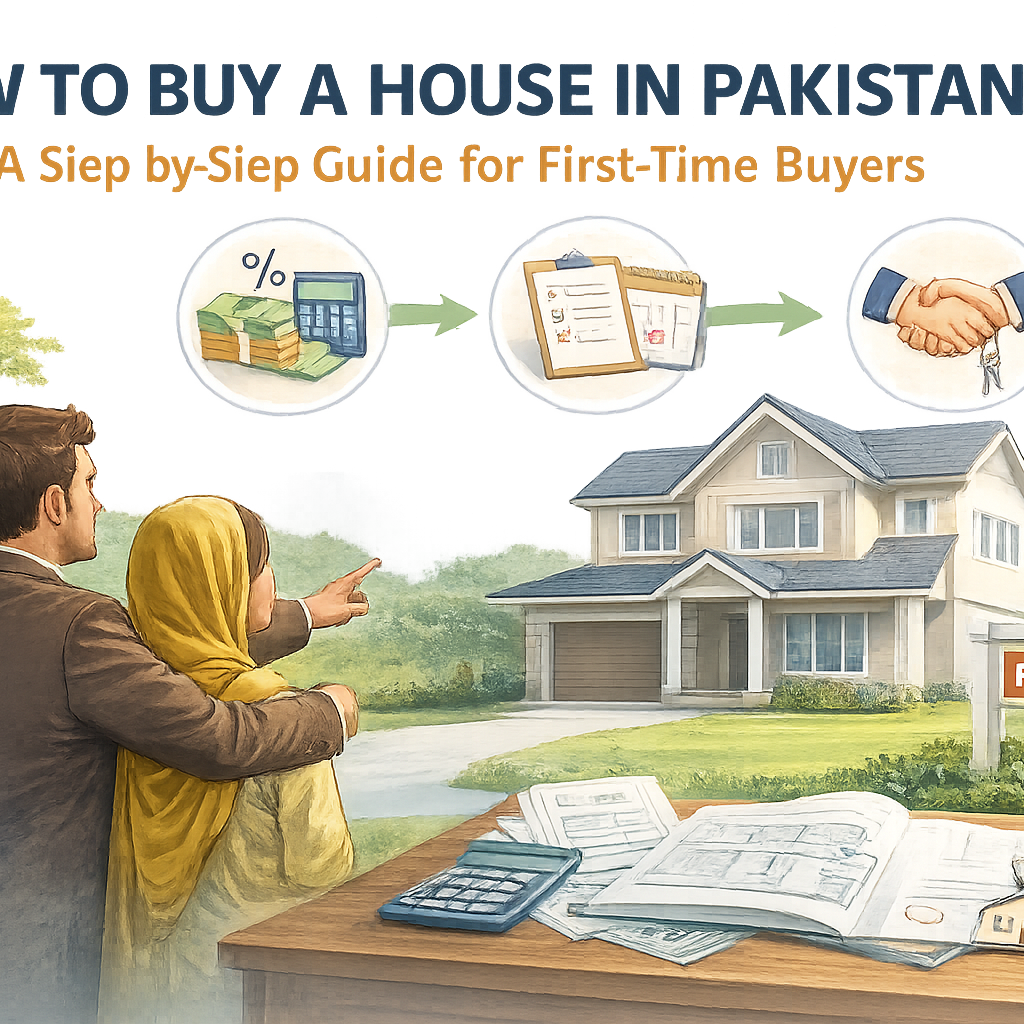
How to Buy a House in Pakistan: A Step by Step Guide for First Time Buyers
Buying your first home in Pakistan is a big moment. It is also a process with plenty of room for costly mistakes. Prices are high, paperwork can be confusing and not everyone you deal with will be honest. The good news is that the steps are knowable. Once you understand the order they come in, the whole thing feels far less daunting.
This guide walks you through buying a house from start to finish. It is written for people doing this for the first time, so nothing is assumed. Take it slowly and tick off each stage before moving to the next.
Work out what you can really afford
Start with your budget, not with the houses. It is tempting to browse listings first, but that only sets expectations you may not be able to meet.
Look at how much cash you have ready. Then add anything you can borrow safely, whether from a bank or family. A house costs more than its sticker price, so leave room for the extras. Transfer taxes, registration charges, agent commission and the cost of small repairs can add a noticeable amount on top of the purchase price.
A sensible rule is to keep a cushion of at least eight to ten per cent of the property value for these costs. If you are buying a 50 lakh house, that means setting aside roughly four to five lakh for everything around the deal. Stretching yourself to the last rupee is risky. Something always comes up.
Decide what you want and where
Once you know your number, you can think about the type of home. A small house on a 5 marla plot suits a young family on a tight budget. A 10 marla or 1 kanal house gives more space but costs far more, both to buy and to run.
Location matters as much as the house itself. A modest home in a well planned society can hold its value better than a larger one in an area with poor roads, water problems or weak security. Think about your daily life too. How far is work? Are there schools nearby? Is there a hospital within reach? These things shape how happy you will be once you move in.
Visit areas at different times of day before deciding. A street that feels calm on a Sunday morning can be noisy and crowded on a weekday evening. Talk to a few residents if you can. They will tell you things no listing ever will.
Begin the search
Now you can look at actual properties. Online portals are the easiest place to start. You can filter by city, society, size and price, which saves a lot of running around. Note down a shortlist and arrange visits.
You may also work with a property dealer. A good local dealer knows which homes are genuinely for sale and which owners are serious. Be clear about your budget and needs so they do not waste your time. Keep in mind that dealers earn commission, usually around one per cent from each side, so factor that in.
When you view a house, look past the fresh paint. Check the water pressure. Switch on the taps and the lights. Look at the ceilings for damp patches and cracks. Ask about the age of the construction and whether the roof has ever leaked. A house can be dressed up to hide problems, so a careful eye pays off.
Verify the legal record before anything else
Never trust a property's ownership on the seller's word alone. You must check the official record. The most important document is the Fard which is also called Fard e Malkiat. In Punjab, you can verify land records through the Punjab Land Records Authority and its Arazi Record Centres.
For property inside a housing society such as DHA or Bahria Town, the society's own office holds the ownership record and the transfer happens through them. Always confirm that the name on the record matches the person selling to you. Check that the property is free of disputes.
Ask whether it is mortgaged, whether there is any court case attached to it and whether all dues and utility bills are clear. A property with an unpaid loan against it cannot be transferred cleanly until that loan is settled. If anything feels off, stop. It is far cheaper to walk away than to fight a legal battle later.
Understand the key documents
A few terms come up again and again and knowing them keeps you in control.
The Fard, as mentioned, proves ownership. The Intiqal or mutation, is the record of a transfer from one owner to the next. The registry or sale deed, is the legal document that records the sale and is signed at the time of transfer. For society plots and houses, you will also hear about the allotment or transfer letter, which the society issues to confirm ownership.
You do not need to memorise the law. You do need to make sure each document exists, is genuine and names the correct people. If you can, have a property lawyer review the papers before you pay any large sum. The fee for this is small next to the price of the house.
Make an offer and pay token money
When you find the right house and the papers check out, you make an offer. Some negotiation is normal. Sellers often quote a little above what they expect, so a polite counter offer is rarely taken badly.
Once you agree on a price, you usually pay a small token amount to hold the property. This signals that you are serious and asks the seller to stop showing the house to others. Get a written receipt for this money. Never hand over cash without proof.
Sign the agreement to sell
After the token, you move to a written agreement, often called bayana. This sets out the agreed price, the amount already paid, the balance due and the date by which the deal must complete.
The agreement should also state what happens if either side backs out. Usually, if the buyer walks away, the token is forfeited. If the seller walks away, they return the token, sometimes with a penalty. Read these terms carefully and make sure both parties sign.
Keep witnesses on this document. Their signatures add weight if a dispute ever arises.
Arrange your money or financing
By now you know exactly how much you need and when. If you are paying in full from savings, make sure the funds are ready and accessible.
If you need a home loan, start the bank process early, because approval takes time. Several banks in Pakistan offer home financing and the State Bank has run schemes to support first time buyers in the past. Banks will check your income, your existing debts and the property itself before approving anything. Gather your salary slips, bank statements and tax records in advance to speed things up.
Compare offers from more than one bank. The profit rate, the processing fee and the repayment terms vary and small differences add up over many years.
Go through the transfer
The transfer is where ownership officially passes to you. The exact venue depends on the property.
For general property, the transfer happens at the office of the sub registrar or the relevant land record centre, where the sale deed is registered. For property inside a society, you both attend the society office and complete their transfer process. The society then issues the transfer in your name.
You and the seller usually need to appear in person with your original CNICs. Photographs and biometric verification are common now, which helps cut down on fraud. The balance payment is typically handed over at this stage, so plan the timing carefully. Many buyers pay by pay order or banker's cheque rather than cash, as it leaves a clear record.
Once the transfer is done, collect every document with your name on it. Keep the originals safe and make photocopies for your own file.
Budget for taxes and fees
Several charges fall due at the time of purchase and they are not small.
You will pay stamp duty and a registration fee, which are calculated on the property's value. There is also a withholding tax on the buyer and the rate depends on whether you are a tax filer or a non filer. Filers pay less. If you are not already on the Active Taxpayers List, becoming a filer before you buy can save you a real amount of money.
The value used for these taxes is usually based on official rates set by the authorities, such as the FBR valuation tables and the district rates. These figures are revised from time to time, so check the current rates close to your purchase date rather than relying on old numbers. A property lawyer or a reliable dealer can give you the up to date position.
Agent commission is separate again. Agree the percentage in advance so there are no surprises at the end.
Take possession and settle in
After the transfer, you take possession of the house. Walk through it one last time before the seller hands over the keys. Confirm that nothing agreed has been stripped out, such as fixtures or fittings that were part of the deal.
Get the utility connections put in your name. Transfer the electricity, gas and water accounts and clear any outstanding bills so they do not become your problem. Update the property tax record with the local authority as well.
It is worth changing the locks once you move in. You never know how many keys are floating around from the previous owner.
A note for overseas Pakistanis
If you live abroad and want to buy back home, the steps are the same, but you will likely act through someone you trust. This is done with a power of attorney, a legal document that lets a named person act on your behalf.
Be very careful here. A power of attorney is powerful and it has been misused before. Limit what it covers, keep it specific to the one transaction and use a lawyer to draft it. Wherever possible, verify the property and the paperwork yourself, even from a distance, before sending money.
A few mistakes to avoid
First time buyers tend to repeat the same errors and most are easy to dodge.
Do not skip the legal verification to save time. Do not pay large sums in cash without receipts. Do not sign documents you have not read. Do not rush because a dealer says the deal will vanish by tomorrow. Pressure is often a tactic, not a fact.
Above all, do not let excitement override caution. A house is likely the biggest purchase of your life. A few extra days spent checking things is always worth it.
Final thoughts
Buying a house in Pakistan is not simple, but it is manageable when you take it one step at a time. Sort your budget, choose your area with care, verify every document and complete the transfer properly. Keep records of everything and lean on a trustworthy lawyer when the paperwork gets heavy.
Do this and the keys you collect at the end will come with peace of mind, not a string of regrets. That is the whole point of getting it right the first time.