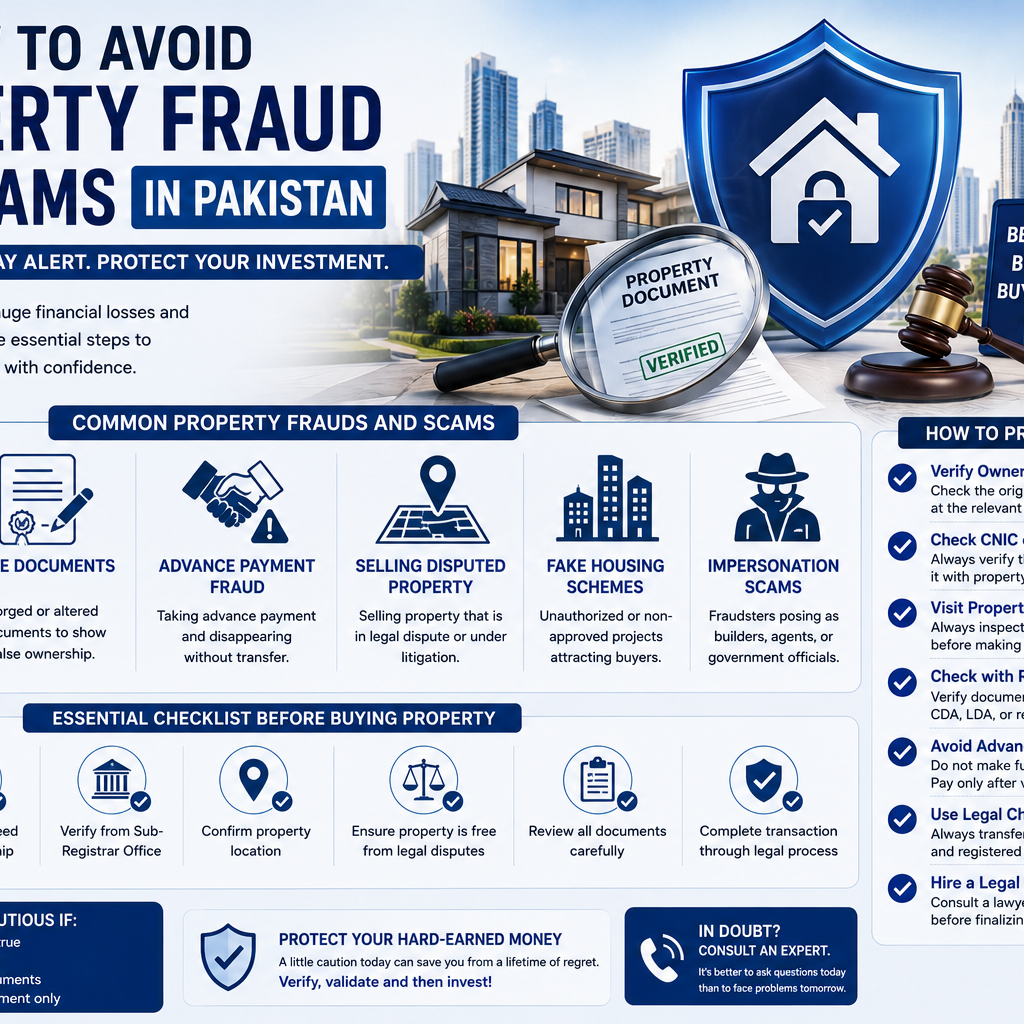
How to Avoid Property Fraud and Scams in Pakistan
Property fraud is one of the biggest dangers facing buyers in Pakistan. Large sums change hands, paperwork is complex and not everyone in the market is honest. Every year, people lose their savings to scams that could have been avoided with the right knowledge and caution.
The reassuring truth is that most property fraud follows familiar patterns. The same tricks appear again and again. Once you know them and once you follow a careful process, you can protect yourself. This guide explains the common scams and the steps that keep your money safe.
Why property fraud is so common
Property attracts fraud for clear reasons. Understanding why helps you stay alert.
The sums involved are large, which makes fraud worthwhile for dishonest people. The paperwork is complex which gives fraudsters room to deceive buyers who do not understand it. Many buyers act on trust or in excitement rather than careful checking which fraudsters usually exploit. And the pressure to move quickly, often created deliberately, stops people from verifying properly. These conditions make property a target. Knowing this helps you approach every deal with the caution it deserves, rather than the trust that fraudsters rely on.
Fake ownership scam
One of the most common frauds is selling a property the seller does not actually own. The fraudsters present false documents and collects the money before disappearing.
This scam relies on the buyer trusting the claim of seller of ownership without checking it. The defence is simple but essential. Always verify ownership through the official record and not the words of seller or papers alone. In Punjab, computerised records let you confirm the recorded owner. For society property, the society's own file is the final word. Match the recorded owner to the seller's CNIC. A fraudster cannot easily fake the official record, so checking it directly is your strongest protection against this scam.
The double sale scam
In a double sale, the same property is sold to two or more buyers. The fraudster collects from each and vanishes, leaving the buyers to fight over a single property.
This scam exploits the gap between agreeing a deal and completing the transfer. The defence is to verify ownership close to the transfer, not just weeks earlier and to complete the transfer promptly. Checking the official record just before you pay reduces the risk that the property has been sold to someone else in the meantime. Paying as ownership passes, rather than well in advance, also protects you. A double sale depends on timing, so closing your deal cleanly and quickly limits the opening for it.
Fake society scam
Some fraudsters create housing societies that look impressive but have no legal approval and no developed land. They sell files and plots that never become real property.
Scam society uses grand advertisements, smart offices and confident sales teams to create an illusion of legitimacy. The defence is to verify the society's approval directly with the relevant development authority, not to trust the society's own marketing. Confirm that the society is approved and that your specific block or phase is sanctioned. A scheme that exists mainly in brochures, with no approval and no development on the ground, is a warning. Trust the authority's record over any sales pitch, however polished.
The unapproved block scam
A subtler version sells plots in a genuine, approved society but in a block or phase that was never sanctioned. The society name is real, so buyers relax their guard.
Because the society itself is legitimate, buyers assume the specific plot is too. This is a dangerous assumption. The defence is to confirm that your exact block and phase fall within the approved layout, not just that the society exists. A plot in an unapproved part of an approved society can be worthless. Always check the specific area you are buying, not just the society's overall standing. This precise checking catches a scam that fools many buyers who verify only the society name.
The power of attorney scam
Fraudsters sometimes sell property using a forged, expired or misused power of attorney, claiming the authority to sell on an owner's behalf. This is a known route to fraud.
Because a power of attorney is legal and common, buyers may not scrutinise it closely. The defence is to treat every power of attorney with suspicion until verified. Confirm it is genuine, valid, specific to the property and the deal and not expired or revoked. Where the stakes are high, verify it through proper channels and involve a lawyer. A forged or misused attorney has cost many buyers their entire payment. Never rely on a power of attorney without checking it thoroughly, especially in deals involving overseas owners.
The hidden loan or dispute scam
Some sellers hide that a property carries an unpaid loan, a mortgage or a dispute. The buyer pays, then discovers the property cannot transfer cleanly or is tied up in conflict.
This scam relies on the buyer not checking for charges and disputes against the property. The defence is to verify that the property is free of loans, mortgages and litigation before paying. Ask directly, check the record and where there is any doubt, have a lawyer confirm there is no court case attached. A property with a hidden loan cannot transfer cleanly until the loan is cleared. Uncovering these problems before you pay, rather than after, is essential. Never assume a property is clear simply because the seller says so.
The inheritance dispute scam
When property is inherited, one heir may try to sell the whole property or more than their share, without the consent of the other heirs. The buyer ends up in a dispute with the remaining heirs.
This scam exploits buyers who do not check that all legal heirs consent to a sale. The defence is to confirm, for any inherited property, that every rightful heir agrees to the sale and takes part. Check how the inheritance was recorded and ensure no heir is missing or excluded. Buying inherited property from a single heir without the others' consent can leave you part owner with several strangers, all entitled to a share. Verify the inheritance carefully and never accept assurances that absent heirs will agree later.
The pressure tactic
Many scams rely on creating urgency, pushing the buyer to pay quickly before they can verify anything. Pressure is a tactic, not a fact.
A fraudster or even a pushy dealer, may claim the deal will vanish by tomorrow, that another buyer is ready or that the price rises next week. This is designed to stop you thinking and checking. The defence is to refuse to be rushed. A genuine, fairly priced property does not usually disappear overnight. When someone pressures you to pay before you have verified everything, treat that as a warning sign, not a reason to hurry. Slowing down has saved many buyers from a costly scam. Patience is one of your strongest protections.
The general process that protects you
Beyond the specific scams, a careful process protects you against fraud in general. Following it consistently is your best defence.
Verify ownership through the official record. Confirm any society and block are approved. Check for loans, disputes and litigation. Confirm inherited property has all heirs' consent. Verify any power of attorney. Match every document to the physical property. Use traceable payments and get receipts. Keep your own records. Refuse to be rushed and involve a lawyer where the stakes are high. This process is not complicated and it is far cheaper than the loss a scam causes. Applied to every deal, it removes most of the danger.
Choosing trustworthy dealers and agents
Not all fraud comes from sellers. Some involves dishonest dealers or agents, so choosing who you work with matters.
A dishonest dealer might push a risky scheme, hide problems with a property or pressure you into a quick decision for their own gain. The defence is to work with dealers who have a genuine, established reputation in your area and to remember that a dealer's interest is in closing the deal, not necessarily in protecting you. Verify everything independently, regardless of what a dealer tells you. Do not let a dealer's confidence replace your own checks. A good dealer adds value by bringing genuine options, but the verification and the final decision must always remain yours. Treat their information as a starting point, not as proof.
Protecting your payments
How you handle money in a property deal affects your exposure to fraud. Careful payment practices protect you.
Use traceable payments, such as a pay order or banker's cheque, for large sums rather than loose cash, since this leaves a clear record. Get a written receipt for every payment, including the token money. Pay the balance as ownership passes at the transfer, not well in advance, so you are not exposed if the seller fails to deliver. You should avoid handing over large amounts on trust before verification is complete. A clear money trail not only protects you if a dispute arises but it also discourages dishonest behaviour. Sound payment practices are a simple but powerful part of protecting yourself from fraud.
What to do if you suspect fraud
If something feels wrong during a deal, acting on that instinct can save you. Knowing how to respond helps.
If you suspect fraud then stop and do not pay further. Verify everything independently through official channels. You should look for advice from a property lawyer who can evaluate the documents and the situation. Do not let the other side pressure you into proceeding before you are satisfied. It is far better to delay or walk away from a genuine deal than to rush into a fraudulent one. Trust your instincts. If a deal feels off, the cost of pausing to check is tiny against the cost of being defrauded. Caution at the right moment protects everything you have.
Final thoughts
Property fraud in Pakistan is a real and serious danger, but it follows patterns you can learn to recognise. Fake ownership, double sales, fake societies, unapproved blocks, misused powers of attorney, hidden loans and inheritance disputes are the common scams and pressure tactics run through many of them.
The defence against all of them is a careful, consistent process: verify ownership and approvals through official records, check for loans and disputes, confirm heirs' consent, scrutinise any power of attorney, match documents to reality, use traceable payments and refuse to be rushed. Involve a lawyer where the stakes are high and act on your instincts if a deal feels wrong. None of this is difficult and all of it is far cheaper than losing your savings. Approach every property deal with this caution and you protect yourself from the frauds that catch the careless and the hurried.