The History of Sindh: A Complete Guide
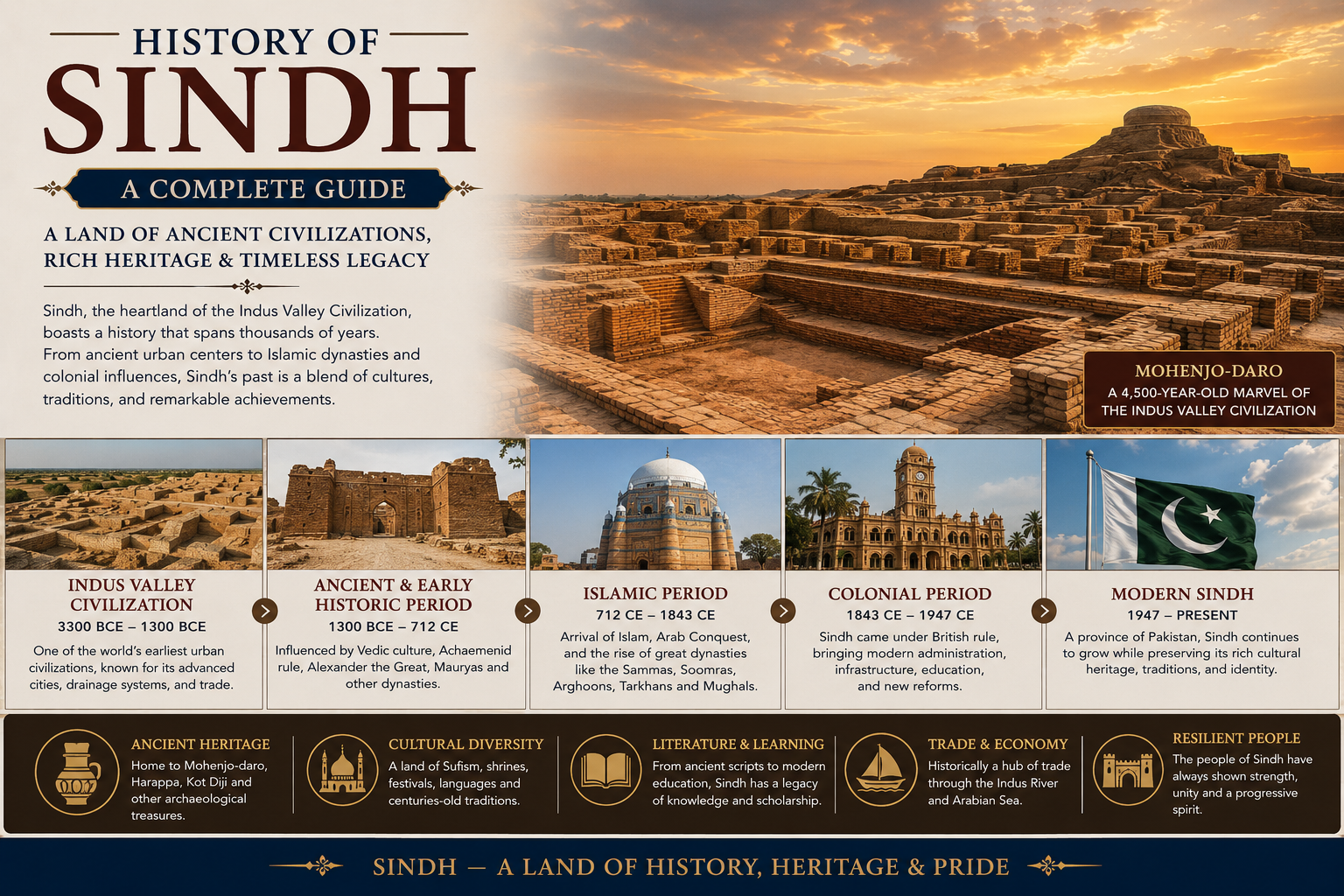
Sindh holds one of the longest recorded histories in South Asia. Its story begins with one of the earliest urban civilisations on earth. Persians, Greeks, arabs, Turks and Mughals all left their mark. Local dynasties ruled from Aror, Thatta, Khudabad and Hyderabad. The British took the province in 1843. This guide covers the history of Sindh from the Bronze Age to the modern era. It explains the great dynasties and the turning points.
This guide offers a general overview of a very long history. Dates for the earliest periods remain approximate.
Quick answer: Sindh holds the Indus Valley Civilisation of around 2600 to 1900 BCE. Persians, Greeks and Kushans ruled parts of it afterwards. The Rai and Brahmin dynasties held power before 712 CE. The Umayyad general Muhammad bin Qasim conquered Sindh in 712. The Habbari, Soomra, Samma, arghun and Tarkhan dynasties followed. The Mughals took it in 1591. The Kalhoras and then the Talpurs ruled independently. The British annexed Sindh in 1843. It became a separate province in 1936.
Indus Valley Civilisation
Sindh holds one of the earliest urban civilisations. The Indus Valley Civilisation flourished from around 2600 to 1900 BCE. Mohenjo daro is its greatest surviving city. Its own dedicated guide covers that site in the Larkana district.
The cities were remarkably advanced. They had grid streets and covered drains. Private houses held wells and bathrooms. This planning was unmatched for many centuries.
The civilisation declined after 1900 BCE. Scholars still debate the reasons. Changes in the rivers and the climate probably played a part. The great cities were gradually abandoned.
The ancient empires
Persia reached Sindh in the 6th century BCE. The Achaemenid empire held the lower Indus as a province. This brought the region into a wide imperial world.
Alexander passed through in 325 BCE. He sailed down the Indus after his Indian campaign. His fleet reached the delta and the sea. Greek accounts of the voyage give us an early description of the region.
Several empires followed in turn. The Mauryans held Sindh after Alexander. Indo Greek, Scytho Parthian and Kushan rulers came later. The Sassanian Persians exerted influence too. Buddhism and Hinduism both flourished through these centuries.
Rai and Brahmin dynasties
The Rai dynasty ruled from Aror. It held Sindh from around 489 to 632 CE. Aror lay near modern Rohri. Much of what we know comes from a later Persian chronicle.
The Brahmin dynasty succeeded them. Chach of Aror took the throne in 631. He founded a new line. His dynasty ruled Sindh for around eighty years.
Raja Dahir was the last of the line. He ruled from 695 to 712. He faced the Arab campaigns of the early 8th century. He died in battle in 712. His defeat ended the dynasty.
Arab conquest and the Habbaris
The Umayyads conquered Sindh in 712. Muhammad bin Qasim led the campaign. He took the port of Debal first. He then advanced up the Indus.
The conquest opened a new era. Sindh came under the Umayyad Caliphate and later the Abbasids. It became one of the earliest regions of the subcontinent under Muslim rule. Sindh is sometimes called the gateway of Islam for this reason.
The Habbaris ruled as emirs. They held Sindh from around 861 to 1010. They governed from Mansura. Their rule became effectively independent of the caliphs.
Soomras and the Sammas
The Soomras rose in the 11th century. They ruled from around 1010 to 1351. They were a local dynasty of Sindhi origin. They moved their capital more than once. Thatta became their seat in the later period.
The Sammas followed them. They ruled from the 14th century to 1524. Their rulers took the title of Jam. Thatta served as their capital. The Makli Necropolis grew alongside it.
Jam Nizamuddin II led the golden age. He reigned from 1461 to 1509. Sindhi art, architecture and culture flourished under him. His tomb at Makli survives as a masterpiece. The dedicated guide to Makli covers it in more detail.
Arghuns, Tarkhans and Mughals
The Arghuns took Sindh in the 1520s. They came from Central Asia. They ruled until 1554. Their arrival ended the Samma golden age.
The Tarkhans succeeded them. They held Sindh from 1554 to the 1590s. They too came from Central Asia. Their tombs at Makli show a distinct style. Thatta remained the capital through this period.
The Mughals annexed Sindh in 1591. The province became the Subah of Thatta. Mughal governors ruled it for around a century and a half. The Shah Jahan Mosque in Thatta dates from this era. Its own dedicated guide covers the building.
Kalhoras and the Talpurs
The Kalhoras won independence. They ruled Sindh from 1701 to 1783. They pushed back Mughal authority. Their reign is remembered as a golden age of Sindhi literature.
Mian Ghulam Shah Kalhoro founded Hyderabad. He established the city in 1768. He made it his capital. The dedicated guide to Hyderabad covers the city. He also strengthened the state considerably.
The Talpurs took power in 1783. They defeated the Kalhoras at the Battle of Halani. Four branches of the family ruled different regions. Hyderabad, Khairpur, Mirpur Khas and Tando Muhammad Khan each had their own Mirs.
The Talpurs built forts and palaces. Mir Sohrab Khan raised Kot Diji Fort and Faiz Mahal. Both have their own dedicated guides. Their tombs and monuments survive across the province.
British and the modern era
The British annexed Sindh in 1843. Charles Napier led the campaign. The Talpur forces lost at the Battle of Miani. A second defeat followed at Dubbo. The conquest ended sixty years of Talpur rule.
Sindh was attached to Bombay. The British administered it as part of the Bombay Presidency. Great engineering works followed later. The Lansdowne Bridge opened in 1889. The Sukkur Barrage followed in 1932.
Sindh became a separate province in 1936. This followed a long campaign for separation. The province gained its own legislature and administration.
Sindh joined Pakistan in 1947. Karachi served as the first capital of the new country. Partition brought vast movements of people in both directions. The province was reshaped by these changes.
Frequently asked questions
How old is the history of Sindh? The recorded history of Sindh reaches back more than four thousand years. The Indus Valley Civilisation flourished from around 2600 to 1900 BCE. Mohenjo daro was one of its greatest cities. Persians, Greeks, Mauryans, Kushans and Sassanians all held or influenced the region afterwards. Local dynasties ruled from Aror before the Arab conquest of 712 CE. This gives Sindh one of the longest continuous histories in South Asia.
Who was Raja Dahir? Raja Dahir was the last ruler of the Brahmin dynasty of Sindh. He reigned from 695 to 712 CE. His father Chach had founded the dynasty in 631. Dahir faced the Umayyad campaigns of the early 8th century. He died in battle against the forces of Muhammad bin Qasim in 712. His defeat ended Brahmin rule and opened a new era in the region.
Which dynasties ruled Sindh? Many dynasties ruled Sindh in turn. The Rai dynasty held power from around 489 to 632 CE. The Brahmin dynasty followed until 712. The Habbaris ruled as emirs from around 861. The Soomras and then the Sammas held Sindh through the medieval period. The Arghuns and Tarkhans came from Central Asia. The Mughals annexed Sindh in 1591. The Kalhoras and then the Talpurs ruled independently until 1843.
When did the British take Sindh? The British annexed Sindh in 1843. Charles Napier led the campaign. The Talpur forces were defeated at the Battle of Miani. A second defeat followed at Dubbo. The conquest ended sixty years of Talpur rule. The British then administered Sindh as part of the Bombay Presidency. It became a separate province in 1936.
What was the golden age of Sindh? Several periods are described as golden ages. The reign of Jam Nizamuddin II from 1461 to 1509 is often named. Sindhi art, architecture and culture flourished under the Sammas at Thatta. The Kalhora period from 1701 to 1783 is remembered as a golden age of Sindhi literature. Each era left monuments that survive across the province today.
Province of many ages
Sindh carries a history of extraordinary depth. Its cities were among the first on earth. Its rivers carried Persian, Greek and Arab fleets. Its capitals moved from Aror to Thatta and then to Hyderabad. Its dynasties rose and fell across four thousand years. Each left tombs, forts, mosques and cities behind.
You may explore that history through the ruins of Mohenjo daro. You may find it in the tombs of Makli or the mosque of Thatta. You may see it in the forts and palaces of the Talpurs. The dedicated guides cover each of these sites. Sindh is a province where every century has left something to see.