Grey Structure vs Finished House: Cost Comparison
When building or buying a house in Pakistan, two terms come up often those are grey structure and finished house. They describe two different stages of a building, and the difference between them affects both the cost and what you need to do next. Many buyers and builders do not fully understand the distinction until it matters.
This guide explains what each term means, how the costs compare, and what to consider when choosing between them. It does not quote figures, since costs vary, but it helps you understand where the money goes and which option might suit your situation and budget.
What grey structure means
The grey structure is the basic built shell of a house, completed without the finishing work. Understanding this is the starting point for the comparison.
A grey structure constitutes the foundation, the walls, the roof, and the whole skeleton of the building, as well as its primary components. It is the essence of the house – already built and existing, but not yet plastered, floored, painted, and finished with all other finishes required to make it a full-fledged, usable house. At the grey structure level, the house is there structurally, but not yet completed. To understand the difference between the grey structure and the finished house one must first understand what the grey structure is.
What a finished house means
A finished house is one where both the structure and the finishing work are complete, making it ready to live in. This is the fully completed home.
Apart from the initial construction of the grey structure, a complete house also has all the works related to plastering, floorings, tiling, painting, doors and windows, fittings related to electricity and plumbing, kitchen and bathroom fittings, and everything else that makes a house habitable and functional. A complete house is one which is completely constructed and is ready for occupation, as there is no major construction work left to be done before occupying it. Having a clear idea about the completion of a house makes one understand why it is more costly than a grey structure.
How the costs compare
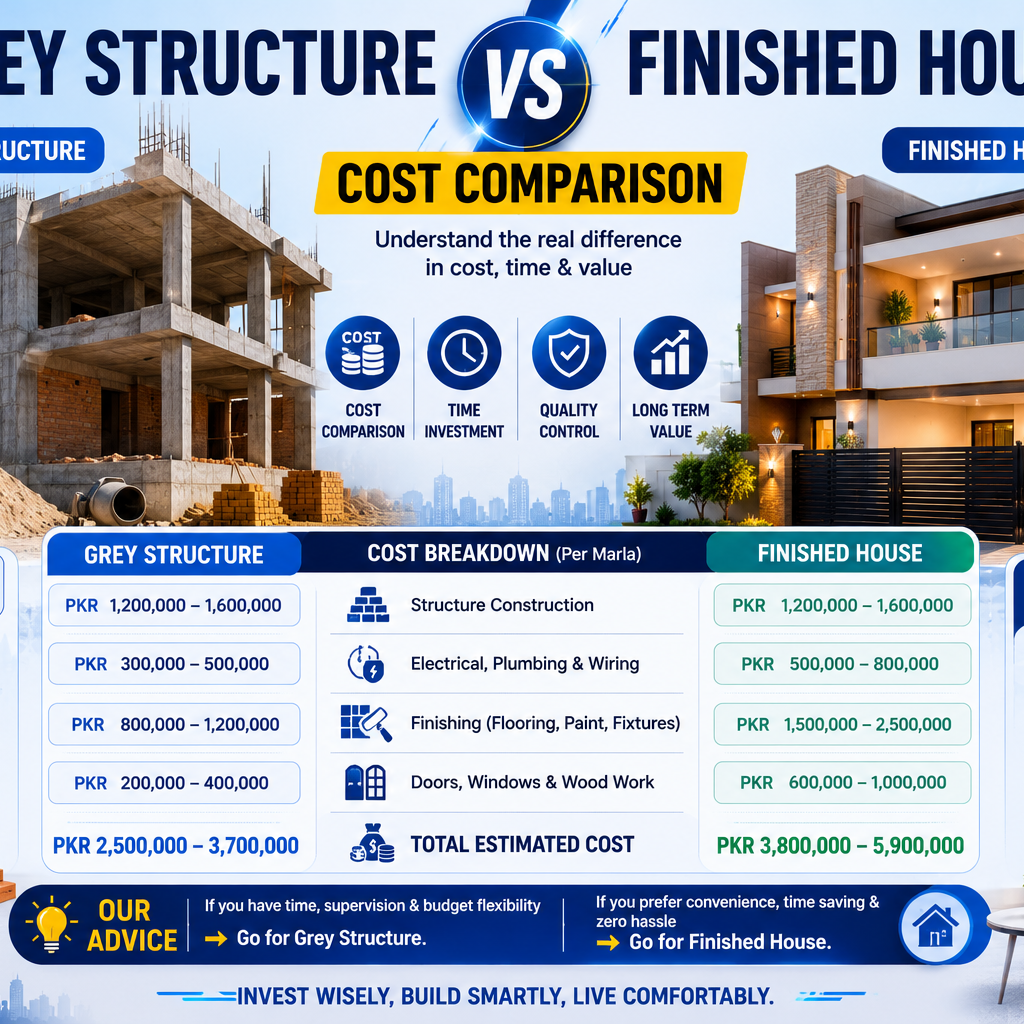
The core of the comparison is that a finished house costs more than a grey structure, because finishing adds substantial cost. Understanding this difference helps you plan.
The grey structure represents a significant portion of the total building cost, since it is the core of the house. But the finishing work adds a further substantial cost on top, often comparable in scale to the structure itself. So a finished house involves both the grey structure cost and the finishing cost combined. The difference between a grey structure and a finished house is essentially the cost of all the finishing work. Understanding that finishing roughly adds to the structure cost, rather than being a minor extra, helps you grasp why the two options differ so much in price.
Why finishing costs so much
The finishing stage carries a large cost for clear reasons. Understanding why helps you see where the money goes and how to control it.
Finishing involves many elements: plastering, flooring, tiling, painting, doors, windows, electrical and plumbing fittings, and kitchen and bathroom fixtures, among others. Each requires materials and skilled labour. The materials for finishing, in particular, vary enormously in quality and price, from simple to premium. Because finishing touches every part of the house and offers so much choice in quality, its cost is both large and highly variable. Understanding that finishing is a substantial, choice-driven cost helps you see why a finished house costs considerably more than a grey structure and where you can control spending through your choices.
The appeal of buying or building to grey structure
There are reasons someone might choose a grey structure rather than a finished house. Understanding its appeal helps you weigh the options.
Stopping at or buying a grey structure costs less than a finished house, which suits those with a limited budget at the time. It also lets the owner control the finishing themselves, choosing the materials, quality, and style to their own taste and budget, and doing the finishing in stages as funds allow. For someone who wants to spread the cost over time, or to personalise the finishes, a grey structure offers flexibility. Understanding this appeal helps you see why some choose the grey structure route, gaining lower upfront cost and control over the finishing in exchange for the work and cost still to come.
The appeal of a finished house
A finished house also has clear appeal, and understanding it helps you weigh the choice. The main benefit is convenience and certainty.
The completed building can be moved into right away because there is nothing else that needs to be done at this point. It is for people who do not want any more time and effort spent on organizing the finishing process. There is no need for one to worry about managing the process of finishing the building because it is a complicated thing to do. It will cost more money and the finishing will be done according to the person who finished it but there is some convenience in that.
Control over quality and choices
A key difference between the two options is the control you have over the finishing quality and choices. This matters to many buyers and builders.
With a grey structure that you finish yourself, you control every choice in the finishing, the materials, the quality, the style, and where to spend or save. This lets you create finishes to your own taste and budget. With a finished house, the finishing has already been done to someone else's choices, which you accept as they are. For those who care about personalising their home and controlling the finishing quality, the grey structure route offers an advantage. Understanding this difference in control helps you decide which matters more to you: the convenience of a finished house or the personalisation a grey structure allows.
Spreading the cost over time
One practical advantage of the grey structure route is the ability to spread the cost over time. This suits many budgets.
By building or buying to grey structure first, and finishing later in stages, an owner can spread the substantial cost of the build across a longer period. This makes building more affordable for those who cannot fund a complete house all at once. They can complete the finishing as funds become available, room by room or stage by stage. Understanding this option helps those on a tighter budget see a path to building that does not require all the money upfront. The ability to phase the finishing is one of the practical reasons the grey structure route appeals to many builders and buyers in Pakistan.
Which option suits you
The right choice between a grey structure and a finished house depends on your situation, budget, and preferences. Considering these helps you decide.
If you have a limited budget now, want to control the finishing, or wish to spread the cost over time, a grey structure may suit you, accepting that finishing work and cost remain. If you want a complete, livable home immediately and without the effort and management of finishing it and you have the budget then a finished house may suit you better. Your priorities, whether cost, convenience, control, or timing, point towards one or the other. Understanding the trade-offs helps you choose the option that fits your means and what you want from the process and the home.
Considerations when buying rather than building
The grey structure versus finished house choice applies not only to building but also to buying, and buyers face particular considerations. Understanding them helps you decide.
A buyer may find both grey structure properties and finished houses on the market. Buying a grey structure costs less and lets you control the finishing, but it means taking on the finishing work, cost, and management yourself after purchase. Buying a completed house is relatively expensive; however, you get your ready-to-use home instantly. For the purchaser, it comes down to how much money you have and your preference whether to finish the building yourself or buy it completed. Understanding that this choice exists when buying, just as it does when building, helps you weigh the options and choose the type of property that fits your situation and what you want from the purchase.
How the choice affects resale
The grey structure versus finished house distinction also affects resale, which is worth considering. Each appeals to different buyers.
A finished house appeals to buyers who want a ready-to-live-in home, while a grey structure appeals to those who want to control the finishing or spread the cost. At the end of the day when you go to sell it, the condition of the house can determine who will want it and how quickly they will want it. An immaculately finished house will have wider appeal than a house that is just grey and needs finishing. Thinking ahead about your decision to build can help if you plan on selling. Considering the eventual buyer, alongside your own needs, is part of making a sound decision between the two options.
Verifying quality in both cases
Whichever option you choose, checking the quality is important, though what you check differs. Careful inspection protects your investment.
For a grey structure, focus on the quality of the construction, the foundation, the structure, and the basic build, since this is the core you will finish. For a finished house, check both the underlying structure and the quality of the finishing work, since poor finishing or hidden structural problems can cause trouble. In both cases, if you lack the knowledge to judge construction quality, consider having a trusted professional inspect it. Verifying quality protects you from problems in either a grey structure you will finish or a finished house you will move into. Sound construction underlies the value of both options.
Final thoughts
The choice between a grey structure and a finished house comes down to understanding what each offers and which fits your situation. A grey structure is the basic built shell, without finishing, costing less and leaving the finishing work and cost still to come. A finished house includes all the finishing, ready to live in, at a higher cost that combines the structure and the substantial finishing expense.
The option for a grey structure allows for low initial cost, control over finishing options and quality, and ability to pay in instalments, in return for remaining work. Finished house is ready for occupancy with no hassle of handling finishing, but for more money and fixed finishes. Consider your finances, your tastes, and your needs when choosing either of these. Regardless of your choice, make sure that quality is good as it is the key factor for any building's value. Given the above information, one can confidently choose between a grey structure and a finished house according to his abilities and expectations.