Government College University Lahore: History and Heritage
Government College University is located on Lower Mall road in the heart of Lahore. It is one of the oldest and most respected seats of learning in the region. The British founded it in 1864 as Government College, Lahore. Its grand neo Gothic building with a tall clock tower has become an icon of the city. The institution has produced some of the most influential figures of the subcontinent. Its alumni include a Nobel laureate, the national poet and several heads of government. For anyone getting to know Lahore, the university is both a historic landmark and a living centre of learning.
This guide explains what Government College University is, its history, its famous building and its notable alumni. It covers both the institution itself and its place among the landmarks of central Lahore.
Government College University
Government College University is known widely as GCU is a public research university in Lahore. It was founded in 1864 as Government College, Lahore, under the British Raj. It was granted university status in 2002. It is considered one of the most prestigious institutions in the country. Its alumni are known as Ravians.
The university sits in the heart of the city. It situated near the junction of The Mall and the Lower Mall in downtown Lahore. Main business and administrative areas, schools, colleges and the old campus of the University of the Punjab surround it. This central location places the university among the major landmarks of colonial and modern Lahore.
The institution has grown into a large university. It has become one of the ten largest educational institutions in the country, with a student body of over 12,000. It has 32 academic departments organised into five faculties. It also runs several research centres focused on academic and industrial projects. The university has been noted for its very high graduation rate and its strong national ranking.
Government College University is famous both for its academic record and for its heritage. The main building is one of the most admired structures in the city. The institution retained the word "College" in its name for historical reasons even after becoming a university, given the wide recognition of the name Government College. Motto of the Government College University is "Courage to Know," which reflects its long tradition of learning.
Quick answer: Government College University is also known as GCU. It is a public research university in Lahore. The British founded it in 1864 as Government College, Lahore. It gained university status in 2002. It is famous for its neo Gothic building with a 176 foot clock tower and for alumni including Allama Iqbal and the Nobel laureate Abdus Salam.
History of the institution
The history of Government College University reaches back to the British period. The establishment of a central college in Lahore was sanctioned in 1856 under the British Raj. The plan required that the teachers be graduates of Oxford, Cambridge, Dublin or Durham. The college finally opened its doors on 1 January 1864.
The college began in a historic setting. It first opened in a portion of the Raja Dhyan Singh Haveli inside the Walled City of Lahore. This haveli had belonged to a minister of the Sikh ruler Ranjit Singh. The inaugural class had just nine students. All of them had matriculated from the University of Calcutta, to which the college was first affiliated. Gottlieb Wilhelm Leitner served as the first principal. He was a professor of Arabic and Islamic Law from King's College in London. His name remains closely tied to the college.
The college moved several times in its early years. It moved to a large bungalow near Anarkali Bazaar in April 1871. It moved again in 1873 to a house called Rahim Khan's Kothi as student numbers grew. The rising numbers made a permanent home necessary. A site on high ground north of the Soldier's Garden, the Gol Bagh, was chosen for a purpose built campus. The college moved to its present building in 1876, with the building completed in 1877.
The status of the institution changed over the following decades. The college was affiliated with the University of the Punjab in 1882. This affiliation lasted for 115 years. The college played a crucial role in laying the foundation for the University of the Punjab. Government College was raised to the status of a university in 2002, after 147 years as a college. It was renamed GC University. The Kala Shah Kaku campus was later added in 2019 to meet the needs of a growing student body.
Famous building
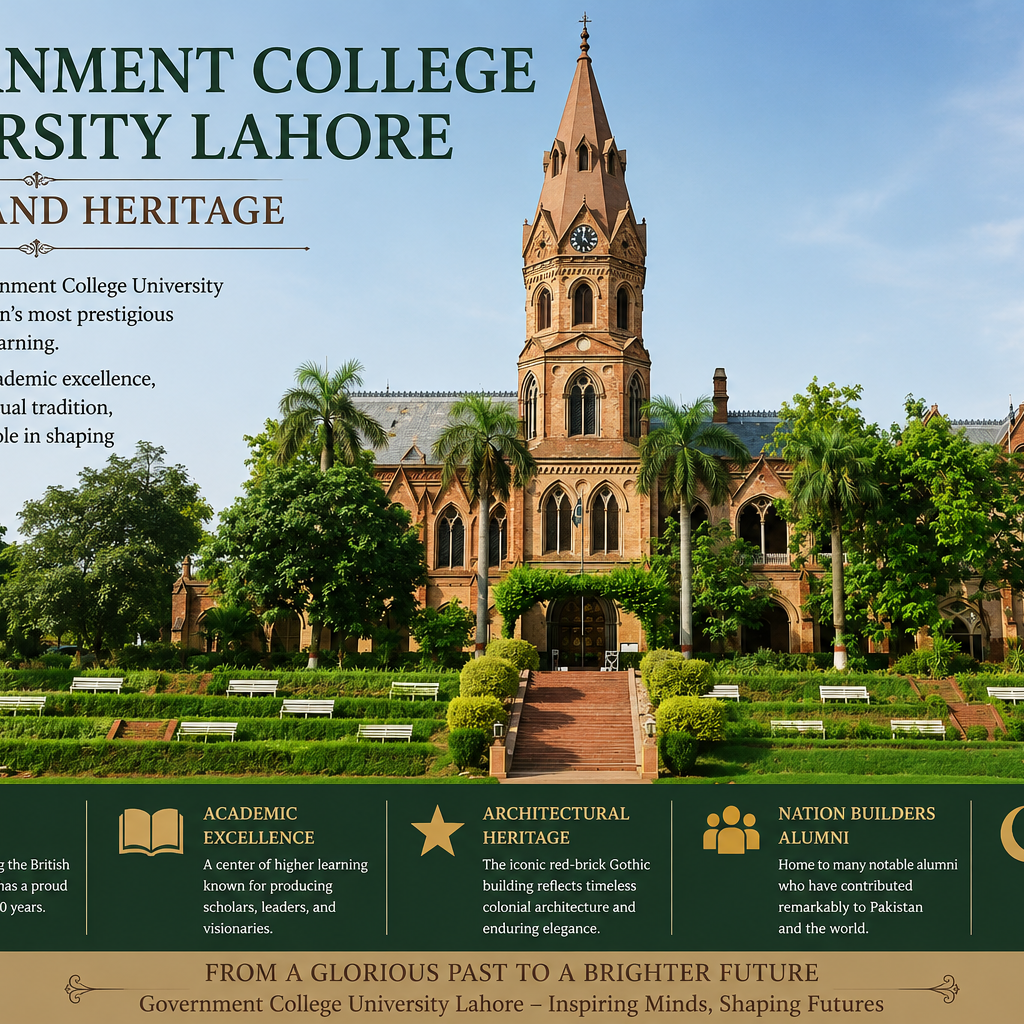
The main building of Government College University is one of the most majestic structures in the city. It is considered among the finest college buildings in the subcontinent. The British architect W. Purdon designed it in the neo Gothic style. The executive engineer Kanhaiya Lal oversaw its construction. The building was completed in 1877 at a cost of 320,000 rupees.
The design reflects the neo Gothic tradition of the period. The building imparts grandeur through its wide verandahs and high ceilings. These features also suited the climate of Lahore. The building sits on the highest level of its sloping site. This adds to its scale and presence. Sprawling lawns and green terracing surround it. The building is framed by trees and is visible above the terracing from the main road, creating a captivating view.
The clock tower is the most prominent feature of the building. It marks the centre of the main building and represents the image of Government College. The tower stands on a 15 foot podium, reached from the garden by a wide flight of stairs. It rises to a total height of 176 feet. It is divided into four storeys and ends in a spire. The octagonal tower has battered sides with dormer windows and enormous clocks visible from a great distance.
The building holds further notable spaces. The most prominent is the Main Hall, now called the Dr Abdus Salam Hall after the Nobel laureate. It has a central nave of double height with aisles running along the sides, forming a gallery on the upper floor. A grand carved wooden door on the south side faces the Oval ground. The architecture combines Lahori brick with black Chiniot stone accents, pointed arches and a steeply sloping roof. The building remains the centrepiece of the campus and an icon of the city.
Oval ground and campus traditions
The Oval ground is one of the best loved features of the campus. This large open ground accompanies the main building. It is the heart of student life at the university. Generations of Ravians have gathered here to sit, relax, talk, study and debate. The ground was renamed the Leitner Oval in 2019 in honour of the first principal of the college.
The name Ravian carries its own history. The alumni of the college are called Ravians. The name comes from the college magazine, the Ravi. The magazine itself was named after the River Ravi that flows near Lahore. The college was once located close to the banks of the river before it changed its course. This name has become a proud symbol of the identity of the institution.
The campus holds many traditions that bind its students and alumni. The Old Ravians Union is elected regularly and serves the whole community of alumni. It represents Ravians across the world, without regard to rank or position. Anniversary celebrations bring old and young Ravians together, drawing graduates from across the world. The campus is also known for its lively student societies and debates.
The campus has grown over the years to meet rising needs. Several buildings and blocks have been added. These include a postgraduate block, a block for intermediate students and a bachelors block reached by an overhead bridge. The Iqbal Hostel is named after Allama Iqbal. It and the Bokhari Auditorium are among the notable additions. The historic core and its traditions remain at the heart of the university.
Notable alumni
Government College University is renowned for the brilliance of its alumni. Generations of students have passed through the institution and reached eminent positions in many fields. The alumni of the college have made great contributions to not only the subcontinent but also outside it. The success of the alumni has earned the college the reputation of being one of the best colleges of the region.
The most celebrated alumni include figures of world importance. Allama Muhammad Iqbal, the national poet and one of the major inspirations behind the creation of the country, studied here. Abdus Salam, who won the Nobel Prize in Physics in 1979, was a student of the college. Har Gobind Khorana, who won the Nobel Prize in Medicine in 1968, also studied here. These figures alone give the institution a remarkable place in the history of learning.
The alumni include many other distinguished names. The literary giant Faiz Ahmed Faiz studied here. The writer couple Bano Qudsia and Ashfaq Ahmed were Ravians, along with the poet and scholar Patras Bokhari. Muhammad Zafarullah Khan, who served as president of both the United Nations General Assembly and the International Court of Justice, was an alumnus. Several heads of government of the region studied here, along with figures from film, including the actor Dev Anand.
The faculty of the college has also included illustrious scholars over the years. These figures shaped the intellectual life of the institution across generations. The pervasive existence of Ravians in every sectors like politics, administration, judiciary, military, sciences and arts is a testament to the impact of the GCU. The history of producing great individuals is what forms the crux of the prestigious reputation of Government College University.
Setting and significance
Government College University sits in the heart of central Lahore near The Mall. The area around the university is a hub of learning, administration and commerce. The old campus of the University of the Punjab, Anarkali Bazaar and the colonial buildings of The Mall lie nearby.
The university holds deep significance for the city and the region. It is one of the oldest seats of learning in the subcontinent. It has witnessed the major eras of the modern history of the region, from the colonial period through the partition of 1947 and the creation of the country. Its long tradition of learning and its liberal values have shaped generations of students. It has been described as a place of pilgrimage for its alumni.
The building of the university is also a heritage landmark in its own right. Its neo Gothic architecture and its clock tower make it one of the most recognisable structures in the city. It stands alongside the colonial buildings of The Mall as part of the architectural heritage of Lahore. It has even featured as a filming location, standing in for a famous fictional school in one production. This adds to its fame as a landmark.
Government College University is part of what gives Lahore its character as a city of learning and heritage. The institution combines a proud history, a famous building and a record of remarkable alumni. For anyone getting to know Lahore, the university is one of the landmarks that captures both the intellectual and the architectural heritage of the city. It remains a living centre of learning and a source of pride for the city.
Places near Government College University
Government College University sits within reach of many landmarks and useful places in central Lahore. This helps visitors plan a fuller trip. The old campus of the University of the Punjab also located near Government College University. The colonial buildings of The Mall, including the Lahore Museum, the General Post Office and the Lahore High Court, are nearby. Anarkali Bazaar, one of the oldest markets in the city, lies close for shopping and food.
The Walled City with the Lahore Fort and the Badshahi Mosque lies a short drive to the north. Data Darbar, the shrine of Data Ganj Bakhsh, is within reach. Mayo Hospital, Sir Ganga Ram Hospital and the King Edward Medical University serve the central area. Aitchison College, another famous educational institution. These connections make the university an easy part of a tour of central Lahore.
Frequently asked questions
Where is Government College University located? Government College University located in downtown Lahore near the junction of The Mall and the Lower Mall. It is surrounded by business and administrative areas and sits close to the old campus of the University of the Punjab and Anarkali Bazaar.
When was Government College University founded? The British founded the institution as Government College, Lahore, on 1 January 1864. It first opened in the Raja Dhyan Singh Haveli in the Walled City. It moved to its present building in 1876 and was granted university status in 2002.
Why are the alumni called Ravians? The alumni are called Ravians after the college magazine, the Ravi. The magazine was named after the River Ravi that flows near Lahore. The college was once located near the banks of the river before it changed its course.
Who are the famous alumni of GCU? The famous alumni include the national poet Allama Iqbal, the Nobel laureate in Physics Abdus Salam and the Nobel laureate in Medicine Har Gobind Khorana. Others include the poet Faiz Ahmed Faiz, the writers Bano Qudsia and Ashfaq Ahmed and several heads of government of the region.
What is special about the GCU building? The main building is a neo Gothic structure designed by W. Purdon and completed in 1877. Its centrepiece is a 176 foot clock tower. The building has wide verandahs, high ceilings and sprawling lawns, including the famous Oval ground, now called the Leitner Oval.
Can visitors see Government College University? The university is a working institution, so access to the campus is subject to its rules and security. The famous building and its clock tower can be admired from the surrounding area. Visitors interested in the heritage should check the current visiting arrangements.
Government College University is one of the oldest and most respected seats of learning in the region and a great landmark of Lahore. The British founded it in 1864. It has since produced some of the most influential figures of the subcontinent, from the national poet Allama Iqbal to the Nobel laureates Abdus Salam and Har Gobind Khorana. Its record of eminent alumni gives it a remarkable place in the history of learning.
The institution is also an architectural icon. Its neo Gothic building with the tall clock tower and the famous Oval ground stands among the finest structures in the city. It sits in the heart of central Lahore close to the colonial buildings of The Mall and the old campus of the University of the Punjab. Whether you value Government College University for its history, its architecture, its traditions or its remarkable alumni, it remains an essential landmark of Lahore and a living centre of learning that continues to shape the city and the region.