General Post Office and the Colonial Mall Road of Lahore
It sits among a remarkable concentration of colonial buildings along The Mall. For anyone getting to know Lahore, the GPO and The Mall tell the story of the British period of the city.
This guide explains what the General Post Office is, its history, its architecture and the wider colonial heritage of The Mall. It covers both the GPO itself and the grand avenue on which it stands.
The General Post Office
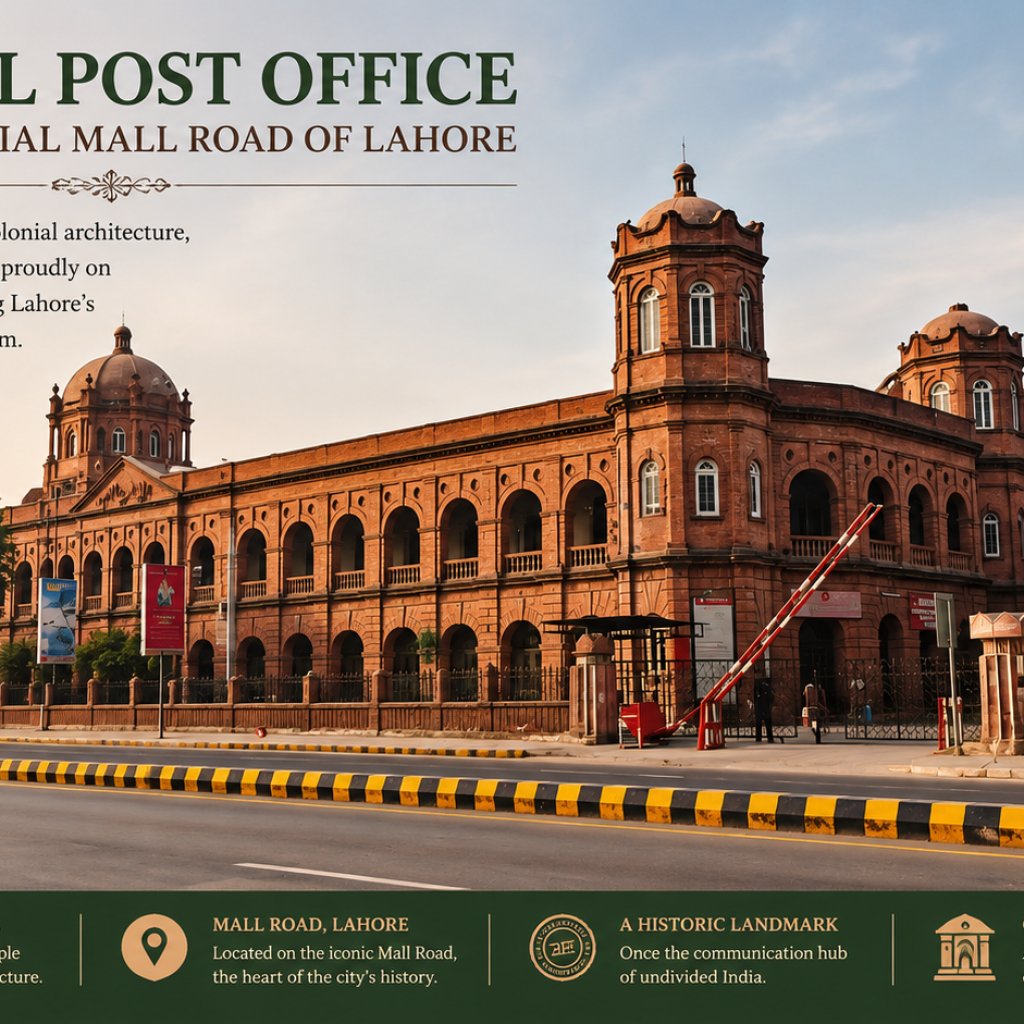
The General Post Office, known widely as the GPO, is the main post office of Lahore. It stands at GPO Chowk on The Mall near Anarkali Bazaar. The British built it in 1887 to commemorate the Golden Jubilee of Queen Victoria. It replaced an earlier telegraph office in Anarkali. It marked the rising importance of Lahore under the British Raj.
The building is one of the most photographed colonial structures in the city. Its red brick facade, grand domes and clock tower give it the look of a palace rather than an office. It was designed by Sir Ganga Ram, one of the leading architects of the time. He also designed the nearby Lahore Museum. The building stands near the shrine of the seventeenth century saint Shah Chiragh.
The GPO remains a working post office. It is the largest postal facility in the city. It handles a large volume of mail each day, put at around 20,000 pieces. The building has two main gates and is organised into sections for domestic mail, international mail and financial services. It also offers services such as utility bill payments. Entry is free. Many visitors come simply to admire the building.
The GPO captures the layered identity of Lahore. It links the colonial past of the city with its working present. Its architecture is an amalgam of European and native architectural styles. It is a structure that serves both as a landmark and as a useful resource for visitors to the city. The structure is an integral part of life in Lahore.
Quick answer: The General Post Office is the main post office of Lahore. It stands on The Mall near Anarkali Bazaar. The British built it in 1887 to mark the Golden Jubilee of Queen Victoria. Sir Ganga Ram designed the red brick building with its domes and clock tower. It still works as a post office today.
History of the General Post Office
The history of the GPO reflects the growth of Lahore under British rule. The British empire took control of Lahore in 1849 after the fall of the Sikh Empire. They made the city the capital of British Punjab. They left their mark through grand civic and commercial buildings. The GPO was one of the most important of these.
The building was constructed in 1887. It was built to commemorate the Golden Jubilee of Queen Victoria, marking fifty years of her reign. It replaced the earlier telegraph office in Anarkali Bazaar. The new building reflected the growing role of Lahore as a communication and administrative centre.
Sir Ganga Ram designed and built the GPO. He was one of the leading architects and engineers of the period. He is often called the father of modern Lahore for his many contributions to the city.
The GPO has served the city for well over a century. Mail was essential for communication and administration during the British period. The building was designed to handle this vital function on a grand scale. It has continued to operate as a post office ever since. It has adapted over the decades to changing needs, adding financial and other services. The building remains a protected heritage structure and a working part of the city.
Architecture of the GPO
The architecture of the General Post Office blends several styles. It combines Victorian and Neo Palladian symmetry with Indo Saracenic and Mughal ornamentation. The result is a grand and distinctive building.
The exterior is the most striking feature. A red brick facade gives the building its warm colour and its palace like appearance. Arched windows run along the front. Mughal style domes and minarets rise above the roofline. A signature clock tower crowns the building, with an iron bell dating from the mid nineteenth century. These elements combine European grandeur with local motifs.
The interior matches the scale of the exterior. High ceilings, sturdy columns and a lime plastered finish fill the halls. The building consists of two main halls. It is divided into sections for domestic mail and financial services, international mail and administration. Wooden counters and vintage fittings give the interior a sense of stepping back in time. A display of historical stamps shows the evolution of postal services over the long history of GPO
The building shows the dual focus of its design, on both function and grandeur. It was built to serve as a working post office on a large scale. It was also built to convey the authority and permanence of the administration of the time. It remains one of the finest examples of colonial architecture in the city.
Colonial Mall Road Lahore
The General Post Office is one of many colonial landmarks along The Mall. The Mall, officially named Shahrah e Quaid e Azam, is the grand avenue of British era Lahore. It stretches several kilometres from the area near Anarkali towards the cantonment and Gulberg. It remains one of the most important roads in the city.
The road was developed during the British period. It was conceived in the 1850s to connect Anarkali with the new British cantonment at Mian Mir. The British built it as a tree lined avenue with wide roads and roundabouts. It was planned in the Victorian style, in contrast to the dense old city nearby. The greatest concentration of colonial buildings in Lahore stands along this avenue. Over 169 protected buildings line the road.
The Mall holds many of the major landmarks of the city. The Lahore Museum, the National College of Arts, the Punjab University old campus, the Lahore High Court and the Punjab Assembly all stand along or near the avenue. The Governor's House, the Punjab Public Library and the Tollinton Market are also here. A focal point of the road is Charing Cross, a junction named after the one in London. The Aitchison College, one of the most famous schools in the country, lies nearby. This concentration of civic, educational and cultural institutions gives The Mall its character.
The Mall marks the transition of Lahore from a Mughal city to a modern one. The architecture along the road evolves from Neoclassical and Neo Gothic styles in the west to the Indo Saracenic style further east. The avenue served as the spine of the colonial city. It remains a busy hub of offices, markets and institutions today. For anyone getting to know Lahore, a walk along The Mall is a journey through the colonial history of the city.
Setting and significance
The General Post Office and The Mall are located at the very heart of the Lahore city, between its Walled City and newer areas. This gives them prime importance as some of the most significant features of the city. GPO Chowk where the post office is located is a busy junction of the avenue. This locality serves as the center of the civic and commercial activity of the city.
The GPO building and the colonial architecture of The Mall have great importance for the Lahore city as they serve as a reminder of the British era when the major part of Lahore was developed. The majestic civic structures, lined trees of the avenue and the institutions along the avenue represent a particular era of Lahore’s history.
Another factor which contributes to the charm and character of central Lahore is the legacy of colonial times. The Mall Road continues to be an important and prestigious area, comprising offices and institutions. The historical significance of the area helps in drawing people to the area and contributes towards the character of the city. This heritage is one of the factors which make Lahore an attractive destination both to visit and to live in.
The GPO and The Mall help give Lahore the character of a historical and cultural city. The colonial avenue runs parallel to the Mughal walled city as well as modern areas of the city. For anyone getting to know the city, the GPO and The Mall are essential to understanding how Lahore came to be the city it is today.
Visiting the GPO and The Mall
The General Post Office and The Mall are among the most accessible heritage sites in Lahore. They stand in the central part of the city and are easy to reach. Visitors can admire the GPO and the other colonial buildings along the avenue on a walking tour.
The GPO is free to visit and remains a working post office. It is open during regular office hours. Visitors can admire the red brick facade and the clock tower from outside. They can also step inside to see the halls, the wooden counters and the display of historical stamps. Photography of the exterior is widely encouraged. It is worth remembering that the building is a busy post office, so it can be crowded during peak hours. Buying a stamp or sending a postcard makes for a memorable souvenir.
The GPO and The Mall are reached easily from across the city by car, taxi, ride hailing service or the Metro Bus. The Metro Bus runs along a nearby route. The GPO sits at GPO Chowk near Anarkali. The central location can be busy, so public transport is often convenient. Parking is available in the area.
The cooler months from around October to March offer the most comfortable time to explore The Mall on foot. The early morning or late afternoon light suits photography of the colonial buildings. A visit to the GPO combines well with the nearby Lahore Museum, Anarkali Bazaar and the other landmarks of The Mall. Visitors are asked to respect the buildings and follow any rules, especially in the working areas of the post office.
Places near the General Post Office
The General Post Office sits within reach of many landmarks and useful places in central Lahore. This helps visitors plan a fuller trip. The Lahore Museum, the National College of Arts and the Punjab University old campus stand nearby on The Mall. The Lahore High Court and the Punjab Assembly are along the same avenue. The shrine of Shah Chiragh stands close to the GPO.
Anarkali Bazaar, one of the oldest markets in the city, lies next to the GPO for shopping and food. The Walled City with the Lahore Fort and the Badshahi Mosque lies a short drive to the north. Data Darbar, the shrine of Data Ganj Bakhsh, is within reach. Mayo Hospital, Sir Ganga Ram Hospital and the King Edward Medical University serve the central area. The Government College University and Aitchison College stand nearby. These connections make the GPO an easy addition to a tour of central Lahore.
Frequently asked questions
Where is the General Post Office located? The General Post Office is located at GPO Chowk on Mall road in central Lahore, near Anarkali Bazaar and the Lahore High Court. It is easily reached from across the city and sits among the other colonial landmarks of The Mall.
When was the GPO built? The British built the GPO in 1887 to commemorate the Golden Jubilee of Queen Victoria. It replaced an earlier telegraph office in Anarkali Bazaar. It was designed and built by Sir Ganga Ram, one of the leading architects of the period.
Who designed the GPO? Sir Ganga Ram designed and built the GPO Lahore. He was one of the leading architects and engineers of the time. He is often called the father of modern Lahore. He also designed the nearby Lahore Museum and several other notable buildings in the city.
Is the GPO still a working post office? Yes. GPO still operates as the principal post office in Lahore and the biggest one in the city too. It processes around 20,000 mails per day and deals with both domestic and international mails. In addition, it provides financial services, including utility bill payments.
Can visitors go inside the GPO? Yes. Entry is free and the building is open during office hours. Visitors can admire the halls, the wooden counters and the display of historical stamps. Photography of the exterior is encouraged. It is a busy post office, so it can be crowded at peak hours.
What colonial landmarks are near the GPO? The Lahore Museum, the National College of Arts, the Punjab University old campus, the Lahore High Court and the Punjab Assembly stand along The Mall nearby. Charing Cross, Tollinton Market, Aitchison College and the shrine of Shah Chiragh are also close by.
The General Post Office is one of the finest colonial landmarks of Lahore and a working part of the daily life of the city. The British built it in 1887 to mark the Golden Jubilee of Queen Victoria. Designed by Sir Ganga Ram, its red brick facade, domes and clock tower make it one of the most striking buildings in the city. It remains the main post office, a rare heritage building that visitors can both admire and use.
The GPO stands at the heart of the colonial Mall Road, the grand avenue that shaped much of modern Lahore. The Mall holds a remarkable concentration of colonial buildings, from the Lahore Museum and the High Court to the great educational institutions of the city. This heritage complements the Mughal Walled City nearby and tells the story of the British period. Its history or simply to send a postcard, it remains an essential landmark of Lahore and a window into the colonial chapter of the city whether you visit the GPO for its architecture.