Fard, Intiqal and Registry: Property Terms Every Buyer Must Know
Buying property in Pakistan means dealing with a set of terms that confuse many first time buyers. Fard, Intiqal, registry, mutation and others come up again and again, often without explanation. Not understanding them leaves you at a disadvantage and that is exactly where mistakes and fraud happen.
The good news is that these terms are not as complicated as they sound. Each refers to a specific document or step in the ownership of property. This guide explains the most important ones in plain language, so you can follow your own property deal with confidence rather than confusion.
Why these terms matter
Property documents are the proof of ownership and the record of every change. The terms attached to them are the language of that record.
A buyer who does not understand these terms cannot properly check what they are buying. They must rely entirely on others, which is risky. Understanding the terms lets you ask the right questions, read the documents and spot problems yourself. It puts you in control of your own deal. These are not just technical words for lawyers and officials. They are the basic vocabulary every property buyer in Pakistan should know to protect themselves.
Fard or record of rights
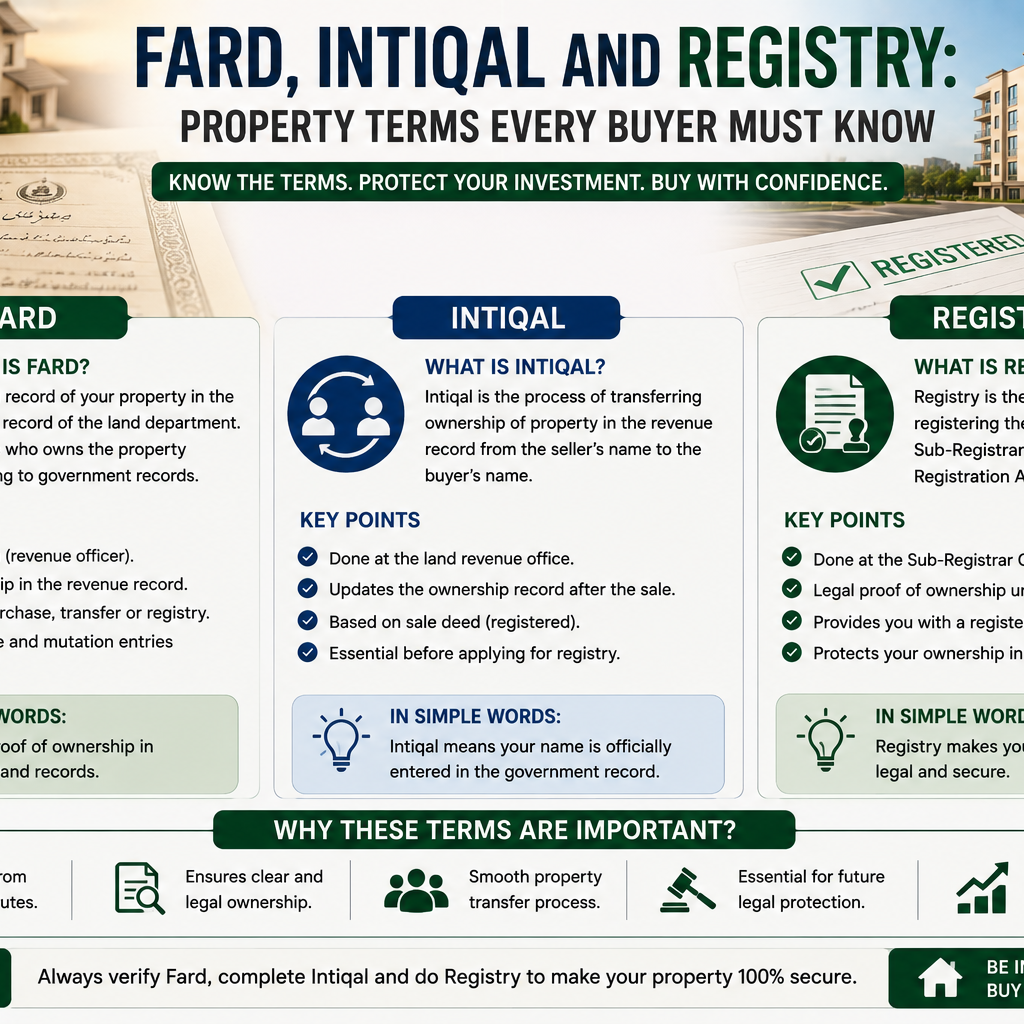
The Fard, also called Fard e Malkiat, is the record of rights. It is one of the most important documents for property held in the general revenue record and it shows who legally owns the property.
When you buy land or a house in the revenue record, the Fard is your primary proof of who owns it. It is issued from the official land record and shows the current ownership. Checking the Fard and confirming the owner's name matches the seller's CNIC, is one of the first things any buyer should do. A fresh Fard, obtained close to your purchase, is more reliable than an old one. Where possible, get it from the official source yourself rather than accepting a copy from the seller alone, since a seller supplied document can be altered.
Intiqal or mutation
The Intiqal, known in English as mutation, is the record of a transfer of property from one owner to the next. Each time ownership changes in the revenue record, a mutation is entered.
The mutation is how a change of ownership is officially recorded in the land register. When you buy a property, a mutation should eventually reflect your ownership. Reviewing the history of mutations shows the chain of ownership over time. How the property passed from one owner to another. A clean, logical chain gives confidence. A broken or confusing one calls for caution. Understanding mutation lets you trace how the seller came to own the property and confirm that the chain of title is sound before you buy.
Registry or sale deed
The registry, also called the sale deed, is the legal document that records a sale of property. For general property, it is prepared and registered at the time of transfer.
When property in the revenue record is sold, the sale deed records the transaction and is registered in the official record. A registered sale deed is a strong form of proof, since it sits in the official register rather than resting only on private papers. If a seller bought their property through a registered sale deed, it confirms how they came to own it. The registry is a key document in a general property transfer and registering your own purchase makes your ownership officially recorded. It is one of the most important protections a buyer has.
How these three work together
The Fard, Intiqal and registry are connected parts of the same system. Understanding how they fit together gives you a clear picture.
The Fard shows current ownership. The Intiqal records each transfer that led to that ownership is forming the chain of title. The registry or sale deed is the legal document behind a particular sale. Together, they tell the story of a property's ownership: who owns it now, how it came to them and through what legal sales. When checking a property, you use all three, confirming the current owner, tracing the chain and examining the sale deeds. They work as a set and a sound property has all of them in order and in agreement with one another.
Society documents: allotment and transfer letters
For property inside a private housing society, the documents differ from the revenue record. The society maintains its own records and different terms apply.
The allotment letter shows to whom the society originally allotted the plot or house to. The transfer letter records later changes of ownership within the society. Together, these form the chain of ownership inside the society, much as the Fard and mutation do in the revenue record. For society property, the society's own file is the final word on ownership. When buying in a society, you check these documents and confirm, at the society office, that the seller is the current recorded owner. Understanding these terms helps you verify society property as carefully as general property.
Token money and bayana
Two terms come up at the start of a deal: token money and bayana. Knowing them helps you understand the early stages of a purchase.
Token money is a small amount paid to hold a property once you agree to buy, signalling you are serious and asking the seller to stop showing it to others. Bayana usually refers to the earnest money and the written agreement to sell, recording the sale price, the amount paid, the balance pending and the completion date. These steps come in the transaction before the transfer. Always get a written receipt for token money and a proper agreement for bayana, since these protect you in the period before ownership passes.
No objection certificate or NOC
The no objection certificate, often shortened to NOC, is a document confirming that a relevant body has no objection to a property transfer. It comes up in several situations.
A society or authority may require an NOC before a property can be sold or transferred, usually confirming that dues are cleared and the property is in order. Where one is needed, the transfer cannot complete without it. For buyers, the NOC is also a useful check, since the need for one points to requirements that must be satisfied. Understanding the NOC helps you anticipate this step and ensure it is obtained in good time, so it does not hold up your deal at the final stage.
Power of attorney
A power of attorney is a legal document that lets one person act on behalf of another. It appears often in property deals, especially involving overseas owners and it carries both use and risk.
Through a power of attorney, an owner can authorise someone else to sell or manage a property for them. This is legal and common, but it is also a known route for fraud. If a seller is acting under a power of attorney, you must confirm it is genuine, valid and specific to the property and the deal and that it has not expired or been revoked. Understanding this term helps you recognise when extra caution is needed. Treat any power of attorney with care and verify it properly before relying on it.
Possession and its meaning
Possession refers to the actual physical handover and control of a property. It is distinct from legal ownership and the difference matters.
You can own a property legally yet not yet have possession or have possession of a plot that is not yet fully developed. In some schemes, possession comes only after development reaches a plot or after a share of payments is made. Confirm both the legal ownership and the right to possession, since having one without the other can cause problems. When buying, clarify when possession passes and ensure it is properly handed over as part of the deal.
Why understanding the terms protects you
Pulling these terms together, their value to a buyer becomes clear. Knowledge of them is a genuine protection.
A buyer who understands Fard, Intiqal, registry, allotment and transfer letters, NOC, power of attorney and possession can follow their own deal, ask the right questions and spot problems early. They are not at the mercy of dealers, sellers or officials who might exploit confusion. This understanding does not replace proper verification or professional help, but it makes both far more effective. The terms are the language of property ownership in Pakistan and learning them is one of the simplest, most valuable steps any buyer can take to protect themselves.
Verifying these documents yourself
Knowing the terms is the first step. Using that knowledge to verify the documents yourself is where it protects you. Several provinces make this easier than before.
In Punjab, computerised land records and the Arazi Record Centres let you obtain and check a Fard, helping you confirm ownership without depending solely on the seller. Other provinces have their own systems at various stages. For society property, the society office holds the master record, which you can ask them to confirm. Wherever possible, obtain or verify these documents yourself rather than accepting copies from the seller alone. A document you pull from the official source is far safer than one handed to you. Use your understanding of the terms to check the records directly, since this is your strongest protection.
Red flags in the documents
Understanding the terms also helps you spot warning signs in the documents. A few red flags should prompt caution or a halt.
Be wary if the names on different documents do not match or if the owner's name does not match the seller's CNIC. Be cautious if the chain of ownership through the mutations is broken or confusing or if the seller cannot explain how they came to own the property. A reluctance to let you verify documents or to obtain a fresh Fard, is a warning sign. So is any document that looks altered. Your knowledge of the terms lets you notice these problems where an uninformed buyer would miss them. When red flags appear, slow down, ask questions and verify thoroughly before going further.
Final thoughts
The terms that surround property in Pakistan, Fard, Intiqal, registry and the rest, are not as daunting as they first appear. Each refers to a specific document or step in the ownership of property. The Fard shows current ownership, the Intiqal records transfers and the registry is the legal sale deed. For society property, allotment and transfer letters do similar work. Terms like NOC, power of attorney and possession each mark important parts of a deal.
Learning these terms puts you in control of your own purchase. You can read the documents, trace the chain of ownership and recognise when caution is needed. Combined with proper verification and professional help where the stakes are high, this understanding protects you from the mistakes and fraud that catch uninformed buyers. Take the time to learn the language of property and you approach every deal with confidence rather than confusion.