Faisal Mosque Islamabad: History, Architecture and the Area Around It
Faisal Mosque is the most recognised landmark in Islamabad. Its white, tent shaped form sits at the foot of the Margalla Hills, visible from much of the city. As the national mosque of Pakistan and one of the largest in the world, it draws worshippers and visitors from across the country and beyond.
This article explains the history of Faisal Mosque, its unusual architecture and the area that surrounds it. For anyone interested in Islamabad, whether visiting, living or looking at property nearby, the mosque is a defining feature of the capital and understanding it helps you understand the city itself.
Faisal Mosque
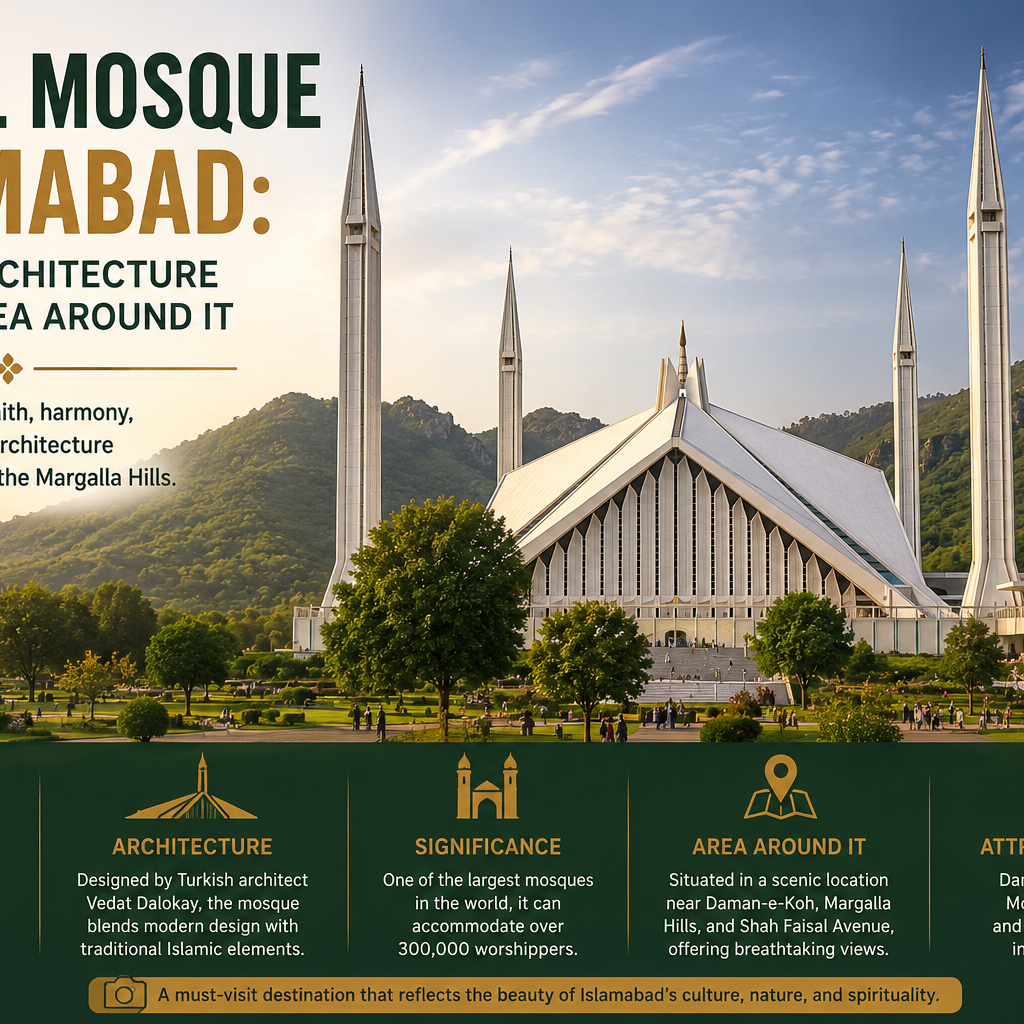
Faisal Mosque is the national mosque of Pakistan, standing at the northern end of Faisal Avenue in Islamabad. It sits at the foot of the Margalla Hills, the westernmost foothills of the Himalayas which gives it a striking natural backdrop and a position visible from far across the city.
The mosque is named after the late King Faisal bin Abdulaziz of Saudi Arabia, who supported the idea of building a national mosque in Islamabad during a visit to Pakistan in 1966. Saudi Arabia funded the project and the mosque became a symbol of the friendship between the two countries. After King Faisal was assassinated in 1975, both the mosque and the avenue leading to it were named in his honour.
Faisal Mosque is one of the largest mosques in the world and it held the title of the largest anywhere from its completion until the early 1990s, when larger mosques in Saudi Arabia overtook it. It remains the biggest mosque in South Asia and the sixth largest in the world and it is one of Pakistan's most photographed and visited sites.
The scale of the mosque is considerable. The complex covers a large area and the main prayer hall can hold around ten thousand worshippers, with the porticoes and courtyard raising the total capacity to roughly one hundred thousand and the surrounding grounds able to accommodate far more during major events such as Eid.
Quick answer: Faisal Mosque is the national mosque of Pakistan, located at the foot of the Margalla Hills in Islamabad. Named after King Faisal of Saudi Arabia and completed in 1986. It is the largest mosque in South Asia and one of the biggest in the world.
The history of Faisal Mosque
The story of Faisal Mosque began in 1966, when King Faisal of Saudi Arabia visited Pakistan and backed the plan to build a national mosque in the new capital. The idea took shape over the following years, leading to a search for the right design.
In 1969, an international competition was held to choose the design. Architects from seventeen countries submitted dozens of proposals. After careful evaluation, the design by the Turkish architect Vedat Dalokay was chosen, notable for breaking away from the traditional mosque form.
Construction began in 1976, carried out by Pakistani engineers and workers and funded by Saudi Arabia. The work took about ten years and the mosque was completed in 1986. It stands today as a joint achievement, designed by a Turkish architect, funded by a Saudi king and built by Pakistani hands.
The mosque quickly became a national symbol. It has hosted major national occasions and remains a focal point for religious and cultural life alongside its role as a place of worship. Its history, spanning the decades of Islamabad's own development, is closely tied to the identity of the capital.
The architecture of Faisal Mosque
The architecture of Faisal Mosque is what sets it apart from almost every other mosque. Instead of the domes and arches common to Islamic architecture, Vedat Dalokay designed a modern structure shaped like a Bedouin desert tent.
The main prayer hall is an eight sided concrete shell that slopes upward into a triangular form, resembling a tent. This unusual shape was a bold departure and it drew criticism at first from those who missed the traditional dome. Over time, though, the design came to be admired as an influential piece of modern Islamic architecture.
Four tall minarets stand at the corners of the main hall, rising around eighty to ninety metres. These are among the tallest minarets in South Asia and their thin, upright form draws on Turkish architectural tradition. The architect described the design as capturing the spirit and geometry of the Kaaba in an abstract way, with the minarets and the tent like hall working together as a single composition.
The mosque is finished largely in white which stands out sharply against the green backdrop of the Margalla Hills. Inside, the main prayer hall is decorated with mosaics, calligraphy and a large chandelier, with decorative work by the noted Pakistani artist Sadequain. The west wall carries calligraphy in Kufic script. The overall effect blends modern engineering with Islamic art and geometry.
The design won recognition beyond Pakistan and the mosque is studied as an important example of contemporary Islamic architecture. Its combination of a modern form with deep religious meaning is a large part of why it has become such a lasting symbol of the capital.
Places near Faisal Mosque
Faisal Mosque sits in one of the most desirable parts of Islamabad and the area around it holds many of the city's important places. This setting is part of why the surrounding sectors are among the most sought after in the capital.
The most obvious neighbour is the Margalla Hills National Park which rises directly behind the mosque. This protected green area gives the mosque its scenic backdrop and offers walking trails and viewpoints. The nearby Daman e Koh and Pir Sohawa viewpoints, up in the hills, are popular spots that look out over the city and the mosque itself.
The mosque lies close to some of Islamabad's prime residential sectors, such as the F and E series which are among the most established and upscale areas of the capital. Their closeness to the mosque, the hills and the city centre makes them highly valued and proximity to this landmark adds to the appeal and character of these neighbourhoods.
Education is well represented nearby. The International Islamic University was originally housed within the mosque's grounds before moving to its own campus and Islamabad is home to several respected universities and schools within reach of the area. Quaid i Azam University and other institutions sit in the wider vicinity.
For everyday needs, the central areas of Islamabad, with their markets, shopping and services, are a short drive away. Landmarks such as the Centaurus mall, the Pakistan Monument on Shakarparian and the government and diplomatic areas all connect easily to the mosque through the city's well planned road network. Hospitals and healthcare facilities serve the surrounding sectors as well.
This concentration of natural beauty, prestigious sectors, education and city amenities around Faisal Mosque is one reason the area is so prized. For property in the nearby sectors, closeness to such a landmark and to the hills adds real appeal.
Visiting Faisal Mosque
Faisal Mosque is open to visitors as well as worshippers and it is one of the top attractions in Islamabad. People come from across the country and abroad to see its architecture and enjoy its setting.
Visitors can admire the mosque from the large courtyard and take in the views of the surrounding hills. Non Muslim visitors are generally welcome to see the exterior and courtyard areas outside prayer times. As with any place of worship, modest dress and respectful behaviour are expected and shoes are removed before entering the prayer areas.
The mosque grounds include a library, a museum, a lecture hall and a café, offering more than just the prayer hall to those who visit. The tomb of a former head of state is also located within the grounds. The cooler months, roughly from October to March, are the most comfortable time to visit and early mornings or weekdays tend to be quieter.
The mosque's position at the end of Faisal Avenue makes it easy to reach from across the city and its size means it is visible long before you arrive. A visit combines architecture, history and the natural setting of the Margalla Hills in one place.
Quick answer: Faisal Mosque welcomes visitors and worshippers. Non Muslims can generally view the courtyard and exterior outside prayer times, with modest dress expected. The grounds include a library, museum and café and the cooler months are the best time to visit.
Why Faisal Mosque matters to Islamabad
Beyond its religious role, Faisal Mosque holds a special place in the identity of Islamabad and of Pakistan. It is the image most associated with the capital, appearing in countless photographs and representing the city to the wider world.
For the city itself, the mosque anchors one of its most attractive areas. Its position against the Margalla Hills, at the head of a major avenue, shapes the character of the northern sectors and adds to their standing. Landmarks like this influence how an area is seen and valued and Faisal Mosque is the foremost example in Islamabad.
The mosque also draws steady tourism which supports the wider appeal of the capital as a destination. For anyone getting to know Islamabad, Faisal Mosque is the natural starting point.
Frequently asked questions
Where is Faisal Mosque located? Faisal Mosque stands at the northern end of Faisal Avenue in Islamabad, at the foot of the Margalla Hills. Its elevated position and large size make it visible from much of the city.
Who designed Faisal Mosque and when was it built? The mosque was designed by the Turkish architect Vedat Dalokay, whose design won an international competition. Construction began in 1976 and was completed in 1986, taking about ten years.
Why is it called Faisal Mosque? It is named after the late King Faisal bin Abdulaziz of Saudi Arabia, who supported and helped fund the project. After his assassination in 1975, the mosque and the avenue leading to it were named in his honour.
What makes the architecture of Faisal Mosque unusual? Unlike traditional mosques, it has no dome or arches. Instead, it features an eight sided, tent shaped main prayer hall inspired by a Bedouin desert tent, with four tall minarets, blending modern design with Islamic geometry.
Can non Muslims and tourists visit Faisal Mosque? Yes. The mosque is a major tourist attraction and visitors are generally welcome to view the courtyard and exterior outside prayer times. Modest dress and respectful behaviour are expected and shoes are removed before entering the prayer areas.
What places are near Faisal Mosque? The Margalla Hills National Park rises directly behind it, with viewpoints such as Daman e Koh nearby. Prestigious residential sectors, universities, the Centaurus mall, the Pakistan Monument and the city's markets and services are all within reach.
Final thoughts
Faisal Mosque is more than the national mosque of Pakistan. It is the defining landmark of Islamabad, a modern architectural achievement and a symbol recognised across the country and the world. Its tent shaped hall, tall minarets and position against the Margalla Hills give it a beauty that has made it one of the most visited and photographed sites in Pakistan.
For those getting to know Islamabad, the mosque is the natural centrepiece, anchoring some of the capital's most attractive and prestigious areas. Its history, architecture and setting come together in a way few landmarks manage. Whether you visit to worship, to admire the design or simply to understand the character of the capital, Faisal Mosque remains the heart of Islamabad and a lasting symbol of the city.