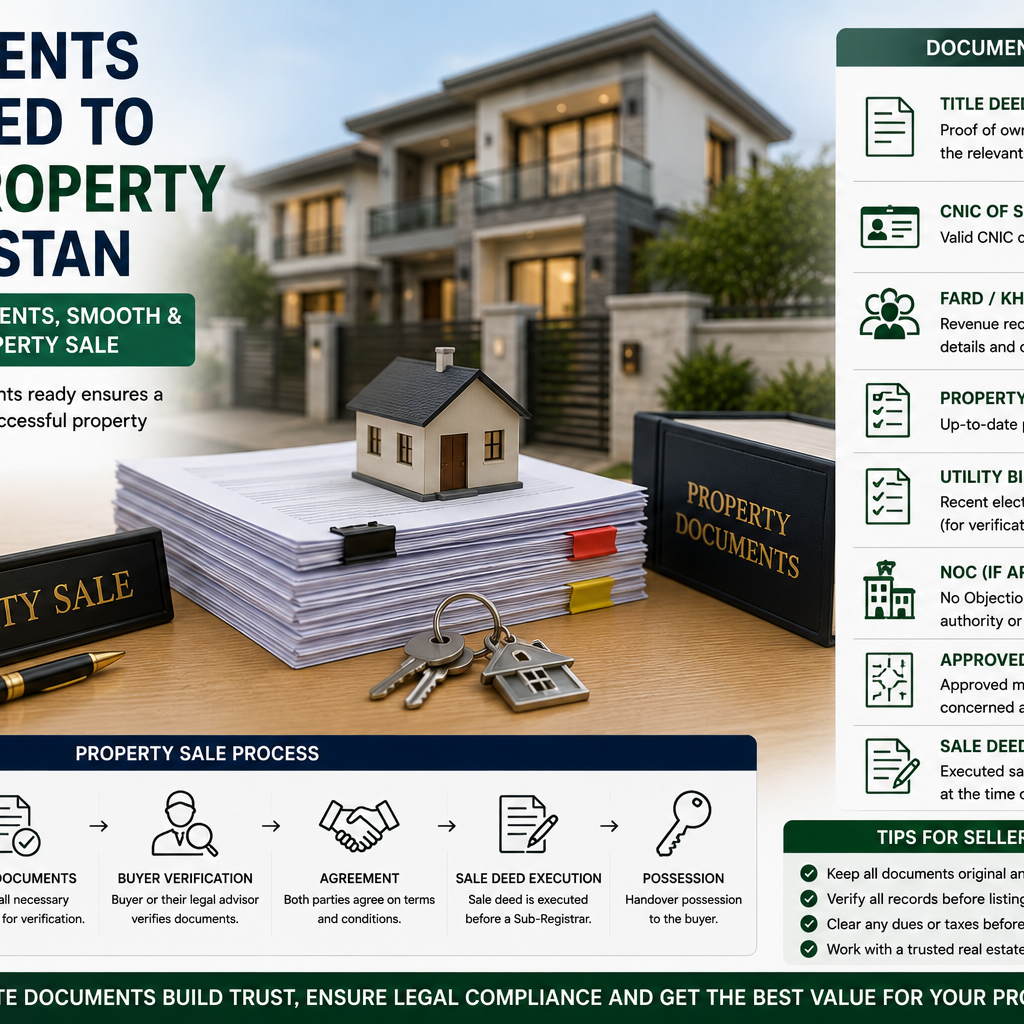
Documents Required to Sell Property in Pakistan
Selling a property is not only about finding a buyer and agreeing a price. The paperwork decides whether the deal actually completes. A seller with documents in order closes quickly. A seller scrambling for missing papers loses buyers and time.
Many sellers leave the documents until the last moment, then panic when a ready buyer asks to see them. This guide sets out what you need before you go to market, so that when the right buyer appears, nothing stands in the way of a clean transfer.
Why your papers matter before you list
A serious buyer will want proof that you own the property and that it is free of problems. If you cannot produce that proof, their confidence drops and the deal slows.
Worse, a buyer who has done their homework will check your documents against the official record. Any gap, error or missing paper raises a question and questions delay sales. Preparing everything in advance turns the document stage from an obstacle into a formality. It is one of the simplest ways to sell faster.
Proof of ownership
The first thing any buyer needs to see is proof that you legally own the property. The document depends on the type of property.
For land and houses in the general revenue record, the Fard or record of rights, shows the rightful owner. For property inside a housing society, the allotment letter or the society's transfer record does the same job. Make sure the ownership document carries your correct name and matches your CNIC exactly. Any difference, even a spelling variation, can cause delay, so sort it out before you list.
If you bought the property through a registered sale deed, keep that ready too.
The mutation or Intiqal
For property in the revenue record, the mutation records the transfer of ownership from the previous owner to you. It is part of the chain that proves how the property reached your hands.
A buyer or their lawyer may want to trace this chain to confirm everything is clean. Having your mutation ready and the earlier ones if you can obtain them, lets them verify quickly. A clear, complete chain of ownership reassures buyers and speeds the deal. A confusing or broken one invites doubt, so address any gap before going to market.
Your CNIC and personal documents
The transfer requires the seller to prove their identity, so keep your CNIC ready and valid. An expired CNIC can hold up the process.
If the property is in joint names then every owner must take part in the sale and provide their CNIC. A husband and wife who own jointly or siblings who inherited together, all need to be involved. Trying to sell a jointly owned property without every owner's consent leads straight to a dispute, so confirm everyone is on board from the start.
For overseas sellers acting through someone in Pakistan, a valid power of attorney is needed and this brings its own requirements, covered further below.
Society documents for plots and houses in schemes
If your property sits inside a housing society, the society holds the master record and its documents are central to the sale.
Keep your allotment letter, which shows the society allotted the property to you and any transfer letter from when you bought it. Before listing, visit the society office and confirm that their record shows you as the current owner with no pending issues. The society's own file is the final word on ownership within the scheme, so it must agree with the papers in your hand.
Clear any society dues as well, since these often must be settled before a transfer can go through.
A no objection certificate where required
Some societies and authorities require a no objection certificate, often shortened to NOC, before a property can be sold or transferred.
An NOC confirms that the relevant body has no objection to the transfer, usually because dues are cleared and the property is in order. Where one is needed, the transfer cannot complete without it, so find out early whether your property requires an NOC and begin the process in good time. Leaving it late can stall a deal at the final step, just when a buyer is ready to pay.
Proof that dues and bills are clear
Buyers want a property free of outstanding charges and unpaid dues can transfer with the property if not settled.
Gather recent electricity, gas and water bills and make sure they are paid. In a society, clear any maintenance charges and development dues. Property tax with the local authority should also be up to date. Being able to show a buyer that everything is clear removes a common sticking point and signals that you are an organised, trustworthy seller.
Settle these before the sale rather than promising to clear them later. A clean position now prevents arguments at transfer.
Confirm the property is free of loans or charges
If you ever mortgaged the property or pledged it against a loan, that charge must be removed before you can sell cleanly.
A property still carrying a bank charge cannot transfer freely until the loan is cleared and the charge lifted, with proof. If this applies to you, sort it out before listing and obtain documentation showing the loan is settled. A buyer who discovers an unresolved loan late in the process will hesitate and rightly so. Clearing it in advance keeps the sale on track.
The agreement to sell
Once you find a buyer and agree terms, you move to a written agreement, often called bayana. This is a key document in the sale.
The agreement should record the agreed price, the token or advance already paid, the balance due and the date for completing the transfer. Agreement should also state what happens if either side backs out. Both parties sign in presence of witnesses. Keep a signed copy safe. This document protects you if any disagreement arises before completion, so do not treat it as a formality.
Documents for a power of attorney sale
If you live abroad or cannot attend the transfer yourself, you may sell through a trusted person using a power of attorney.
The power of attorney must be properly drafted, valid and specific to the property and the sale. For overseas sellers, it usually needs to be attested through the correct channels to be accepted in Pakistan. Keep it limited to the single transaction rather than granting broad, open ended powers. A buyer and their lawyer will examine the attorney closely, since misused attorneys are a known route to fraud, so make sure yours is clean and clear.
What the buyer will check on your documents
It helps to know what a careful buyer looks for, so you can prepare for it.
They will confirm the owner's name matches your CNIC. They will trace the chain of ownership through the mutation or society record. Buyer will check for loans, disputes and pending dues. Buyer will compare the documents against the actual property and they may bring a lawyer to review everything before paying.
If your papers pass all these checks without trouble, the sale moves smoothly. Knowing this in advance lets you fix any weak point before a buyer ever finds it.
Keep copies and stay organised
Throughout the sale, keep your own organised file of every document and receipt. This is good practice and protects you if a question arises later.
Hold copies of the ownership papers, the mutation, the society documents, the agreement, the NOC if required and every receipt for money received. Note the dates and the people involved at each step. Organised records make the whole sale calmer and faster and they are valuable evidence should any dispute ever surface after completion.
Get professional help where needed
If your documents are complicated or you are unsure about any of them, a property lawyer is worth the modest fee.
A lawyer can confirm your ownership is properly recorded, check that the chain is clean, prepare or review the agreement and guide you through any NOC or attorney requirements. For sellers with inherited property, joint ownership or an overseas situation, this guidance can prevent costly errors. It also reassures buyers, since a deal handled properly is one they can trust.
Extra documents for inherited property
Selling property you inherited brings additional paperwork, because you must prove your right to it.
When an owner dies, the property passes to the legal heirs and the transfer of ownership must be recorded properly before a sale. You may need a succession certificate or similar legal proof showing you are a rightful heir entitled to sell. If there are several heirs, every one of them must consent to the sale and take part, since no single heir can sell the whole property alone.
Sort all this out before going to market. Buyers are wary of inherited property precisely because of these complications, so a seller who can show clean, complete inheritance records stands out as trustworthy and closes far more easily. If the situation is complex, take legal advice early.
Requirements for overseas sellers
Many property owners in Pakistan live abroad and need to sell from a distance. This is common, but it adds steps to the document side.
An overseas seller usually acts through a trusted person in Pakistan, using a power of attorney. That document must be drafted correctly, kept specific to the sale and attested through the proper channels so it is accepted at home. The person holding the attorney handles the transfer on your behalf, so choose them with great care.
Keep your own documents, including your CNIC or relevant identity papers, ready and valid. Communicate clearly with whoever is acting for you and stay involved in the key decisions even from abroad. Selling from overseas works smoothly when the paperwork is prepared properly and the person you trust is genuinely reliable.
Final thoughts
The documents are the backbone of a property sale in Pakistan. Proof of ownership, a clean chain through the mutation or society record, a valid CNIC, cleared dues, any required NOC and a proper agreement all need to be in place. Where a power of attorney or a past loan is involved, handle it carefully and in good time.
Prepare all of this before you go to market, not after a buyer appears. A seller with complete, verified documents closes deals quickly and inspires confidence. A seller who is missing papers loses both buyers and momentum. Get your file in order first and the rest of the sale becomes far easier.