Dera Ghazi Khan: A Complete Guide
Dera Ghazi Khan is a frontier city where four provinces almost meet. It lies in a strip between the Indus River and the Sulaiman Mountains. It was founded by a Baloch chief and still carries a rich tribal culture. It is the gateway to the cool hill station of Fort Munro. It anchors a district rich in cotton, dates, cement and minerals. This guide covers Dera Ghazi Khan for the curious traveller. It explains the history the culture the economy the sights the property scene and how to visit.
This guide offers a general overview. Figures for the population vary between sources.
Quick answer: Dera Ghazi Khan, often called D.G. Khan, is a city in the south west of Punjab. It lies in a strip between the Indus River and the Sulaiman Mountains, near where four provinces meet. It was founded in the 15th century by a Baloch chief and named after his son, Ghazi Khan. It is a great centre for cotton, dates, cement and minerals. It is the gateway to the hill station of Fort Munro. Its people are a mix of Saraiki, Baloch and Sindhi communities. Winter is the best time to visit.
About Dera Ghazi Khan
Dera Ghazi Khan is a frontier city in south west Punjab. It lies in a narrow strip between the Indus and the Sulaiman Mountains. It is often known simply as D.G. Khan. It blends the cultures of the plains and the hills.
The location is a great crossroads. The city lies close to the borders of all four provinces of the country. This makes it a natural gateway between Punjab and Balochistan. It was once even considered as a possible capital.
Indus flows to the east and the Sulaiman range rises to the west. Green fields the Pachad desert and the mountains all meet here. This gives the district a striking variety of scenery.
The people are diverse and hospitable. The population is a mix of Saraiki, Baloch and Sindhi communities. Saraiki and Balochi are widely spoken. This blend gives the city a warm and open character.
History of Dera Ghazi Khan
The city was founded by a Baloch chief. Mir Haji Khan Mirani founded it in the 15th century. He named it after his son, Mir Ghazi Khan. It became a stable Baloch state for several centuries.
Mirani dynasty ruled the region. They made a nominal submission to the Mughal empire under Akbar. They kept their local power through the payment of tribute. The Baloch tribes held the hills and plains.
British made it a district. They took control and declared it a district in 1849. They divided it into a settled area and a tribal belt. The tribal belt remained under the Baloch tribes.
A flood remade the city. The old city lay ten kilometres east of the present one. A heavy flood in the Indus destroyed it in 1908. The present city was built afresh in 1910.
It joined Punjab after independence. The Baloch land was divided by administrative boundaries. Dera Ghazi Khan was added to Punjab in 1951. It kept its deep ties to the neighbouring regions.
Economy of Dera Ghazi Khan
Economy rests on agriculture. Cotton is the great crop alongside wheat, sugarcane and dates. The Indus and the Taunsa Barrage water the fields. Farming supports much of the district.
Minerals are a great asset. The Sulaiman Mountains hold iron, gypsum, marble and limestone. Coal, uranium and other reserves lie in the range. This mineral wealth is a distinctive strength.
Industry is growing. A major cement plant operates in the district. Tractor manufacturing and food processing add to it. Carpet weaving and wooden toys are traditional crafts.
The location aids trade. The city is a junction between several regions. It links the plains of Punjab to the hills of Balochistan a natural trade centre for the south west.
Sights in Dera Ghazi Khan
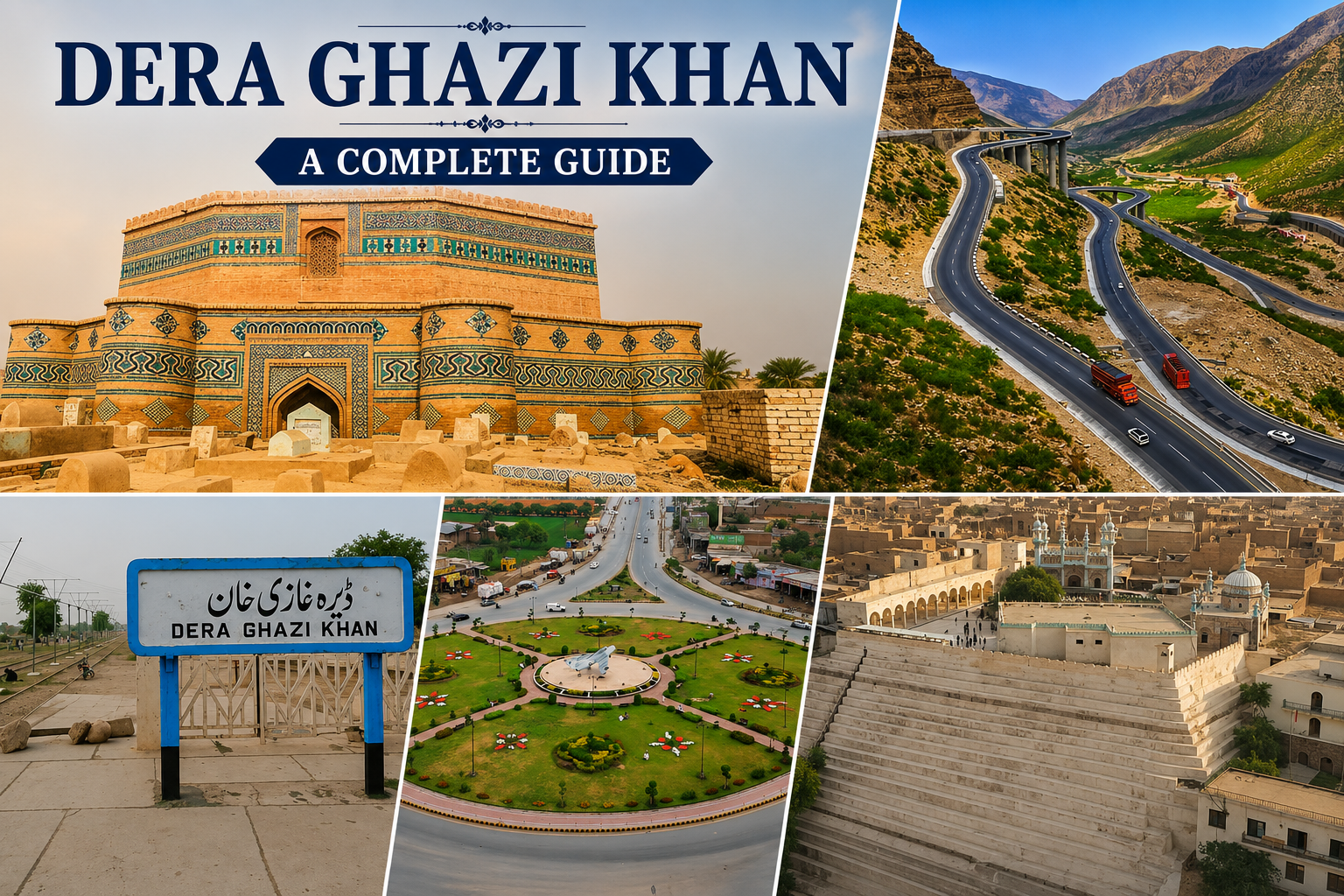
Fort Munro is the great escape. This hill station lies in the Sulaiman Mountains west of the city. It rises to around 1,800 metres, cool even in summer. It offers panoramic views and a respite from the heat.
Road to Fort Munro is a marvel. The Rakhi Gaaj steel bridges climb the steep mountains. This engineering feat zigzags up the rocky slopes. It resembles a giant rollercoaster on the highway.
Shrine of Sakhi Sarwar draws pilgrims. This 12th century Sufi shrine lies just outside the city. It has long been revered by people of different faiths. It is a symbol of the syncretic traditions of the region.
Ghazi Ghat lies on the Indus. This scenic village lies on the river east of the city. Families come for the river views and the fresh fish. Boat rides and stalls line the bank.
Taunsa Barrage is a haven for wildlife. It lies on the Indus in the district. It is known for the rare Indus river dolphin. Migratory birds gather here in season.
Property market in Dera Ghazi Khan
Property market is steady. The farming and industrial wealth support it. New housing schemes ring the city. Demand rises with the growth of the district.
The location is a great asset. Dera Ghazi Khan is a gateway between provinces. Road links reach Punjab, Balochistan and beyond. This connectivity lifts the property market.
Property choice is varied. The old city offers heritage and trade. New schemes offer modern living. The rural fringe offers agricultural land. Each suits a different buyer.
Visiting Dera Ghazi Khan
Come in winter. The summers are among the hottest in the country. The winter months from November to February are the finest season. The weather is pleasant then.
Escape to Fort Munro. The cool hill station is the great highlight. The drive up the Rakhi Gaaj bridges is unforgettable. It offers respite even in the summer heat.
Visit the shrine and the river. The shrine of Sakhi Sarwar is a place of devotion. Ghazi Ghat offers river views and fresh fish. Both give a sense of the character of the district.
See the wildlife. The Taunsa Barrage shelters the rare Indus dolphin. Migratory birds gather in season. It rewards the patient nature lover.
Frequently asked questions
What is Dera Ghazi Khan famous for? Dera Ghazi Khan is famous for its position as a frontier city near where four provinces meet, making it a great gateway between Punjab and Balochistan. It is known for its cotton, wheat, sugarcane and dates. The minerals of the Sulaiman Mountains, including a major cement industry add to its wealth. It is the gateway to the cool hill station of Fort Munro. The shrine of Sakhi Sarwar and the wildlife of the Taunsa Barrage add to its appeal.
Who founded Dera Ghazi Khan? Dera Ghazi Khan was founded in the 15th century by Mir Haji Khan Mirani a Baloch chief, who named it after his son Mir Ghazi Khan. It became a stable Baloch state ruled by the Mirani dynasty for several centuries. Under the Mughal emperor Akbar the dynasty made a nominal submission while keeping its local power. The British made it a district in 1849. It was added to Punjab in 1951.
What is Fort Munro? Fort Munro is a hill station in the Sulaiman Mountains around 80 kilometres west of Dera Ghazi Khan on the road to Quetta. It rises to an elevation of about 1,800 metres, offering cool air and panoramic views even in the summer heat. It is locally known as Nimroo in Balochi. The journey there features the spectacular Rakhi Gaaj steel bridges an engineering feat that zigzags up the steep mountains like a giant rollercoaster.
Why is Dera Ghazi Khan called a crossroads? Dera Ghazi Khan holds a unique geographical position near the borders of all four provinces of the country: Punjab, Sindh, Balochistan and Khyber Pakhtunkhwa. It lies in a strip between the Indus River and the Sulaiman Mountains, linking the plains of Punjab to the hills of Balochistan. This location has made it a natural hub of trade and a melting pot of Saraiki, Baloch and Sindhi cultures. It was once even considered as a possible capital.
When is the best time to visit Dera Ghazi Khan? The best time to visit Dera Ghazi Khan is winter, from November to February, when the weather is pleasant. The summers here are among the hottest in the country. Winter suits a trip up to the cool hill station of Fort Munro. It is ideal for the shrine of Sakhi Sarwar and the scenic Ghazi Ghat on the Indus. The Taunsa Barrage is also a fine spot for seeing the rare Indus river dolphin and migratory birds.
Frontier city of the four provinces
Dera Ghazi Khan is the frontier city where four provinces almost meet. It lies between the great river and the rugged mountains. It carries the proud Baloch heritage of its founder and its tribes. It guards the road to the cool heights of Fort Munro. It draws its wealth from cotton, dates, cement and the minerals of the hills. Few cities blend the plains and the frontier so vividly.
You may come to Dera Ghazi Khan for the mountains the shrine or the river. The city rewards the visit either way. You can climb the Rakhi Gaaj bridges to cool Fort Munro. You can seek the rare dolphin at the Taunsa Barrage. You can eat fresh fish by the Indus at Ghazi Ghat. Come in winter and explore the frontier of the south west. Dera Ghazi Khan is the gateway of the four provinces.