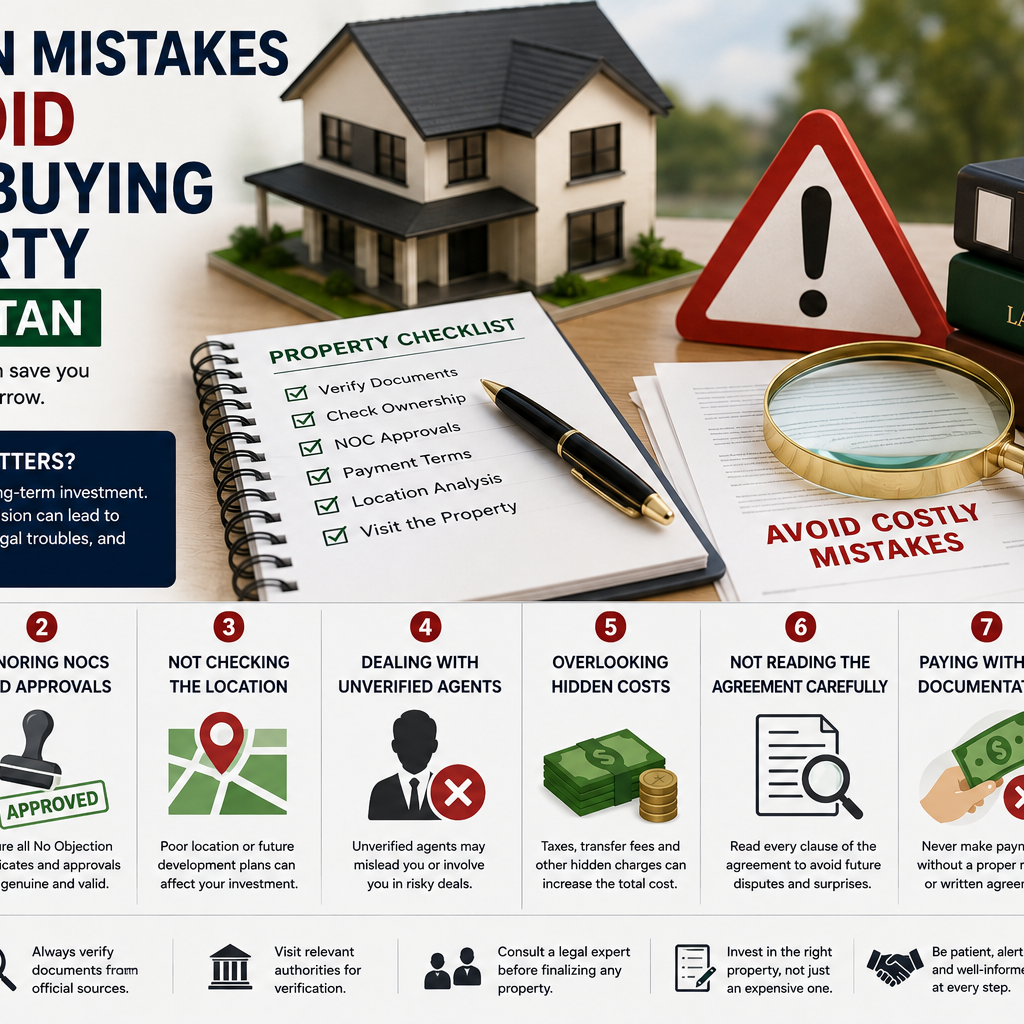
Common Mistakes to Avoid When Buying Property in Pakistan
Buying property is one of the biggest financial decisions most people ever make. It is also one where mistakes are expensive and hard to undo. A wrong move can cost you years of savings, drag you into a dispute or leave you holding a property you cannot sell.
The encouraging part is that most buyer mistakes are predictable. The same errors trip people up again and again. Once you know what they are, you can sidestep them. Here are the ones that cause the most damage and how to avoid each.
Skipping proper document verification
This is the mistake behind most property fraud. A buyer likes the property, trusts the seller and pays without checking the papers.
Never rely on the seller's word about ownership. Confirm it through the official record, whether that is the Fard for general land or the society's own file for a scheme. Match the owner's name to the seller's CNIC. Trace the chain of transfers and rule out loans and disputes before any money changes hands. A genuine seller will not object to this. A fraud will not survive it.
Not confirming the society is approved
Plenty of buyers pour money into housing societies that were never legally approved. The office looks smart, the marketing is convincing and the plots seem cheap.
Before trusting any scheme, confirm that it is sanctioned by the relevant development authority and that your specific block or phase is part of the approved layout. An unapproved society can be sealed, demolished or left without water and electricity for years. Check this with the authority directly, not with the society's sales team.
Letting emotion drive the decision
A house can pull at your feelings. The right address, a pretty front, a sense that this is the one. That feeling is exactly what some sellers and dealers play on.
Decisions made on emotion tend to skip the boring checks that protect you. Slow down. Treat the purchase as the large financial commitment it is. Let the documents, the location and the numbers decide, not the rush of excitement. The house will still be there after you have done your homework.
Ignoring the full cost of buying
Buyers often budget only for the purchase price and forget everything around it. Then the extra charges arrive and the plan falls apart.
A property deal carries costs beyond the sticker price. There are transfer taxes, registration charges, agent commission and the cost of any repairs or development. Keep a sensible cushion on top of the price so these do not catch you short. Stretching to the last rupee leaves no room for the surprises that always seem to appear.
Trusting verbal promises
In property, what is said means little once a disagreement starts. Only the written word holds up.
A seller might promise to fix something, leave certain fittings or clear a pending due. Unless it is written into the agreement, do not count on it. Put every term on paper: the price, the payment dates, who pays which charges and what happens if either side backs out. Keep witnesses and signed copies. Clear documents prevent most disputes before they begin.
Rushing because of pressure
A common sales tactic is urgency. The buyer is told the deal will vanish by tomorrow, that another buyer is ready, that the price rises next week.
Pressure is often a tactic, not a fact. It is designed to stop you thinking and checking. A genuine, fairly priced property does not usually disappear overnight. If someone pushes you to pay before you have verified everything, treat that as a reason for caution, not haste. Walking away from pressure has saved many buyers from a bad deal.
Overlooking the location and surroundings
Buyers sometimes focus so hard on the house that they forget where it sits. Location shapes both daily life and resale value.
Visit the area at different times of day. A quiet morning street can be loud and crowded by evening. Check access roads, water supply, drainage and security. See how far you are from work, schools and a hospital. A modest home in a well run area often holds its value better than a grand one in a neglected one. The property and its surroundings come as a pair.
Buying a file without understanding the risk
In new societies, plots are often sold as files long before the land is developed. A file is a claim on a future plot, not a piece of ground you can stand on today.
Files can work as an investment in a genuine, approved society. But they carry more uncertainty, because you are betting on a promise. Some buyers treat a file as if it were a developed plot and are then surprised by years of delay or by a society that never delivers. Know exactly what you are buying and weigh the risk honestly before paying.
Not checking dues and outstanding charges
A property can arrive with unpaid baggage that becomes your problem after purchase.
Unpaid utility bills, society maintenance dues and pending development charges can follow the property rather than the previous owner. Ask for a clear statement of what is paid and what is owed. Make settling any outstanding amount a condition of the deal. Clearing this up front is far easier than chasing the seller once the property is yours.
Mishandling a power of attorney
Sometimes the seller is not the owner but acts under a power of attorney. This is legal, yet it is also a favourite route for fraud.
If an attorney is involved, confirm it is genuine, valid and specific to this property and this deal. Check that it has not expired or been revoked. A vague or old power of attorney should make you pause. Where the stakes are high, verify it properly and bring in a lawyer. Forged and misused attorneys have cost buyers their entire payment.
Not involving a property lawyer
Many buyers try to save a small fee by handling everything themselves, then lose a fortune to a problem they could not spot.
A property lawyer can confirm ownership, trace the chain of transfers, check for loans and litigation and read the agreement for weak points. They know the local traps that catch ordinary buyers. The fee is tiny next to the value of the property. For a first time buyer especially, this is one of the wisest costs in the whole process.
Paying large sums in cash without records
Handing over big amounts of cash with no proof leaves you exposed. If a dispute arises, you may struggle to prove what you paid.
Use traceable payments such as a pay order or banker's cheque for large sums. Get a written receipt for every payment, including the token money. Keep these in your own file alongside the documents. A clear money trail protects you if the deal is ever questioned and it discourages dishonest behaviour from the other side.
Forgetting to transfer utilities and update records
The deal does not end at the transfer. New owners often forget the final housekeeping and it comes back to bite them.
After buying, put the electricity, gas and water connections in your own name and clear any outstanding bills. Update the property tax record with the local authority. If you skip this, you may be chased for the previous owner's dues or face confusion over who is responsible for the property. A short list of after sale tasks saves real trouble later.
Believing a price that is too good
A property offered far below the going rate should raise a question, not just excitement. Bargains in property usually have a reason.
The reason might be a dispute, an unpaid loan, an unapproved society or a problem with the title. Sometimes the seller is desperate for honest reasons and the deal is fine. But a low price is a prompt to check harder, not to relax. Find out why it is cheap before you celebrate.
Not inspecting the property in person
Some buyers, especially those living away from the city or abroad, commit to a property they have never properly seen. Photos and a dealer's description are not enough.
A site visit reveals what no listing shows. The condition of the construction, the water pressure, damp patches, the state of the surrounding streets, the noise and the level of the land all matter. For a plot, walking the site confirms it exists where the file claims and matches the stated size. If you genuinely cannot visit, send someone you trust to inspect it carefully on your behalf. Buying blind is a gamble that too often goes wrong.
Misjudging the resale potential
Many buyers think only about today and forget that one day they may want to sell. A property that is hard to resell ties up your money for years.
Before buying, think about who would want this property later. A house in a well run, approved society with good access tends to find buyers when the time comes. An oddly shaped plot, a property in a struggling scheme or a home in an area with poor services can be far harder to move. You do not have to plan your exit in detail, but you should avoid buying something that only suits you and no one else.
Failing to plan the timing of payment and transfer
Buyers often agree a deal without thinking through when money moves and when ownership passes. Poor timing creates risk on both sides.
The balance payment and the transfer should happen together, at the same place and time, so that you pay as ownership passes to you. Handing over a large sum well before the transfer leaves you exposed if the seller delays or backs out. Likewise, appearing for transfer without the funds ready wastes everyone's day. Plan the sequence carefully, arrange traceable payment and make sure both sides know exactly what happens on the day. A smooth, well timed completion protects your money at the most sensitive moment of the whole deal.
How to protect yourself overall
The thread running through every one of these mistakes is the same: people skip the checks because they are in a hurry or because they trust too easily.
Slow the process down. Verify the documents and the society. Put everything in writing. Use traceable payments and keep receipts. Bring in a lawyer when the stakes are high. None of this is difficult and all of it is far cheaper than the problems it prevents.
Treat each step as part of the deal, not as an optional extra. The few days you spend checking are nothing against the years you might spend regretting a rushed decision.
Final thoughts
Property mistakes in Pakistan are rarely original. The same errors repeat across thousands of deals, which is good news, because it means you can plan around them. Verify before you pay. Resist pressure. Keep records. Confirm the society. Involve a lawyer.
Get these basics right and you remove most of the danger from the process. A property purchase will still take effort and patience, but it will be effort that ends in a clean title and a home you can enjoy, rather than a costly lesson you wish you had avoided.