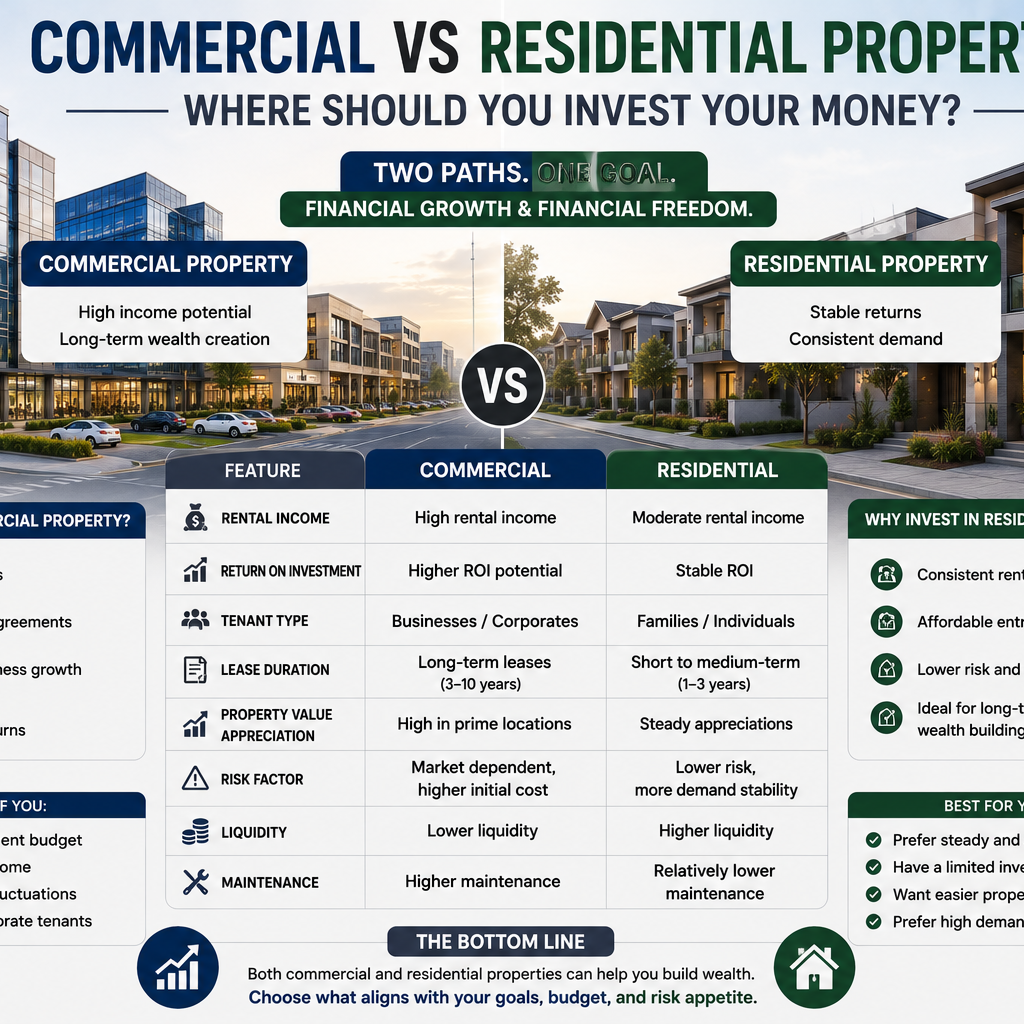
Commercial vs Residential Property: Where Should You should invest Your Money?
Property investors in Pakistan usually start with residential property because this is what most people know. Commercial property, such as shops, offices and other business spaces offer a different set of opportunities and risks. Choosing between the two shapes your returns, your effort and your level of risk.
Neither is simply better than the other. Each suits a different kind of investor and a different goal. This guide compares commercial and residential property honestly, so you can decide where your money fits best.
Basic difference
Residential property means homes: houses, flats and plots meant for residence. Demand comes from families and individuals who are looking for somewhere to live.
Commercial property means spaces used for business: shops, offices, warehouses and similar. Demand comes from businesses, which depend on the economy and the specific location. The two serve different needs, attract different tenants and behave differently as investments. Understanding this difference is the starting point for choosing between them.
Case for residential property
Residential property is the more familiar and accessible choice and it has real strengths. Most investors begin here for good reasons.
Demand for housing is broad and constant, since people always need somewhere to live. It makes residential property easier to rent and to sell because with a large pool of potential tenants and buyers. It is also easier to understand, since most people have lived in a home and know what makes one desirable. Entry prices range widely, so residential property is accessible at many budgets. For a first time or cautious investor, residential property offers a steadier, more understandable path.
The trade off is that residential rental returns in Pakistan have often been modest against the property's value, so much of the gain comes from rising prices rather than rent.
The drawbacks of residential property
Residential property is not without its weaknesses and these are worth weighing. The main one is the modest rental return relative to value.
Rent from a home, set against what the property is worth, has often been low in Pakistan, which limits the income side of the investment. Managing residential tenants also takes effort, with the usual demands of upkeep, tenant needs and occasional disputes. And because residential property is so familiar, competition among investors can be high, which affects both prices and rental rates. None of this makes residential property a poor choice, but it does temper the income it produces.
The case for commercial property
Commercial property attracts investors looking for stronger income. Its advantages centre on the return it can produce.
Commercial property often generates higher rental returns relative to its value than residential property does. Business tenants may also sign longer leases, giving more stable, predictable income over time. A well located shop or office in a busy commercial area can produce a steady, attractive return. For an investor focused on income rather than only price growth, commercial property can offer more than a home. It is one reason experienced investors often move into commercial property as their means grow.
The drawbacks of commercial property
Commercial property carries greater risk and demands more from the investor. These drawbacks must be taken seriously.
The biggest risk is that commercial demand depends heavily on the economy and the specific location. A shop in the wrong spot or in a downturn, can sit empty for a long time, earning nothing. Vacancies in commercial property can last longer than in residential, since the pool of business tenants is smaller. Commercial property usually requires a larger investment, putting it out of reach for smaller budgets. It also demands more knowledge, since judging a good commercial location and tenant is harder than judging a home. The higher return comes with higher risk.
How the two compare on income
Income is where the clearest difference lies. Commercial property generally offers a higher rental return relative to value, while residential offers a lower but steadier one.
A commercial space in a strong location can produce attractive rent and longer leases, giving better income. But that income is more exposed to the economy and to vacancy risk. Residential income is lower but more reliable, since the demand for housing rarely disappears. The choice depends on whether you prioritise higher potential income with more risk or steadier income with less. Be honest about which you value, since it points clearly towards one or the other.
How the two compare on risk
Risk is the other defining difference. Residential property is easier to manage while commercial property requires more expertise.
Residential demand is broad and constant, which cushions it against downturns. People always need homes, even in hard times. Commercial demand is narrower and more sensitive to the economy. When business slows, commercial vacancies rise and a commercial property can sit empty far longer than a home. A cautious investor or one who cannot afford a long vacancy, leans towards residential. An investor who can tolerate more risk for more reward and who understands the commercial market, may choose commercial.
How the two compare on effort and knowledge
The two also differ in how much knowledge and effort they demand. Residential property is easier to understand and manage, while commercial property requires more expertise.
Most people can judge a good home and a reasonable tenant, since the experience is familiar. Commercial property demands a sharper eye for location, footfall, business demand and the right kind of tenant. Getting these wrong is costly. Commercial property also involves dealing with business tenants and longer, more complex leases. For an investor without commercial experience, the learning curve is real. This is one reason many investors start residential and move to commercial only as they gain knowledge.
How leases differ between the two
The nature of the lease is another important difference between commercial and residential property and it affects your income and your involvement.
Residential tenancies tend to be shorter and more frequent, with tenants moving every year or few years, which means more turnover and more frequent searches for new tenants. Commercial leases are often longer, since a business that fits out a space wants to stay and recover its investment. A longer commercial lease gives more stable income and less frequent turnover, which many investors value. But a long lease with the wrong tenant or one that struggles, can also be harder to resolve. Understand the lease patterns of each before choosing, since they shape how often you deal with tenants and how predictable your income is.
A sensible starting point for most investors
For investors deciding where to begin, residential property is usually the wiser first step. There are good reasons for this.
Residential property is easier to understand, lower in risk, more accessible at smaller budgets and supported by demand that never disappears. It lets a new investor learn how property works, how to manage a tenant and how to handle the buying and selling process, all with less danger of a costly mistake. Once you have gained experience and built up your means, commercial property becomes a reasonable next step for higher income. Starting residential and moving towards commercial over time is a path many successful investors have followed. There is no need to take on the greater risk of commercial property before you are ready.
Matching the choice to your situation
The right choice depends on your budget, your goals, your risk appetite and your experience. Consider each honestly.
If you have a smaller budget, want a steadier and more understandable investment and prefer lower risk, residential property fits well. If you have a larger budget, seek higher income, can tolerate more risk and longer vacancies and understand the commercial market, commercial property may suit you. Your level of experience matters too, since commercial property punishes mistakes more harshly. There is no universally better option, only the one that matches where you are as an investor.
The role of location in both
Whichever you choose, location decides the outcome, though what makes a good location differs between the two.
For residential property, a good location means a desirable, well connected area where people want to live, with services and good access. For commercial property, a good location means strong business demand, footfall, visibility and the right surroundings for the intended use. A shop thrives in a busy commercial area and fails on a quiet residential street. Judging the right location for each type is a separate skill. Get the location wrong and neither residential nor commercial property will perform.
A balanced approach for larger investors
Some investors, as their wealth grows, hold both residential and commercial property, balancing the steadiness of one against the higher income of the other.
This spreads risk and combines the strengths of each. Smaller investors usually start with one type, typically residential and may add commercial later. As your means allow, a mix can make for a steadier and more rewarding overall position than relying on either alone.
Final thoughts
The choice between commercial and residential property is not about which is better in general, but about which fits you. Residential property offers steadier demand, lower risk, easier understanding and broad accessibility, but modest rental returns. Commercial property offers higher income and longer leases, but greater risk, longer vacancies, larger sums and a need for real expertise.
Match the choice to your budget, your goals, your risk appetite and your experience. Above all, choose the right location for whichever type you pick, since location decides the result. For most investors, especially those starting out, residential property is the natural beginning. As knowledge and means grow, commercial property can offer stronger returns for those ready to handle its risks. Decide what you want from your money first and the right choice between the two becomes clear.