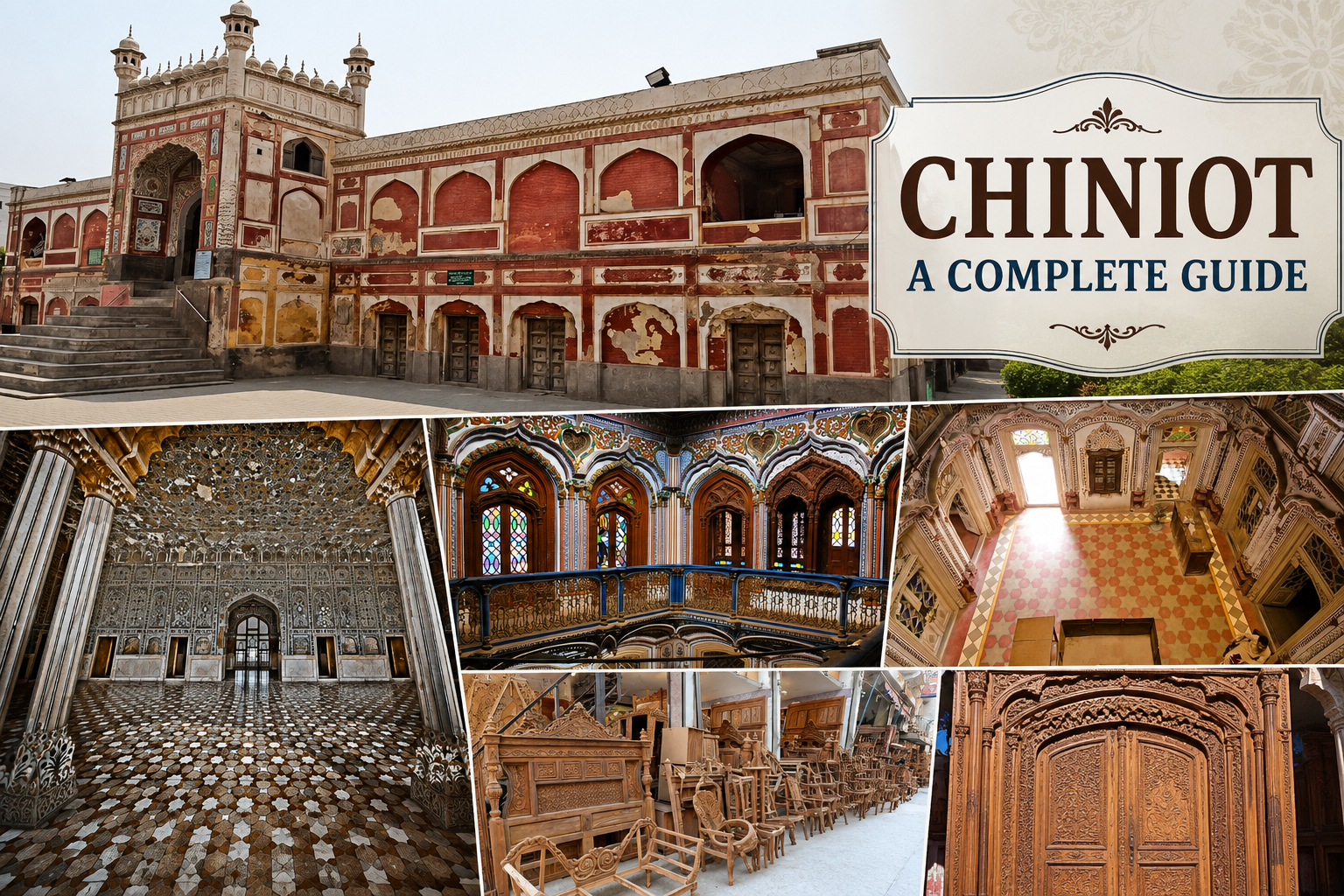
Chiniot: A Complete Guide
Chiniot is the City of Woodwork, famed for its exquisite carved furniture. It rests on the bank of the Chenab River, on a small rocky hill. Its artisans are so skilled that they were called to work on the Taj Mahal and the Wazir Khan Mosque. It holds one of the most beautiful wooden buildings in South Asia the Omar Hayat Mahal. It has also given the country some of its great business families. This guide covers Chiniot for the curious traveller. It explains the history the woodwork the architecture the sights the property scene and how to visit.
This guide offers a general overview. Figures for the population vary between sources.
Quick answer: Chiniot is a historic city in central Punjab, on the bank of the Chenab River around 40 kilometres north of Faisalabad. It is world famous as the City of Woodwork, known for its finely carved sheesham furniture. Its artisans worked on the Taj Mahal and the Wazir Khan Mosque. Its landmarks include the Mughal Shahi Mosque and the wooden Omar Hayat Mahal. It became a district in 2009, carved from Jhang. It is also a home of great business families. Winter is the best time to visit.
About Chiniot
Chiniot is a historic craft city in central Punjab. It lies on the left bank of the Chenab River. It rests on a small rocky hill above the water. It is famous across the country for its woodwork and architecture.
The setting shaped its craft. The Chenab flows past the edge of the city. Timber from Kashmir was once floated down the river to Chiniot. This gave the city its great tradition of woodworking.
The name has poetic roots. Some trace it to the Punjabi words for behind the moon. Others tie it to a princess named Chandan who founded a settlement here. The true origin is lost to time.
It carries deep roots. The city has been inhabited since the days of the Indus Valley Civilisation. It later became part of the Faisalabad region. It became a district in its own right in 2009.
History of Chiniot
The origins are ancient and obscure. Records of the founding of Chiniot are lost to history. Legend ties it to a princess who was charmed by the scenery. The city has stood by the Chenab for many centuries.
It flourished under the Mughals. Nawab Saadullah Khan a grand vizier of Shah Jahan, was from here. He commissioned the great Shahi Mosque in the 1640s. The city thrived as a craft centre under the empire.
Its artisans built imperial wonders. Master craftsmen from Chiniot were recruited for the Taj Mahal. They also worked on the Wazir Khan Mosque in Lahore. Their skill was prized across the empire.
The Sikhs took the city. Ranjit Singh captured the Chiniot Fort in 1803. He brought the city into his empire. This began a new period in its history.
The British followed the Sikhs. They took the region and developed its administration. Chiniot remained part of the Jhang District for many years. It became its own district only in 2009.
Woodwork in Chiniot
Chiniot is the City of Woodwork. Its craftsmen are considered the finest in the country. They carve furniture and interiors of great beauty. Their work is exported around the world.
The craft has deep roots. The tradition grew from the timber floated down the Chenab. It draws on Mughal era techniques passed down the generations. The dedicated guide to Chiniot woodwork covers the craft in detail.
The Chinioti style is renowned. It features intricate carving and fine inlay work. Brass and bone are set into the dark sheesham wood. These designs are prized far beyond the city.
The metalwork was also famed. Chinioti metalworkers ranked among the best in Punjab. Their designs were considered superior to their rivals. This craft heritage runs deep in the city.
Architecture in Chiniot
Shahi Mosque is the great jewel. Nawab Saadullah Khan built it between 1646 and 1655. It shows the imperial Mughal style of Shah Jahan. Frescoes and carved wooden interiors adorn it.
Omar Hayat Mahal is a wooden marvel. The merchant Sheikh Omar Hayat built it between 1923 and 1935. It is one of the most beautiful wooden buildings in South Asia. A tragic family story adds an air of mystery to it.
The palace shows the Chinioti art. Master carvers created its five storeys of woodwork. Storm damage later reduced its upper floors. It remains a great symbol of the craft of the city.
Havelis and shrines add more. Old carved havelis line the streets of the city. The shrine of Bu Ali Qalandar lies by the river. These recall the layered heritage of Chiniot.
Economy and property of Chiniot
The economy rests on woodwork. The furniture industry is the heart of the city. It employs skilled craftsmen across the district. It carries the name of Chiniot around the world.
Agriculture supports the district. The fertile plains grow wheat, rice and sugarcane. Sugar mills process the local crop. Farming underpins the rural economy.
The city breeds business families. Chiniot is known as the home of great trading families. Many have built industrial empires across the country. This enterprising spirit marks the city.
The property market is steady. The craft wealth and the business heritage support it. New housing schemes ring the city. The link to Faisalabad lifts the market.
Visiting Chiniot
Come in winter. The plains are hot in summer. The winter months from November to February are the finest season. The surrounding fields are green and pleasant then.
See the Omar Hayat Mahal. This wooden palace is the great highlight. Its carved storeys are unforgettable. It reflects the finest craft of the city.
Visit the Shahi Mosque. This Mughal mosque is a jewel of the city. Its frescoes and woodwork are exquisite. It offers cool, peaceful courtyards.
Explore the woodwork bazaars. The traditional wooden bazaars are a delight. You can watch the carvers at work. The riverbank offers a pleasant walk.
Frequently asked questions
Why is Chiniot famous for woodwork? Chiniot is world famous as the City of Woodwork thanks to its finely carved sheesham furniture. The craft grew because timber from Kashmir was floated down the nearby Chenab River to the city. Its artisans, drawing on Mughal era techniques are considered the finest in the country. Their work is exported around the world. Their skill was so renowned that Chinioti craftsmen were recruited for the Taj Mahal and the Wazir Khan Mosque in Lahore.
What is the Omar Hayat Mahal? The Omar Hayat Mahal also known as Gulzar Manzil, is a five storey wooden palace in the heart of Chiniot. The merchant Sheikh Omar Hayat built it between 1923 and 1935. It is considered one of the most beautiful wooden buildings in South Asia. It is the quintessence of the Chinioti woodcarving style. A tragic family story is linked to it adding an air of mystery. Storm damage later reduced its upper floors, though it remains a great attraction.
What is the Shahi Mosque of Chiniot? The Shahi Mosque is the primary architectural monument of Chiniot, built between 1646 and 1655 by Nawab Saadullah Khan a grand vizier to the Mughal emperor Shah Jahan. It shows the imperial Mughal style, with a stone structure, frescoes and intricate carved wooden interiors. It shares a stylistic kinship with the Jama Masjid in Delhi, overseen by the same statesman. It remains the great jewel of the city.
When was Chiniot made a district? Chiniot became the administrative headquarters of its own district in 2009, when it was carved out of the Jhang District. Before that, it had long been part of Jhang and the wider Faisalabad region. The city itself is far older, having been inhabited since the days of the Indus Valley Civilisation. It lies on the bank of the Chenab River and is the 28th largest city in the country.
When is the best time to visit Chiniot? The best time to visit Chiniot is winter, from November to February, when the weather is pleasant and the surrounding fields are green. The plains are hot in summer. Winter suits a visit to the Omar Hayat Mahal the Shahi Mosque and the traditional woodwork bazaars, where you can watch the carvers at work. A walk along the bank of the Chenab River is also pleasant in the cooler months.
City of the carvers
Chiniot is the city of the carvers on the Chenab. It floated the timber down the river and turned it into art. It sent its master craftsmen to build the Taj Mahal and the Wazir Khan Mosque. It raised the wooden marvel of the Omar Hayat Mahal in its heart. It has given the country great mosques, great furniture and great business families. Few cities carry such craft in their hands.
You may come to Chiniot for the woodwork the mosques or the river. The city rewards the visit either way. You can wander the carved storeys of the Omar Hayat Mahal. You can rest in the courtyards of the Mughal Shahi Mosque. You can watch a carver shape sheesham in an old bazaar. Come in winter and see the craft of the Chenab. Chiniot is the city of the carvers.