Chauburji Lahore: The Historic Mughal Gateway
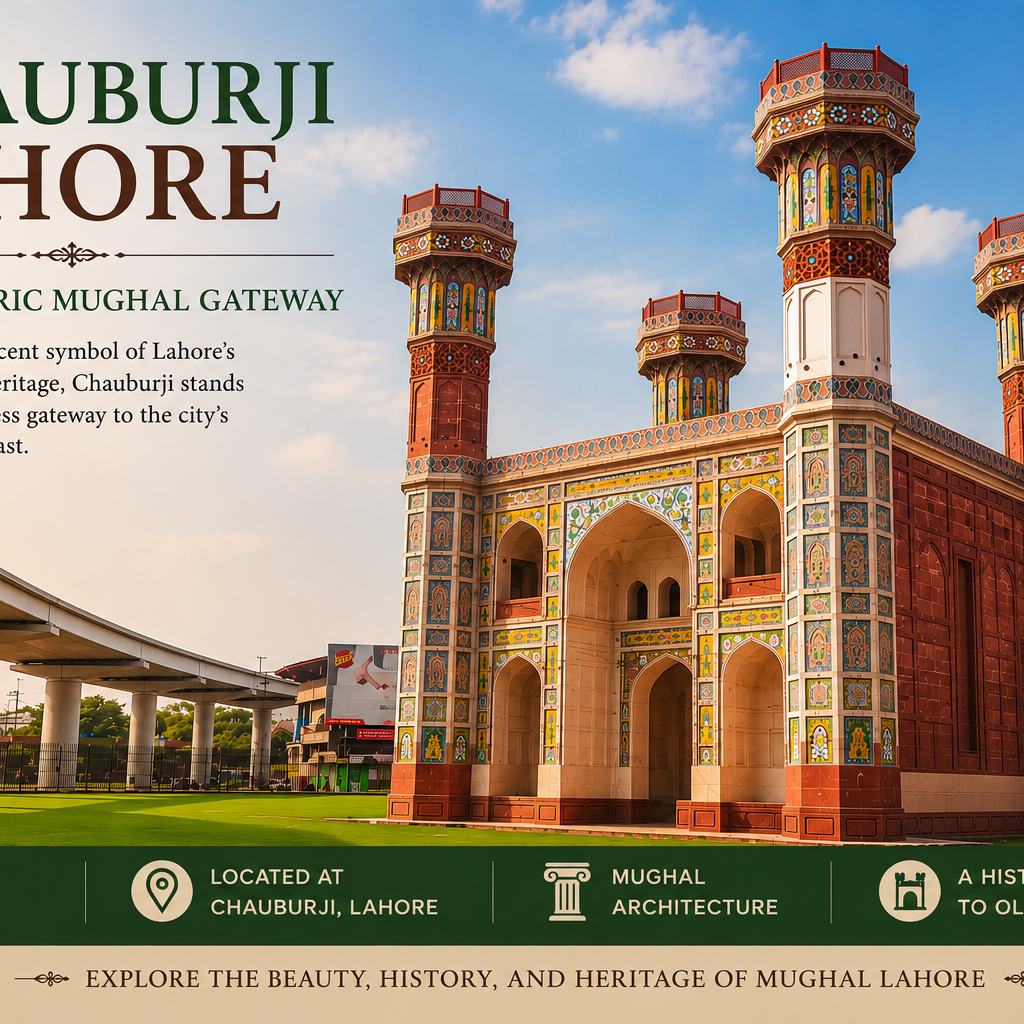
Chauburji is located in the heart of Lahore from where roads goes to all sides. It is a striking Mughal era gateway from the seventeenth century. The monument was built in 1646 during the reign of the Emperor Shah Jahan. It once served as the grand entrance to a large garden that has since vanished. Four tall corner minarets give the structure its name. Chauburji means "four towers" in Punjabi and Urdu. The gateway now stands alone on a busy junction, a survivor of the age when Lahore was known as the City of Gardens.
This guide explains what Chauburji is, its history, its architecture and its setting in the city. It covers both the monument itself and the lost garden it once guarded.
Chauburji
Chauburji is a Mughal era monument in the city of Lahore. It stands on Multan Road at the intersection with Bahawalpur Road. That road leads southwards to Multan. The monument was built in 1646 during the reign of Shah Jahan. It served as a monumental gateway to an extensive garden in Mughal times. The name means "four towers" and refers to the four corner minarets of the structure.
The gateway is one of the few surviving examples of Mughal garden architecture in Lahore. The garden it once guarded no longer exists. Only the gate remains. It now sits on a grassy roundabout at one of the busiest intersections in the city, surrounded by traffic and commerce. The junction and the surrounding area take their name from the monument.
Chauburji is famous for its decoration. Blue, green and white glazed tile work, known as kashi kari, once covered the entire facade. Much of this tile work survives on the minarets and the arches. Quranic and Persian inscriptions run across the structure. The verse Ayat ul Kursi appears over the main vault in blue enamelled letters. The inscription also records the year of construction, 1646. This blend of red brick and colourful tile makes the monument distinctive.
The Department of Archaeology of the Government of Punjab owns and maintains Chauburji. The monument has survived earthquakes, flooding and the growth of the city around it. It remains one of the best known heritage icons of Lahore. It offers a glimpse into the grandeur of the Mughal gardens that once surrounded the city.
Quick answer: Chauburji is a Mughal era gateway in centre of Lahore from where roads go to all sides. It was built in 1646 during the reign of Shah Jahan. It once served as the entrance to a large garden that no longer survives. The name means "four towers" and refers to its four corner minarets. It is famous for its blue and green tile work.
History of Chauburji
Chauburji was built in 1646 during the reign of Shah Jahan. This was the golden age of Mughal art and architecture. The monument served as the grand gateway to an extensive pleasure garden. The garden reflected the title of Lahore as the City of Gardens. It stretched from Nawankot in the south towards the city.
The patron of the garden is a matter of historical debate. An inscription on the gateway records that a lady founded the garden in 1646. It describes her as "Sahib e Zebinda Begum e Dauran," meaning "the elegant lady of the age." Local tradition attributes the garden to the Mughal princess Zeb un Nisa, the daughter of the Emperor Aurangzeb. Zeb un Nisa was only around eight years old at the time of construction. Many historians therefore doubt this attribution. They suggest the inscription more likely refers to Jahanara Begum, the eldest daughter of Shah Jahan. Jahanara held the title of first lady of the empire after the death of her mother in 1631. She was a known patron of gardens in Lahore. Letters of Aurangzeb confirm that she had a garden in the city.
The garden did not survive the centuries. Flooding from the River Ravi is believed to have destroyed most of it during the reign of Aurangzeb. Neglect over time completed its disappearance. No trace of the once extensive garden survives today apart from the Chauburji gateway. The monument stands as the only reminder of a garden that has otherwise vanished.
The gateway itself has faced damage over the years. A severe earthquake in 1846 caused the northwestern minaret to collapse. Cracks appeared in the central arch. This left the monument with three of its original four towers for a long period. The Department of Archaeology carried out restoration in the late 1960s. This work rebuilt the lost tower and preserved the surviving parts of the gateway. Conservation of the monument continues to this day.
Architecture of Chauburji
The architecture of Chauburji blends several traditions. It combines Mughal architecture with the older Timurid style from Central Asia and Perso Arabic styles from the Middle East. This mix reflects the artistic exchange of the Mughal period. The monument is built mainly of red brick with lime mortar and faience tile inlay.
The eastern and western facades are the most striking feature. Each carries a two storey Timurid style iwan. An iwan is a vaulted hall walled on three sides with one end open. Two levels of alcoves flank each iwan in a style typical of the Shah Jahan period. The formal gateway to each iwan is a projecting portal known as a pishtaq. Muqarnas, the honeycomb like decorative element, embellishes the tops of the iwans. This element first entered Mughal architecture with the construction of the Wazir Khan Mosque in Lahore.
The four corner minarets give the monument its name and its distinctive profile. The minarets are slender for their height. They are octagonal and unusual in form. They expand slightly towards the top rather than tapering. This feature is not found elsewhere in the subcontinent. Each minaret ends in a coved platform. These platforms once carried arched pavilions or cupolas that have since been lost. The entire facade, including the minarets, was once covered in rich mosaic and tile work.
The decoration is the main artistic merit of the building. Azure blue, sea green, lemon yellow and white glazed tiles once covered the structure. Floral and geometric patterns fill the surviving tile work. The Ayat ul Kursi inscription over the main vault, in blue enamelled letters, adds a spiritual dimension. The red brickwork is typical of Muslim buildings of the subcontinent. Doorways and windows run through the interior corridors. Although much of the original decoration has worn away, the monument has kept its elegance. It stands as a fine example of the decorative art of the Mughal age.
Setting in the city
Chauburji sits on Multan Road at its intersection with Bahawalpur Road in central Lahore. This is one of the busiest junctions in the city. The monument now stands on a grassy roundabout surrounded by traffic, shops and businesses. The junction and the surrounding neighbourhood are known as Chauburji Chowk after the monument.
The setting has changed completely since Mughal times. The extensive garden that Chauburji once guarded has vanished. The city has grown up around the gateway. The area is now a commercially important part of Lahore. It features a variety of shops and businesses. It is also a significant transport hub. Buses, rickshaws and other transport pass through the intersection.
The monument sits along the route of the Orange Line of the Lahore Metro. The planned metro line passed close to Chauburji and several other heritage sites. Heritage campaigners petitioned the Lahore High Court over the risk to these monuments. In August 2016 the Court halted construction within 200 feet of any heritage site. This aimed to prevent what UNESCO described as potentially irreversible damage. The Chauburji station was originally planned as an underground station. It was changed to a raised station to comply with the heritage regulations. The monument now sits close to the Orange Line. This offers easy access for visitors.
Chauburji is part of the rich Mughal heritage that gives Lahore its historical character. It stands as a reminder of the pleasure gardens that earned the city its title as the City of Gardens. Its central location places it within reach of the other landmarks of Lahore. The monument adds to the appeal of the city as a place of history and culture. This heritage is part of what makes Lahore a distinctive and desirable city.
Visiting Chauburji
Chauburji is one of the most accessible heritage monuments in Lahore. It stands at a central junction and is easy to reach. Visitors can view the gateway and its tile work from the roundabout. There is generally no entry fee to see the monument.
The monument is reached easily from across the city by car, taxi or ride hailing service. It sits on Multan Road at the Chauburji Chowk intersection. The Orange Line metro also serves the area with a stop at Chauburji station a short walk away. The busy junction means traffic can be heavy. Visitors should take care when approaching the monument on the roundabout.
The cooler months from around October to March offer the most comfortable time to visit. They avoid the summer heat. The morning and late afternoon light bring out the colours of the surviving tile work. The monument is a popular subject for photography with its four minarets and blue and green mosaics against the red brick. A visit takes less time than the larger sites. Chauburji combines well with the other landmarks of the city on a wider heritage tour.
The tomb attributed to Princess Zeb un Nisa lies a short distance away near the Samanabad area. Some historians identify it instead as the tomb of Mian Bai, the lady associated with the Chauburji garden. The tomb is tucked among shops and easy to miss. Asking a local for directions helps in finding it. This adds a further point of interest for those exploring the history of the monument.
Places near Chauburji
Chauburji sits within reach of many landmarks and useful places in central Lahore. This helps visitors plan a fuller trip. The Orange Line metro connects the monument to the rest of the city. The tomb attributed to Zeb un Nisa lies a short distance away near Samanabad.
The Walled City with the Lahore Fort and the Badshahi Mosque lies a short drive to the north. Anarkali Bazaar and the Mall Road, with the Lahore Museum, are also within reach. Data Darbar, the shrine of Data Ganj Bakhsh, lies nearby. For shopping, the area around Chauburji Chowk offers busy local markets. Major hospitals of the city, including Mayo Hospital, Sir Ganga Ram Hospital and Services Hospital, serve the central area. The University of the Punjab and other institutions lie within the wider central district. These connections make Chauburji an easy addition to a tour of central Lahore.
Frequently asked questions
Where is Chauburji located? Chauburji stands on Multan Road at its intersection with Bahawalpur Road in central Lahore. The junction is known as Chauburji Chowk after the monument. It is easily reached from across the city and served by the Orange Line metro.
When was Chauburji built? Chauburji was built in 1646 during the reign of the Mughal Emperor Shah Jahan. An inscription on the gateway records the year of construction. It served as the entrance to a large garden that no longer survives.
Why is it called Chauburji? The name Chauburji means "four towers" in Punjabi and Urdu. It refers to the four corner minarets of the structure. The monument lost its northwestern minaret to an earthquake in 1846. Restoration in the late 1960s rebuilt the lost tower.
Who built the Chauburji garden? An inscription attributes the garden to a lady described as the elegant lady of the age. Local tradition names the princess Zeb un Nisa. Many historians instead suggest Jahanara Begum, the eldest daughter of Shah Jahan and a known patron of gardens in Lahore, since Zeb un Nisa was only around eight at the time.
What happened to the garden? The extensive garden that Chauburji once guarded no longer survives. Flooding from the River Ravi is believed to have destroyed most of it during the reign of Aurangzeb. Neglect over time completed its disappearance. Only the gateway remains.
Is there an entry fee for Chauburji? There is generally no entry fee to view Chauburji. The monument stands on a roundabout at a central junction and can be seen from the surrounding area. It is best visited in the cooler months and in the morning or late afternoon light.
Chauburji is one of the most striking and best known heritage monuments of Lahore. It was built in 1646 during the reign of Shah Jahan as the grand gateway to a large pleasure garden. The garden has long since vanished. The gateway survives. Its four minarets and its blue and green tile work stand as a reminder of the age when Lahore was celebrated as the City of Gardens.
The monument offers a glimpse into the grandeur of the Mughal gardens and the decorative art of the period. It now stands alone at a busy junction in the heart of the city, a survivor of centuries of earthquakes, flooding and urban growth. Its central location and its place on the Orange Line make it one of the most accessible landmarks in Lahore. It remains one of the essential monuments of the city and a lasting link to the golden age of Mughal Lahore whether you visit Chauburji for its architecture, its tile work, its history or the mystery of its lost garden.