Cathedral Church of the Resurrection and the Churches of Lahore
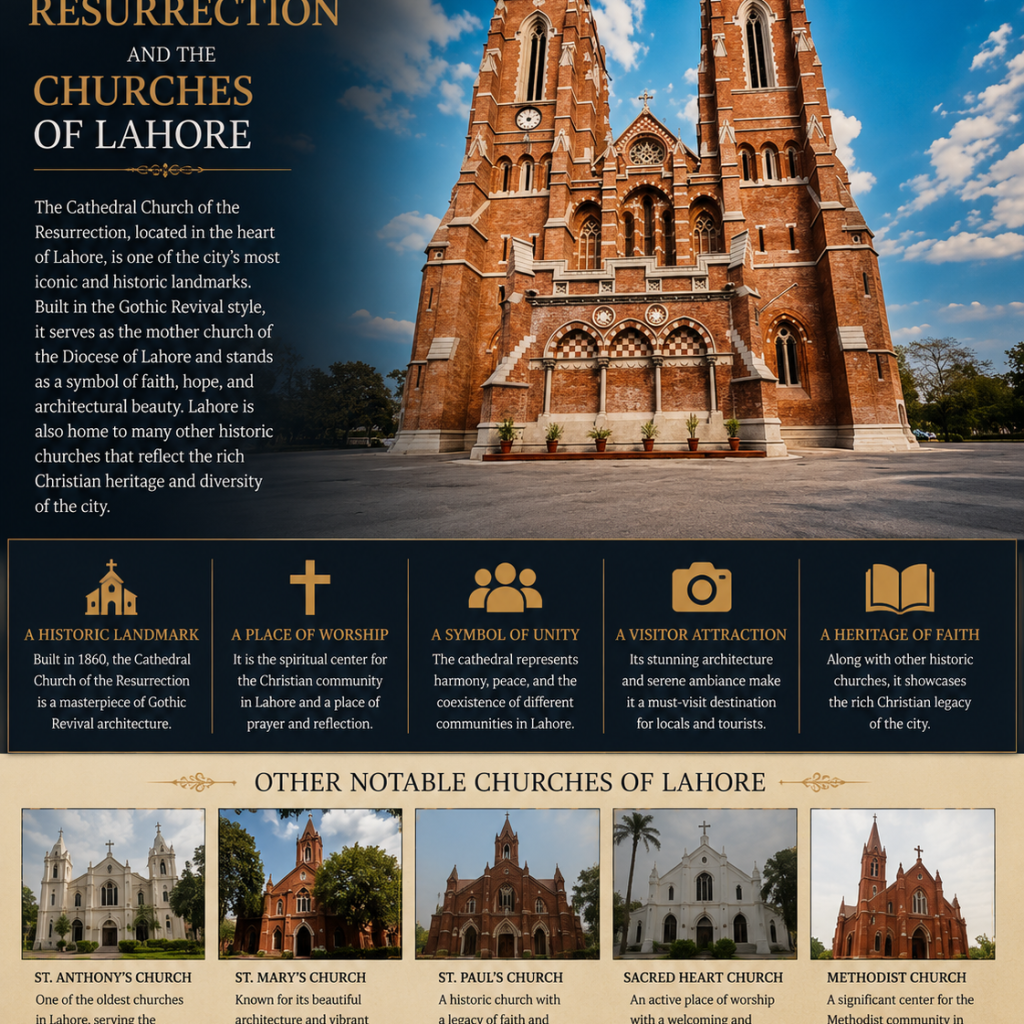
The Cathedral Church of the Resurrection is situated on The Mall in the heart of Lahore. It is the grandest church in the city and one of the finest examples of Gothic architecture in the country. The British built it in 1887, opposite the Lahore High Court. Its pink sandstone walls, pointed arches and stained glass make it a striking landmark. The cathedral is the seat of the Diocese of Lahore of the Church of Pakistan. For anyone getting to know Lahore, it is one of the great heritage buildings of the colonial city.
This guide explains what the Cathedral Church of the Resurrection is, its history, its architecture and its place among the churches of Lahore. It treats the cathedral with respect as a place of worship and heritage.
Cathedral Church of the Resurrection
The Cathedral Church of the Resurrection is also known simply as Lahore Cathedral. It is an Anglican cathedral in the heart of Lahore. It is situated on The Mall, opposite the Lahore High Court and near the McLeod Road. It was built in 1887 and consecrated on 25 January of that year. It serves as the seat of the Diocese of Lahore of the Church of Pakistan.
The cathedral is a grand and monumental structure. It was built in the Neo Gothic style. The British introduced this style to the city. Pink sandstone forms its walls. Its distinctive Gothic features include soaring height, pointed arches, tracery, flying buttresses and stained glass. The building follows a Latin cross plan, the traditional shape of a great church. It is situated in green lawns amid the traffic of The Mall.
The cathedral is affectionately known to locals as Kukar Girja. The word Girja means church in Urdu, coming from the Portuguese word for church. Kukar refers to a weathercock that was once mounted on the central lantern, one of the highest points of the building. The weathercock gave the cathedral its popular local name. It was removed as a safety precaution after an earthquake. The name has remained.
The cathedral is an active place of worship as well as a heritage landmark. It offers English language services on Sundays. Christians visit to perform their religious obligations. It is the centre of the Christian community of the city. The building is also visited for its architecture and history. It is situated as one of the major religious heritage sites in the country and a grand ornament of The Mall.
Quick answer: The Cathedral Church of the Resurrection is also called Lahore Cathedral. It is an Anglican cathedral on The Mall in Lahore, opposite the Lahore High Court. The British built it in 1887 in the Neo Gothic style, from pink sandstone. It is the seat of the Diocese of Lahore and is known locally as Kukar Girja.
History of the Cathedral church Lahore
The history of Christianity in Lahore reaches back much further than the cathedral. The first church in the city dates to the Mughal era. The Emperor Akbar invited Jesuit missions to his court. The third mission, led by Father Jerome Xavier, arrived in Lahore in 1595. Akbar granted permission for a church to be built near the Lahore Fort that year.
This early church had a difficult history. It was closed in 1614 on the order of the Emperor Jahangir. It was reopened ten years later. It was then demolished in 1632 on the orders of the Emperor Shah Jahan. Various missions continued to live and preach in the city despite this. The story of the earliest church shows the long presence of the Christian community in Lahore, going back to the Mughal age.
The present cathedral came two centuries later, under British rule. The British took control of Lahore in the mid nineteenth century. They developed The Mall as the grand civic centre of the colonial city. The Diocese of Lahore was created in 1877, carved out of the vast Diocese of Calcutta. This new diocese covered a huge area. A grand cathedral was needed as its seat. The cathedral was first based at a site in the Anarkali area before the new building was constructed.
The construction of the present cathedral spanned the 1870s and 1880s. The foundation was laid in the 1870s and the building was completed in January 1887. It was consecrated on 25 January 1887. Two towers with tall steeples were added in 1898. The steeples were taken down after the earthquake of 1911 for safety. The roof and interior were repaired after the damage. The cathedral has served as the centre of the diocese ever since.
Architecture of the cathedral
The architecture of the Cathedral Church of the Resurrection is a fine example of the Gothic Revival style, also called Neo Gothic. This style drew on the great medieval cathedrals of Europe. The British brought it to Lahore for their grandest churches and public buildings. The cathedral is considered one of the best examples of the style in the country.
The cathedral was designed by a notable architect. John Oldrid Scott designed it, the son of the famous architect George Gilbert Scott. He built the cathedral out of pink sandstone. This gives it a warm colour. The building was influenced by the design of Southwark Cathedral in London. This connection ties the Lahore cathedral to the great Gothic churches of England.
The building shows the hallmarks of Gothic architecture. Its spires once reached towards the sky, adorned with intricate tracery. Flying buttresses support the walls and add to the design. Pointed arches within the nave draw the eye upwards. Stained glass windows fill the interior with coloured light. Gargoyles and a rose window complete the Gothic character. The building follows a Latin cross plan, with a nave, aisles and a main altar.
The interior holds several treasures. The cathedral houses an ancient Saint Thomas Cross, excavated in 1935 near the site of the ancient city of Sirkap near Taxila. It keeps six change ringing bells imported from England, said to be the only working bells of their kind in South Asia. The stained glass windows, especially those in the ladies chapel, are a notable feature. The cathedral also holds a faldstool used by King George V at the Delhi Durbar of 1911. These items add to the historical richness of the building.
The churches of Lahore
The Cathedral Church of the Resurrection is the grandest of several historic churches in Lahore. The city has a long Christian heritage. Its churches are part of its diverse religious history. Lahore has been home to buildings tracing Muslim, Christian, Sikh, Hindu and Buddhist history over the centuries. The churches form part of this rich mix.
The colonial period saw the building of several churches in the city. The British built churches, cathedrals and missionary schools as part of their development of the city. Many of these stand in the areas developed during the colonial era, including The Mall and the cantonment. The cathedral has an adjacent missionary school, known as the Lahore Cathedral School. This reflects the strong contribution of the Christian community to education in the city.
The Roman Catholic community has its own cathedral in the city. The Sacred Heart Cathedral serves the Catholic Archdiocese of Lahore. Other historic churches from the colonial period stand across the older parts of the city. The area around one former church near Anarkali is still known as Church Road, a reminder of the long presence of these communities. These churches together tell the story of the Christian heritage of the city.
The churches remain active places of worship and heritage. They serve the Christian community of the city. This community has made a notable contribution to education, health and social life. The churches are also admired for their architecture, from the Gothic grandeur of the cathedral to the simpler colonial chapels. For anyone getting to know Lahore, the churches are part of what makes the city a place of many faiths and a rich, layered heritage.
Setting on The Mall
The Cathedral Church of the Resurrection is situated on The Mall, the grand avenue of colonial Lahore. This avenue holds the greatest concentration of colonial buildings in the city. The cathedral is one of the finest of these. Its setting places it among the major civic and cultural landmarks of the British period.
The cathedral is situated opposite the Lahore High Court, one of the grandest colonial buildings on the avenue. The General Post Office, the Lahore Museum, the National College of Arts and the Punjab University old campus stand nearby along The Mall. The Town Hall and other colonial buildings are close by. Together these buildings form a heritage corridor of colonial Lahore. The cathedral adds a note of Gothic grandeur to this collection.
The setting adds to the significance of the cathedral. The building is situated among the institutions that shaped the civic and cultural life of the city under British rule. Its green lawns provide a quiet space amid the busy traffic of The Mall. A visit to the cathedral naturally includes the other colonial landmarks of the avenue. This makes it easy to include on a heritage walk of The Mall.
The cathedral and The Mall are part of what gives Lahore its character as a city of layered history. The colonial avenue and its churches sit alongside the Mughal Walled City nearby. Together they tell the story of the different ages and faiths of the city. This heritage adds to the appeal and identity of central Lahore. The cathedral is one of the buildings that captures the colonial and Christian chapter of the history of the city.
Visiting the cathedral
The Cathedral Church of the Resurrection is one of the most rewarding heritage buildings to visit in Lahore.
Visitors are welcome to admire the building, though it is worth being mindful of services and the worshippers who use it. As a place of worship, respectful behaviour and modest dress are appropriate. It is worth checking current visiting arrangements before a trip, as access may vary and some visitors have reported needing prior arrangement. The peaceful interior, with its stained glass and Gothic detail, rewards a quiet visit.
The cathedral is reached easily as it is situated on The Mall in central Lahore. It is accessible by car, taxi, ride hailing service or the Metro Bus. The Metro Bus runs along a nearby route. It is situated opposite the Lahore High Court, near Anarkali. The central location can be busy, so public transport is often convenient. Parking is available in the area.
The cooler months from around October to March offer the most comfortable time to explore The Mall on foot. The green lawns and the pink sandstone of the cathedral make it a fine subject for photography. A visit combines well with the nearby High Court, the General Post Office, the Lahore Museum and Anarkali Bazaar. Visitors are asked to respect the church, its services and its worshippers.
Places near the cathedral
The Cathedral Church of the Resurrection is situated within reach of many landmarks and useful places in central Lahore. This helps visitors plan a fuller trip. The Lahore High Court is situated directly opposite the cathedral. The General Post Office, the Lahore Museum and the National College of Arts are nearby on The Mall. The Punjab University old campus lies close by.
Anarkali Bazaar, one of the oldest markets in the city, lies close for shopping and food. The Walled City with the Lahore Fort and the Badshahi Mosque lies a short drive to the north. Data Darbar, the shrine of Data Ganj Bakhsh, is within reach. Aitchison College and the Government College University stand nearby. Mayo Hospital, Sir Ganga Ram Hospital and the King Edward Medical University serve the central area. These connections make the cathedral an easy part of a tour of central Lahore.
Frequently asked questions
Where is the Cathedral Church of the Resurrection located? The cathedral is situated on The Mall in central Lahore, opposite the Lahore High Court and near the McLeod Road. It is situated among the colonial landmarks of The Mall, close to the General Post Office and Anarkali Bazaar.
When was the cathedral built? The cathedral was built in the 1870s and 1880s and completed in January 1887. It was consecrated on 25 January 1887. Two towers with steeples were added in 1898. The steeples were removed after the earthquake of 1911.
Why is it called Kukar Girja? Locals call the cathedral Kukar Girja. Girja means church in Urdu, from the Portuguese word for church. Kukar refers to a weathercock that was once mounted on the central lantern of the building. The weathercock gave the cathedral its popular local name.
Who designed the cathedral? The cathedral was designed by John Oldrid Scott, the son of the famous architect George Gilbert Scott. He built it from pink sandstone in the Neo Gothic style. The design was influenced by Southwark Cathedral in London.
Is the cathedral still in use? Yes. The cathedral is an active Anglican church and the seat of the Diocese of Lahore of the Church of Pakistan. It holds services on Sundays, including English language services. It also has an adjacent missionary school, the Lahore Cathedral School.
Can visitors go inside the cathedral? Visitors are generally welcome to admire the building, though it is worth being mindful of services and checking current arrangements before a visit, as access may vary. Respectful behaviour and modest dress are appropriate, as the cathedral is a place of worship.
The Cathedral Church of the Resurrection is one of the great heritage buildings of Lahore and the finest church in the city. The British built it in 1887 in the Neo Gothic style, from pink sandstone, opposite the Lahore High Court on The Mall. Its pointed arches, stained glass and Gothic grandeur make it a striking landmark. Its treasures, from the ancient Saint Thomas Cross to the working English bells, add to its richness.
The cathedral is part of the long Christian heritage of Lahore. This reaches back to the Mughal age and the first church built with the permission of the Emperor Akbar. It is situated among the colonial landmarks of The Mall, alongside the churches and institutions that reflect the diverse faiths and history of the city. It remains one of the essential heritage landmarks of Lahore and a reminder of the many communities that have shaped the city whether you visit the Cathedral Church of the Resurrection for its architecture, its history or its calm and spiritual atmosphere.